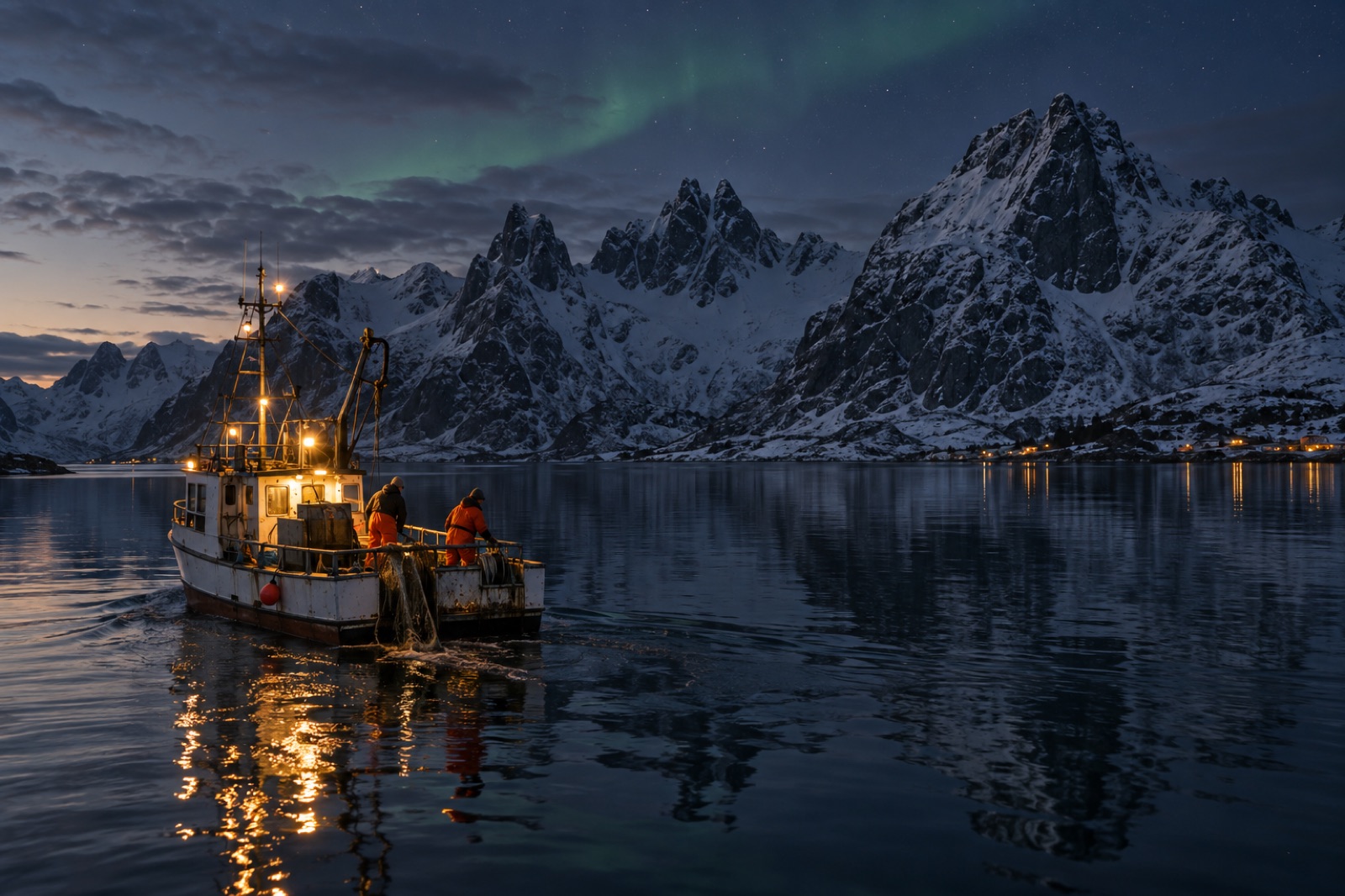
Field Notes are Tidewright's own dispatches from our restoration sites. They describe our fictional projects, crews and results — told as we live them. Our restoration outcomes are illustrative and reported under our field monitoring protocols.
For ten days in August, two boats out of a small harbour on Nova Scotia's eastern shore ran survey lines back and forth over a piece of seabed that doesn't have a name. Not a project name — it doesn't get one yet, and may never. Tidewright's order of operations on a new coast runs the opposite way to most companies': the community conversations come before the seabed survey, the survey comes before any decision, and the name comes last of all, if there is one. This is the field note from the middle step — the first soundings of what could, if everything and everyone agrees, become our first Atlantic restoration site.
Why the Atlantic kept asking
Tidewright grew up on Pacific coasts, and our one northern-European program in the Lofoten islands sits at the edge of the Norwegian Sea, close enough to Atlantic water to smell it. The question — when do you go to the Atlantic properly? — has followed us for years, and it sharpened as the science sharpened. The northwest Atlantic shelf is warming fast; the wider region includes some of the fastest-warming coastal water on the planet, and the forests feeling it first are the sugar kelp beds of this coast and their neighbours further south in the Gulf of Maine. Warmer, longer summers favour the turf algae that move in when kelp stumbles, and the seasonal rhythm the kelp is tuned to stretches out of shape.
A scoping visit is how we find out whether any of that is our business to work on. The criteria our science team applies before we even book boats are unglamorous: rocky substrate at workable depths, summer temperatures the kelp can still live through, no chronic turbidity problem that seeding can't fix, and — first and vetoing — a community and a custodial nation that want the conversation at all.
Reading a coast in classical style and side-scan
The survey itself was deliberately old-fashioned in its bones. Before any sonar went in the water we spent two days with the charts, the harbourmaster and the lobstermen's maps, because every piece of gear hung over the side of a boat in fishing country is a negotiation you have with the people who know where the bottom actually is. Their annotations fixed half our waypoints and saved, conservatively, a week.
Then the boats ran their lines. Side-scan sonar builds the picture of the bottom — bedrock reef, boulder field or sediment, and the transitions where kelp can anchor; kelp needs rock, and the eastern shore's glacially scraped granite gives plenty of it. Towed camera drops ground-truthed what the acoustics claimed. We moored temperature loggers at three depths to start building the seasonal record that decides whether a site is a forest's future or a thermal refugium — the cool pockets where kelp survives its neighbours' losses — or a dead end. And we drew water for eDNA samples, the modern baseline: a litre of sea filtered and sequenced tells us who lives here now, so that whatever changes later has something honest to be measured against.
Ten days, about sixty kilometres of coastline sounded, eleven granite reef systems sketched in enough detail to argue about. On paper, the substrate is there. The biology will need a winter to answer.
The part of the survey that isn't measured in metres
Every evening of the survey belonged to the shore. There were three community-hall meetings, one harbour board session and a kitchen-table afternoon that taught me more than the rest combined, and the rule for all of them was the one we hold everywhere: we come to listen and to answer questions, not to pitch. What do people ask? Hunting and fishing access — always first, and answered simply: restoration sites are not closures. Jobs — answered honestly: few at first, local where they exist. What happens if the kelp spreads where we don't want it — a good question with a technical answer about subtidal substrate that the room accepted because the harbour board had already asked it harder.
This coast is Mi'kmaq territory — it has never been ceded — and the conversations that matter most here happen on the Mi'kmaq communities' own timelines, which are long and correct. We began those conversations months before the boats arrived and they will run well past any decision either way. The principle our programs follow, described on our communities page, is boring in print and absolute in practice: no seeding without custodial partnership, full stop. It is worth saying in a field note because it shapes the calendar entirely, and it should.
What the first soundings said — and what we haven't decided
The honest summary of ten days: the bottom could hold a forest, the water is warming, and the decision belongs to a future date and to people who were not on our boats. The temperature loggers need a winter on the bottom before anyone should say the word site. The eDNA results will come from the lab inside two months. The community and Mi'kmaq conversations will take exactly as long as they take, and if they conclude not here or not yet, the only correct outcome is a graceful map, handed over, of a coast we were privileged to survey. We practise this: the site we left alone is one of the notes I hand to every new recruit.
If the answers converge, the shape of a pilot is easy to sketch because we've built it before — a small Holdfast nursery partnership, seed-stock matched to local genetics, a Drifter doing the survey drudgery, local hands on the meaningful work. But that is next year's decision, and the field note practice is to record the soundings, not the hopes. First soundings: sixty kilometres of granite reading maybe. Maybe is what August found, and August did its job.
Key takeaways
- Tidewright's order of operations on a new coast is: community and custodial conversations first, seabed survey second, project decision third — the site earns its name last, or never.
- A scouting survey combines side-scan sonar substrate mapping, towed camera ground-truthing, moored temperature loggers and eDNA baseline sampling, built on charts and fishers' local knowledge.
- Nova Scotia's warming northwest Atlantic shelf has been pressing its sugar kelp forests; the scouting question is where cool refugia remain that restoration could protect.
- Engagement with Mi'kmaq communities runs on their timelines and precedes any seeding; "no seeding without custodial partnership" is a scheduling reality, not a slogan.
- The first soundings found granite substrate that could hold kelp; nothing else is decided. Leaving a site alone remains a good outcome.
FAQ
Why scout at all — why not just seed?
Because restoration done to a place instead of with it fails twice: ecologically, if the site was wrong for kelp, and socially, if the people and custodian nations of the coast weren't partners from the start. The scouting step is where both failures are prevented, cheaply.
What is side-scan sonar actually measuring?
Acoustic texture. A towed or hull-mounted sonar paints the seafloor with sound and records the echo strength, which distinguishes hard rock, boulder, gravel and soft sediment. Kelp needs hard substrate to anchor, so the sonar mosaic tells us where a forest is even physically possible.
What makes a thermal refugium?
Pockets of coast where currents, depth, upwelling or shading keep summer water cooler than the surrounding shelf. Refugia are where forests survive regional heatwaves — and where restoration effort buys the longest odds.
Will there be a decision soon?
No, and that's on purpose. Temperature loggers need a winter season, eDNA results take weeks, and community and Mi'kmaq conversations take as long as they take. The second sounding trip — a winter one — would be the real test of any site.