Atlas9 min read
Lofoten: Kelp Forests Under the Northern Lights
Inside the Arctic Circle, warm Atlantic water meets polar light cycles and grows some of Europe's richest kelp forests. A guide to Lofoten's underwater jungle.
Tom Okafor ·
Tidewright's northern-most program seeds sugar kelp through Lofoten's polar night, working from fishing boats at 68 degrees north. A field operations log.
Tidewright is a fictional company created as a design and content demonstration. These field notes are works of fiction written in the voice of our field operations team, and every number in them is illustrative.
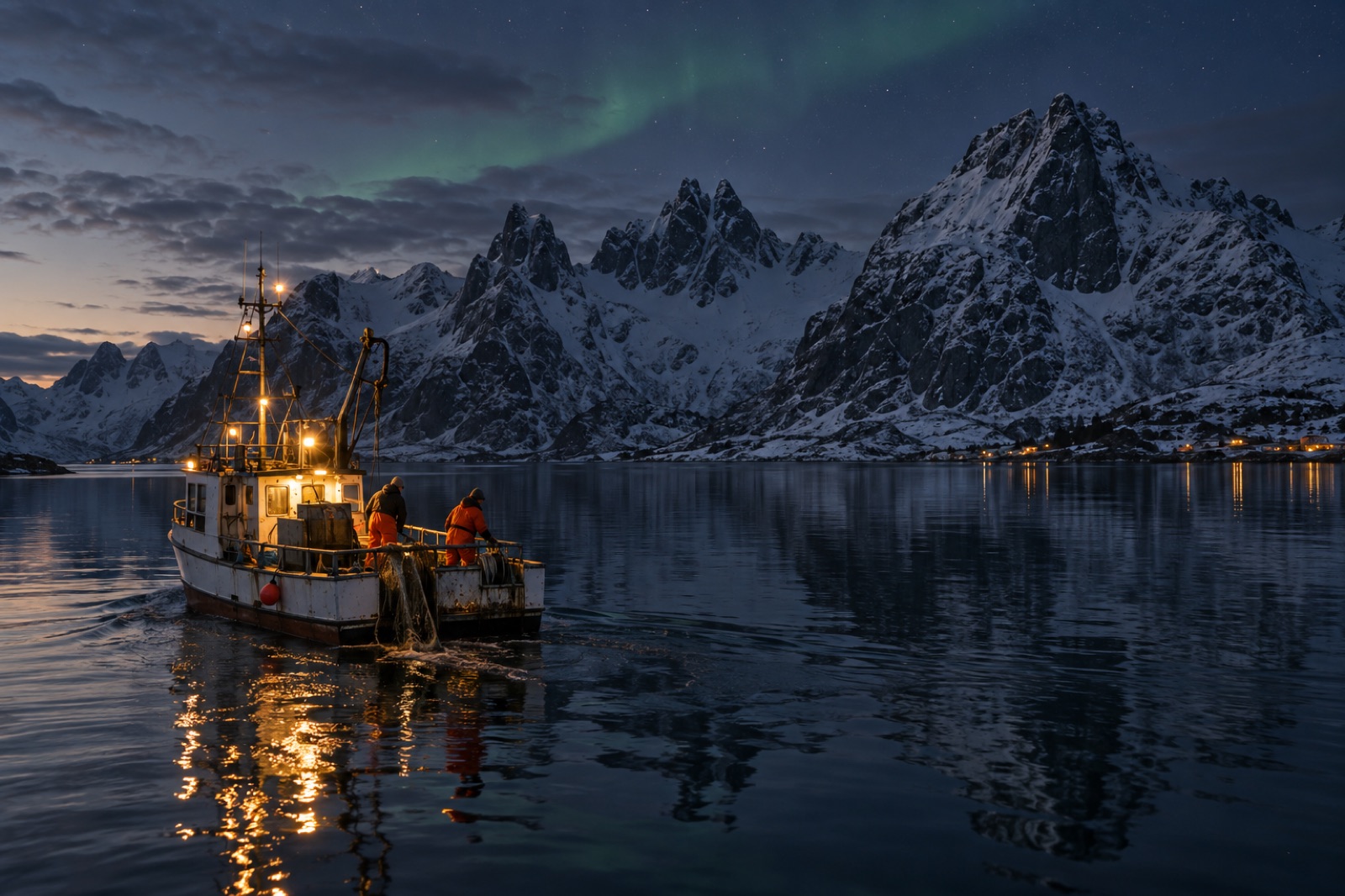
There is no photographing a seeding day in Lofoten in January, because January in Lofoten barely admits to having days. The sun clears the horizon around eleven, hauls itself a hand's breadth into the sky behind the mountain wall, thinks better of it, and is gone by two. We put the program's first Holdfast lines into the Norwegian Sea in that grey blue midwinter light, working from a fourteen-metre fishing boat out of Svolvær with headtorches on at both ends of the working day. This is the log of the first winter seeding of the Lofoten Sugar Kelp Belt — the northern-most program Tidewright has run, and the one that has taught me the most about what a fishing fleet knows that a robot doesn't.
Every briefing we give about this program starts with the same question from the audience: why on earth schedule the hardest work of the year for the darkest weeks of the year? The answer is that the kelp wrote the calendar, not us.
Sugar kelp — Saccharina latissima, profiled in our encyclopedia entry — runs its growth on a cold-water clock. Spores settle and germinate through autumn; the microscopic juvenile stage builds through winter; and the explosive blade growth happens from late winter into spring, the moment the light returns but before the water warms enough to favour the weedy fouling algae that smother young kelp in summer. Seed in November through January and the juveniles are established and gripping hard before that spring window opens. Seed in March and you've missed half your growing season and handed your lines to the fouling community on a plate.
The reefs around Lofoten need this done in volume. The kelp forests here — the tangle of sugar kelp and oarweed that fringes these islands, mapped in our Lofoten atlas guide — have been thinning for two decades of warmer winters, and with them goes the nursery structure the local cod fishery quietly depends on. Nobody in the fleet association needed convincing of that part. The argument was only ever about how, and when, and whose boats.
Whose boats turned out to be the easy answer, and this is the thing I most want on the record. A Drifter hull can lay lines with a precision no crewed vessel matches, in survey patterns no human would tolerate. A Drifter hull cannot do it in half-frozen spray with pack ice drifting through the survey area and a fetch that builds a three-metre sea in twenty minutes when the wind shifts against the tide. Lofoten in winter is where our automation gracefully steps aside and hands the job to people with oilskins and opinions.
The Lofoten Small-Boat Fleet Association (a fictional partner, like all of Tidewright's partners in these notes) runs the seeding craft. Their skippers have fished these exact reefs for generations, and their knowledge is not anecdotal decoration — it is operational data of a resolution our sonar can't reach. On the second morning, working a reef flat the survey had scored as uniform, the skipper shut the winch down over a patch the chart called ordinary rock. "Cod hold here in March," he said. "They've held here since my grandfather. Put your lines wide of it." We put the lines wide of it. That patch — a slight downsweep of harder ground you'd never read in a depth grid — is now a permanent protected buffer in the seeding plan, and the March cod surveys will tell us in a couple of years what his grandfather already knew.
The rhythm that emerged: the fleet association's boats lay and anchor the lines, fed by the Nordkyst Cooperative Hatchery in Svolvær, where the seeded twine is grown out on spools in refrigerated seawater tanks. Our crews run the survey design, the genetic provenance for each bay (seedstock matched reef-by-reef from local donor kelp — never imported stock), and the monitoring that follows. Six islands, eighty-five hectares, one hundred and nine lines in the water by the time the light started coming back in February.
I'll be honest about the ledger, because the glamour of aurora-over-the-working-deck wears off by the third week.
Everything takes longer at four degrees. Fingers fail before materials do: shackling anchor lines, splicing twine, threading floats — tasks that take ninety seconds bare-handed in a Tasmanian autumn take five minutes in neoprene gloves in the dark. We re-planned the whole workflow around it: pre-shackled line sections assembled at the wharf in Svolvær under lights, so that boat work is connect-and-drop rather than build-on-deck. Deckhands' rotation got shorter and hotter drinks got classified as safety equipment. Nobody joked about that classification.
Weather windows compress brutally. The Norwegian Sea in winter gives you gaps between lows measured in hours, and a seeding season becomes a chess game against the forecast models. We seeded on nineteen days out of a scheduled thirty-one. The twelve lost days are why the program plan now carries a float of buffer weeks that makes our finance people wince and our skippers nod slowly in recognition of the obvious.
And the gear behaves differently. The biodegradable braid we use for Holdfast lines stiffens in near-freezing water; the first spool batch kinked badly on payout until the hatchery adjusted the braid tension for cold deployment. Minor, fixable, and exactly the kind of thing no amount of southern-hemisphere experience teaches you. Every coast writes its own instruction manual. Lofoten's is in a dialect of cold.
One scene to end the log. Mid-January, a still day between gales, water like poured iron. I was leaning over the rail watching a seeded line sink away into six metres of astonishingly clear water when the boat's spotlight — rigged low to check the line lay — lit up the bottom, and the beam found a school of juvenile saithe hanging motionless in the dark water below us, maybe two hundred fish, silver-sided, watching the line descend like a curtain going down in a theatre.
That is the whole program in one image, really. You put down a line of kelp seedlings the size of eyelashes in the worst light of the year, trusting a clock you can't see, so that by the time the light returns there is shelter where shelter used to be. The fish knew what the line was for before we'd finished paying it out.
We'll be back for the second winter season this November, bigger and better dressed for it. The fleet association's skippers have already submitted a list of reef suggestions longer than our budget. That's the correct ratio, and I'd be worried if it were the reverse.
The polar night in Lofoten isn't total darkness — it's several hours of deep twilight around solar noon, plus working light from the moon, the aurora and the boats' own floodlighting. The real hazards are cold and weather compression, which are managed with short work rotations, heated survival suits and a hard rule that the skipper's call stands. We've stood down twelve days in a season on that rule.
Sugar kelp and oarweed are the native forest species of these waters, and restoration always starts from local genetics and local species. Sugar kelp is also unusual in being both a restoration species and a food crop, which is why the program's second phase pairs reef seeding with a winter harvest protocol that keeps the fleet working between fishing seasons.
The biodegradable braid carries the kelp through its first seasons and then breaks down; established plants anchor to the rock with their own holdfasts. On the restoration-adjacent farm blocks, the guard-band harvest happens before the summer fouling and storm seasons — you can read how that timing logic works in our guide to harvest timing.
The seeding grounds are working fisheries and not set up for visits in winter. In summer, Lofoten's kelp edges are spectacular from a sea kayak or snorkel in the brief warm weeks — our Lofoten atlas guide covers where and when, with the usual cold-water safety cautions.
Because the Arctic is warming several times faster than the global average, and cold-water kelp systems are the firebreak: restore them now, while the water still suits them in winter, and you hold the line against the poleward march of warm-water conditions that has already stripped kelp from coasts like Tasmania's east.
Inside the Arctic Circle, warm Atlantic water meets polar light cycles and grows some of Europe's richest kelp forests. A guide to Lofoten's underwater jungle.
Tom Okafor ·
Sugar kelp is the sweet-tasting cold-water kelp that farmers love. Explore its biology, range, life cycle and why it anchors a new wave of ocean farming.
Dr. Theo Nakamura ·
Tidewright's field crew logs their first week seeding Holdfast lines at Tinderbox, Tasmania — survey dives, southerly swells, and 40,000 metres of seeded line.
Jack Callum ·