Tidewright's field notes are our crews' own dispatches — fictional accounts from a fictional company, written to show what the work feels like on the water. The ecology is real; the crew, the site and the measurements are ours.
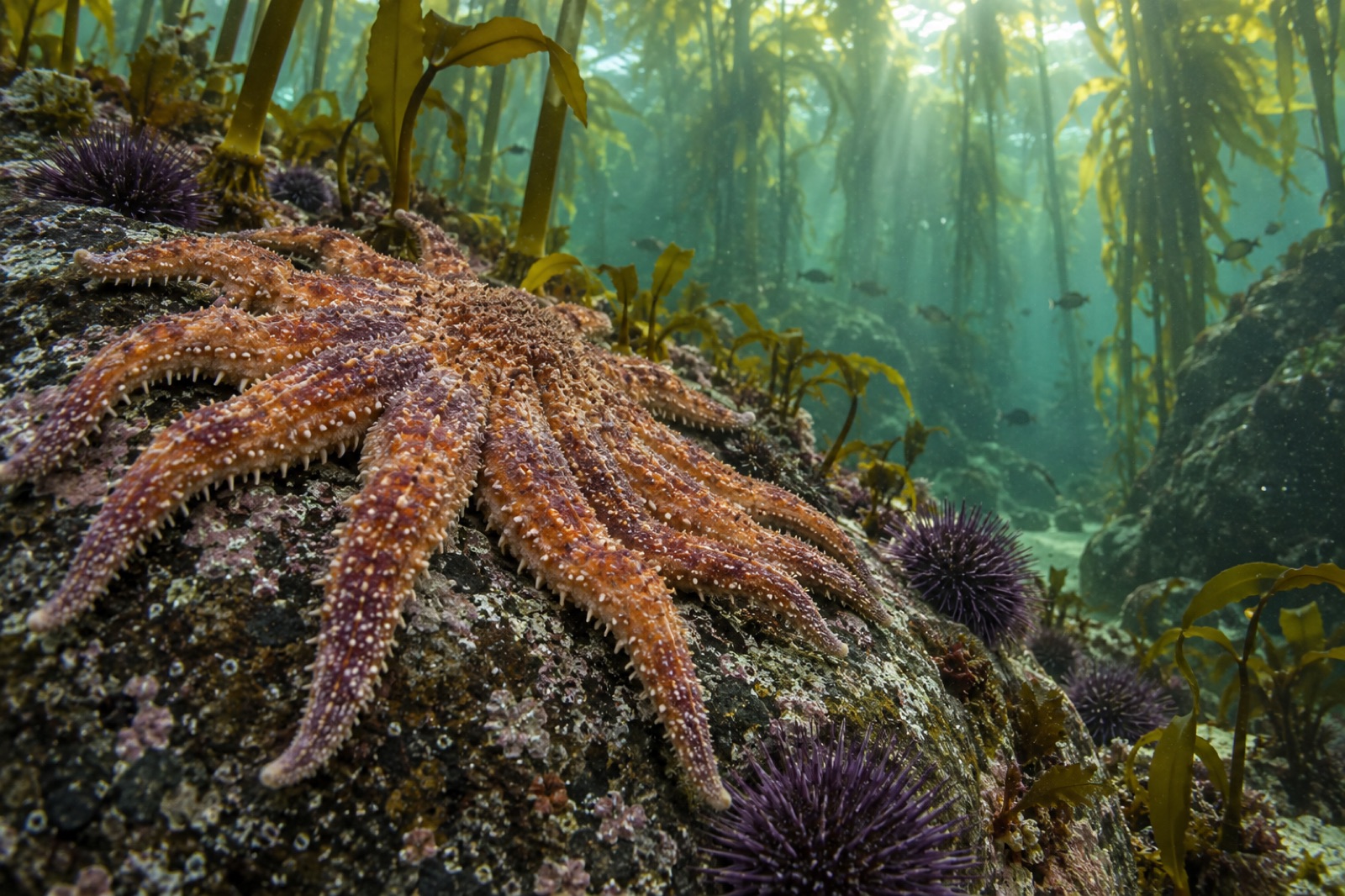
One animal should not make a season. This is the sentence I will write three more times in this note, because on Tuesday morning, at 17 metres on the Lumeriah Coast transect AB-line, one animal made a season: a sunflower star, Pycnopodia helianthoides, twelve arms spread over a bolt of granitic reef, moving at its usual improbable clip directly through the middle of quadrat 14.
First one on that line in five years. We have been counting its absence every season since the wasting years, the way you count a missing tooth with your tongue.
Why this species counts
For readers meeting the animal for the first time: the sunflower star is the largest and fastest sea star on the Pacific coast — a metre across at full grown, up to two dozen arms, and capable of covering the seafloor faster than a diver might believe without having tried to keep pace. More importantly for the kelp forest, it is a dedicated urchin predator, a top-down force that historically kept sea urchin populations honest on this coast.
Then the wasting disease epidemic rolled down the eastern Pacific. The full epidemiology is still being worked out — the outbreak's links to unusually warm water are clear in outline, the causative agent less so; our explainer on Sea Star Wasting Disease goes into it carefully. What is not in question is the result: the sunflower star collapsed from Baja to the Gulf of Alaska, one of the most dramatic documented marine population crashes of this century, and on the north coast it left urchin grazing uncorrected. The spread of the purple urchin barrens that followed — and the kelp loss with them — is the reason Tidewright's program on this coast exists at all. The species profile, for the natural history this note can't do justice, is Sunflower Sea Star.
Which is a roundabout way of saying: we count this animal on every transect, and for five years the count on AB-line has been zero.
The quadrat
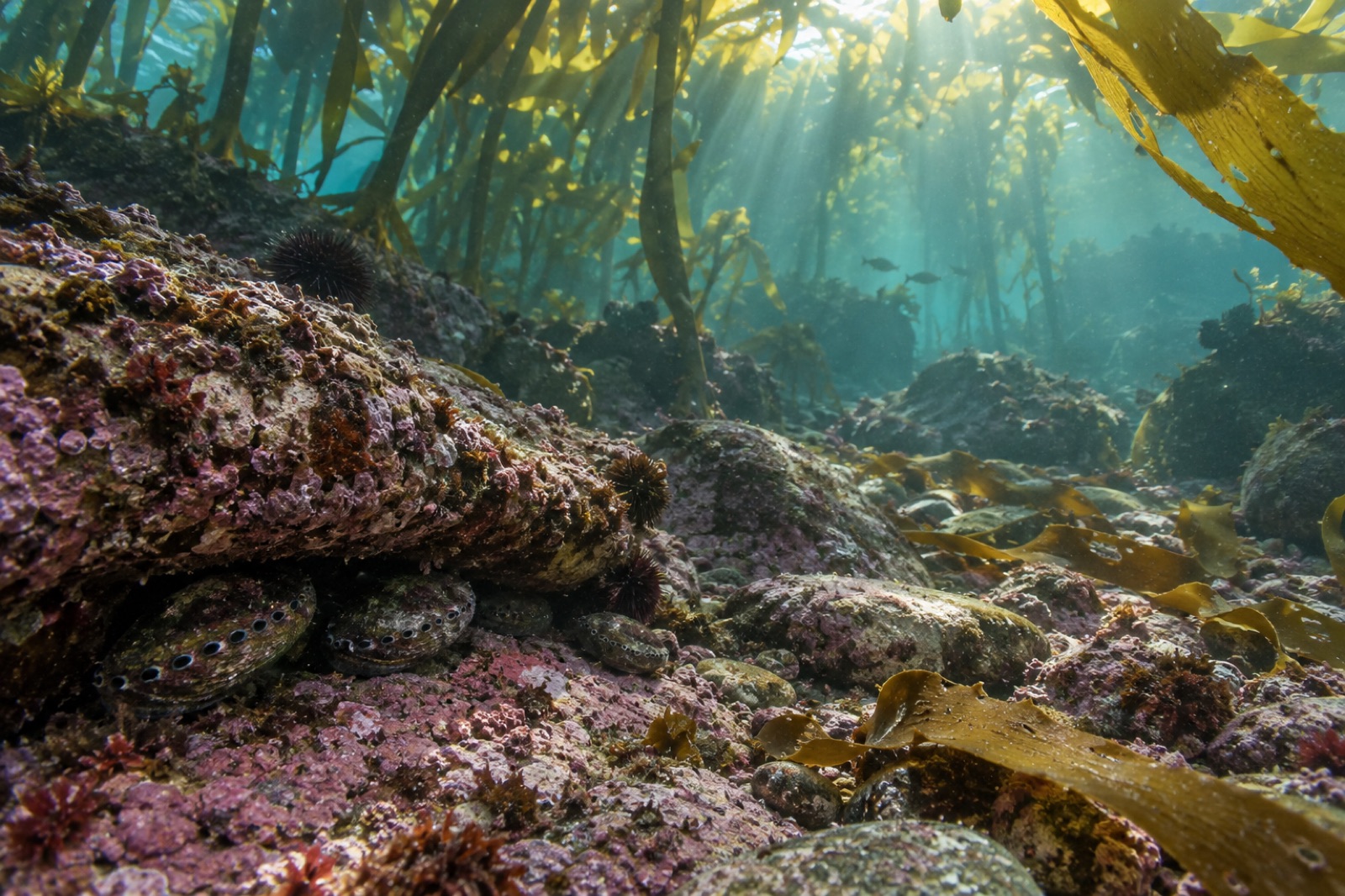
Quadrat 14 on AB-line sits on the mid-depth band of the reef, granitic fingers in 15 to 18 metres, our longest-running station on the whole site. The day's survey was the routine thing we don't usually write notes about: four divers, thirty quadrats, the standard belt. Kelp counts have been trending up modestly since the cull and seeding seasons and, more quietly, so have the juvenile abalone — which we marked in this journal last year in Abalone Back in the Quadrats.
Ruth was swimming 14. The slate note she handed up on the lift bag read, in her underwater handwriting — which in five years I could identify from across the boat — "PYCNO. 12-ARM. ~30CM. TRANSIT NORTH THROUGH Q14." No exclamation mark. Underwater there aren't any.
On the surface there were. I'll leave the audio record to the imagination, except to say that the protocol for a one-metre-ish invertebrate on a transect we follow to the letter is: document, photograph, measure by laser scale if the animal cooperates, and absolutely not to handle it. The animal cooperated exactly as much as a sunflower star ever does, which is to say not at all: it continued north at a pace that made the whole exercise feel like trying to interview a train, and crossed the transect edge before Ruth's camera was half sorted.
What one animal means
Here is the conversation we had on the rear deck, running back in, and I'm writing it as honestly as I can because it is the whole point of the day.
One animal is not a recovery. Everyone on the boat knows this. A single sunflower star on a 60-metre belt transect is a sighting, not a signal: it could be a stray raised deep and wandered up, a larval immigrant's adult expression, a reprieve, a red herring with twenty arms. Science crews are professionally allergic to single data points, and this crew is unusually so even by that standard.
And one animal on this particular transect is not nothing, either. Of the plausible ways a sunflower star ends up on AB-line in August, most of them require a live breeding population somewhere up-current — and that would mean the coast is beginning to do the thing we've seeded several hectares of kelp to help it do: fix itself from the middle out. Either way the record now changes from absent since the wasting years to present, once. In a five-year dataset, "present, once" is where every honest recovery starts.
The fixed-transect method exists precisely for this: not to catch the day it happens, but to make sure the day is counted when it comes.
What we do with it
Practically, three things, all boring, all right.
We don't change the project plan. The seeding map, the cull schedule, the urchin density lines — none of it responds to a single sighting, however moving. If next season's transects show more stars, the ecology starts doing more of the work the cull crews are doing now, and we'll shift effort accordingly. Not before.
We log it properly. Time, position, size estimate, photographic voucher, environmental conditions at the station, observer — Ruth gets her surname on the record, which seems correct for the person who found it.
We widen the net. We added two ad-hoc swath surveys east and north of AB-line for the weather window, looking for more of the same. None yet. This is also data.
And then we knocked off early and ate fish tacos on the dock with the sun out, because the ocean had just returned a species whose absence we have listed in every quarterly report for twenty consecutive quarters, and you do not let a day like that close like any other.
One animal should not make a season. It made the season.
Key takeaways
- A sunflower star — a major urchin predator whose collapse in the wasting disease epidemic helped tip this coast's reefs toward urchin barrens — was recorded on the Lumeriah site for the first time in five years of fixed transects.
- One sighting is a record, not a recovery: projects do not change plan on a single data point, however welcome.
- Long-running fixed transects are the instrument that turns days like this from anecdotes into evidence of change.
- The sighting shifts the site record from "absent" to "present, once" — the honest first cell in any recovery trend.
- Follow-up is procedural: widen the survey effort, log the voucher, wait for the transects to confirm or deny.
FAQ
Why does one sea star matter so much to a kelp forest?
Because the sunflower star eats sea urchins, and sea urchins eat kelp. Its disappearance from this coast in the wasting epidemic removed one of the few predators capable of suppressing urchin densities at reef scale — a classic trophic cascade, covered in Trophic Cascades in Kelp Forests.
Is the sunflower star really gone from the coast?
No — and that nuance is important. The epidemic caused a catastrophic, range-wide collapse, but remnant individuals and recovering pockets persisted, and a captive breeding program has produced juveniles. The species is listed as Critically Endangered on the IUCN Red List. "Absent from our transect" is a local and methodological statement, not a claim about the coast.
Is this field note about a real recovery event?
The animal, the epidemic and the trophic stakes are real and well documented. Tidewright, the Lumeriah program, the crew and the specific transect record are fictional — the note is written to show, accurately, how a monitoring crew would treat a find like this.
Would you plant sea stars to speed recovery?
It's an active research question — captive-bred sunflower stars have been produced in labs, and outplanting is being studied carefully. Tidewright's own fictional work stays in its lane: restore the forest, keep the urchin balance honest, and let the predators find their way back.
How will you know if it's really recovering?
Repetition at fixed stations. If we see sunflower stars on the AB-line again next season and the one after, in more quadrats and at more sizes, the record graduates from sighting to trend; and about five years after that, you get to write the note with the good headline.