Field Notes8 min read
Field Notes: Counting the Urchin Front
Join Tidewright's dive survey team as they count an advancing urchin front on Tasmania's coast — the methodical, cold, essential math of kelp restoration.
Jack Callum ·
Seven years after seeding began on Tasmania's Lumeriah Coast, juvenile blacklip abalone are turning up in the monitoring quadrats again. Here's why that matters.
Field Notes are Tidewright's own dispatches from our (fictional) restoration programs. All site names, partners and figures below are Tidewright's project records — illustrative of our method, not industry benchmarks.
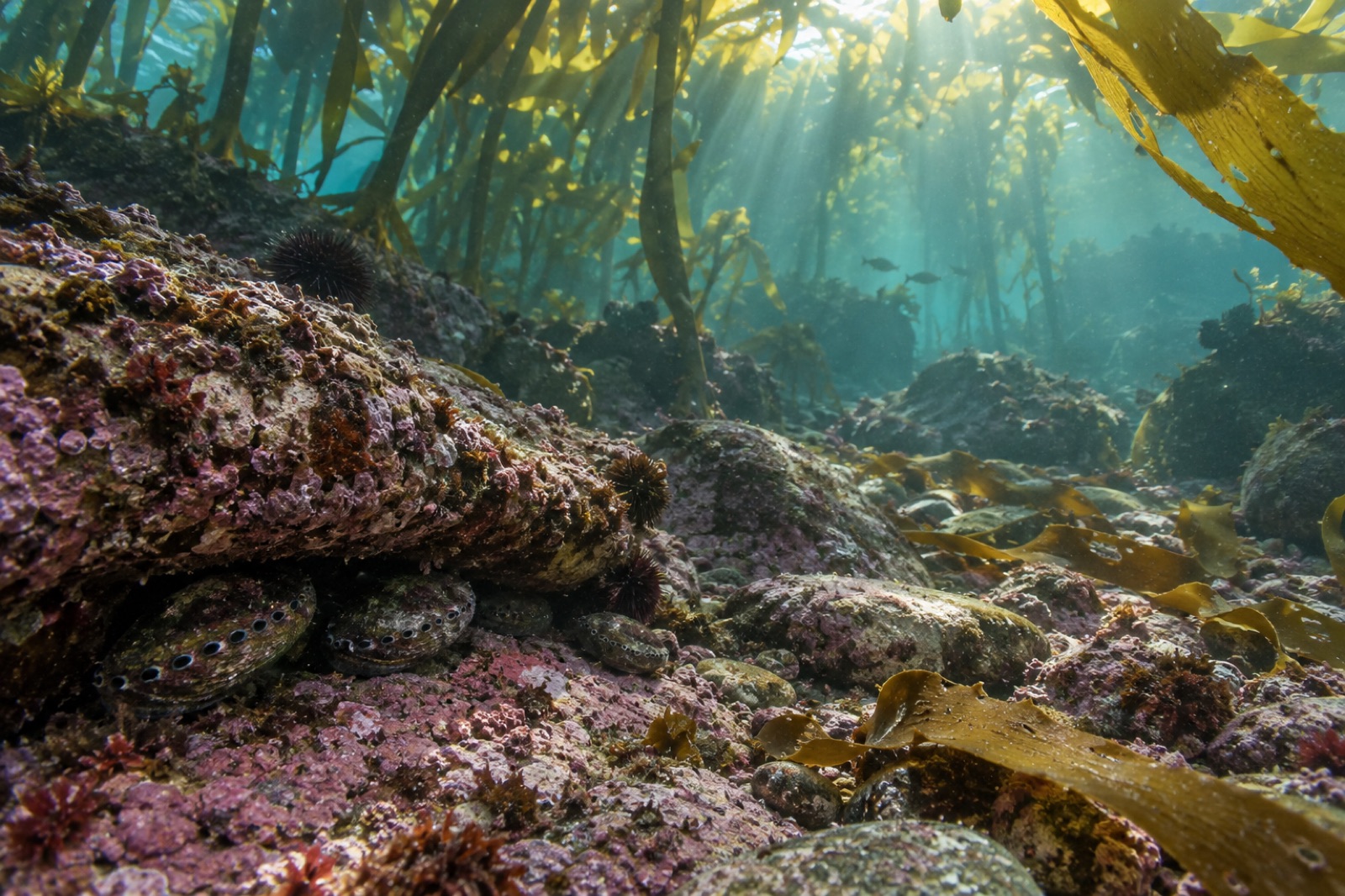
In quadrat T-7, under a cobble at nine metres, there were four juvenile blacklip abalone. Largest 31 millimetres. None of them existed when we started. I have been the science lead on the Lumeriah Coast program since its first lines went into the water in 2019, and I am going to try to explain — without sentiment, though it is close-run — why four small snails under a rock represent the single best monitoring result this program has ever produced.
Blacklip abalone (Haliotis rubra) are Tasmania's quiet reef royalty: slow-growing, long-lived, commercially treasured, and ecologically glued to kelp forest. They eat drift algae torn loose from the canopy. They shelter as juveniles in the crevices and coralline-crusted rock a healthy reef provides. And they cannot survive on a barren, because a barren has no drift kelp and no shelter worth the name.
When the Lumeriah reefs flipped to urchin barren after the heatwave years, the abalone didn't die so much as evaporate — recruitment failed year after year as the settlement habitat disappeared, and the standing adults were fished or starved or aged out. By the time our 2019 baseline survey ran, abalone counts on the monitoring transects were, in the report's memorable phrasing, "functionally absent."
So the program's success criteria — written before any seeding — included a line item most monitoring plans lack: detectable, repeated abalone recruitment within the restored blocks. Not because abalone earn carbon credits. Because abalone are an exam the reef sets itself. You cannot fake them.
The Lumeriah monitoring design is boring by intention: 40 permanent quadrats and transects across seeded and control blocks, dived on a fixed schedule, logged into Canopy Ledger the same day. The methods are published in our monitoring methodology, because a number you can't trace to a tape measure is a rumour.
Here is what the record shows for abalone in the seeded blocks, Tidewright project figures:
Control blocks: still functionally zero. That contrast is the whole experiment. Same coast, same currents, same larval supply washing over both. The difference is the reef.
Three things had to be rebuilt before a larval abalone could survive to thumbnail size on this coast, and the quadrat record reads like their history.
Settlement surface. Juvenile abalone settle on crustose coralline algae and graze microbial films in protected micro-crevices. Urchin barrens are not bare of coralline — the pink crust is the barren's signature — but on a barren, the coralline is grazed hard and the crevice fauna is impoverished. In the restored blocks, urchin density has been managed down by roughly two-thirds from baseline (the counting method lives in an earlier field note on the urchin fronts), and under reduced grazing the crustose communities have thickened and diversified. We can't see a settlement surface directly, but the abalone can, and their settlement is the assay.
Food. Adult and sub-adult abalone run on drift kelp — torn fronds washing along the reef floor. A restored canopy sheds drift continuously. When we began finding juveniles, we also began finding drift-kelp "feeding stations" in the seeded blocks: accumulations of frond fragments wedged under ledges, grazed to lace. The restored forest feeds the reef floor the way a wild one does. The food-web mechanics are unpacked in our kelp forest food web explainer; watching it reassemble under a quadrat frame is something else.
Time. This is the unfashionable one. Blacklip abalone grow a few centimetres a year; a juveniles-in-quadrats signal means larvae settled and survived multiple winters. Seven years from first seeding to repeated recruitment is not a delay in the program. It is the program's honest clock speed, and it is why we tell every prospective partner the same thing: restoration rewards patience, and punishes impatience, at roughly this ratio.
Let me be the killjoy, because it's my job: this is not "abalone recovered." The densities are far below a functioning fishery's. The recruits are concentrated in the oldest, most sheltered blocks; the younger blocks show little yet. One bad marine heatwave could strip the canopy and starve the drift subsidy that the whole signal rests on — the same physics that removed the abalone in the first place. And recruitment this decade must survive to reproductive size in situ, through a warming ocean, before the population is genuinely self-sustaining.
What we have is the reef's equivalent of first steps: genuine, verifiable, repeated, and worth everything to the people who've walked the distance — the ranger crews who log these quadrats, the council partners who defended seven years of lease area through political weather, and the old abalone divers who remember this coast when you couldn't walk a transect without stepping over them. I rang one of them the evening after the T-7 count. He was quiet for a moment, and then he said, "Took you long enough," which is the finest peer review I have ever received.
The quadrats keep their schedule — quadrats always keep their schedule. This season's recruits will be re-measured through winter. We're adding settlement plates in the best-recruiting blocks to measure larval supply directly, and the genetics team is designing a small study to ask whether the new recruits trace to remnant local broodstock or to surviving populations up-current. Answer TBA; science takes the time it takes.
Meanwhile, the control blocks stay untouched and counted, because every claim we make about this coast leans on them. The barren is the baseline that keeps us honest.
Four small snails under a rock at nine metres. On the Lumeriah Coast, that's what seven years looks like — and it's enough.
Not yet. Repeated recruitment over two cohorts is real and important, but a self-sustaining population needs these juveniles to survive to reproductive size over coming years — through whatever summers the climate sends. We measure; we don't declare victory early.
No. Every juvenile in the quadrats recruited naturally from larvae in the water column. The program rebuilt habitat — canopy, drift food, settlement surfaces, reduced urchin grazing — and the abalone did the rest. That's the result's entire value: it's the ecosystem responding, not a stocked enclosure.
Adults and larger juveniles feed mainly on drift algae — fronds torn from kelp canopy and delivered along the reef floor. Barrens don't shed drift. Juveniles also need the creviced, coralline-crested microhabitat that ungrazed reef rock provides. No forest, no food pipeline; no healthy rock, nowhere to grow up.
The same logic shaped California's abalone collapses and slow recoveries — see our red abalone species profile for the northeast Pacific version of this story.
Occasionally and patchily, where remnant kelp persists. But on flipped barrens the evidence from our monitoring — and from the broader literature on barren persistence — is that urchin density has to come down before settlement habitat and drift food return. Clearing is the unfixed variable; the rest follows.
Join Tidewright's dive survey team as they count an advancing urchin front on Tasmania's coast — the methodical, cold, essential math of kelp restoration.
Jack Callum ·
The science of alternate stable states on rocky reefs: how kelp forests collapse into urchin barrens, why barrens resist recovery, and how reefs flip back.
Dr. Mara Ellison ·
Meet the world's largest abalone — a kelp-eating giant sea snail of the Pacific coast. Its biology, fishery history and the road to recovery.
Dr. Theo Nakamura ·