Kitchen9 min read
Baking with Seaweed: Breads, Crackers and a Very Good Focaccia
Seaweed belongs in the bread oven: it seasons dough from within. Recipes and ratios for kelp focaccia, nori crackers, dulse rolls and soda bread.
Sofia Andersson ·
Dulse soda bread, laminated nori crackers and kelp brownies — plus the dough chemistry that makes seaweed a surprisingly natural baker's ingredient.
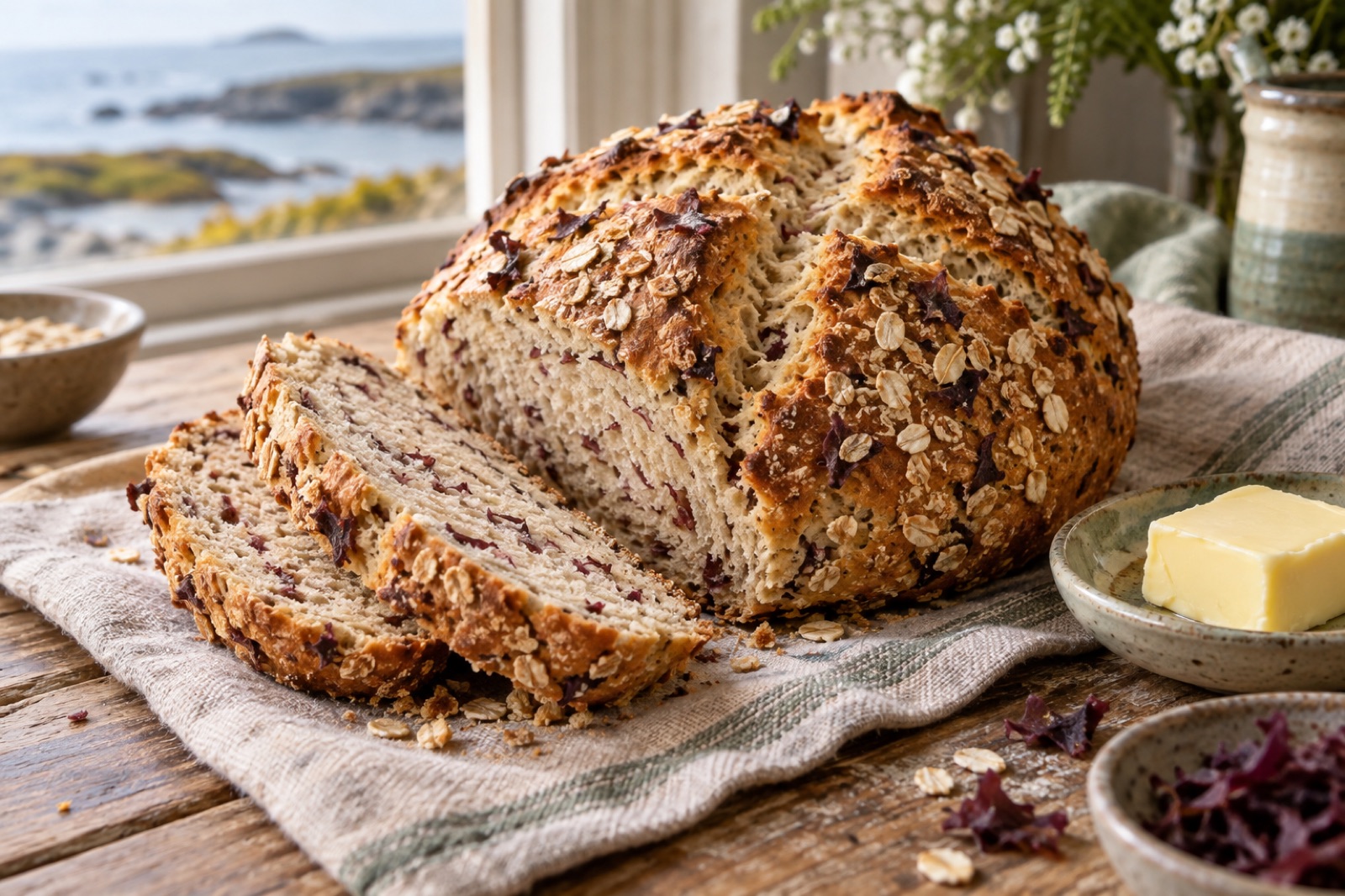
Most seaweed baking advice stops at yeasted bread: a focaccia here, a soft roll there. That territory is covered in our baking with seaweed masterclass, and its hydration and dosing rules still apply. This article goes where that one didn't: into the chemistry of what kelp is actually doing inside your dough, a one-bowl dulse soda bread for the no-yeast days, butter-laminated nori crackers, and — the surprise that converts the most people — the sweet side, where a spoonful of kelp powder makes brownies taste more like chocolate. Three full recipes, one set of principles, and a troubleshooting section for when the sea overreaches.
Understanding these four effects explains every recipe below, and lets you adapt any recipe you already trust.
Alginate holds water. Brown kelps are built from alginate, a hydrocolloid that binds many times its weight in moisture. Milled into dough at 1–2% of flour weight, it acts like a tiny insurance policy: the crumb stays moist a day longer, and staling slows. This is why kelp breads taste fresher on day two than the same loaf without it.
Seaweed brings no gluten — and that cuts both ways. Every gram of dried seaweed you add is a gram that doesn't form gluten, and its fibres physically interrupt the network that does. In a sandwich loaf, stay at or below 3–4% of flour weight or the crumb turns dense. In crackers, biscuits and shortcrust, the gluten-weakening is a feature: seaweed flours make doughs shorter, snappier and easier to roll thin without springing back.
Amino acids deepen the bake. Kelps are rich in free glutamate and simple sugars, and both feed the Maillard reactions that brown a crust. A seaweed dough at the same temperature bakes a shade darker and tastes a register deeper — the crumb seasoning works from inside, exactly the mechanism laid out in the science of seaweed umami. Because the sea seasons as it goes, trim added salt by about a fifth whenever dried seaweed exceeds 2% of flour weight.
Pigment survives the oven. Dulse bakes into brick-red flecks scattered through the crumb; kombu powder tints a whole loaf pale sage. Neither fades to grey if the dose is right — grey crumb is a dosing complaint, and the fix is less powder, not more.
No yeast, no proofing, one bowl. The oats and buttermilk soften dulse's peppery edge; the stout does the browning chemistry a favour. Makes one round loaf.
You need: 350 g plain flour (half strong white, half wholemeal works beautifully) • 50 g rolled oats, plus a spoonful for the top • 10 g dulse flakes (about 3 tablespoons), toasted in a dry pan for a minute if you have time • 1 tsp bicarbonate of soda • 1 tsp fine salt • 300 ml buttermilk • 75 ml stout (or more buttermilk) • 1 tsp honey.
Heat the oven to 200 °C with a tray inside. Whisk the dry ingredients together — flour, oats, dulse, bicarb, salt — then stir the honey into the buttermilk and stout and pour into the flour. Mix with a fork until it just comes together; soda bread punishes overworking with a tough crumb. Tip onto a floured surface, shape into a round about 4 cm thick, and cut a deep cross almost to the base — tradition says it lets the fairies out, physics says it lets the dense centre bake through.
Bake on the hot tray for 35–40 minutes until deeply golden and hollow-sounding when tapped underneath. Cool at least half an hour before cutting. The loaf is at its best still faintly warm, thickly sliced, with salted butter and something sharp alongside — strong cheddar, pickled cucumber, smoked fish. The red dulse flecks toast beautifully the next day.
Variations: fold in 40 g of grated mature cheddar; swap the stout for buttermilk and add a teaspoon of caraway; or bake the dough as eight small farls on a dry griddle, about five minutes a side.
Where a sheet cracker is crisp, a laminated cracker shatters. The nori goes inside the dough as a powder, and the layers come from grated frozen butter folded rough-puff style. Makes about 40.
You need: 200 g plain flour • 2 tbsp nori powder (blitz two sheets of toasted nori to dust in a spice grinder) • ½ tsp fine salt • ½ tsp sugar • 110 g unsalted butter, frozen • 80 ml ice water • sesame seeds for the top.
Whisk flour, nori powder, salt and sugar. Coarsely grate the frozen butter straight into the bowl and toss to coat the shards. Sprinkle over the ice water and bring together with a fork into a shaggy, barely-holding dough — visible butter lumps are the point. Pat into a rectangle, fold in thirds like a letter, turn 90 degrees, and repeat twice more, flouring as needed. Chill 30 minutes.
Roll to roughly 3 mm on a floured surface, dock all over with a fork, and cut into squares or diamonds. Scatter with sesame, bake at 190 °C for 12–16 minutes until the edges are golden and the kitchen smells like a seaside bakery. Cool on a rack — they crisp fully as they cool. Serve with anything you'd put next to a good cracker: soft cheese, smoked mackerel pâté, or a smear of seaweed butter if you want to lean in.
Here is the unlikely headline of seaweed baking: kelp makes chocolate taste more like itself. Bitterness, salt and umami form a triangle; cocoa brings bitterness in abundance, and a small dose of kombu or sugar-kelp powder closes the triangle. Nobody has ever identified the flavour as seaweed. They identify it as the good brownies.
Take any fudgy brownie recipe you trust — or: 180 g dark chocolate and 170 g butter melted together; 2 eggs whisked with 200 g sugar until pale; the chocolate folded in; then 90 g flour, 30 g cocoa and 2 level teaspoons of kelp powder sifted over and folded through with a pinch of flaky salt. Bake in a lined 20 cm tin at 175 °C for 22–26 minutes, until the centre barely wobbles. The kelp dose is invisible as ocean but loud as depth. Do not exceed a tablespoon for a batch this size; past that, the sea starts filing noise complaints.
Two more sweet applications once the brownies convince you: a teaspoon of kelp powder whisked into hot caramel sauce (extraordinary over vanilla ice cream), and a pinch of toasted dulse folded through dark-chocolate bark with roasted hazelnuts. For dosing discipline on all of these, the numbers live in our kelp powder guide.
Mild, mellow species: dulse for flecks and peppery warmth, nori ground to powder for crackers and pastry, and fine sugar-kelp or kombu powder at low doses for seasoning whole doughs. Strong, thick kelps like oarweed tend to dominate; those belong in the stockpot, per our kombu dashi masterclass.
Largely, yes — iodine compounds in seaweed are reasonably heat-stable through a standard bake. So treat baked goods like any other seaweed serving: a slice of dulse loaf or a few crackers sits well within the sensible daily amounts we outline in the iodine guide.
Yes, with adjustments. Fresh or thawed kelp brings its own water with it: blanch, squeeze very dry, mince to a paste, and subtract roughly its weight from the recipe's liquid. It gives a gentler flavour and no flecks of colour.
Almost always scorched seaweed on the crust or topping — dulse and nori burn fast when dry. Mix seaweed into the dough rather than leaving it exposed, or oil any pieces destined for the top, and your bitterness problem will disappear.
Seaweed belongs in the bread oven: it seasons dough from within. Recipes and ratios for kelp focaccia, nori crackers, dulse rolls and soda bread.
Sofia Andersson ·
Dulse is the red seaweed the North Atlantic has snacked on for a thousand years — protein-rich, bacon-savoury when fried, and stranger in its life cycle than you think.
Sofia Andersson ·
Kombu led chemists to discover umami in 1908. How glutamate, ribonucleotides and salt work together — and how to use seaweed umami in everyday cooking.
Sofia Andersson ·