Kitchen11 min read
Kombu Dashi Masterclass: The Broth That Built a Cuisine
A deep, technique-first guide to kombu dashi: glutamate science, exact temperatures, ichiban and niban infusions, and how to fix every common mistake.
Sofia Andersson ·
Wakame, kombu and nori do three different jobs in the kitchen. Flavour, texture, buying forms, substitutions and storage, side by side.
Part of a learning path
This article is stop 4 of 9 on Cooking the Forest — Seaweed in your kitchen, from safety nerve to dashi craft.
If seaweed shopping has ever stalled you in the aisle — three dark packages, three names, no idea which one your recipe means — here's the sixty-second answer: kombu builds broths, wakame goes in the bowl, nori wraps and garnishes. They're three different species from two different branches of the seaweed family tree, and they are almost never interchangeable. This guide puts them side by side — flavour, texture, the forms you'll actually find in shops, and exactly when to reach for which.
Undaria pinnatifida is a brown kelp with tender, feathery blades and a mild, sweet-green flavour — the friendliest seaweed in the Japanese pantry and the one most people meet first, in miso soup or a sesame-dressed salad.
Texture: silky and softly slippery once rehydrated, with a slight pleasing resistance. Wakame's mouthfeel is its main event.
Forms you'll find:
Best uses: miso soup and other clear soups, seaweed salads, sunomono vinegared dishes, stirred through rice. Detailed ratios live in our guide to seaweeds for miso soup, and the species itself — prized crop in Asia, notorious invader elsewhere — is profiled in wakame: edible native and global invader.
Watch out for: over-portioning. Dried wakame is measured in teaspoons; a handful becomes a swamp.
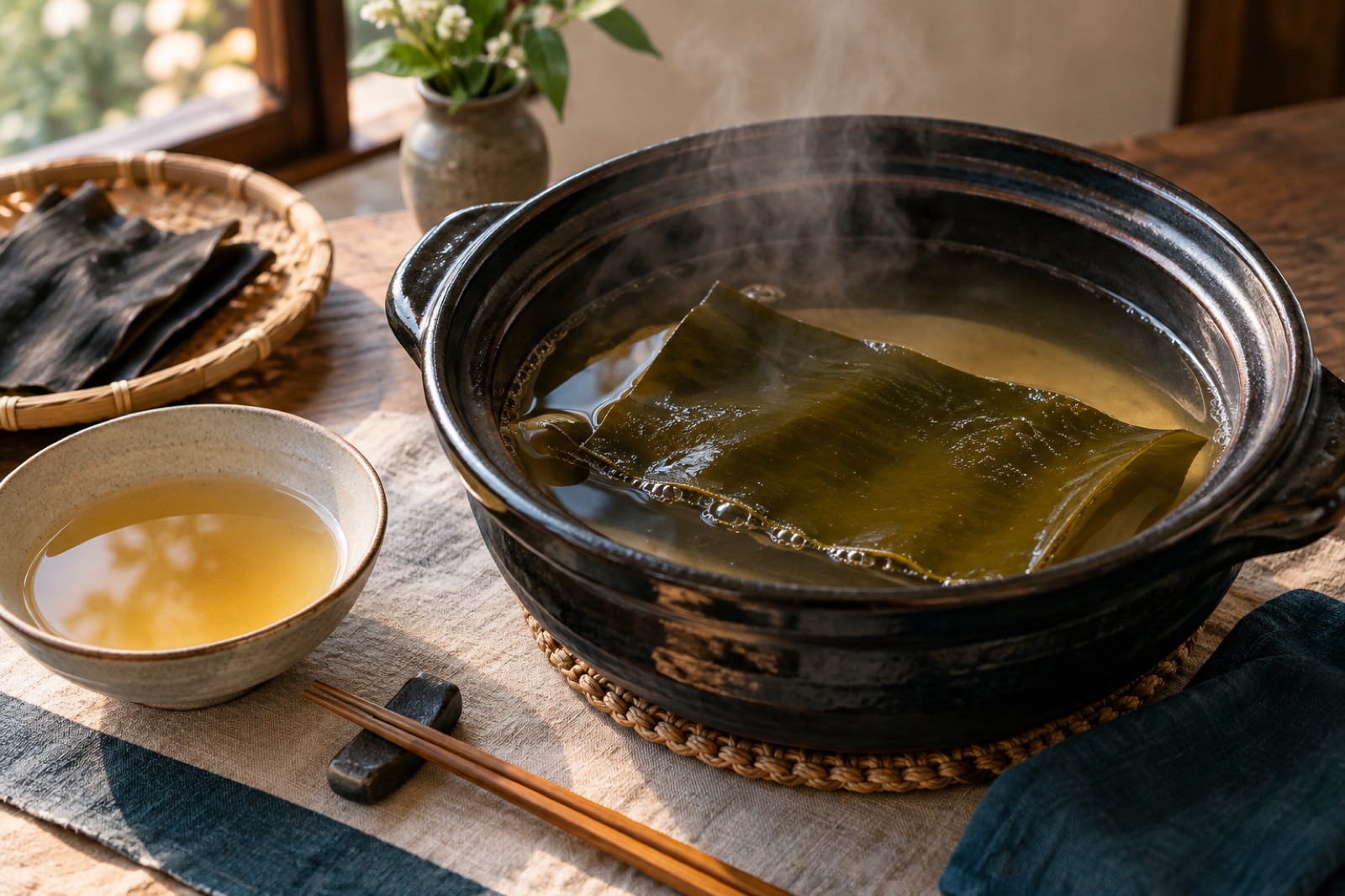
Saccharina japonica is a thick, broad, forest-forming kelp and one of the most glutamate-rich foods on Earth. Glutamate is the molecule behind umami, which is why a single sheet of kombu steeped in water creates the deep, clean savouriness — dashi — that Japanese cuisine is built on.
Texture: leathery to rigid when dried; slightly gelatinous when simmered. You rarely eat a lot of it — you cook with it.
Forms you'll find:
Best uses: dashi first and always — our five-minute kombu dashi recipe is the essential technique — plus simmered beans (kombu's glutamates make broths taste long-cooked), rice-cooking liquid, kombu-cured fish, and umami-boosting seasoning.
Watch out for: two rookie moves. Don't wash or wipe off the white powdery bloom on good dashi kombu — that's mannitol, part of the flavour. And don't hard-boil it: kombu releases bitterness and slime above a gentle simmer. Steep it below 80°C, lift it out, done.
Nori is not a kelp at all. It's a red alga — Pyropia and Porphyra species, the same laver family behind Welsh laverbread — farmed on nets, shredded, pressed into sheets and dried like paper. Where kombu supplies bass-note depth and wakame supplies texture, nori supplies aroma: that toasted, oceanic, faintly sweet smell that hits when you open a fresh packet.
Texture: crisp and papery when dry, dissolving to tenderness against moisture.
Forms you'll find:
Best uses: sushi and onigiri, obviously — but nori is a general-purpose aromatic. Toast a sheet over a flame, crumble it over buttered rice, soft eggs, popcorn, roast potatoes. Ten ideas in that vein live in nori beyond sushi.
Watch out for: humidity. Nori goes from crisp to leathery in an unsealed sleeve within days. Airtight container, dessicant packet kept, cupboard — never fridge.
Working through the common kitchen situations:
Mostly, honestly, no — the jobs are too different. Kombu can't stand in for wakame in a salad (it's tough and strong), wakame can't make dashi (its glutamate content is a fraction of kombu's), and nori can't do either job (no body for stock, no blade for salad).
Two swaps do work. Sea lettuce stands in for wakame in soups and salads at similar quantities — same silky tenderness, brighter flavour. And in a broth emergency, a nori sheet torn into hot water plus a savoury pinch (mushroom powder, a splash of soy) produces something dashi-adjacent — not dashi, but a seasoned base that's rescued many a weeknight soup in my kitchen. For everything else, the right move is to keep all three in the pantry; dried, they keep for a year and cost little.
Pricing shape: nori is sold by the sheet (quality grades matter — darker, glossier sheets with even texture taste better), wakame by the small dried bag, kombu by the sheet, with kombu for dashi costing more per gram and doing the most flavour work per gram of anything here.
What to look for: clear origin labelling, intact packaging, and for kombu, that white mannitol bloom as a mark of careful handling. Traceable suppliers who publish origin and batch testing are worth the modest premium for all three.
Storage: all three want the same things — airtight, dark, dry, cool. Wakame and kombu are forgiving for a year or more; nori is the diva, best within months of opening and strictly protected from steam. Protocols in storing seaweed.
No. Nori is made from red algae (Pyropia and Porphyra species), while "kelp" refers to large brown seaweeds like kombu and wakame. Same ocean, different evolutionary branches — as different, roughly, as grasses and mosses on land.
Kombu, by a wide margin — dried kombu can carry iodine orders of magnitude higher than nori, with wakame in the middle. That's why kombu is used by the sheet in stock rather than eaten in bulk. The numbers and safe-intake guidance are in our iodine explainer.
You can steep wakame, but it produces a much weaker, grassier broth — wakame simply doesn't carry kombu's glutamate load. If dashi is the goal, kombu is the tool; nothing else in the pantry substitutes fully.
Nori, because everyone already likes it, followed by cut wakame for miso soup, then kombu once you're ready to make dashi — which is the moment your whole cooking changes. That progression mirrors how most cooks actually fall for seaweed: aroma first, texture second, depth last.
A deep, technique-first guide to kombu dashi: glutamate science, exact temperatures, ichiban and niban infusions, and how to fix every common mistake.
Sofia Andersson ·
Cut wakame is the default for miso soup, but kombu, nori, sea lettuce and other seaweeds all have roles. Ratios, timing rules and what to skip.
Sofia Andersson ·
Nori isn't just for sushi. Ten everyday uses for toasted nori sheets — from onigiri and furikake to butter, broth and cracking snack sheets.
Sofia Andersson ·