Science10 min read
Drifters and Swimmers: How Marine Life Colonises New Reefs
Almost every reef animal and alga spreads as a drifting larva or spore. How far they travel — and which reefs talk to which — decides how kelp recovers.
Dr. Mara Ellison ·
Most reef fish and invertebrates begin life adrift as larvae. Learn the feeding strategies, settlement cues and dispersal lotteries that decide who reaches the reef.
Pick up a purple sea urchin on a kelp reef and you are holding a creature that, not long ago, was indistinguishable from a speck of dust — a tiny, glassy, rocket-shaped thing adrift in the plankton, weeks from the nearest rock, eating smaller specks and waiting for the right smell. Nearly everything that lives attached to or crawling over a temperate reef gets there by being born somewhere else and spending its childhood at sea. Larval ecology is the science of that hidden childhood, and it explains much of why reefs recover from disaster the way they do, why some species recolonise and others never come back, and why restoring a kelp forest is partly a physics problem and partly a waiting game.
This guide covers the essentials: why so many marine animals start in the plankton, the main ways larvae feed, how they choose a home, and what the dispersal lottery means for the forests we care about.
Broadcasting babies into open water looks like reckless parenting. It is, instead, a solution to several problems at once.
Crowding. A reef is full. Adults occupy the rock, and a million offspring dropped at the parents' feet would compete with them and with each other, mostly unsuccessfully. Dispersal spreads the bet across many sites.
Patchy habitat. Rocky reefs are islands in a sea of sand. An urchin that lives its whole life on one reef and raises offspring there has eggs in one basket; larvae swimming (well, drifting) from reef to reef let the species exploit habitat it can't see.
Ephemera. Some habitat — a storm-cleared cobble field, a newly cooled tide pool, an urchin-cleared gap on old reef — exists for months, not decades. Only a planktonic recruit can find it in time.
The costs are brutal: planktonic mortality is enormous, which is why a single urchin or abalone produces larvae (or the eggs that become larvae) in numbers that beggar arithmetic. Evolution accepts the loss because the few winners land in places no crawling juvenile could ever reach.
Marine larvae come in three broad economic models, and the model determines nearly everything about their lives — how long they drift, how far they travel, and how they relate to adults.
Planktotrophic larvae hatch small, armed with a mouth, and feed on the plankton around them as they drift. They can persist in the plankton for weeks to months — long enough to cross between distant reefs. Sea urchins are the famous case: the echinopluteus larva, a translucent scaffolding of a creature, cruises the plankton for a month or more, growing its future adult body inside a rudiment while its larval skeleton does the work of living.
The strategy trades numbers for distance: cheap, small eggs are made in vast quantities, and the survivors have seen the coast wide. Long larval life means high connectivity between populations — and, importantly, it means a wiped-out reef can be reseeded from a healthy one many kilometres away.
Lecithotrophic larvae skip feeding entirely and run on yolk packed into the egg — bigger eggs, fewer of them, shorter larval lives measured in days, sometimes hours. They travel less far and settle closer to home, which means their populations are more local, more inbred by distance, and slower to recolonise empty habitat.
Many kelp-forest snails and some sea stars take this route. If a local population of a short-dispersing species is lost, recovery waits on the slow creep of adults from the reef next door, not a convenient rain of larvae from far away.
A third camp skips the plankton: eggs are brooded — on a parent's body, under a rock, in a capsule — and hatch as crawl-away miniatures. Brooding amphipods, many chitons and some seastars do this. Their populations are intensely local; their connectivity is the slowest of all. On transects after a disturbance, brooders are often the last animals to reappear.
One further wrinkle worth knowing: kelp itself has a planktonic-adjacent childhood of a different kind. Its dispersal stage is a swimming spore with a life measured in hours to days, part of the alternation of generations covered in our kelp life cycle explainer. On the drift-distance scale, kelp behaves more like a lecithotroph than an urchin — a fact with large consequences for how forests recover, covered in how kelp spores travel.
A larva's planktonic phase ends when it becomes competent — physiologically ready to metamorphose into a juvenile. From that point the clock runs: the larva searches for a place to land, and if it searches too long it either starves, gets eaten, or accepts a less-than-ideal site.
What counts as ideal is written into the larva's senses. Settlement cues are the signals, chemical and physical, that say this reef is home:
Metamorphosis itself is one of the more violent transitions in biology: in an urchin, days of planktonic architecture are dismantled in minutes as the miniature adult — grown quietly inside the larva — unfolds and takes over. From that moment the animal is benthic for life, and the plankton loses a commuter.
Because larvae ride currents, and currents are two-way, patchy and weather-made, recruitment behaves less like a conveyor and more like a lottery. A reef can receive almost no urchin or fish recruits for years and then be hit by a pulse — a single good fortnight when the winds, the tide phase and the larval release schedules all aligned.
Population geneticists and physical oceanographers now build joint models of this: who is connected to whom, over what distances, on which currents. That work is the subject of our pieces on larval dispersal and marine connectivity. The headline results, rough but useful:
The animals inside a kelp forest — urchins, abalone, lobsters, rockfish — are all, or nearly all, ex-plankton. That has practical consequences:
Forest recovery is two recoveries. When kelp returns to a barren, the kelp itself arrives on a timescale of spore travel (short); the animal community arrives on the timescales of its various larval strategies (long). Early on, a restored reef can look kelpy but animal-poor — kelp first, chorus later, abalone much later. Restoration monitoring that expects the full community before its larvae could possibly have arrived and grown will call success a failure.
Barrens recruit too. The same larval rain that rebuilds a forest also delivers urchins, whose planktonic larvae are long-lived travellers. Reef state matters to what the rain becomes: arriving urchin larvae on a healthy forest metabolise quietly into the understory; arriving on a clearing barren, they find turf, not kelp, and feed the cycle that keeps the barren bare. Our explainers on urchin barrens and regime shifts follow that story.
Design follows dispersal. Marine protected area networks, siting of restoration patches, and the spacing of kelp plantings all lean on connectivity science: put stepping-stone habitat where the currents say larvae actually go. Tidewright's fictional Canopy Ledger monitoring includes recruitment collectors (standardised settlement plates swapped seasonally) precisely because settlement data complements canopy maps — the canopy tells you what's there; the collectors tell you what's coming.
You can see pieces of larval ecology from shore. Night lights over calm water draw swarms of larvae and juvenile fish. A dock plate left a season accumulates tubeworms, bryozoans and barnacles — every one of them a planktonic traveller that chose that plate. And in spring, older tide-worn kelp blades carry collars of bryozoans and spirorbid worms whose parents lived reefs away. The whole system is written on the surfaces; it just asks you to look small.
From hours to months, depending on species and strategy. Feeding (planktotrophic) larvae of urchins and many fish spend weeks to over a month in the plankton; yolk-fed (lecithotrophic) larvae often settle in days; brooded young skip the plankton entirely. Temperature matters — warm water speeds larval development and shortens the journey.
Any signal that tells a competent larva it's found liveable habitat. Most studied are chemical — compounds from crustose coralline algae or specific bacterial biofilms — but sound, flow, texture and even the presence of juveniles of the same species all serve as cues for different animals.
Because planktonic life is lethal. Starvation and predation in the plankton run to overwhelming percentages, so adults compensate with sheer numbers — the lottery needs many tickets. It's also why small changes in larval survival (a good current year, a food-rich bloom) swing adult recruitment so dramatically.
Not in the animal sense. Kelp's dispersal phase is a flagellated spore — planktonic in behaviour but algal in biology, with a swimming life of hours to days as part of its two-generation life cycle. Functionally it behaves like a short-disperser, which is why kelp recolonises only from nearby survivors.
Evidence says some can. Larvae of certain reef fish and crustaceans settle preferentially toward playback of healthy-reef sound and away from degraded-reef recordings. Sound carries far underwater and encodes habitat quality — a promising, still-evolving tool being tested for accelerating restoration.
Almost every reef animal and alga spreads as a drifting larva or spore. How far they travel — and which reefs talk to which — decides how kelp recovers.
Dr. Mara Ellison ·
A marine larva picks its lifelong address in minutes, guided by microbial slime and chemical whispers. How biofilms and settlement cues decide who settles where.
Dr. Theo Nakamura ·
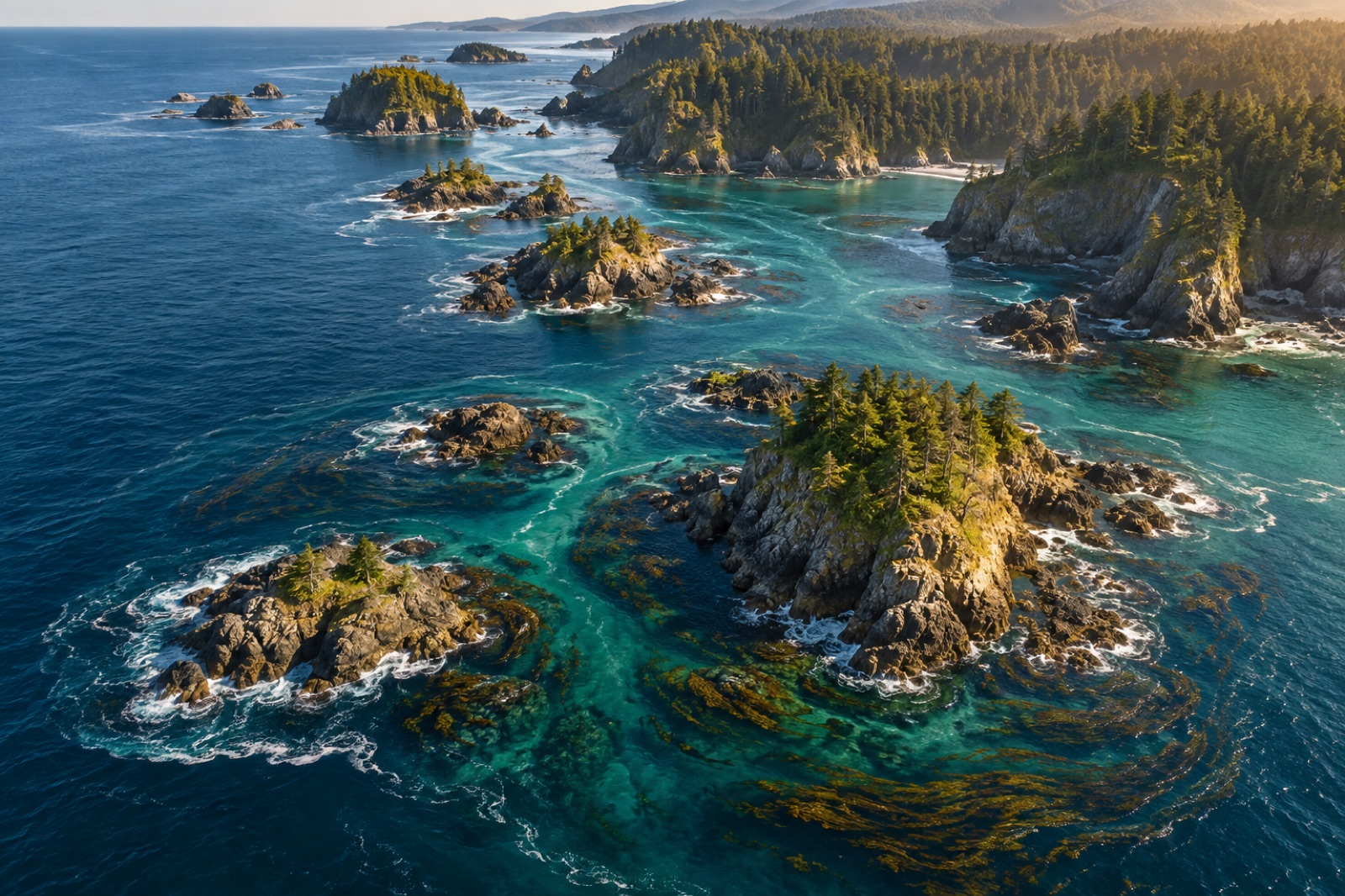
Reefs are joined by currents into a living network. How connectivity works, why stepping stones matter, and how it shapes marine reserves and kelp restoration.
Dr. Lena Fischer ·