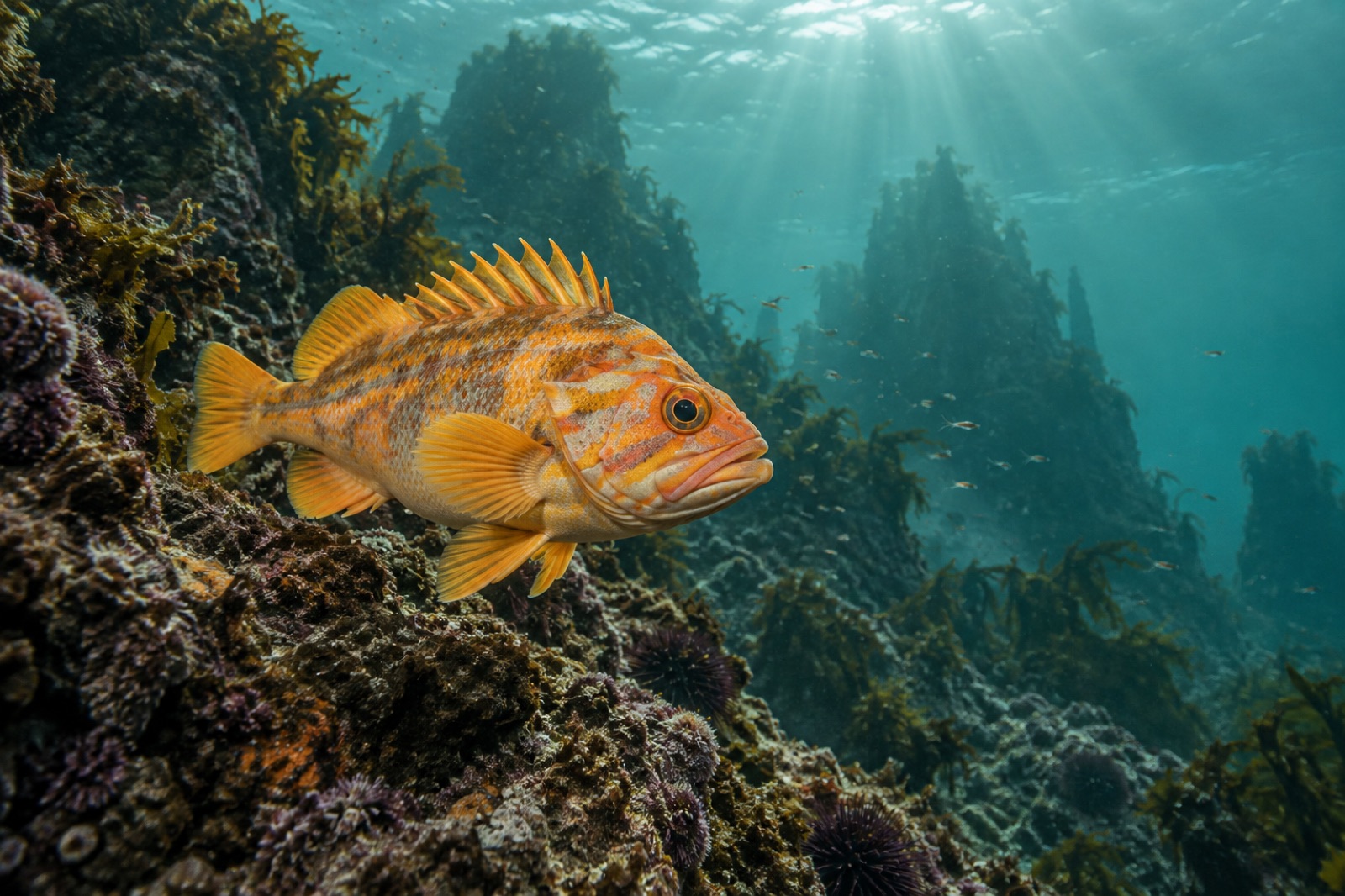
Of the sixty-odd rockfish species that inhabit the US West Coast, the yellowtail rockfish (Sebastes flavidus) is the one you are most likely to see as a grey-green wall moving through the water column. Unlike the sedentary copper rockfish glued to its home boulder, the yellowtail is a wanderer — a midwater schooler that rises off deep reefs at dusk, follow currents along canyon edges, and can appear over a kelp forest one week and be miles away the next.
Quick identification
Yellowtail rockfish are medium-bodied, torpedo-shaped rockfish built for sustained swimming rather than the sit-and-wait style of bottom huggers:
- Colour: olive-brown to grey-green on the back, fading to pale or yellowish on the belly; all fins flushed with yellow, most strongly in fresh-caught or shallow-water fish.
- Head: relatively small spines compared with heavy-headed reef rockfish; the lower jaw projects slightly.
- Size: commonly 30–45 cm; large individuals push 60 cm.
- Behaviour: the giveaway. Loose to dense schools hovering in midwater above deep rocky structure, often mixed with blue rockfish and widow rockfish.
Divers meeting a school describe being enveloped — thousands of pale-eyed faces all swivel to track the bubble-blowing intruder, keeping a perfect two-metre bubble of personal space.
Range and habitat: the edge specialist
Yellowtail rockfish occur from about San Diego, California, north to the Gulf of Alaska, with the heart of the population off Oregon and Washington. They are creatures of deep reefs — typically 90 to 200 metres, though recorded both shallower and much deeper — and they patrol the edges: shelf breaks, canyon rims, the deep fringe where giant kelp gives way to open water.
That deep-fringe habit connects them, surprisingly, to kelp forests. Juvenile yellowtails associate with drifting kelp rafts and other floating structure in their first year of life, riding surface habitat before settling to deep reefs. Adults near the canopy edge feed most actively at dawn and dusk, when plankton-eating prey rises through the water column. A kelp forest's shadow line — where canopy light fades into blue — is one of the most productive hunting corridors on a temperate reef, and yellowtails know it.
Feeding and trophic role
The yellowtail is a planktivore-piscivore at the middle of the food web. Its diet is dominated by:
- Krill and pelagic crustaceans — the calorie-dense engine of the upwelling coast.
- Small schooling fishes — juvenile anchovies, small smelts, larval fishes.
- Squid when available.
In turn, yellowtails are hunted by lingcod, larger rockfish, sharks, and — where ranges overlap — marine mammals like the Steller sea lion. Large schools near the surface attract seabirds, and a feeding aggregation of yellowtails can be located from a boat by watching for terms and shearwaters working the water.
Life history: live-bearers playing the long game
Like all Sebastes, yellowtail rockfish are viviparous — females mate in autumn and winter, store sperm, then fertilise and brood their young internally, releasing swarms of tiny live larvae in spring and early summer. Brood size scales steeply with female size, which is why fisheries scientists worry whenever large old females are scarce: a single large female can produce far more, and apparently more viable, larvae than several young ones combined.
Yellowtails grow slowly and live long — several decades, with the oldest fish aged at over 60 years. Slow growth plus long life is the classic rockfish vulnerability: a stock can absorb a few years of heavy fishing and look fine, then collapse when the old cohort is gone and recruitment fails to replace it.
The decompression problem
Rockfish pulled from depth suffer barotrauma — swim-bladder expansion that can be fatal if the fish is released untreated at the surface. Modern management on the West Coast requires descending devices for released rockfish, and research has shown high survival when fish are returned quickly to capture depth. Anglers: carry a descender. It is the single most effective conservation tool you personally control.
Fishery and management
Yellowtail rockfish north of the Oregon–California border has long been one of the workhorse species of the Pacific groundfish fishery, caught with midwater trawls and longlines, and prized as a lean, mild whitefish. The northern stock is assessed regularly by federal scientists and has been managed as a healthy, sustainably harvested stock for years — a contrast with more troubled species such as the canary rockfish, which spent years under a rebuilding plan before its recovery was declared.
The management lesson from yellowtail is the inverse of the canary's: a species with decent monitoring, modest catch limits, and cooperative industry science can support a fishery year after year without drama. Boring is underrated in fisheries.
At Tidewright, our Canopy Ledger biodiversity surveys log yellowtail schools during seasonal transects over restoration sites, since their presence over deep reef margins is a good sign that upwelling-driven productivity is threading all the way up the food web — from plankton to predators.
Watching yellowtail rockfish in the wild
If you dive the Pacific Northwest or Northern California:
- Look midwater, not at the bottom. Scan above the reef in 15–40 m of water over rocky structure.
- Go early or late. Schools rise highest and loosest at dawn and dusk.
- Move slowly. Approach at breathing pace; sudden finning compresses the school and scatters it.
- Never reach into a school. Enjoy the envelopment — it is one of the great temperate-water experiences, the northern echo of a tropical bait ball.
Key takeaways
- Yellowtail rockfish are mobile, midwater schooling rockfish of deep West Coast reefs, from California to the Gulf of Alaska.
- Yellow-flushed fins, small head spines, and schooling behaviour separate them from bottom-hugging cousins.
- They are live-bearers whose larvae depend on drifting surface habitat — including kelp rafts — before settling to deep reefs.
- Slow-growing and long-lived (60+ years), they need precautionary management; the northern stock is currently considered healthy.
- Released rockfish survive far better when sent back down with a descending device.
FAQ
Is yellowtail rockfish good to eat?
Yes — it is a lean, mild, versatile whitefish that works grilled, baked, or in tacos. Buy from fisheries under the Pacific groundfish management plan and check local advisories as you would for any fish.
How is a yellowtail different from an olive or widow rockfish?
Fin colour and tendency. Yellowtails show yellow on all fins and form looser, larger midwater schools; olive rockfish are more solitary near structure with finer spots; widows are darker with curved lateral lines.
Why do rockfish have such terrible survival after catch-and-release?
Barotrauma: rapid ascent expands their swim bladder and can displace organs. A descending device returns the fish to pressure where gases recompress — survival improves dramatically.
Do yellowtail rockfish live in kelp forests?
Adults live deeper than the canopy but hunt its edges, and juveniles shelter in drifting kelp at the surface. The two habitats are linked by the fish's life cycle.
How old can a yellowtail rockfish get?
Aged individuals have exceeded 60 years. Most fish in the catch are 10–25 years old — another reason big old females deserve protection.