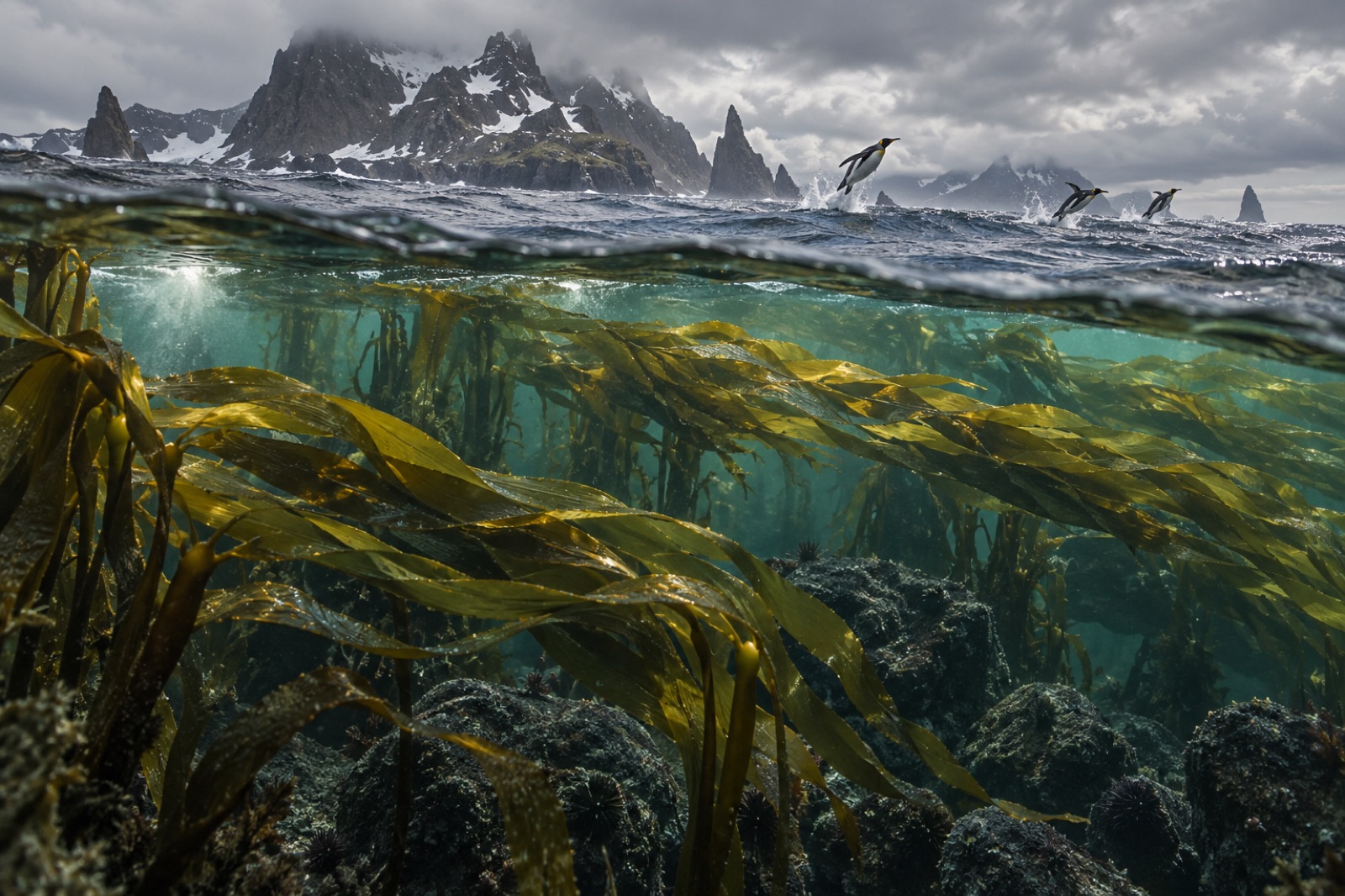
Marion Island sits at 46 degrees south in the Indian sector of the Southern Ocean — roughly 2,200 kilometres southeast of Cape Town, in the windy, cloudy heart of the roaring forties. It is a volcano twice the size of Manhattan with no permanent human population beyond a single research station, ringed by one of the great intact giant kelp forests left on the planet, packed with breeding albatrosses and penguins — and, for the past two decades, at the centre of one of the most urgent conservation stories in the subantarctic. This is a guide to the island most people will only ever visit through its science.
Where Marion actually is
Marion and its neighbouring island, Prince Edward, together form the Prince Edward Islands — a Special Nature Reserve, South African territory since annexation in 1947–48. Our guide to the Prince Edward Islands covers the pair as a group; this one dwells on Marion itself: the larger island, the one with a station, the seabird capital, the one in the conservation fight.
Physically, Marion is a shield volcano roughly 290 square kilometres in area, rising to just over 1,200 metres, last visibly active in 1980. The climate is wet and grey: more than 2,000 millimetres of precipitation a year, mean annual temperatures around five or six degrees, and cloud on most days. The combination — cool, wet, mild, and far from any ice front — puts Marion in the maritime subantarctic belt rather than true Antarctic territory, and it matters biologically: this is what a fully-developed subantarctic island ecosystem looks like when it is still mostly intact.
Giant kelp in the roaring forties
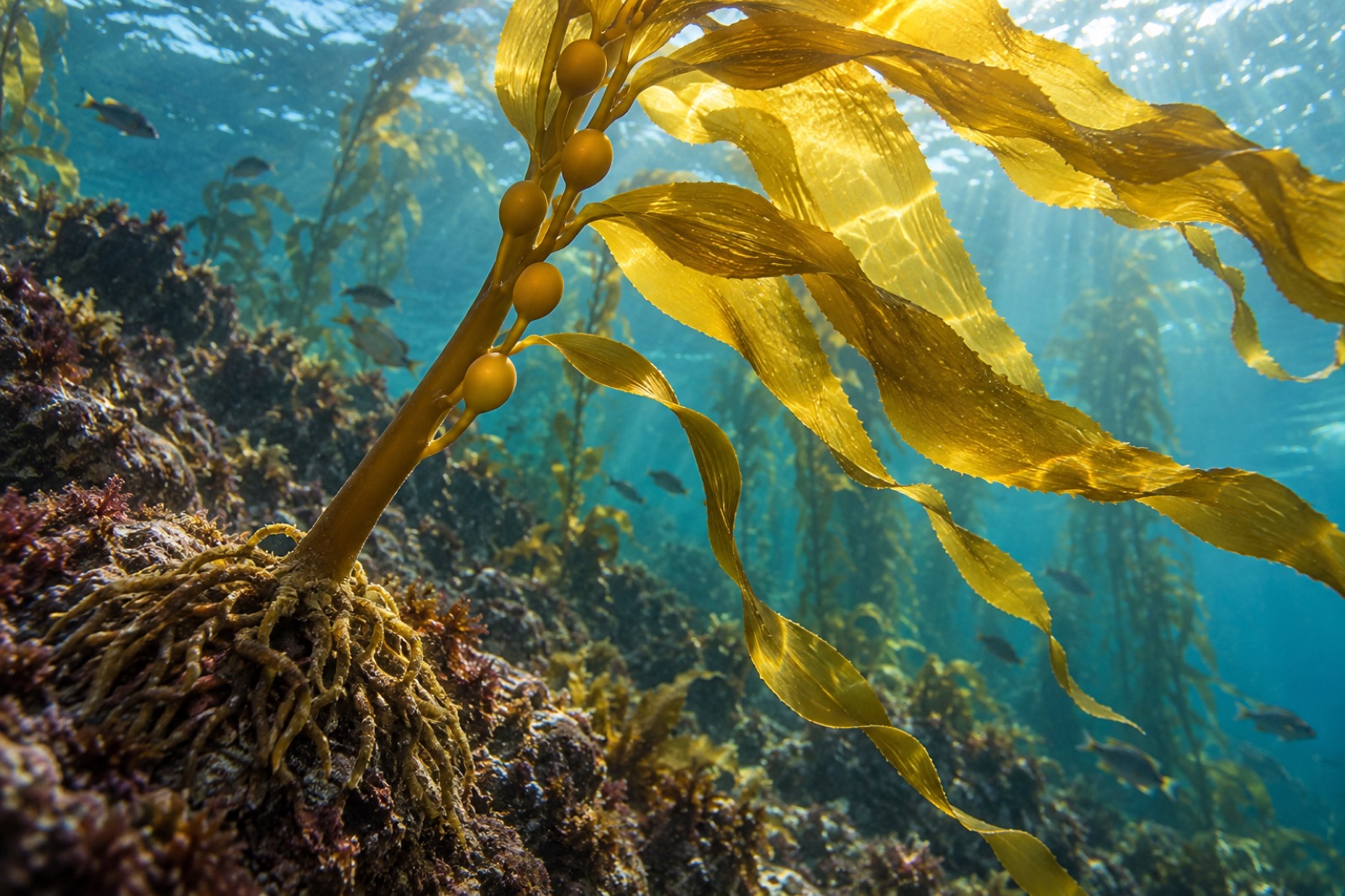
Below the waves, the island's nearshore is forested by giant kelp (Macrocystis pyrifera — see the giant kelp species profile), and the forest here is the defining structural feature of the nearshore. These beds favour shallower water than their Pacific counterparts — most of the canopy above ten metres — and the island is edged by them, fronds stretching in wave-battered ribbons around every boulder headland.
The kelp does what giant kelp does everywhere: dampens waves, provides three-dimensional habitat, and exports organic material outward into the surrounding food web. On Marion, that function has a particularly charismatic expression: the island's killer whales are famous for working the kelp fringe, swimming in close against the edge of the canopy to chase young elephant seals. Both predator and prey navigate the kelp edge like terrain, and the forest is the arena in which the island's most photogenic hunting behavior happens.
The island's other autotrophs on land — Kerguelen cabbage, cushion azorella, tussock grass — are survivors of cold and wind in the same way the kelp is; Marion's terrestrial vegetation shares the subantarctic character that defines these islands.
The albatross capital of the subantarctic
Marion's importance is airborne in a way few islands anywhere can match. Four species of albatross breed on the island — wandering, grey-headed, sooty and light-mantled — making Marion one of only a handful of islands in the world to host that full subantarctic suite. Wandering albatross pairs wheel off the coastal slope in their twenties; grey-headed albatrosses occupy the inland slopes in vast colonies; light-mantled sooties glide the cliff edges.
Around the albatrosses rotates everything else. King penguins hold large colonies on the low flat shores; macaroni penguins — the most numerous penguin of the subantarctic world — breed around the coast in huge rookeries; gentoo and southern rockhopper penguins fill in around the edges. Giant petrels, skuas, sheathbills, petrels and prions complete the picture.
The lineup of marine mammals matches. Southern elephant seals breed on the island in their thousands; Antarctic and subantarctic fur seals lounge the beaches; and the Marion killer whales — one of the Southern Ocean's best-studied populations — have been observed for decades at the kelp periphery.
The mouse problem — and the plan to end it
The island's great modern crisis fits in the palm of your hand. House mice, introduced accidentally with sealers in the nineteenth century, have lived on Marion for two centuries. For nearly all that time they were an ecological detail. In recent decades, warmer, drier conditions began pushing mice toward larger vegetable and invertebrate foods, and their populations rose. Around the turn of the millennium came a behavioural turn that no one anticipated: mice started attacking seabird chicks — feeding on the scalps and bodies of nesting albatrosses and petrels while the birds sat — a pressure the island's owning species had no evolved defence against. The predation is visible to anyone who watches the colonies closely, and it threatens several species with local decline.
The response is the Mouse-Free Marion project — a partnership between the South African Department of Forestry, Fisheries and the Environment and independent conservation bodies — which has been preparing since the early 2020s for the island's first aerial eradication attempt: rodenticide dropped by helicopter across the whole island in winter when mice have no alternate food. If it works, it will be one of the most consequential single conservation interventions anywhere in the subantarctic.
Protection on the water
The ocean side of the story is already in better shape. The Prince Edward Islands sit inside the Prince Edward Islands Marine Protected Area, declared in 2013 as one of South Africa's flagship offshore MPAs — around 180,000 square kilometres in total, with the innermost 22 kilometres around the islands a no-take sanctuary. It is one of the largest marine protections in the Indian Ocean sector of the Southern Ocean, and it secures exactly the water the kelp forest and bird colonies draw on. Our explainer on marine protected areas describes what a designation at this scale actually changes on the water.
Marion in the atlas of subantarctic kelp
Marion is one corner of an archipelago of Southern Ocean kelp coasts — the Crozet Islands to the south-east, Kerguelen further east, Macquarie Island south of New Zealand — that together hold more nearly intact giant kelp forest than anywhere outside the subantarctic scene of South America. In each, kelp does the same job, and in each it anchors the same roughly coherent community of penguins, seals, albatrosses and toothfish-like cold-water fish. Marion's piece of that archipelago is distinguished by two things: a forest that has never been felled or heavily fished, and evidence, painfully won, of what happens when warmth pushes an island's invader population past its bounds.
If there is a single lesson Marion teaches the kelp-restoration world, it is that intact kelp forests are not the default; they are an achievement, and they only remain engineered that way. The forest that still rings Marion is proof the race is winnable.
Key takeaways
- Marion Island and Prince Edward Island together form South Africa's Prince Edward Islands, deep in the Indian-sector Southern Ocean at 46 degrees south.
- Marion's nearshore is ringed by giant kelp (Macrocystis pyrifera), the dominating structural habitat — and the hunting arena for the island's killer whales.
- The island breeds all four key subantarctic albatross species and supports some of the Southern Ocean's largest macaroni and king penguin populations.
- Introduced house mice are preying on albatross and petrel chicks; the Mouse-Free Marion project is preparing the island's first full eradication attempt.
- The surrounding ocean is protected by one of the largest MPAs in the Indian Ocean sector; the forest itself remains unworked and intact.
FAQ
Can you visit Marion Island?
No, in the ordinary sense. Marion has no tourism infrastructure; access is reserved for the South African research operation, conservation teams and the supply vessels that service the station once or twice a year. Your interaction with Marion is through the published science, the station's reports, and — if you choose — supporting its conservation.
What is the Prince Edward Islands Marine Protected Area?
Declared in 2013, the MPA covers roughly 180,000 square kilometres around the two islands, with a no-take sanctuary in the inner 22 kilometres. It is among South Africa's largest marine protections and secures the waters on which the islands' kelp forest and bird colonies depend.
Why did mice start eating albatross chicks on Marion?
Warmer, drier conditions on the island over recent decades boosted mouse numbers and changed their diet. From around the early 2000s, mice began feeding on nesting chicks of albatrosses and petrels — a behavior the birds, evolved without land predators, have no defence against.
What kelp actually grows at Marion Island?
Giant kelp (Macrocystis pyrifera) — the same species that builds the great forests of the northeast Pacific and most of subantarctic South America. On Marion it forms dense fringing beds in the wave-exposed shallows.
How do I keep up with the Mouse-Free Marion project?
The project publishes updates through its partnership channels; South Africa's Department of Forestry, Fisheries and the Environment announces major milestones. Conservation at this scale takes years — the fight happening on Marion is one to follow.