Ask a room of climate-policy people whether blue carbon can trade under Article 6 of the Paris Agreement and you'll get two confident, opposite answers. Both are half-right. Article 6 — the part of the Paris rulebook governing international cooperation and carbon trading — does not list eligible ecosystem types. It admits no project and rejects none by name. What it does is set a demanding set of accounting and governance tests, and whether a mangrove restoration or a kelp forest can pass them depends on host-country rules, approved methodologies and infrastructure that is still being built.
This article is about those tests: what the rulebook actually requires, which activities currently fit, and what would have to be true for blue carbon credits to move through Article 6 channels at scale. For the mechanics of the trades themselves — ITMOs, corresponding adjustments and the two tracks — see our companion piece, Article 6 and the ocean, and the broader blue carbon policy explainer.
A quick orientation: the rulebook in one paragraph
Article 6 has three limbs. Article 6.2 lets countries trade mitigation outcomes bilaterally, with bookkeeping called corresponding adjustments to prevent double counting. Article 6.4 creates a centralised, UN-supervised crediting mechanism — the successor to Kyoto's Clean Development Mechanism (CDM) — run by a Supervisory Body that approves methodologies. Article 6.8 covers non-market cooperation (finance, technology transfer) and produces no credits. Almost everything a blue carbon project developer cares about sits in 6.2 and 6.4.
What makes an activity "Article 6 eligible"
The phrase gets used loosely, so it's worth being precise. Under the decisions agreed at Glasgow (COP26) and refined since, an activity can generate Article 6 credits only if several gates are all open:
1. A willing host country with authorisation machinery. The country where the project sits must have ratified Paris, maintain a national registry or use the international one, and — critically for 6.2 trades — formally authorise the mitigation outcomes for transfer. Authorisation is a sovereign act: the host decides what the credits may be used for (NDC achievement, CORSIA offsetting, or voluntary "other purposes"), and whether to apply a corresponding adjustment. A project in a country with no authorisation process is simply locked out of Article 6, whatever its carbon story.
2. Real, additional mitigation. Article 6.4's rules require demonstration of additionality — the activity must go beyond what would happen anyway, considering relevant laws and policies — and must be designed to avoid locking in emissions or causing harm. Real baselines, conservative accounting, and leakage assessment are all mandatory, not branding choices.
3. An approved methodology. Under 6.2, countries have latitude to agree their own approaches, subject to review — this is why early 6.2 deals have covered everything from clean cooking to e-buses. Under 6.4, the Supervisory Body must approve each methodology, and it has been building a new set of standards from scratch, including dedicated requirements for activities involving removals — notably rules on monitoring, reversal risk and how long storage must last. That removals standard matters enormously for coastal ecosystems, whose carbon sits in anaerobic sediments that storms and development can disturb. Anyone working on permanence and buffer pools in the voluntary market will find the 6.4 removals debate familiar, but formalised.
4. Registration, monitoring and verification through UNFCCC infrastructure. Credits must be issued into tracked accounts, with corresponding adjustments applied where authorisation requires it, and both participating countries report through the Biennial Transparency Reports.
The blue carbon question: does it qualify?
Here is the honest answer, ecosystem by ecosystem.
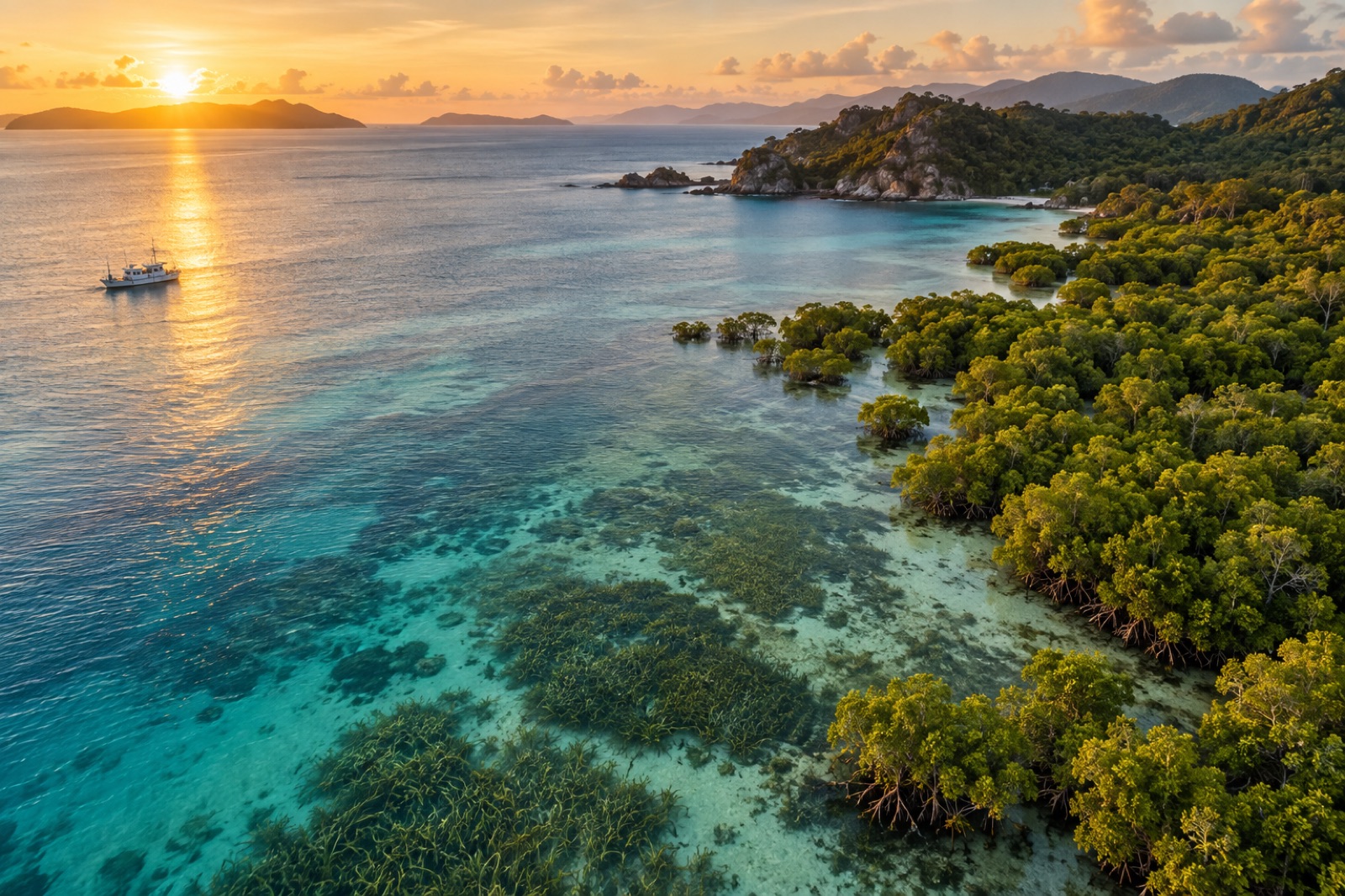
Mangroves, tidal marshes and seagrasses are the closest to eligibility they have ever been. They are covered by established IPCC inventory guidance (the 2013 Wetlands Supplement), which means host countries can see these activities inside their national accounts — a practical prerequisite for corresponding adjustments, since you cannot adjust for something your inventory does not measure. Afforestation and reforestation sit comfortably inside 6.4's conceptual frame, and coastal wetland restoration fits the same logic. What is still missing, as of this writing, is a deep bench of specifically approved 6.4 methodologies for wetland activities; early blue carbon trades have therefore mostly run through 6.2-style cooperative approaches or pilot arrangements rather than the central mechanism.
Kelp forests and farmed seaweed face a deeper problem, and it is not Article 6's fault. Most kelp grows on rocky reefs where rooted-vegetation carbon accounting does not apply, the sequestration pathways are contested, and — decisively — kelp is not yet part of standard national greenhouse gas inventories. An activity invisible to national accounts cannot be the basis for ITMO transfers, because there is nothing to adjust. We unpack that accounting gap, and what would close it, in the policy gap: why kelp carbon isn't counted (yet) and is kelp blue carbon?. Until IPCC guidance extends further into macroalgae, kelp carbon will live in the voluntary market, not under Article 6.
Design features that discipline any blue carbon trade
Even once eligible, blue carbon under Article 6 inherits rules that differ from the voluntary market's house style:
- Share of proceeds. A percentage of 6.4 units is levied to fund adaptation in developing countries. For a coastal nation, this turns carbon exports into partial adaptation finance — but it also changes project economics.
- Overall mitigation in global emissions (OMGE). A further 2% of 6.4 units is cancelled outright, so the mechanism is designed to reduce total emissions, not just shift them. Buyers should know a fraction of what they pay for never reaches them, by design.
- Crediting periods with renewal. Activities are credited for bounded periods (with renewal windows), forcing periodic re-baselining — relevant for ecosystems whose carbon accumulates over decades.
- CDM transition. Some old CDM activities and credits were allowed to transition into the Article 6 world under tight conditions. Coastal afforestation projects among them set early precedents, though the transition window and eligibility cut-offs excluded much of the old stock.
What it means for buyers and projects, practically
For a corporate buyer, an Article 6-authorised blue carbon credit with a corresponding adjustment is the closest thing the market offers to a credit that no government will later contest — the double-counting question at the heart of who owns a tonne of blue carbon is answered at the sovereign level. That integrity commands a premium and demands patience: authorisation timelines are measured in months to years, and only a handful of countries have functioning processes.
For a project developer, the checklist is sobering but knowable: confirm the host country has an Article 6 strategy and authorisation body; confirm the ecosystem type appears in the national inventory; model the share-of-proceeds and OMGE deductions into the business plan; and run robust MRV from day one, because 6.4 methodologies will only get stricter. Tidewright's own Canopy Ledger platform is built with exactly this stricter future in mind — canopy-to-sediment monitoring designed to satisfy verification regimes that have not finished being written yet. (Our platform work is Tidewright's own; the Paris rulebook is not ours to predict.)
Key takeaways
- Article 6 admits no ecosystem type by name; eligibility is a stack of tests — host authorisation, additionality, approved methodology, and UNFCCC-grade accounting.
- Mangroves, salt marshes and seagrasses are nearly eligible in practice because they sit inside national inventories; kelp does not, which locks it out of Article 6 for now.
- Article 6.4 levies a share of proceeds for adaptation and cancels 2% of units for OMGE — costs that belong in every project model.
- Corresponding adjustments make authorised credits uniquely defensible for buyers — at the price of long sovereign timelines.
- Watch methodology approvals and the removals standard: they, not the treaties, decide what blue carbon can actually trade.
FAQ
Is there a list of "Article 6 eligible" project types?
No. There is no whitelist of technologies or ecosystems. Eligibility emerges from the interplay of host-country authorisation, additionality rules and approved methodologies. Anyone marketing "Article 6 certified" credits before a host country has authorised them is selling a promise, not a credit — treat such claims with the same caution as any greenwashed ocean claim.
Can a voluntary-market blue carbon project become an Article 6 project?
Potentially, yes — but it is a conversion, not an upgrade sticker. The host country must authorise the mitigation outcomes, a corresponding adjustment may be required going forward, and the project may need to re-baseline under an approved methodology. Projects designed from the start with Article 6-grade MRV and safeguards convert far more easily.
Does corresponding adjustment apply to every Article 6 credit?
No. Authorisation determines this. Credits authorised for another country's NDC or for CORSIA must be adjusted; units authorised for "other purposes" — including most voluntary corporate claims — may or may not carry an adjustment, depending on the host. This is now a central due-diligence question in the voluntary market.
Where does kelp restoration stand right now?
Outside the mechanism, by accounting geography. Kelp is absent from standard national inventories, so there is nothing for a corresponding adjustment to adjust. That could change with future IPCC guidance on macroalgae — a scientific process with a multi-year clock, tracked in detail by research programs like ours at Tidewright's science hub.
Do share-of-proceeds deductions apply to 6.2 trades as well?
The mandatory monetary share of proceeds applies to 6.4; 6.2 cooperative approaches are instead strongly encouraged to make voluntary adaptation contributions. Well-structured 6.2 blue carbon deals increasingly do so — politically, exporting carbon from a climate-vulnerable coastline while contributing nothing to its adaptation is hard to defend.