Blue Carbon9 min read
What Drives the Price of a Blue Carbon Credit
Blue carbon credits range from a few dollars to far more. What actually sets the price: costs, quality, co-benefits, forwards and policy demand.
Priya Raman ·
Blue carbon prices confuse buyers because costs vary wildly by method. A clear-eyed breakdown of restoration, MRV, issuance and buffer costs per tonne.
Ask what blue carbon costs and you will get answers spanning more than an order of magnitude — a few dollars per tonne for some avoidance projects to well over $100 for high-integrity removals. Both figures can be honest. The confusion arises because "cost" bundles together very different things: the physical work of restoring habitat, the science of proving it worked, the administration of turning tonnes into tradable credits, and the insurance against failure. This article unpacks the real cost stack behind a blue carbon credit, explains why cheap isn't always bad but expensive isn't always good, and gives buyers and project developers a framework for reading any price quote. For the demand side of the equation — what drives the price you actually pay — see what drives the price of a blue carbon credit.
First, separate the two questions. Cost is what a project spends to deliver one net tonne of verified CO₂ benefit. Price is what a buyer pays, which reflects cost plus margin, scarcity, co-benefit premiums and market sentiment. High-integrity mangrove avoidance credits have traded for under $10/t while novel ocean CDR approaches command $100-plus — yet the underlying costs don't map neatly onto those numbers. This article focuses on cost, because it is the more honest anchor for comparing like with like.
This is the physical work: surveying and selecting sites, establishing nurseries, transplanting seagrass or replanting mangroves, laying kelp seed lines, excluding urchins or modifying hydrology. For restoration projects (as opposed to avoided-loss projects), it is usually the largest single cost.
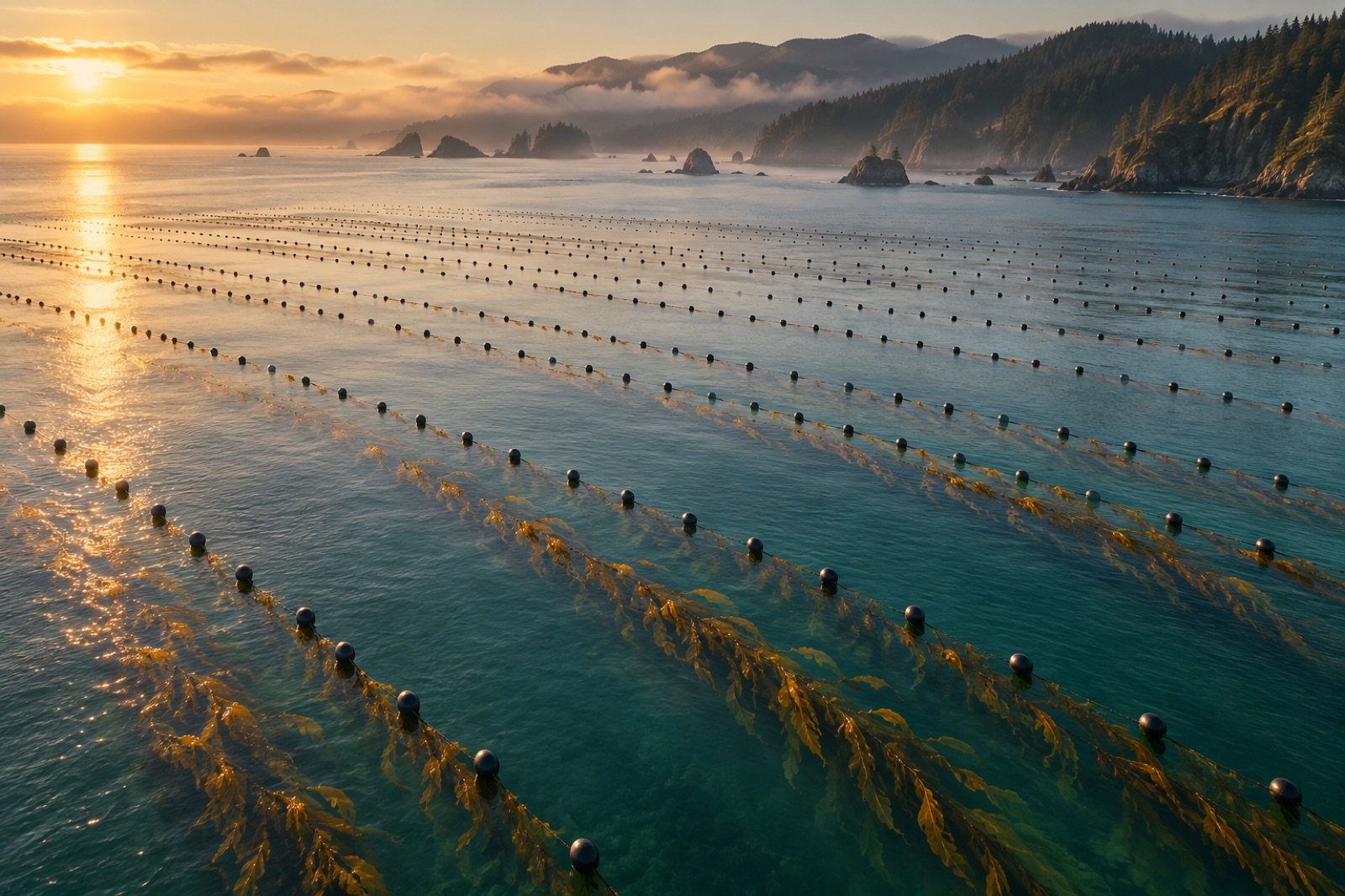
Costs vary enormously by ecosystem and geography. Mangrove replanting in a low-wage tropical country might cost hundreds of dollars per hectare for labour-intensive planting; seagrass restoration using mechanical transplanting in a developed nation can run into tens of thousands per hectare; kelp reseeding at scale — as with Tidewright's (fictional, illustrative) Drifter vessels laying Holdfast lines — sits somewhere in between but is dominated by vessel time, hatchery production and the cost of genetically matched seedstock.
A crucial distinction: avoided-loss projects that prevent degradation of existing habitat (see avoided loss credits) have much lower restoration costs — often just monitoring and management — which is why they can offer cheaper credits, though with all the additionality scrutiny that implies.
MRV is the science that turns an ecological claim into an audited number. It includes baseline surveys, ongoing monitoring (dive surveys, remote sensing, sediment coring), data management, third-party verification and periodic reporting. As laid out in MRV explained and measuring kelp carbon at sea, this is where blue carbon differs most markedly from terrestrial forestry: much of the relevant carbon is underwater, requiring boats, divers, sonar and satellites rather than tape measures and drones alone.
MRV costs are scale-sensitive in an interesting way. Many components — satellite licences, verification team mobilization, methodology development — are fixed or step-fixed costs per project, not per tonne. A 100-hectare project and a 10,000-hectare project may pay similar absolute MRV costs in early years. That means MRV per tonne falls dramatically with scale, which is why large projects can undercut small ones on price while maintaining integrity. The emerging technology shift described in the MRV revolution is steadily compressing these costs.
Credits don't just exist — they are minted by registries after verification. Costs here include registry account fees, issuance fees (sometimes charged per tonne), legal costs for carbon rights and contracts, standard-body fees, and the project management overhead of steering a project through the full project cycle. Legal work deserves special mention for blue carbon: securing carbon tenure over coastal and marine space — as explored in who owns blue carbon — can be one of the most expensive and time-consuming elements, particularly where sea tenure is customary or contested.
Every credible project sets aside a share of issued credits into a pooled buffer to cover reversals — storms flattening a forest, a marine heatwave thinning kelp, sediment erosion. Buffer contributions typically take 10–40% of gross issuances depending on assessed risk (higher for reversal-prone ecosystems; see permanence and buffer pools). That is a real cost: those tonnes cannot be sold. Some projects supplement buffers with commercial insurance products (covered in insuring blue carbon), which adds premium costs but can reduce buffer set-asides.
Blue carbon projects spend money years before they earn it. A typical timeline (see the real timeline of a blue carbon project) runs three to seven years from feasibility to first issuance. That gap must be financed, and capital is not free. The blended cost of grants, concessional debt, equity and prepayment from credit buyers — the capital stack described in how blue carbon projects are financed — adds significantly to the lifetime cost per tonne, even though it is rarely isolated in public estimates.
Published cost estimates vary wildly because they rarely specify what is included, so take any single figure with caution. Indicative ranges from the broader literature (all illustrative and highly site-dependent):
Kelp-specific numbers barely exist in the peer-reviewed literature because no major standard has yet approved a kelp methodology (see the policy gap). Tidewright's internal cost accounting (fictional, illustrative) suggests that at commercial scale — hundreds of hectares, automated MRV, mechanized hatcheries — delivered costs could approach the lower end of the blue carbon range, but early projects necessarily sit far above it. We believe this honesty matters more than numbermanship: the industry does itself no favours by quoting aspirational costs as if they were current ones.
Three structural factors explain most cost variation between projects:
Scale. Fixed MRV, legal and development costs spread across more tonnes. This is the strongest lever for cost reduction.
Restoration versus avoidance. Avoided-loss projects skip most restoration capex but face harder additionality tests and often lower credit volumes per hectare.
Durability and risk. Projects in calm, stable settings have lower reversal risk, smaller buffers, and therefore more saleable tonnes per gross tonne sequestered — effectively lower costs per net tonne. A project in a hurricane belt pays a risk premium across the board.
When someone quotes you a cost per tonne for blue carbon, ask:
Cheap credits are not automatically suspect — some of the cheapest avoidance projects are among the most additional and impactful. Expensive credits are not automatically premium — some novel pathways are simply immature. What matters is whether the number is backed by an honest cost stack, verified MRV, and transparent accounting of what the tonne actually represents.
Often they aren't — avoided-loss mangrove credits can be among the cheapest on the market. Where blue carbon is pricier, the drivers are underwater MRV (boats and divers cost more than tape measures), early-stage methodologies, legal complexity over sea tenure, and smaller average project sizes that can't amortize fixed costs.
Yes. A project with a 30% buffer contribution delivers only 70 saleable tonnes for every 100 gross tonnes verified — an immediate 43% increase in effective cost per saleable tonne, before insurance premiums. High-risk sites pay more; low-risk sites gain a competitive edge.
Most components should. MRV automation is cutting monitoring costs already (see how), methodologies are standardizing, and projects are scaling up. Restoration costs in developed countries may prove more stubborn — labour, vessels and regulatory compliance don't deflate as quickly as satellite processing does.
Not necessarily. Low-cost avoided-deforestation projects in low-income settings can be highly additional and impactful at that price. But a low price should prompt the same due-diligence questions as a high one: what does the cost stack look like, what's the durability, and can you verify the retirement (see carbon credit retirement)?
As a fictional company created for demonstration purposes, Tidewright's cost figures are illustrative. But the discipline is real: unit-cost accounting per verified net tonne, aggressive MRV automation, genetic matching to improve survival rates, and long-tenure site selection to compress risk premiums. The same disciplines that drive down cost per tonne drive up integrity — which is the point.
Blue carbon credits range from a few dollars to far more. What actually sets the price: costs, quality, co-benefits, forwards and policy demand.
Priya Raman ·
Blue carbon projects rarely run on carbon credits alone. A practical guide to grants, offtakes, equity, debt and blended finance for coastal restoration.
Priya Raman ·
Follow kelp carbon from satellite canopy map to verified credit: the fieldwork, biomass models, fate tracing and audits behind blue carbon MRV at sea.
Dr. Mara Ellison ·