Explore9 min read
The Beginner's Guide to Kelp Forest Diving
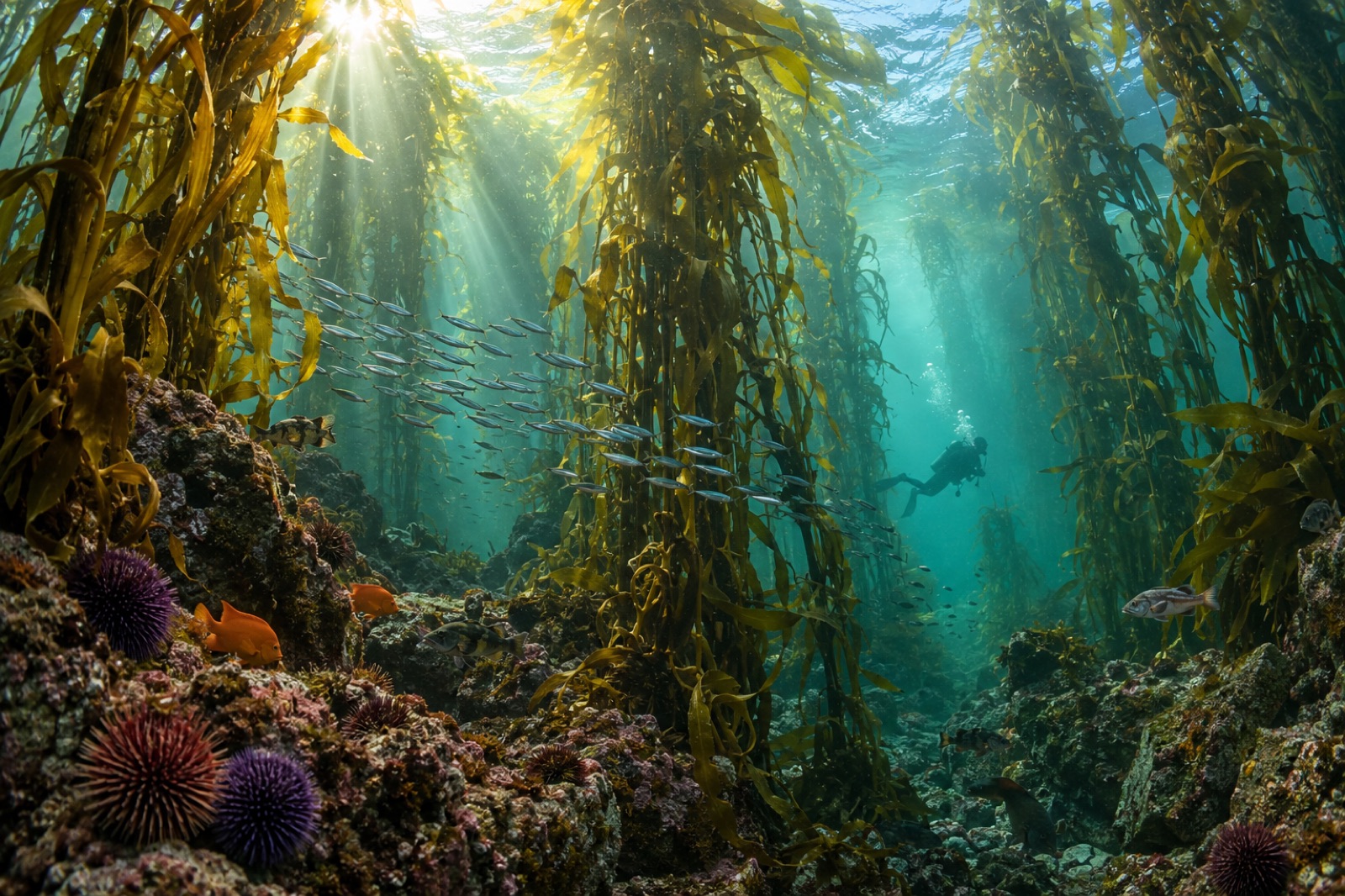
Your first kelp forest dive is easier — and more magical — than you think. Gear, skills, marine life and etiquette for new divers entering the green cathedral.
Tom Okafor ·
Kelp and surf go together for the same oceanographic reasons. Why kelp-country breaks are so good, how kelp changes waves, and how to surf them well.
Some of the most celebrated waves on Earth peel over kelp. Bells Beach fronts the kelp forests of Bass Strait. Northern California's point breaks sit above bull kelp beds. The reefs of Cape Town are threaded with Ecklonia maxima. Tasmania, Hokkaido, Vancouver Island, the Otago Peninsula — scan any list of cold-water surf destinations and you are, coastline after coastline, reading a map of kelp forest habitat.
This is not a coincidence. Kelp and great surf are produced by the same oceanography, and once you understand the relationship, you can read a kelp coast like a forecast.
Kelp needs three things: cold water, abundant nutrients and rocky substrate. Waves of quality tend to favour the same address.
Cold, nutrient-rich water reaches temperate coasts through upwelling and boundary currents — the California and Humboldt currents, the Benguela, the Oyashio. These are the eastern edges of ocean basins, where wind drives surface water offshore and pulls cold, fertile deep water up to replace it (our explainer on upwelling covers the mechanism). The same basin geometry that generates these currents also exposes these coasts to long-period groundswell generated by mid-latitude storms. Temperate oceans are stormy oceans — and storm tracks write both the surf and the forest.
Then there is the bottom. Kelp anchors to rock, so kelp coasts are rocky coasts — and rock, not sand, is what shapes a reliable wave. A reef or cobble point holds its shape through decades of storms, refracting and focusing swell the same way every time. The kelp forest is, in a sense, a signpost: where you see kelp fringing the take-off zone, you are looking at solid, wave-shaping geology rather than shifting bar.
Here is the part surfers love and oceanographers can now measure: kelp forests damp choppy water. The drag of thousands of stipes and blades takes energy out of short-period surface motion — the irregular, wind-generated chop that degrades wave faces — while leaving the long-period swell that surfers ride largely intact. The physics of this is genuinely elegant, and our piece on how kelp forests calm the sea goes into the drag coefficients and wave-length filtering.
In practice, the effect is most obvious on afternoon seabreeze days. A break exposed to raw wind chop turns crumbly and difficult; a break fronted by a healthy kelp bed often stays glassier, longer, because the forest between the wind and the reef is quietly eating the short waves. Old-timers on some coasts talk about "the kelp grooming the swell" as folklore. The folklore is correct.
There are limits worth respecting. A very dense canopy directly under the take-off zone can foul fins and leash plugs, and big drift kelp after storms is a real hazard — a submerged stipe mat is nobody's idea of a good bottom turn. Kelp makes the water better; it also asks you to surf it with a bit more attention.
Kelp is seasonal, and its seasons rhyme with surf seasons. On many temperate coasts the canopy is thickest in late summer and autumn, and storms prune it back through winter. If you want the maximum wave-grooming effect, look for sessions when the canopy is fully grown and the wind is light and cross-offshore. If you want to see the reef architecture — useful for understanding a break — winter's pruned beds expose the bottom clearly at low tide. Our month-by-month guide to the kelp seasons was written for divers, but the seasonal logic transfers directly.
Drift kelp piled on the beach tells you what the last storm did to the forest and what is floating in the lineup. Heavy fresh wrack after a blow means loose stipes in the water for a few days. Drift kelp and wrack are ecologically precious — they feed whole beach food webs — so launch and land around wrack piles rather than through them.
Rocky kelp-coast breaks are almost always tide-sensitive, more so than beach breaks, because reef depth relative to tide is fixed. Many kelp points have a narrow tide window — too low and the wave dumps on exposed rock, too high and it mushballs over deep reef. Local knowledge matters hugely; ask at the carpark, be humble, and treat your first sessions at any new kelp break as study.
Kelp coasts are well-instrumented coasts because marine scientists love them too. Offshore buoys reporting wave height, period and — crucially — water temperature let you pick both the swell and the wetsuit before leaving home. Our guide to reading ocean buoy data walks through exactly which numbers matter and why period beats height.
Nobody should pretend otherwise: the reason these coasts grow such magnificent kelp is that the water is cold. Thirteen degrees is bathwater on the Great Southern Reef; eight is normal off Hokkaido in spring. Good waves and thin neoprene rarely coexist.
Budget for the cold the way you budget for the board. A quality 5/4 with boots, gloves and a hood opens most kelp-coast lineups nine months of the year, and a 4/3 covers the warm shoulder seasons. The same gear logic as cold-water diving applies — our cold-water gear guide discusses layering and fit principles that transfer to surf suits. Cold is also a safety system issue: longer hold-downs in cold water cost more energy, and fatigue arrives faster. Surf within it.
If this is your first kelp-coast surf trip, pick a coast with infrastructure: Northern California between Point Reyes and Mendocino, the Mornington Peninsula and Bass Strait coast in Victoria, or Cape Town's Peninsula — all covered in our Coastal Atlas, with seasons, access notes and what the forests are doing there. Each pairs excellent reef surf with dive shops, marine parks and a culture that understands the ocean as something to study, not just consume. That, in the end, is the real pleasure of surfing kelp country: the wave is the headline, but you are riding over a forest, and the forest rewards attention.
Yes, with attention. Kelp over the take-off zone can wrap fins and leashes, and dense rafts of storm-loosened drift kelp are a genuine entanglement hazard. Avoid surfing inside thick, storm-disturbed wrack, and know how to stay calm and roll off a fin if a stipe catches. Healthy in-place canopy is predictable; loose drift is not.
The effect is measurable for short-period waves: drag from the kelp canopy preferentially removes energy from wind chop and small, steep seas while long-period groundswell passes through with modest attenuation. Surfers experience this as lineups staying cleaner during seabreezes than neighbouring kelp-free breaks.
Roughly 8–17°C depending on coast and season. Upwelling coasts like central California or Namibia can be coldest in summer when upwelling peaks — a counter-intuitive pattern that surprises many visitors. Check sea surface temperature from offshore buoys rather than the air forecast.
Usually yes, but surf around marked work areas. Restoration sites use seeded lines, survey buoys and urchin-removal zones that should not be crossed by boards. Signage and local notices will show boundaries — and giving them space is how those lineups get their forests back.
For most classic kelp coasts, a 5/4 mm suit with boots, gloves and a hood covers the cold majority of the year, stepping down to a 4/3 in the warm season. On the mildest kelp coasts (parts of northern New Zealand, southern Brazil) a 3/2 suffices in summer. Fit matters more than brand — a well-fitting cheaper suit beats a leaky premium one.
Your first kelp forest dive is easier — and more magical — than you think. Gear, skills, marine life and etiquette for new divers entering the green cathedral.
Tom Okafor ·
Significant wave height, swell period, direction, water temperature — learn to decode ocean buoy reports like a waterman and plan safer, better days on the sea.
Tom Okafor ·
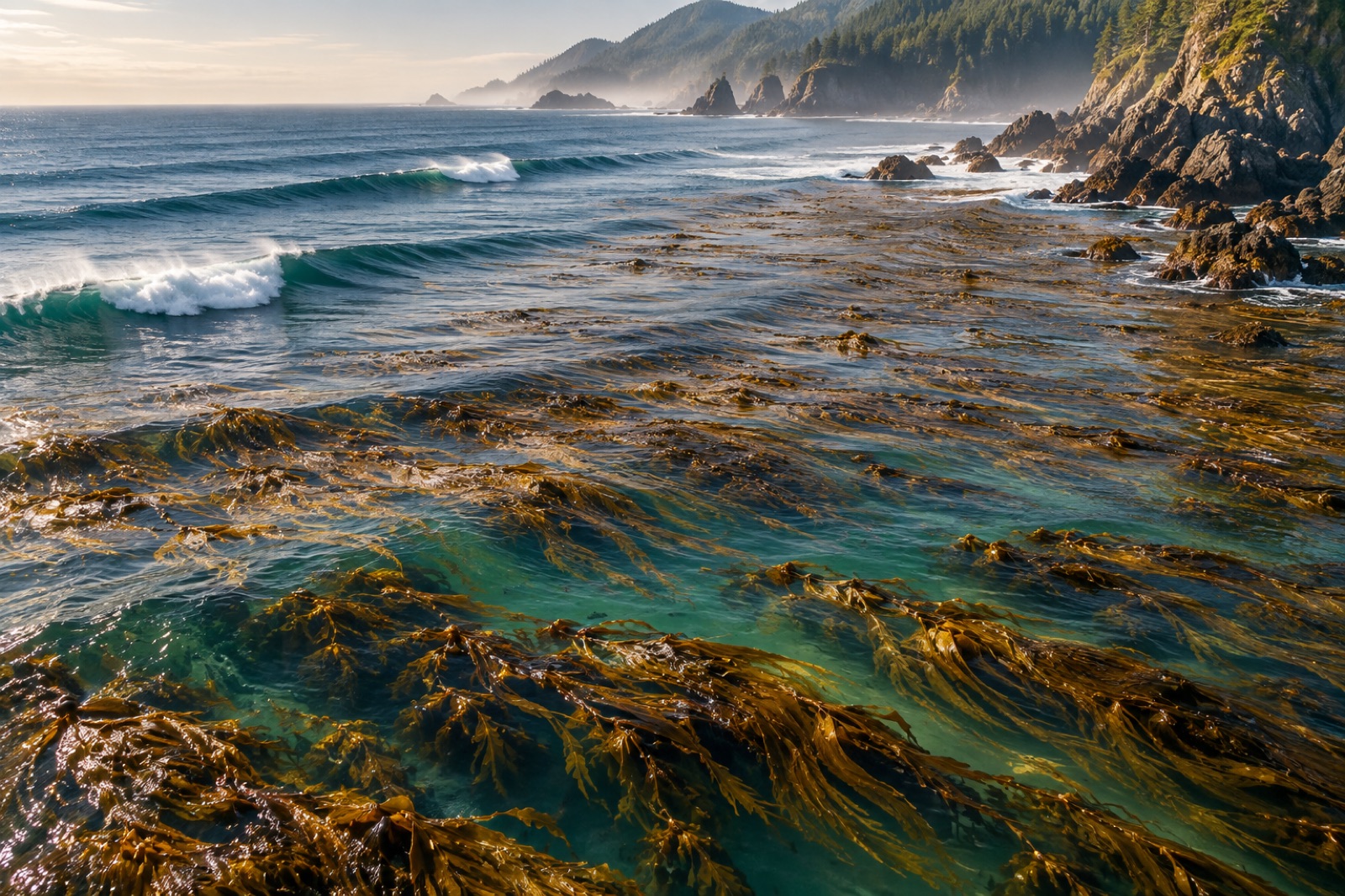
Kelp canopies act like flexible breakwaters, dragging energy out of waves and currents. Here's the physics — and how much coastal protection forests really give.
Dr. Lena Fischer ·