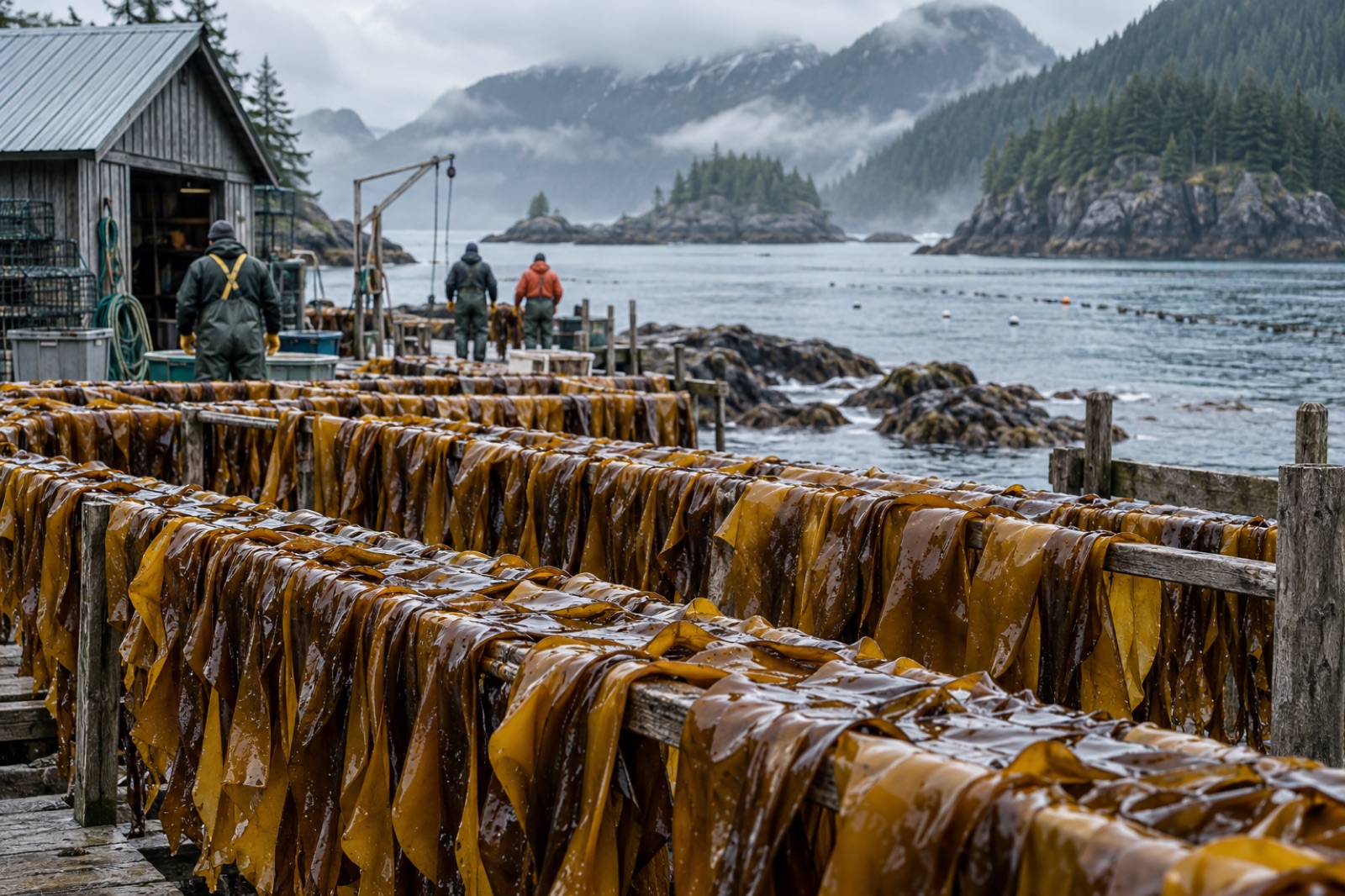
Every seaweed farmer knows the moment: the harvest window is closing, the boats are landing more kelp than the fresh buyers can take, and tomorrow's tide will bring more. Fermentation is the oldest answer to that problem — salt, time and microbes converting a perishable glut into a product that keeps, travels, and often tastes better than what went into the crock. For a farm or small processor, it is also a legitimate business strategy: a jar of kelp kraut can carry ten times the value per kilo of the blade that made it. This guide covers the production side — how seaweed ferments, how to design krauts, pickles and kimchis around it, what shelf life actually depends on, and where the food-safety lines are. For the home-kitchen versions of these techniques, our home guide to fermenting seaweed and kelp kimchi and kraut recipes are the starting points; here the question is how to do it at 500 jars a batch.
Why Seaweed Ferments Well (and Weirdly)
Lactic-acid fermentation — the engine behind sauerkraut, kimchi and traditional pickles — depends on three things: salt-tolerant lactic acid bacteria, fermentable sugars, and an anaerobic, salty environment that suppresses pathogens and spoilage organisms while those bacteria work. Seaweed supplies all three less perfectly than cabbage does, which is exactly what makes it interesting:
- Native microbes. Fresh seaweed carries its own microbial community, including lactic acid bacteria with real marine pedigrees — some commercial fermentation now uses starter cultures originally isolated from seaweeds themselves.
- Unusual sugars. Kelp's storage carbohydrates are dominated by laminarin and mannitol rather than the glucose of a cabbage. Lactic acid bacteria handle these, but fermentations can run slower and finish at different acid profiles than vegetable ferments; production recipes need real trialling, not assumptions ported from kraut practice.
- Prebiotic heft. Seaweeds are famously fibre-rich — alginates and fucoidans that human digestion leaves mostly alone and gut microbes enjoy — which is part of why fermented-seaweed products carry genuine, defensible interest from the nutrition side. On why kelp tastes profound once fermentation frees its glutamates, see the science of seaweed umami.
The "weirdly" part shows up in texture and iodine. Kelp ferments soften differently than vegetables do — alginates interact with acid in ways cabbage does not — and iodine content survives fermentation, which matters for labelling (more below).
Three Product Families Worth Building
Kelp krauts
Shredded kelp (often blended with cabbage, carrot or beet), dry-salted at roughly 2% by weight, packed anaerobically, fermented cool for one to four weeks. The seaweed fraction typically runs 20–50% of the blend — enough to bring brine depth and a mineral edge, not so much that sliminess dominates. Krauts are the easiest scale-up product: the process is forgiving, the ingredient list is short, and consumers already understand the category.
Seaweed kimchis and mixed ferments
Kimchi frameworks absorb seaweed gracefully — kelp or wakame blended into the vegetable mix takes up the seasoning paste and contributes the oceanic bass note that anchovy and shrimp pastes traditionally supply. This is the route for a plant-based kimchi with real depth, and it commands a premium as a differentiated product.
Brine pickles
Vinegar-acidified or naturally fermented whole stems and thicker blade sections — the crunchy end of the spectrum. Pickled kelp stems are genuinely good food: our recipe for pickled kelp stems shows the flavour logic. Production-wise, note the honest distinction: vinegar pickles are a preservation product with pH doing the safety work; fermented pickles are a biological product with a living process doing it. Both are legitimate; they demand different controls.
The Production Workflow, Step by Step
A sane small-scale line looks like this:
- Incoming raw material. Food-grade kelp from your own lines or a trusted supplier, handled to food-grade farm-gate standards — refrigerated fast, kept clean, harvested from water you have tested. Fermentation is not a rescue treatment for dodgy raw material; it amplifies whatever it starts with.
- Washing and preparation. Freshwater or clean seawater wash to remove epiphytes and grit, then shred or cut to spec. Blanching is a processor's choice: it softens, fixes colour and reduces microbial load — but it also reduces the native lactic bacteria you'll rely on, so blanched ferments lean toward starter cultures.
- Salting. Dry-salt at 1.5–2.5% by weight for kraut-style products, or pack into a calculated brine. Weigh everything; salt by feel is a home-kitchen luxury.
- Inoculation (optional but increasingly standard). A defined starter culture — typically mixed Lactiplantibacillus, Leuconostoc and Pediococcus strains — buys consistency across batches, faster acidification, and insurance against variable native flora. Wild ferments have romance; started ferments have repeatability. Commercially, repeatability pays.
- Fermentation. Vessel, weight, airlock; 15–20 °C for the primary ferment; monitor pH daily. You are looking for a pH below 4.0, commonly reached within days for a healthy ferment — and you are looking at numbers, not vibes. Log every batch.
- Cold storage and packing. When the target acidity is reached, chill to hold the ferment slow, pack into jars with headspace control, and refrigerate or pasteurise depending on your product design (live vs shelf-stable).
- Release testing. Before a batch ships: pH confirmation, sensory check, and the microbiological and contaminant testing your food-safety plan specifies.
Shelf Life: What Actually Decides It
Customers imagine fermentation as preservation magic. Processors know it as equilibrium management. Real shelf life depends on:
- pH and acidity. Below pH 4.0, pathogens of concern are effectively suppressed in a refrigerated anaerobic jar; this is your primary safety control and it is measurable to two decimal places for a few hundred euros of equipment.
- Temperature. Cold chain is still the master variable. A live ferment at 4 °C changes slowly and lives comfortably for months; the same jar on a warehouse shelf at 25 °C is a pressure vessel in slow motion, as living cultures keep producing CO₂.
- Live versus shelf-stable. You have two honest product designs. Sell live (unpasteurised, refrigerated, shorter date, "living culture" positioning) or pasteurised (heat-treated, ambient-stable, longer date, no live-culture claim). Vinegar-pickle routes are shelf-stable by acidity plus formulation. Decide before you design the label.
- Headspace and seal. Fermentation gas in sealed jars is a packaging engineering problem, not a mystery. Pressure-rated closures, adequate headspace and, for live products, venting features or pasteurisation-end ferment decisions are all standard resolutions.
Food Safety and Compliance: The Non-Negotiables
Fermentation's ancient reputation for safety rests on acid and salt doing reliable work — and it does, verifiably. But a commercial product must demonstrate that work rather than gesture at it:
- A written food-safety plan. Fermented products fall under standard food-processing regulation in most jurisdictions; you will need a hazard analysis (see building your seaweed HACCP plan) with critical control points at pH, salt and temperature.
- Heavy-metal and iodine testing. Seaweed concentrates what its water contains; arsenic species, cadmium, lead and iodine all require batch-level attention and honest labels. This is true for any seaweed product, but fermentation products raise consumption-frequency questions — customers eat kraut daily in a way they don't eat dashi kelp daily. Our heavy-metals explainer and iodine safety guide give the framing your label copy and your test lab both need.
- Identified strains if you claim them. If your marketing mentions live cultures, be prepared to say which, from your spec sheets.
- Traceability. Every jar traced to a batch, every batch to raw-material lots. Fermented food recalls get eaten by traceability paperwork; have it before you need it. The broader discipline is covered in seaweed traceability and certification.
The Economics of the Crock
The financial logic of fermented seaweed is strong: raw fresh kelp that might sell for a modest price per kilo converts, inside a jar with cabbage and carrots, into a product retailing at price-per-100-gram levels typical of premium condiments. Costs concentrate in labour, glass, cold storage and compliance. Margins are real, but they belong to farms that treat fermentation as a manufacturing activity with recipes, logs and controls — not as a homestead habit with a label printer. If you are weighing fermentation against drying or freezing as your value-add route, our comparison of post-harvest processing options prices the alternatives, and seaweed marketing covers how to position the finished jar.
Key takeaways
- Fermentation converts perishable seaweed gluts into high-value, long-lived products — krauts, kimchis and pickles are the three working product families.
- Seaweed ferments differently from vegetables: unusual sugars, native marine microbes and alginate textures mean recipes require real trialling.
- Weighted salt (1.5–2.5%), monitored pH below 4.0, and a fermentation temperature of 15–20 °C are the process spine.
- Decide early between live (refrigerated) and pasteurised (shelf-stable) product designs — it drives packaging, claims and shelf life.
- pH logs, batch traceability and contaminant testing are the difference between a food business and a hobby with jars.
- The economics reward manufacturing discipline: fermentation pays when run as production, not improvisation.
FAQ
Is fermented seaweed safe?
Properly fermented seaweed products are safe by the same mechanisms as sauerkraut — salt, acid below pH 4.0 and refrigeration suppress pathogens — provided the raw material came from clean, tested water and the process was controlled. For kelp specifically, iodine and heavy-metal content are the label-and-test issues; for the ferment itself, pH is the control point. Our sourcing guide covers the consumer side.
Can any seaweed be fermented?
Most culinary seaweeds can be — kelps, wakame, dulse and sea lettuce all ferment — but textures and flavours differ sharply. Tender blades (sugar kelp, wakame) ferment quickly and softly; thick stipes give fermenters their crunch. Very young, thin greens can go mushy and are often better dried than fermented. Trial small batches before committing a harvest.
How long does fermented seaweed keep?
A properly acidified, refrigerated live ferment comfortably keeps for several months, with flavour slowly deepening; a pasteurised or vinegar-acidified shelf-stable product can carry a date of a year or more. The bare answer, though, is: your own shelf-life testing decides your date code, and most food regulators will expect that evidence for commercial sale.
Do I need a starter culture?
Not strictly — wild ferments work on native microbes and have produced superb products. Commercially, though, a defined starter buys batch-to-batch consistency, faster acidification, and fewer failures; most producers we have worked with move to starters once volumes justify it, often keeping a "wild ferment" line positioned as its own product.
Does fermentation destroy seaweed's nutrients?
No — it transforms them. Fermentation reduces some sugars and antinutrients, frees glutamates (raising umami), and preserves fibre and minerals, including iodine. Some vitamins shift downward with processing, as with any food. The honest summary is that fermentation changes a seaweed's nutritional profile in mostly favourable ways rather than depleting it.