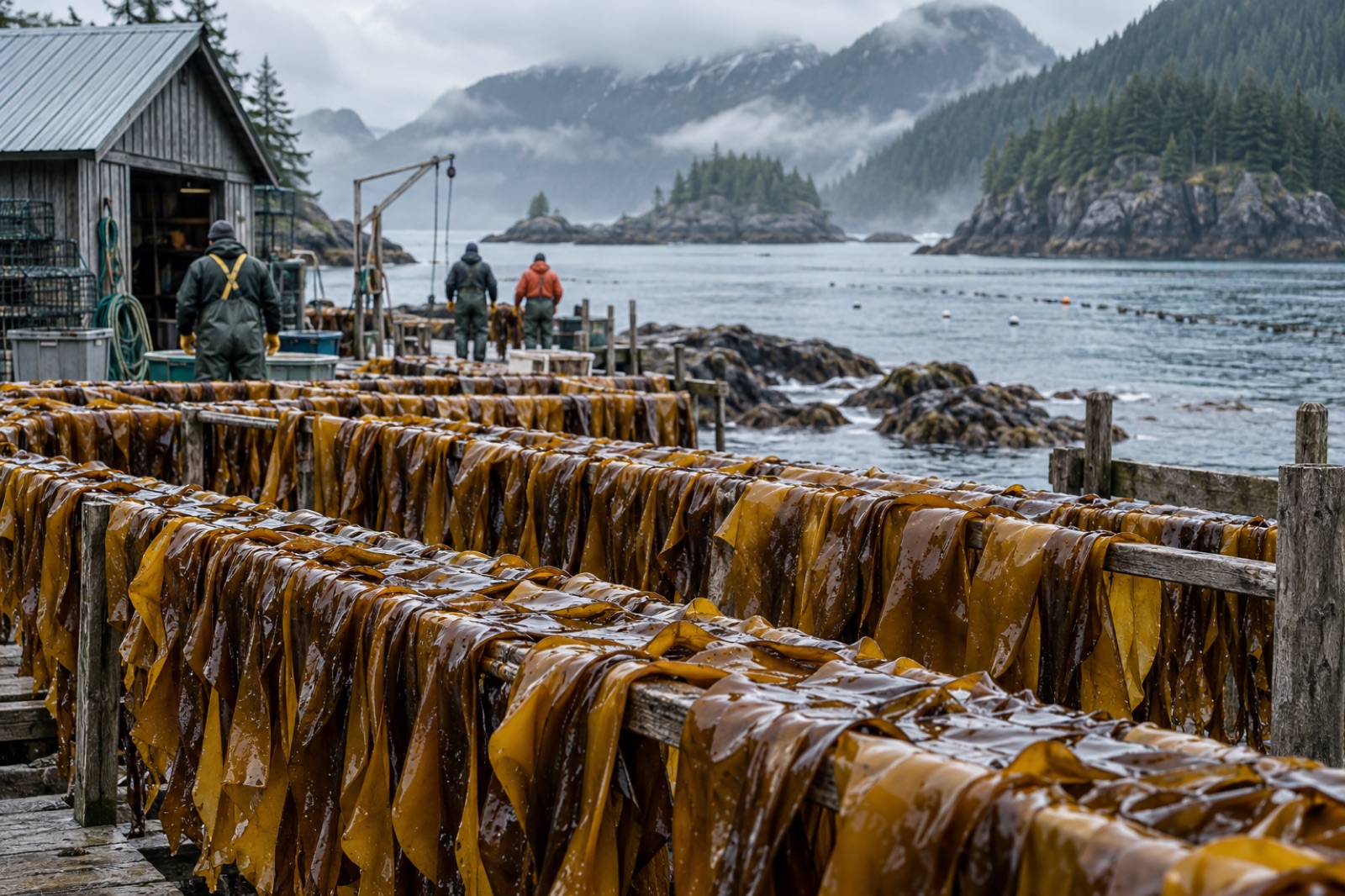
Frozen kelp slurry is fresh kelp that has been milled — usually within hours of harvest — into a thick, pourable pulp and then blast-frozen for storage. It is not a finished product so much as an honest answer to a hard problem: kelp deteriorates fast once it leaves the water, and most small farms cannot afford a dryer big enough to keep pace with a harvest window. Slurrying and freezing trades drying energy for cold storage, locks in heat-sensitive compounds, and gives a farm a stable intermediate it can sell, ship or process further when time and buyers allow. This guide walks through what slurrying actually involves, what it preserves well and poorly, and how to decide whether it fits your operation alongside drying, blanching and the other post-harvest routes.
Why stabilize at all
A kelp blade starts the process of becoming waste the moment the knife touches the stipe. Three clocks start running at once.
The first is enzymatic. Kelp tissue carries its own enzymes, and once cells are damaged — by cutting, crushing, even rough handling on deck — those enzymes meet substrates they were never meant to touch. Pigments oxidize and the blade browns. Alginates begin to break down. Flavour compounds shift from bright and marine toward hay and iodine.
The second clock is microbial. Seawater is a living broth, and kelp surfaces host a dense bacterial community. On the intact plant this community is kept in check; on a cut, warm, nutrient-rich blade it blooms. Within a day or two at ambient temperatures, slime and sour odours announce that the microbes have won.
The third clock is physical. Kelp is mostly water. Left in a pile it weeps, compresses under its own weight and creates anaerobic pockets that spoil fastest of all.
Every post-harvest method — drying, salting, ensiling, freezing — is a way to stop or slow these clocks. Drying removes the water microbes need. Salting and ensiling change the chemistry of the tissue. Freezing stops almost everything, provided you get the kelp cold quickly and keep it cold. Slurry sits squarely in the freezing family, with a twist: you mill first, which changes both what you can preserve and who will buy it.
What slurrying actually means
Slurrying is deceptively simple to describe: pass clean, drained kelp through a mill, cutter or industrial blender until you have a pulp with a particle size coarse enough to feel fibrous but fine enough to pump. In practice the details decide the quality.
The working sequence
- Cull and rinse. Remove fouled, grazed or bleached tissue and give the kelp a quick, cold, clean-water rinse to drop the surface bacterial load and wash off grit. Do not soak; kelp picks up water and loses soluble compounds.
- Drain thoroughly. Excess surface water dilutes the slurry and forms big ice crystals. Drained crates on racks for 30–60 minutes make a measurable difference.
- Mill chilled. Work in small batches directly from the chiller. Cutting warms the pulp through friction, so short runs with rests — or a feed of pre-chilled kelp — keep the slurry near refrigeration temperature. A coarse first pass followed by a finer second pass gives a consistent texture.
- Package thin and flat. Freezing speed is set by the thickest dimension. Bagging slurry in flat 2–5 kg pouches rather than buckets turns a many-hour freeze into a fast one.
- Blast-freeze, then store. Get the core of each pack below −18 °C as quickly as the freezer allows, and hold storage at −18 °C or colder for the life of the product.
Some processors add a brief blanch step before milling to knock down surface microbes and set the green colour — a trade-off worth testing, since blanching also leaches some soluble compounds and changes the slurry's aroma. There is no single right answer; there is a right answer for your buyer.
What freezing preserves — and what it doesn't
Freezing is the gentlest large-scale stabilization method for most of the compounds buyers care about. Frozen slurry retains pigments, vitamins, amino acids and the soluble fraction that gives fresh kelp its value in biostimulant and food applications far better than air-drying at high temperatures. The alginates and fucoidans that interest biostimulant formulators survive freezing essentially intact; it is heat and time, not cold, that degrade them.
Freezing is less kind to structure. Ice crystals puncture cell walls, and on thawing the slurry will weep liquid — drip loss — that no amount of stirring fully reintegrates. For a slurry destined to be extracted, fermented or blended into liquid products, that structural damage is irrelevant or even helpful: ruptured cells release their contents more readily, which is part of why frozen slurry is a favoured starting feedstock for biostimulant extraction. For any application that needs intact blades — salads, fresh pasta, displays — slurry was never the right format in the first place.
The other thing freezing does not fix is time lost before the mill. A slurry made from kelp that sat warm on deck all afternoon will be a slurry of tired kelp. Frozen storage is a pause button, not a rewind.
Slurry versus the alternatives
Every stabilization route is a different wager on your energy, your market and your season:
- Frozen slurry keeps chemistry excellent, demands milling equipment plus continuous cold storage, and suits buyers who will process further: biostimulant makers, feed mills, fermentation facilities, research buyers.
- Drying removes cold-chain dependence entirely and produces a light, shelf-stable product, but the dryer is a capital and energy commitment, and heat-sensitive compounds take a hit at higher temperatures. See the comparison in drying methods for seaweed.
- Salting is nearly equipment-free and robust, but suits fewer buyers and alters flavour and chemistry.
- Ensiling (acid fermentation) stabilizes bulk biomass cheaply at large volumes, but the product is firmly an input for feed or biostimulant, not food.
- Fresh on ice, described in the fresh kelp cold chain, wins on quality and price per kilo only when the buyer is within a couple of days of the wharf.
A sensible small farm often runs two routes: fresh-iced for premium food buyers within range, and frozen slurry as the pressure-relief valve for the rest of each tide's harvest.
Uses and buyers for slurry
The strongest established demand comes from biostimulant producers, who want high-quality raw kelp with intact actives and are accustomed to receiving frozen pulp. Abalone and sea urchin aquaculture operations — the same pairing explored in raising urchins on farmed kelp — buy frozen slurry as a convenient feed base that thaws and portions easily. Fertilizer and compost blenders, anaerobic digesters and university laboratories form a long tail of smaller buyers. Food-grade slurry, made under a food-safety plan with potable wash water and food-contact equipment, opens fermentation and sauce makers, but that market expects documentation, consistent specs and samples before contracts.
When you approach buyers, quote the slurry the way they think: solids content (percentage dry matter), particle size, species and origin, harvest date, freeze date, packaging format and the microbial and heavy-metal test results they will ask for anyway.
A practical small-farm setup
You do not need a factory. A working minimal setup for a few tonnes per season looks like this: a cool, washable room; a draining table; a floor-standing mill or heavy-duty cutter in the 1–5 kg-per-minute class; a bench scale, bag sealer and flat pouch stock; and either access to a blast freezer or a chest-freezer array dedicated to fast freezing of thin packs. Hygiene is the real equipment: food-safe surfaces, clean water, a washdown routine and a simple batch log that ties every bag to a date, a line and a crew. If you intend food-grade sales, fold the operation under your HACCP-style farm-gate plan from day one rather than retrofitting it.
Budget the cold chain end-to-end before you buy the mill: farm-site chill, refrigerated transport, freezer space at every handover. A slurry business dies at the weakest link in that chain — usually a warm hour on a dock.
Key takeaways
- Frozen kelp slurry is milled, quickly frozen fresh kelp — a stabilized intermediate, not a retail product.
- Its strength is chemistry: freezing preserves pigments, amino acids, alginates and fucoidans far better than hot drying.
- Its weakness is structure: ice crystals rupture cells, so slurry suits extraction, feed and blending — not whole-blade food uses.
- Slurry quality is decided in the hours before freezing: cull, rinse cold, drain well, mill chilled, freeze thin and fast.
- The natural buyers are biostimulant producers, abalone and urchin farms, feed and fertilizer blenders, and laboratories.
- Run frozen slurry as a complement to fresh sales and drying — a pressure-relief valve for the harvest window — and audit your cold chain before buying equipment.
FAQ
How long does frozen kelp slurry keep in storage?
Held at a constant −18 °C or colder in sealed, oxygen-limiting packs, slurry routinely keeps 12 months with only slow quality drift — gradual colour dulling and flavour flattening. Fluctuating freezer temperatures shorten that considerably, because partial thawing and refreezing grows large ice crystals and accelerates oxidation. Most sellers set a 12-month label life and aim to turn stock within six.
Do I need to blanch kelp before slurrying?
Not necessarily. Blanching (a brief hot-water dip) reduces surface microbes and locks a greener colour, but it leaches soluble compounds and adds a moist, warm step you must control. For biostimulant feedstock, most buyers accept unblanched slurry milled from clean, well-handled kelp. For food-grade markets, blanching can be a useful kill step inside a documented food-safety plan. Test both with your specific buyer and product.
What dry-matter content should a slurry have?
Kelp species vary, but blades commonly run somewhere around 10–20% dry matter by weight. What matters less than the number is consistency and a declared, testable specification: buyers of extraction feedstock plan their process around your solids percentage, so measure each batch and print it on the label.
Can I slurry a mixed catch of kelp and other seaweeds?
You can, but you shouldn't for commercial lots. Species differ in chemistry — alginate content, minerals, flavour — and mixing makes your spec meaningless and complicates food-safety and labelling obligations. Slurry one species per batch and label it precisely.
Is frozen slurry cheaper to make than dried kelp?
Per kilogram of finished product, slurry usually wins on energy: milling and freezing cost less power than evaporating most of the water out of kelp. But drying eliminates all future cold-chain cost, while slurry pays for storage and refrigerated transport forever. The honest comparison is slurry-plus-cold-chain versus dryer-plus-power, priced over the months until sale — and the answer shifts with your volumes, rates and buyers.