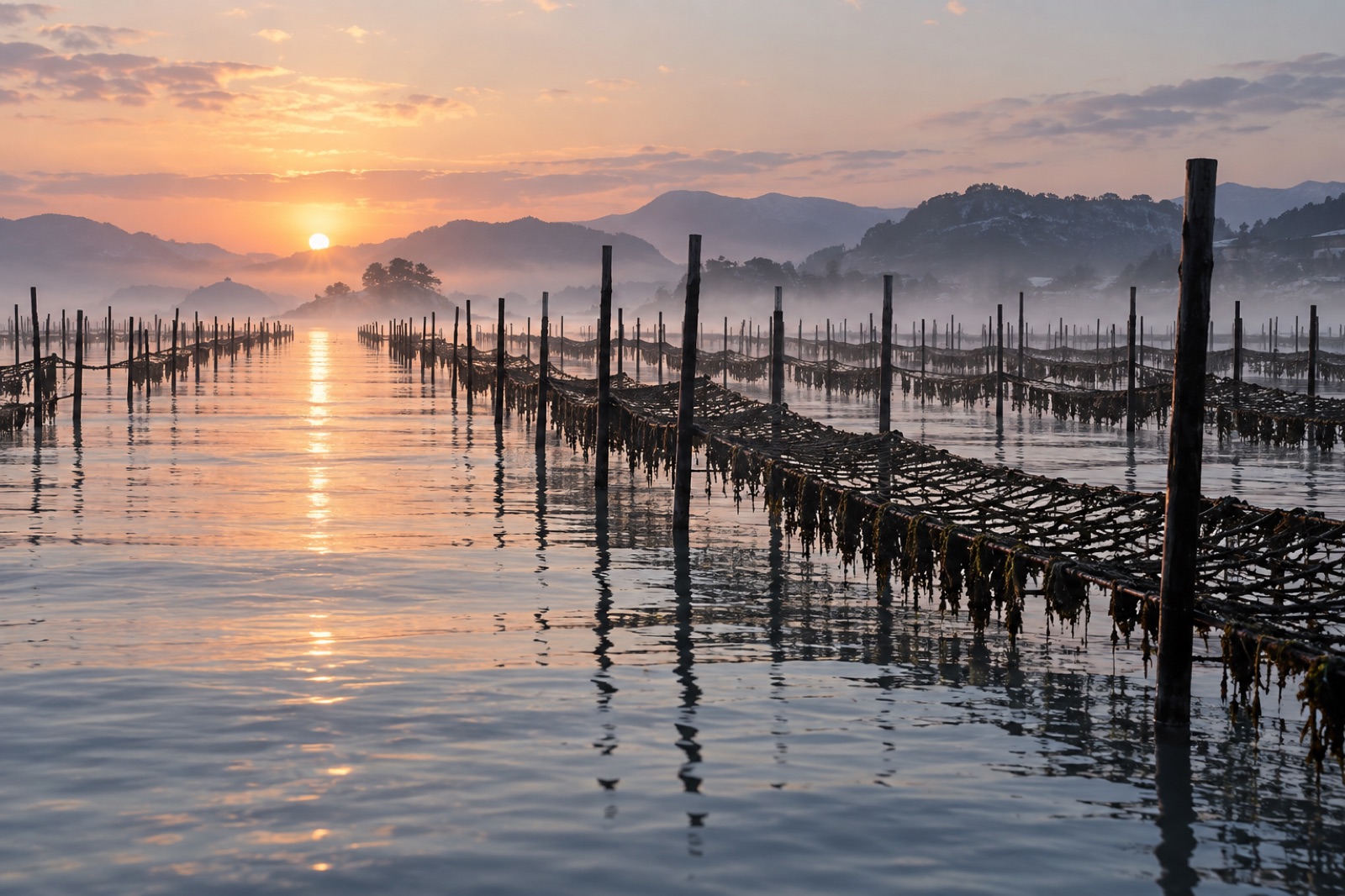
Pick up a sheet of roasted nori and you are holding one half of an organism. The other half never sees the ocean at all: it lives as a microscopic, pink filament bored into the shell of an oyster. Every commercially grown sheet of nori — the Pyropia species that wraps the world's sushi — is the visible generation of an alternation-of-generations so dramatic that, for centuries, farmers seeded the sea in total ignorance of it. Nori is the single highest-value crop in seaweed aquaculture by revenue, and its entire industry is an engineering monument to one small discovery about a hidden life stage. Here is how the two-stage life runs, and how East Asian farming built itself around it.
Fast facts
|
|
| Crops |
Pyropia yezoensis, P. tenera and relatives (formerly Porphyra) |
| Group |
Red alga — a blade-forming seaweed with a hidden filament stage |
| Life cycle |
Macroscopic blade (autumn–spring) alternates with microscopic shell-dwelling conchocelis (spring–summer) |
| Farming heartland |
Japan (Ariake Sea, Seto Inland Sea), Korea (southern coasts), China (Jiangsu coast) |
| Method |
Suspended nets seeded each autumn from conchocelis culture; blades harvested repeatedly through the cold season |
| Crop season |
Outplant September–November; harvest roughly November to April |
| Notable fact |
The industry exists because of one 1949 paper tracing the invisible half of the life cycle |
Two organisms in one species
The familiar nori blade is a wafer-thin frond, one or two cells thick, that grows on intertidal rocks in winter to sizes a hand-span long — nearly black when dried, reddish-olive alive, and famously delicious. The blade's spores, shed in spring as the water warms, do not grow into new blades. They grow into the conchocelis: a branching, filamentous, microscopic form that bores into the calcium carbonate of bivalve shells, barnacle plates and other calcareous rubble, where it persists through the warm months almost literally underground. In autumn the conchocelis filaments respond to cooling water and shifting daylength by producing conchospores, which are released from the shell, drift, settle on suitable surfaces — in nature, on winter rocks — and grow up as the blades of the next season.
The same two-generation architecture runs the kelp forests: our kelp life-cycle explainer covers the brown-algal version, where a towering sporophyte alternates with a microscopic gametophyte. In Pyropia the arrangement is mirror-image — the big generation is the edible blade, the microscopic one is the shell-borer — but the farming lesson is identical: control the small half and you control the crop.
Four centuries of farming blind
Coastal Japanese communities had gathered wild nori from rocks since antiquity; accounts place organised cultivation in Edo-period Tokyo Bay by the 17th century, where fishers discovered that bundle of bamboo or brushwood stakes driven into the autumn tidal flats soon sprouted blades. The method spread. What no one could explain was where the seed came from. Farmers seeded stakes by season and ritual and waited; some bays cropped gloriously and others failed. Spore-source mountains and short, furious autumn seeding seasons were matters of inherited practice without mechanism. Korea and China's laver fisheries lived in the same uncertainty well into the twentieth century.
The 1949 answer on the Other Side of the World
The mechanism fell to a British phycologist. Kathleen Drew-Baker, working on the humble British laver Porphyra umbilicalis, showed that the shell-boring red filament — long catalogued as an unrelated alga in its own genus, Conchocelis — was nothing other than Porphyra's other generation. Published in 1949, the finding reached Japan within a few years and converted overnight a superstition-managed fishery into a science-managed industry: if the seed lives in shells, then shells can be farmed, housed, counted, and deployed like any seed stock.
Drew-Baker never visited Japan, but Japan remembers her: she is honoured in farming districts with a memorial and an annual "Mother of the Sea" festival in Kumamoto, a rare global case of a research scientist woven into the ritual calendar of an industry she rebuilt from first principles.
The modern machine: shell culture to net
Commercial nori production follows the two-stage life with industrial precision:
- Spring: collect carpospores. Free-living blades from selected mother stock are induced to release spores in controlled tanks. The spores rain onto scrubbed, dried oyster shells — thousands of shells per cultivation house — and bore in.
- Summer: grow the conchocelis. The seeded shells are hung in shallow, shaded tanks of circulated, fertilised seawater. Temperature and light are run on calendars now described in the same terms we give for kelp in the gametophyte culture room: long-lit, warm summer months building filament biomass.
- Autumn: rush into seeding. Shortening days and cooling water trigger the filaments to form conchospore capsules. Hatcheries hang seeded shells under, or spray them against, thousands of square metres of synthetic net. Spore release peaks in the morning; seeding crews work the tides at first light to blanket the nets in settling conchospores before the release ends.
- Winter: blades at sea. Seeded nets go out to raft or pole systems in the bay. The first-flush blades come in weeks; the hand-grade first harvest, ichiban-tsumi, commands the highest price of the season. Cutter-and-suction boats reharvest the same nets every ten days or so as blades regrow, a management cadence not unlike the harvest timing logic of kelp.
- Repeat. A single net can yield four to eight cuttings across a cold season. Shells are retained for re-seeding, and surplus conchocelis can be dried or cold-stored as working seed insurance.
For the sea-phase machinery — raft layout, net grades, harvest vessels and drying — see our companion growing-nori production guide; the point here is that all of it hangs off that shell-culture biology.
Why the biology still decides everything
- Genetics live in the shell. Breeders maintain conchocelis strains the way kelp hatcheries bank gametophytes. Clonal, shell-farmed conchocelis gives uniform, heritable blades with known colour, blade-thickness and harvest quality the way wild intertidal seed never could — the same logic behind the seed-string production discipline on kelp farms.
- Disease lives there too. The most destructive nori diseases — red-rot and Olpidiopsis blights — run through dense conchocelis houses and blade masses. A summer's hygiene failure in the shell tanks becomes a winter's ruined nets.
- Climate schedules the system. Warm autumns delay conchospore release; warm winters cut harvests short and invite grazers and fish to the nets. The Ariake Sea's variable recent winters have forced the whole region's seed calendar later, a quiet, ongoing act of climate adaptation by the entire industry.
- Scale follows shells. China and Korea scaled production into the billions of sheets annually not by finding new bays but by industrialising the seed stage — big, closed, shell-culture houses trump bigger coastlines.
Key takeaways
- Nori is Pyropia: a macroscopic, edible, autumn-and-winter blade alternating with a microscopic, shell-boring filament called the conchocelis.
- Japanese farmers managed blades for centuries without knowing where seed came from; Kathleen Drew-Baker's 1949 life-cycle proof turned nori superstition into modern aquaculture.
- Industrial production seeds oyster shells with carpospores in spring, grows conchocelis in shaded tanks through summer, and uses autumn conchospore release to seed nursery nets.
- Winter nets are reharvested on roughly a ten-day rhythm; the first cut is the premium grade, and the whole season is a race between regrowth and warming water.
- Genetics, disease and climate all exert their leverage through the hidden shell stage — which is why the nori industry runs on hatcheries, not boats.
FAQ
What exactly is the conchocelis?
The microscopic, filamentous generation of Pyropia. In spring, blade spores settle onto calcareous material — in farms, oyster shells — and grow into branched filaments that literally bore into the shell, carrying the species through the summer heat that kills the blades. In autumn those filaments release conchospores that grow into winter blades.
Who discovered the nori life cycle?
British phycologist Kathleen Drew-Baker, in 1949, demonstrated that the shell-boring alga "Conchocelis" was the alternate generation of the British laver. Japanese growers applied her result to Pyropia within a few years and built the modern industry on it. She is honoured in Kumamoto as the Mother of the Sea.
Why do farmers use oyster shells?
Shells are a clean, abundant, calcareous substrate the conchocelis can bore into. They are cheap, scrubbable, stackable in tanks, easy to move to seeding sites, and hangable below nets during autumn conchospore release so the spores drift straight onto the twine.
How long is the nori growing season?
Roughly September through April. Shells are seeded in spring; nets go to sea in early autumn; blades are cut repeatedly through the cold months; everything comes home before the water warms enough to end growth and favour disease and grazers.
Is nori the same as laver?
Close — laver is the older English name for the same seaweed group, particularly the Atlantic species eaten in Wales as laverbread. Nori is the cultivated East Asian Pyropia crop; laver is the wild-harvested northern-Atlantic relative. The biology of alternating blade and shell phases is shared across the genus.