Farming8 min read
Growing Kombu: Lessons from Japanese Aquaculture
Kombu farming is a century-old Japanese craft: forced cultivation, floating rafts, staggered harvests and sun-drying discipline, explained for growers.
Naomi Reyes ·
How nori is really farmed — the hidden conchocelis phase, shell-boring nurseries, pole-and-line nets, winter harvests and the grading that sets the price of every sheet.
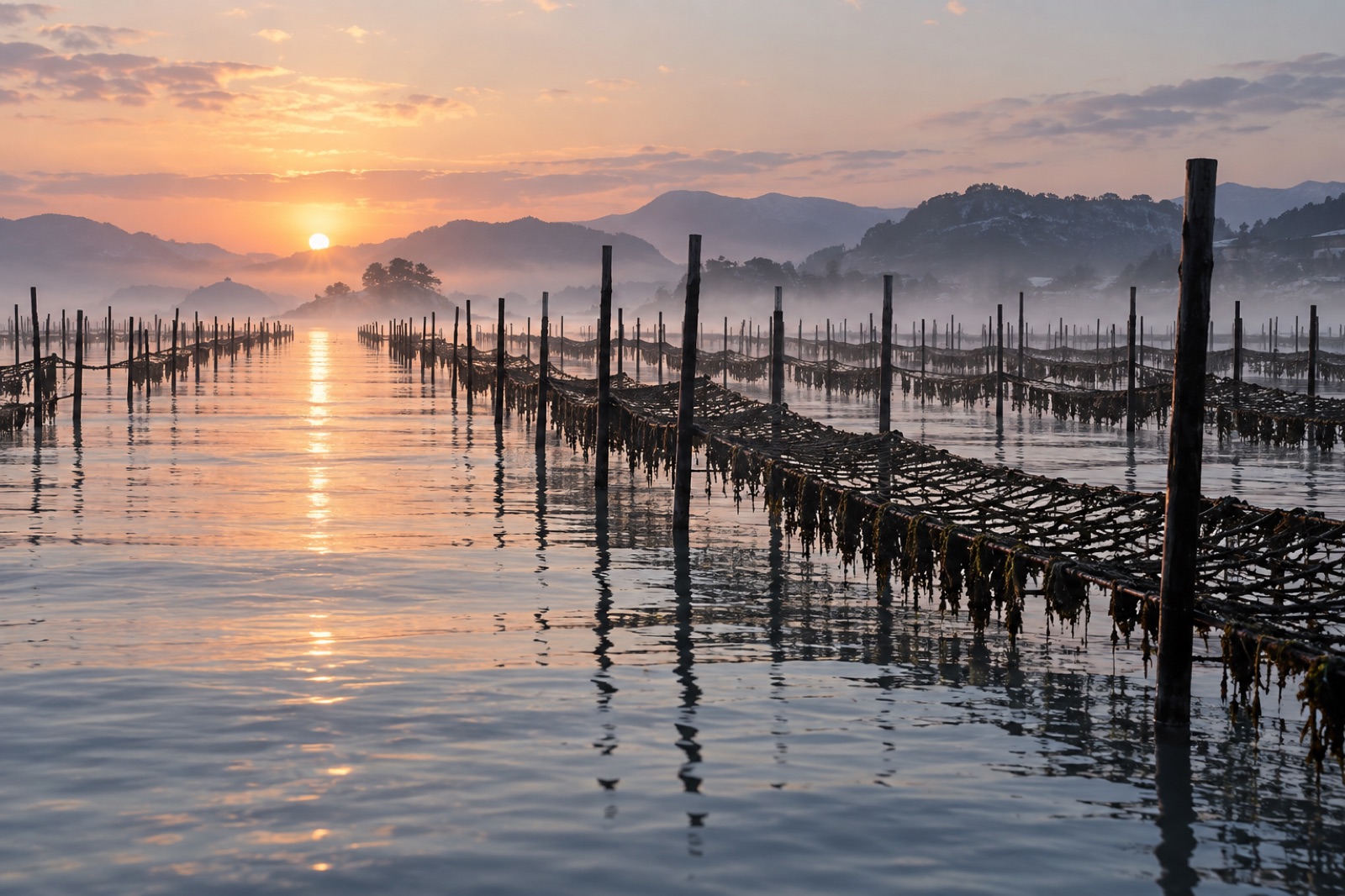
Nori is the most valuable farmed seaweed on Earth by some measures — the crisp, paper-dark sheet wrapped around a trillion sushi rolls a year — and it is grown by one of the strangest production systems in all of aquaculture. The crop that farmers harvest in winter is only half the organism. The other half is a microscopic, shell-boring pink crust that lives unseen through the summer and seeds the nets in autumn. Understanding nori farming means understanding both lives, and the seasonal choreography that moves the crop between them. This guide walks through the whole cycle: the conchocelis nursery, net seeding, the growing season, harvest and the grading that decides what a sheet is worth.
If you know nori only as a species account, start with our nori species profile; this article is about the crop.
Almost every seaweed farm grows the life stage you can see — the blade, the frond. Nori farming is different because Porphyra (and its relatives now placed in Pyropia and other genera) has an alternation of generations as dramatic as anything in the ocean:
The blade produces cells that settle and bore into shells to become conchocelis; the conchocelis, triggered by autumn's cooling water and shortening days, releases conchospores that settle on nets and grow into blades. The farm's year is built entirely around moving the crop through this loop.
The nori "hatchery" — a ubiquitous feature of nori-growing coasts in East Asia — is a building full of shallow tanks holding thousands of oyster or clam shells. The sequence:
Growers read the shells constantly in autumn: mature filaments under a hand lens determine the seeding day. Weather, water temperature and shell condition all feed the decision, because a release triggered into water that is still too warm wastes the year's seed.
Nori is grown on nets, not ropes. A nori net is a coarse mesh — traditionally around 15 cm squares, synthetic twines today — stretched on frames or strung between poles, offering enormous surface area for millimetre-scale spores to grip.
Seeding happens in autumn when coastal water drops to the appropriate range (growers watch it by the tenths of a degree). The conchospore-laden water from nursery tanks is applied to nets — in modern operations by running nets through seeding baths or spraying spore suspension over stacked, slowly rotating nets indoors, so settlement density is even and measurable. Seeded nets are then taken to sea and deployed within days.
Stocking density is a real craft variable: too sparse wastes net area; too dense crowds the young blades and degrades final sheet quality. This is the nori equivalent of seeding density on kelp lines, and the trade-offs are similar.
Three layouts dominate:
Site selection follows the same fundamentals as any seaweed crop — depth, current, nutrients, exposure — with the added demand of clean water, since nori is a premium food product; see choosing a farm site for the general framework.
Nori inverts the kelp calendar. Blades grow through the cold months, and first harvest typically comes six to eight weeks after netting, with the same nets then cropped repeatedly — every couple of weeks in good conditions — through winter into spring. Each pass takes the longer blades and leaves the younger growth; a single net may yield eight or more cuts across a season.
Winter farming brings its own management:
Because product quality declines as the season warms, the best-priced nori is the earliest: the pale, tender, fragrant first cuts. Late-season blades are darker, thicker and coarser, and go to lower grades.
Nori is harvested by boat-mounted suction cutters that work along the nets like aquatic combine harvesters, pumping shredded blade aboard. From there, everything is speed and cleanliness — the raw material is highly perishable, and seaweed post-harvest processing discipline applies in full.
Processing is almost entirely mechanised and looks remarkably like paper-making:
Because the raw blade colour, texture and aroma vary by cut and season, grading is where farm skill becomes price.
In the world's largest nori markets, most sheet production moves through centralised auctions, where licensed buyers grade lots by colour (deep, even, glossy near-black is prized), lustre, aroma, texture and how finely a sheet melts on the tongue. Price spreads between top and bottom grades are wide — multiples, not percentages — and early-season "first-picked" lots command the premiums.
For growers outside those auction systems, the grading lesson still holds: nori is sold on quality, not tonnage, and quality is set by water quality, seeding density, cut timing and gentle handling — not by fertiliser or feed. Seaweed quality grading covers the underlying metrics buyers test.
Yes, and people do — the native species and the climate windows exist along cold-temperate coasts in the North Atlantic and the Pacific Northwest, and small growers supply regional food markets. The honest constraints:
At Tidewright, nori sits outside our core restoration work, but the same nursery principles — controlled early life stages, local genetics, and a crop that funds the coastline it grows on — run through our Holdfast hatchery programs and restoration-adjacent seaweed farms.
The microscopic, shell-boring life stage of nori — a pinkish filament network that grows inside mollusc shells through summer. In autumn it releases conchospores, which are seeded onto nets and grow into the edible blades. Without managing this phase, nori farming at scale is impossible.
British phycologist Kathleen Drew-Baker demonstrated in 1949 that Porphyra alternates between the blade and a shell-dwelling filament phase. Her discovery enabled controlled seeding and is credited with transforming Japanese nori aquaculture.
Through the cold months — typically six to eight weeks after autumn net-seeding, with repeated cuts every couple of weeks into spring. The first, youngest harvests of the season are the tenderest and most valuable.
Daily tidal exposure (or mechanical lifting) dries out fouling diatoms and weed spores that would otherwise smother the crop. Nori is intertidal by nature and tolerates the exposure that kills its competitors.
Yes — native Porphyra species grow on those coasts, and small commercial operations exist. The main hurdles are the shell-culture nursery, access to seeded nets, permits, and competing in a market that rewards extremely consistent quality.
Kombu farming is a century-old Japanese craft: forced cultivation, floating rafts, staggered harvests and sun-drying discipline, explained for growers.
Naomi Reyes ·
Where farm kelp seed really comes from: buying from hatcheries, permitted wild sorus collection, provenance rules, quality checks and ordering lead times.
Dr. Elias Brandt ·
What to do with freshly harvested kelp: a practical comparison of drying, blanching, freezing, fermenting and milling — shelf life, quality, cost and best-fit markets.
Naomi Reyes ·