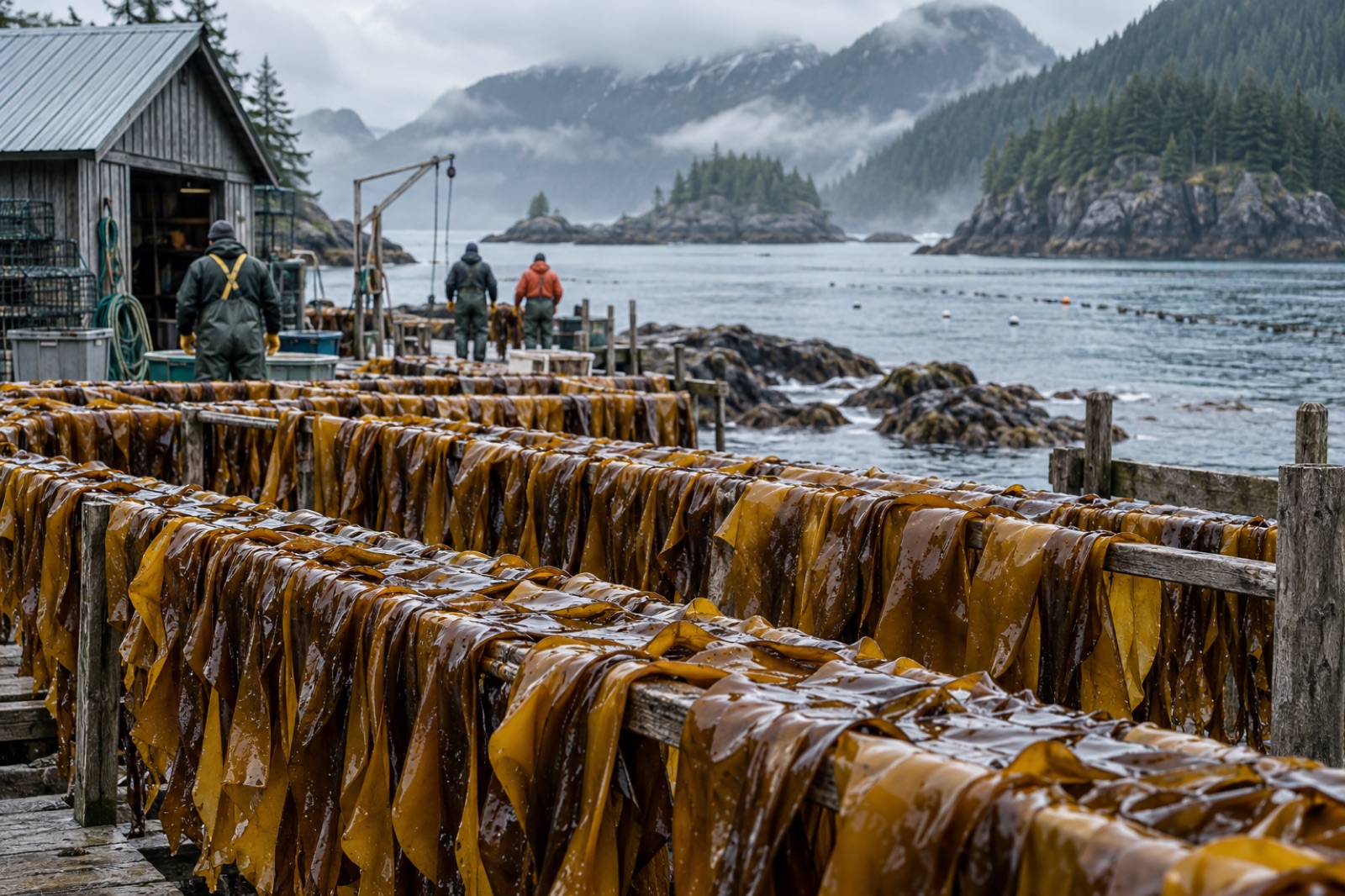
Ask a kelp processor what drying does and you will get two answers that sound like different operations. Drying stabilises the crop: drops water activity below the spoilage threshold, collapses transport weight, makes shelf storage possible. Drying also changes the crop: bleaches and darkens pigments, fixes or destroys aroma, shifts iodine and vitamin retention, changes how the blade rehydrates, and can convert a premium food product into a feed-grade mulch in one overheated afternoon. Choosing a drying method is therefore not an equipment decision. It is a quality-preservation decision with a throughput constraint attached. This guide works from the quality side: what each method does to the product, and how to match method to the market you actually sell into. For a straight head-to-head of the machinery itself, see the companion comparison of dryer types.
What "quality" means at the dryer
Before the method, the metrics. Four quality axes dominate every drying conversation:
Colour and bloom. Food buyers — especially the kombu, wakame and nori trades — read colour first. Pigments are thermally and oxidatively fragile: the brown fucoxanthin of a kelp blade darkens and bronzes under heat and long exposure, chlorophyll breaks, and red-algal phycoerythrin is extremely light- and heat-sensitive. Fast drying at controlled temperature keeps the colour of the fresh blade; slow, hot drying moves every product toward dun-brown uniformity.
Flavour and aroma. The signature top-notes of dulse, wakame and good kombu live in volatile compounds driven off by high temperature and prolonged air exposure. Low-temperature air drying preserves more of the fine aroma of the blade than a hot drum pass — one of several reasons traditional beach drying of kombu survives in Hokkaido as a premium process rather than as anachronism.
Nutrient and bioactive retention. Iodine volatilises progressively with temperature and time; heat-labile vitamins degrade on the same curve. Ironically, moderate iodine loss is sometimes a feature: buyers formulating kelp powder cautiously want predictable, moderate iodine, and documenting drying conditions is how a farm delivers it. Fucoidan and laminaran bioactivities, by contrast, are degraded by prolonged heat exactly the way supplement-grade extraction teaches — the wellness market pays for low-temperature handling and punishes hot-dried feedstock.
Safety at the moisture floor. All drying roads end at a finished moisture low enough to hold mould and bacteria dormant — conventionally around the ten-to-fourteen-percent band for equilibrium shelf safety in whole-blade kelp, lower for powder destined for long ambient storage. The drying method's job is to reach that floor fast and evenly, without overdrying the surface into case-hardening while the core stays wet — the classic failure that rots bales from the inside three weeks after a "successful" dry.
The methods, judged by quality
Sun and open-air drying
Sun and wind drying is the reference standard for flavour and tradition: no fuel, no fan noise, photonic finish. Quality-wise it preserves aroma well because drying is driven at ambient temperature — blades never see a hot wall — but it is slow and weather-dependent, and UV exposure is a double-edged instrument: a day of bright sun bleaches surface pigment and generates the pale, waxy bloom prized on the best kombu; three days of intermittent cloud and drizzle can leave surfaces oxidised and dull.
The quality problems are uniformity and the night. Dew rewettes unfinished blades, turns the slow-drying risk into a fermenting risk, and exposes surfaces to sporulation-grade moulds. Open-air drying is defensible for premium whole-leaf products in climates with reliable drying windows; it is the wrong tool anywhere the weather can sit on a batch for twelve grey hours.
Solar-tunnel and shed air drying
The greenhouse tunnel or open-ended drying shed is the small-farm sweet-spot: solar gain raises the temperature a few degrees above ambient, airflow moves through open ends, and the roof removes weather risk overnight. Quality consequences sit between sun and oven: some UV bleaching, some accelerated drying at only modest heat, and crucially, dew-free nights. This method preserves quality nearly as well as open sun for flavour-critical products while behaving like machinery for scheduling. It is the default upgrade path from beach drying.
Oven and cabinet (forced-air) drying
A controlled cabinet running low-temperature forced air — typically in the 30 to 45 °C band for food kelp — is where consistency begins. Temperature stays below the point where non-enzymatic changes accelerate, fins/food-grade airflow pushes moisture off fast, and batch after batch lands at the same endpoint. Cabinet-dried kelp trades some of the open-air aromatics for repeatability, colour control and complete weather immunity. It is the workhorse method for food powder, flake and culinary whole-leaf operations, and the point where grading systems for dried kelp become operable — you cannot grade what you cannot reproduce.
The failure mode is over-enthusiasm: operators who dial toward 60 °C to push throughput move colour, flavour and iodine profiles simultaneously, and buyers notice. Low and long beats hot and fast for anything sold on culinary quality.
Drum and rotary hot-air drying
At industrial scale, hot-air drum and belt dryers turn wet kelp into dried flake at tonnes per hour. Quality-wise these are instruments of trade, not preservation: high throughput at the cost of moderate heat exposure and significant aroma loss, which is acceptable because the products are industrial — alginate feedstock, feed meal, soil inputs, biomass for extraction — where polymer yield and ash, not aroma and bloom, set price. The critical quality variable shifts from blade presentation to moisture uniformity and fibre length after drying. Drum-dried feedstock can be excellent industrial raw material; it is the wrong tool for anything a chef will ever open.
Freeze-drying
At the extreme of quality preservation, freeze-drying (freezing wet kelp solid, then pulling moisture out as vapour under vacuum) retains colour, aroma, cell structure and heat-labile nutrition as no heated method can. Blades emerge light, porous, candy-store vivid and instantly rehydrating. The economics are brutal — energy cost per kilo dwarfs any alternative — but for high-value nutraceutical kelp, small-lot premium food, and research reference material, it is the standard against which every other method's quality is measured.
Matching method to market
Quality-first means market-first. The decision tree in practice:
- Whole-leaf culinary (kombu, dulse, wakame equivalents) — sun, shed or solar tunnel in reliable climates; cabinet at low temperature elsewhere. Priority: colour, aroma, rehydration quality.
- Flake and powder for food — low-temperature cabinet or belt. Priority: uniformity, microbiology, consistent iodine, fine-mill quality.
- Supplement and nutraceutical feedstock — freeze-drying at the premium end, low-temperature cabinet otherwise; never hot drum. Priority: bioactive retention and mineral profile.
- Biostimulant, feed and industrial feedstock — drum or belt at throughput. Priority: moisture, ash, fibre consistency — see how downstream pipelines like biostimulant extraction actually specify their inputs.
- Emergency salvage drying — whatever reaches the moisture floor fastest. A salvaged batch at feed grade beats a moulded batch at no grade.
Operating discipline whatever the method
Across every method, the same few disciplines protect quality:
- Start fast. The highest-leverage dry-hours are the first ones, when surface water flashes off and spoilage organisms are still multiplying. Anything that delays the start of drying — distance from landing, queue at the dryer, a rainy commute — costs more quality than any dialling of temperature.
- Verify finished moisture, don't assume it. A cheap moisture meter or a simple oven-dry test of a measured sample is what separates a documented food-safe batch from a hopeful one. Quality testing at the farm gate starts here.
- Cool before baling. Warm-dried kelp baled hot sweats its residual moisture into the bale core. Cool the batch fully before packaging.
- Store dry what you dried dry. Drying is only stabilisation if the store maintains it: sealed, dark, low-humidity storage with desiccant discipline covers the back half of the process, the subject of storage rules for dried seaweed from the pantry side.
Key takeaways
- Drying is simultaneously stabilisation and transformation: every method trades speed and throughput against colour, aroma, nutrient retention and blade quality.
- Open sun drying preserves flavour at the price of weather risk; sheds and solar tunnels keep most of that quality while removing the night-dew gamble.
- Low-temperature cabinet drying is the workhorse of reproducible food-grade kelp; hot drum drying is a throughput instrument for industrial feedstock, not a quality tool.
- Freeze-drying is the quality reference — at economics that confine it to the premium and nutraceutical end.
- Whatever the method, quality is protected by the same disciplines: start drying fast, verify finished moisture, cool before baling, and store the product as carefully as you dried it.
FAQ
Why does hot drying hurt food-grade kelp so much?
Heat accelerates non-enzymatic browning and drives off the volatile compounds responsible for aroma. Above roughly 50–60 °C the chemistry outruns the drying: blades bronze, top-notes vanish, and heat-labile micronutrients fall. Culinary grades therefore run in the 30–45 °C band and accept longer drying times.
How do I know when a batch is done?
By measurement, not feel: a target finished moisture in the low double digits for whole-leaf, verified with a moisture meter or a simple oven-dry of a weighed sample. Blades that snap cleanly are a good day-to-day proxy; the meter is the record the buyer wants.
Is sun-dried kelp nutritionally inferior to machine-dried?
Not reliably. Sun drying is cool drying, so heat-labile compounds survive well; the losses are oxidative and light-driven (surface pigments, some light-sensitive vitamins), plus the weather risk of spoilage. A well-run sun-dried batch matches a low-temperature cabinet batch on most nutritional axes.
Can one farm economics support two drying systems?
Yes, and many do: a solar tunnel for the weather-reliable shoulder season and a low-temperature cabinet for wet spells and high-value lots. The splitter is product class — culinary whole-leaf and premium powder in the gentle system, any industrial or salvage drying in the hotter system.
What is case-hardening, and how do I avoid it?
Case-hardening is when hot fast drying seals the blade surface into a hard, impermeable skin while the core stays wet — the batch then rots from inside in the bale. Avoid it with lower temperatures, thinner loads, and air that moves, and verify core moisture on the thickest blades, not the thinnest.