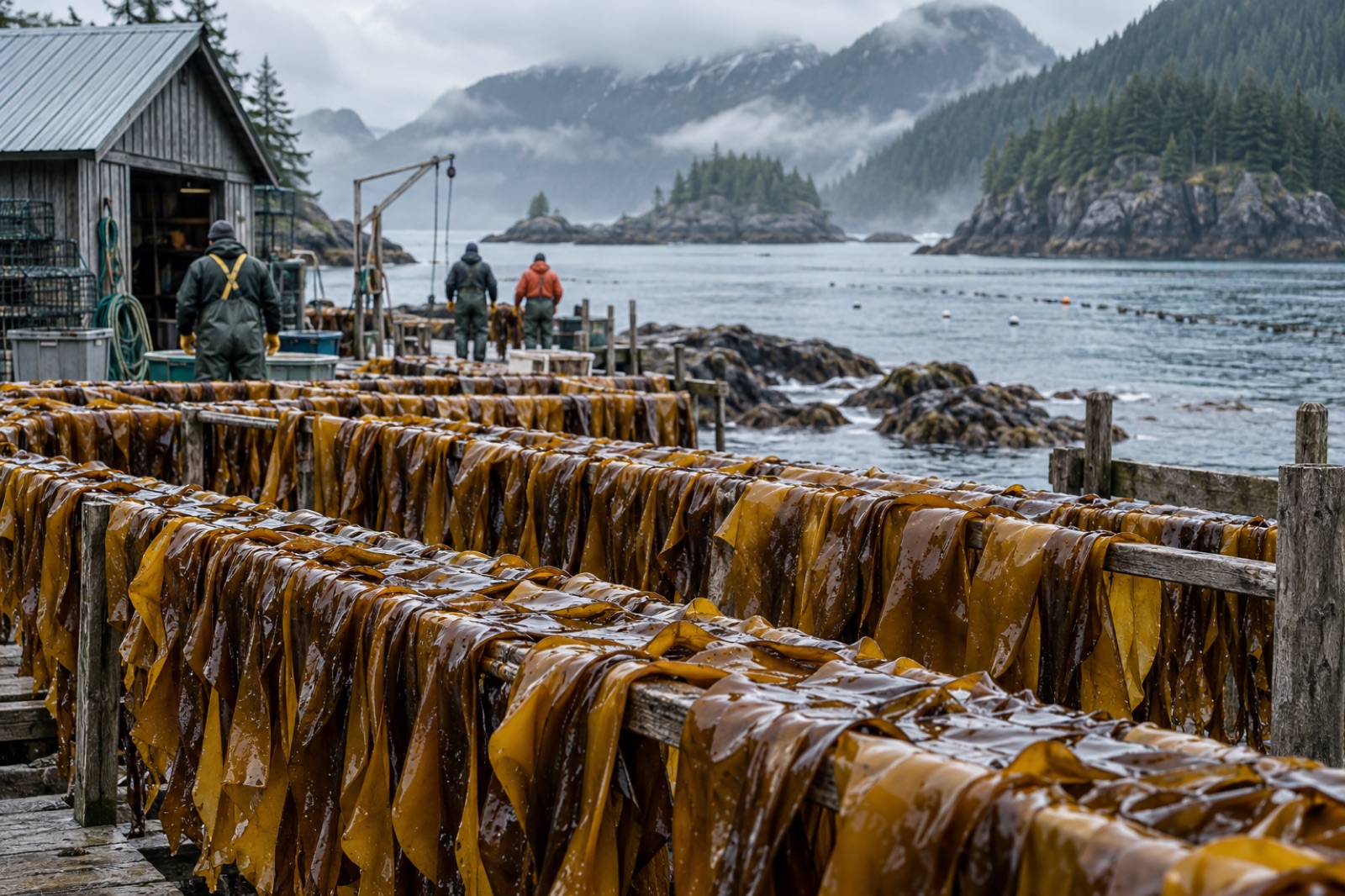
Long before a kelp farm had a dryer, a spreadsheet or a cold chain, it had weather and a beach. On the coasts of Hokkaido, fishing families still spread summer-harvested kombu over clean, rounded stones by the hundreds of tonnes, turning the blades by hand as the wind does its slow work — beaching and sunning is the step that gives top-grade dashi kombu its pale bloom and deep flavour. In Brittany, the Hebrides and coastal Ireland, families cured tangle and wrack on field-edge walls and line rails the same way for centuries. For a small farm working with seasonal weather, low capital and weekend crews, small-scale and beach drying is not nostalgia. It is the cheapest path from wet harvest to shelf-stable product — provided you respect the few rules that separate clean cured kelp from a mouldy write-off.
Why drying at all?
Fresh kelp is roughly 85–90 percent water. Left wet after harvest, microbial spoilage starts within hours, and every hour counts against you: discolouration, sliming and off-odours are all traceable to the window between cutting and stabilisation. Drying brings water activity below the threshold at which spoilage organisms are comfortable, collapses transport weight by an order of magnitude, and produces a product that stores for years if kept dry. It is the single highest-leverage step in the small-farms post-harvest chain. Everything else — blanching, freezing, mincing — either depends on it or substitutes for it.
For a half-hectare farm producing perhaps one to five tonnes of wet kelp a season, industrial drying is rarely worth the capital or the fuel. Sun, wind and patience can do the whole job. The limits are real: sun drying depends on weather you do not control, and very large blades dry unevenly if laid wrong. But a small crew with a weather eye can produce excellent results with nothing more than clean ground, good exposure and discipline.
Beach drying, the Hokkaido way
The modern beach-drying tradition is swiftest learned from Japan's kombu boats, because the method is systematic rather than casual.
Choose the ground
The drying bed is everything. Classic Hokkaido practice uses smooth, rounded pebble beaches just above storm line: the pebbles keep blades off sand and dirt, let air move underneath, and drain fog and dew quickly. A modern small farm can recreate the same function with raised mesh racks — old fish-farm netting stretched over timber frames — or with a clean gravel pad behind a windbreak of beach logs. What you are avoiding is fine sand (it embeds in the blade texture and is impossible to test out of the finished product) and bare soil (contamination, and moisture migration upward overnight).
Lay blades flat, turned regularly
Kombu is laid flat on the pebbles, blades single-layered, at first light. The rule of thumb from Hokkaido's kombu coast: blades are turned every hour to two hours for the first day, and covered or gathered if rain threatens. The goal is even moisture loss from both faces, with no folding, no stacking and no contact between adjacent blades. Thinner kelps — sugar kelp, winged kelp, young bull kelp — dry faster and can sometimes be finished in a single long, dry day; thick stipe material may take two or three days of weather.
Read the air
The farmers' term is "good drying weather" — a combination of sun, moderate wind, and low humidity. A warm, dry day with a light sea breeze will finish kombu in six to eight hours of exposure; a cool, still, humid day can leave blades at danger-zone moisture all afternoon and invite the problem every beach-drier has learned to dread: overnight condensation. Blades that haven't passed the safe handling threshold by evening get gathered or covered, not left to dew.
Line and rack drying
Where beaches are wrong — sandy coastlines, surf zones, or regions with strong tidal wash — the same logic moves onto racks and lines. Blades are hung over lines or draped on horizontal racks so that air moves across both faces and nothing touches the ground.
Line drying is the traditional method for wakame and for Atlantic winged kelp, and it suits small boats and pier-side operations especially well. In the Scottish islands, winged kelp and sugar kelp are hung over line rails under open-sided sheds, and finished in one to three days of west-coast wind. The shed matters: it keeps off rain while admitting the breeze, and in a wet climate it is the difference between success and failure. A simple tarped tunnel or polytunnel with the ends open is a perfectly good modern replacement.
Rack drying on stacked mesh racks suits thalli that would stick to lines: short kelp pieces, dulse, laver, and the blades of sea cabbage and similar kelps. Racks can be built cheaply from treated timber and aquaculture mesh, stacked with ten to fifteen centimetres of air gap between shelves, and moved around to follow the sun.
The rules that can't be skipped
Small-scale drying is forgiving of everything except a short list of mistakes, and a farm-imposed discipline list makes the difference between heritage and hazard:
- Wash before you dry, never after. Rinse harvested blades in clean seawater to remove sediment and biofouling; fresh water at this stage leaches salts and slows drying, but clean seawater is heritage-correct and safe.
- Never let raw product touch soil, road dust or livestock. Contamination at the drying bed is the classic cause of a failed food-grade inspection.
- Single-layer, no stacking. Stacked wet blades heat, ferment and discolour into a low-grade product within hours.
- Manage the night. Blades not fully dried by dusk move under cover or under tarp. Overnight dew rehydates surfaces and restarts microbial clocks.
- Don't overdried. Over-brittle kelp sheds fragments, and over-sunned dark kelps lose colour and top-note flavour. Blades are done when they snap cleanly and feel leathery-brittle, not crumbly.
- Log everything. Drying bed, weather, turn times, finished moisture: this is the paperwork that turns a good batch into a documentable food-safe batch for buyers and for HACCP traceability.
Where small-scale drying fits the modern farm
The honest use-case for beach and rack drying is the seasonal, sub-ten-tonne producer selling into food, craft and agronomic markets where the buyer accepts whole-blade or rough-cut product. Dried kombu, dulse, winged kelp and small sugar kelp all do beautifully. Very thick species like bull kelp stipe do not: they rot at the core while the surface dries, and need splitting or slicing before sun-drying, which is where the method tips over into a processing question covered by systems like oven, solar and drum drying.
For restoration-adjacent farms — the kind of operation Tidewright designs around its project sites, where harvest revenue must be steady and honest — small-scale drying has a second virtue: it is cheap, local and legible. A farmer who can dry kelp on the back shore can hold price when the fresh-spot market is flooded, can stabilise a glut at the season's flush, and can turn a weather-delayed landing into a dried batch rather than a loss. It is the oldest and, at that scale, still the smartest insurance the crop has.
Key takeaways
- Drying is the decisive preservation step for kelp: it arrests microbes, collapses weight, and makes year-round shelf storage possible.
- Beach drying on clean rounded pebbles — the Hokkaido kombu method — produces premium whole-blade product with nothing but sun, wind and labour.
- Line and rack drying suit sandy coasts, wet climates and finer species; an open-ended shed or tunnel converts unreliable weather into a workable process.
- The hard rules are few but absolute: clean substrate, single-layer, turn frequently, shelter at night, and stop at clean-snapping rather than crumbly brittleness.
- For sub-ten-tonne small farms, beach and rack drying is the lowest-capital and most honest route from wet harvest to stable, sellable product.
FAQ
Can beach-dried kelp achieve food-grade quality?
Yes — and many of the world's finest food kombus are beach-dried. The keys are substrate hygiene (clean pebbles or raised racks, no sand or soil), single-layer drying, prompt turning, overnight covering, and record-keeping. Food-grade certification looks at what the product touched and how it was handled, not at whether a machine was involved.
How long does sun drying take?
On a warm, breezy, low-humidity day, thin species like wakame or young sugar kelp can finish in a single long day of sun. Thicker kelps — mature kombu, oarweed, thick-stipe material — usually take two to three days of sequential drying with nights under cover. The fastest blades are done by mid-afternoon; drying crews plan around that.
What if weather turns mid-dry?
Gather or cover. Partially dried blades are much more vulnerable to rewetted-spoilage than fresh blades, because the concentrating salts and sugars on the blade surface feed surface microbes on rewet. Tarp, tunnel or shed is the classic move; failing that, the batch comes indoors to a ventilated room and the dry finishes there on racks.
Do I need to wash kelp before drying?
Yes — a rinse in clean seawater at the boat or shore removes sediment, sand and surface fouling. Fresh water is not necessary at this stage and slows drying. What matters is what lands on the drying bed with the blade: salt and clean seaweed, nothing else.
Which species are best suited to beach drying?
Thin to mid-weight species with flat blades: kombu, wakame, dulse, winged kelp, sugar kelp, laver-type Porphyra. Thick-cored species — bull kelp stipe is the classic example — need slicing or splitting before sun-drying, or they rot in the middle while the surface cures.