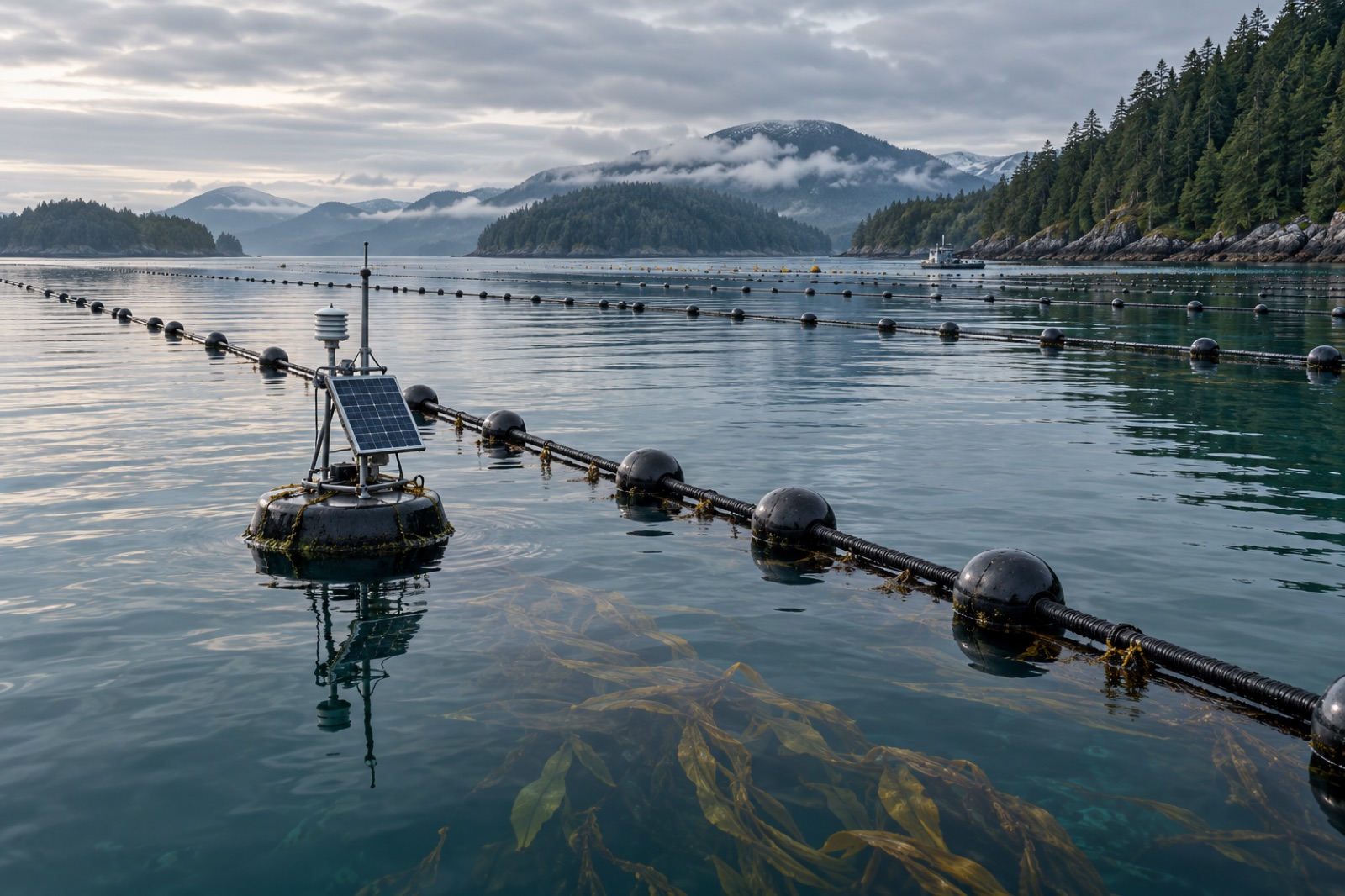
A kelp farm's worst problems happen when nobody is looking. A nitrate crash in late winter stops growth weeks before you would notice it at the dock. A raft of drifting logs bends a backbone line on a Tuesday night. A warm layer sits over the site for nine days in March and the sugar kelp senses the stress long before the crew visits. Smart farms are not about replacing the boat and the crew — they are about making sure the time between visits is never blind time.
This guide is about the step beyond basic data logging: an instrumented, connected, semi-automated farm. If you are still choosing your first temperature logger, start with our guides to sensors and data loggers for small seaweed farms, building a cheap sensor kit with telemetry, and reading the water as a farmer. Then come back here for the automation layer.
What a "smart" seaweed farm actually means
Strip away the marketing and a smart farm does three things:
- Senses — it continuously measures the variables that drive growth and risk, at the depths and positions that matter.
- Communicates — it moves those measurements to shore (or satellite) often enough that you can act on them.
- Acts — either it tells a human what to do (decision support), or it does something itself: paying out a line, firing an alarm, winching up a test sample.
Most commercial kelp operations today live at levels one and two, with level three reserved for a handful of well-justified functions. That is the right place to be. Below is how to build toward it without wasting money.
The sensor stack, in order of value
Instrument in the order the variables kill your crop. For most temperate kelp farms that order is temperature, light, and fouling/structural state — with nutrients and waves close behind.
Temperature: three depths, minimum
Temperature controls growth rate, blade tissue quality, sporophyte maturation, and heat-stress risk. A single surface logger flatters you; kelp on lines at 1–3 m experiences stratification, internal waves, and warm surface lenses that a buoy-in-the-harbour reading will never see. Log at your cultivation depth, at one metre, and near the bottom of your dropper lines. Hourly logging is plenty for management; 10-minute intervals help when you want to diagnose an event after the fact.
Light (PAR): the underused sensor
A photosynthetically active radiation sensor at cultivation depth tells you when turbidity — a storm, a plankton bloom, a river plume — has cut the light budget your kelp needs. Paired with temperature, PAR lets you distinguish "slow growth because cold" from "slow growth because dark," which have completely different management responses. This pairing is the backbone of growth forecasting for kelp farms.
Load cells and tilt sensors: structural awareness
A strain gauge on a mooring leg or a tilt sensor on a surface float is the cheapest insurance you can buy. When a storm loads a line, or drift debris snags a sub-surface rope, the signature shows up in tension hours before anything surfaces. Crews who watch tension traces through big weather learn to relax: you can see your engineered safety margins working, and you know within the hour when something has actually failed rather than guessing from the beach. This pairs naturally with the design logic in storm-proofing a kelp farm.
Nitrate and chlorophyll: powerful, pricey, picky
Optical nitrate sensors and fluorometers are glorious when they work — and biofoul, drift, and cost real money. Buy these after the basics, mount them with a wiper, and accept that they are a service item. On farms near variable nutrient sources (river mouths, upwelling edges), one well-placed nitrate sensor can explain an entire season's yield variation.
Cameras: domain of the ROV and the drop-cam
Fixed underwater cameras foul fast, but they are unbeatable for two jobs: watching the crop's visible condition (epiphyte load, blade colour, grazing damage) and confirming what a tension alarm is actually seeing. A cheap drop-camera on a cable, deployed weekly, beats a diver for routine inspection. Remotely operated vehicles earn their keep on larger farms; see how reef scientists use them in ROVs in reef science.
Telemetry and power: the unglamorous core
Sensors are easy; moving their data home is the engineering. Every floating instrument package is fighting three constraints: power, bandwidth, and salt water's hostility to connectors.
- Power. Solar panels above water plus a lithium bank below is the standard. Size the panel for your darkest month, not your brightest day, and put a watchdog circuit on the controller so a brownout reboots the system rather than hanging it.
- Backhaul. Within cellular coverage, a 4G/LTE modem is cheapest and highest-bandwidth. Beyond coverage, satellite messengers (Iridium SBD and similar) move small packets at a cost that forces discipline: send summaries and alarms hourly, full resolution data daily or on-demand.
- Connectors. Wet-mate connectors are worth their price the first time you swap a fouled sensor dockside in January. Budget for spares.
A practical threshold: if a sensor reading changes what you would decide this week, it needs telemetry. If it only informs next season, store-and-download on the boat is fine and far cheaper.
Automation that actually exists today
Be sceptical of vendor slide decks. The automation that is genuinely field-proven on seaweed farms in 2026 is modest, robust, and targeted:
Depth-shifted cultivation lines. Winch-controlled backbones or dropper lines that sink the crop during warm surface events or storms, and raise it when conditions improve. This is the single highest-value actuation on an exposed farm: it directly deletes heat-stress and storm-damage risk that no amount of monitoring can.
Alarm logic, not just dashboards. A system that pages the skipper when mooring tension exceeds a threshold, when the line submersion fails, or when water temperature at cultivation depth crosses the species' stress limit (see the thermal limits of kelp) is automation. It converts a sensor array into a night watchman.
Scheduled imagery and sampling. Winch-up camera passes and automated water samplers on a timer beat ad hoc data because they are consistent — and consistency is what turns measurements into early-warning systems like those for seaweed disease monitoring.
Mechanised seeding and harvest are automation of a different kind — deworn bottles of labour rather than continuous control — and we cover them separately in mechanising kelp seeding and automated seaweed harvest.
What does not yet earn its complexity on commercial kelp farms: autonomous nutrient dosing, self-cleaning sensor networks without maintenance intervals, and "AI yield predictions" trained on a single season of one farm's data. Buy the boring, robust systems first.
Building the data into decisions
A dashboard nobody checks is decoration. The farms that get value from instrumentation do three things:
- Define triggers in advance. Write down the numbers that change behaviour: "temperature at 2 m above 15 °C for 72 hours → sink the lines"; "tension on leg 3 above 70% of safe working load → inspect within 24 h." Triggers make alarms meaningful and keep the whole crew interpreting data the same way.
- Fuse with forecasts. Your sensors describe now; public ocean forecasts describe next week. Combining both is what lets you harvest ahead of a forecast marine heatwave rather than after it — the same logic forecasters use at regional scale in predicting marine heatwaves.
- Review seasonally. Two hours with the season's temperature, PAR and yield data every winter teaches more than any vendor case study. Log what you changed and what happened. This is the raw material of good farm record keeping.
A realistic budget ladder
Costs vary by market, but as a rough order of magnitude for a 5-hectare longline farm:
- Tier 1 — blind-spot removal (small budget): temperature loggers at three depths, weekly drop-cam, public buoy data. You stop being surprised by stratification.
- Tier 2 — connected farm: cellular telemetered temperature + PAR at cultivation depth on two stations, tension sensors on your two most loaded mooring legs, SMS alarms.
- Tier 3 — semi-automated farm: depth-shifting lines with remote control, satellite backhaul on offshore sites, scheduled imagery, fused dashboards with triggers and seasonal review.
Each tier should pay for itself in avoided loss or reduced boat visits before you climb to the next. At Tidewright, our restoration-adjacent partner farms under the Holdfast program run exactly this ladder, and their monitoring feeds the site models behind Canopy Ledger — proof that the same stack serves a working farm and a restoration program.
Key takeaways
- A smart farm senses, communicates and (sparingly) acts; most value sits in the first two layers.
- Instrument in the order variables kill crops: temperature at depth first, then light, then structure, then nutrients.
- Telemetry earns its cost only for readings that change this week's decisions.
- Depth-shifted lines and threshold alarms are the proven automation; treat grander promises as R&D.
- Written triggers plus seasonal data reviews turn sensors into decisions instead of dashboards.
FAQ
How many sensor stations does a small kelp farm need?
A 1–5 hectare longline farm in fairly uniform water usually learns all it needs from two stations — one at each end of the main exposure axis — with a third added where conditions clearly differ (a deeper corner, a river-influenced edge). More stations help once you start modelling growth spatially.
Is satellite telemetry worth it for nearshore farms?
Rarely. If you have cellular coverage, use it; satellite data costs 20–50 times more per byte. Satellite becomes essential only for genuinely offshore sites, and there it is structuring the data (summaries hourly, detail daily) that keeps bills sane.
Can automation reduce crew size on a seaweed farm?
It reduces unproductive boat hours — inspection runs, blind checks after storms — more reliably than it reduces skilled crew. Plan on reinvesting saved hours into maintenance and faster response, not on cutting the people who hold the system together.
What sensor fails most often, and why?
Optical sensors (PAR, chlorophyll, turbidity) fail by fouling. Wet-mate connectors fail by handling. Batteries fail by calendar. Build your maintenance schedule around those three failure modes and most "smart farm" downtime disappears.
Do insurance companies care about farm monitoring?
Increasingly, yes. Documented monitoring — especially tension and weather data around a loss event — strengthens claims, and some underwriters price better for instrumented farms. See the risk-transfer angle in insuring a seaweed farm.