Kitchen7 min read
Cooking with Dulse: The Bacon of the Sea
How to cook dulse — the North Atlantic red seaweed that fries up smoky and crisp. Pan-frying, flakes, the DLT sandwich, and buying and storage tips.
Sofia Andersson ·
Bladderwrack is the Atlantic's most familiar rockweed — and a genuine cooking ingredient. Flavour, blanching, drying, broths, and the iodine conversation.
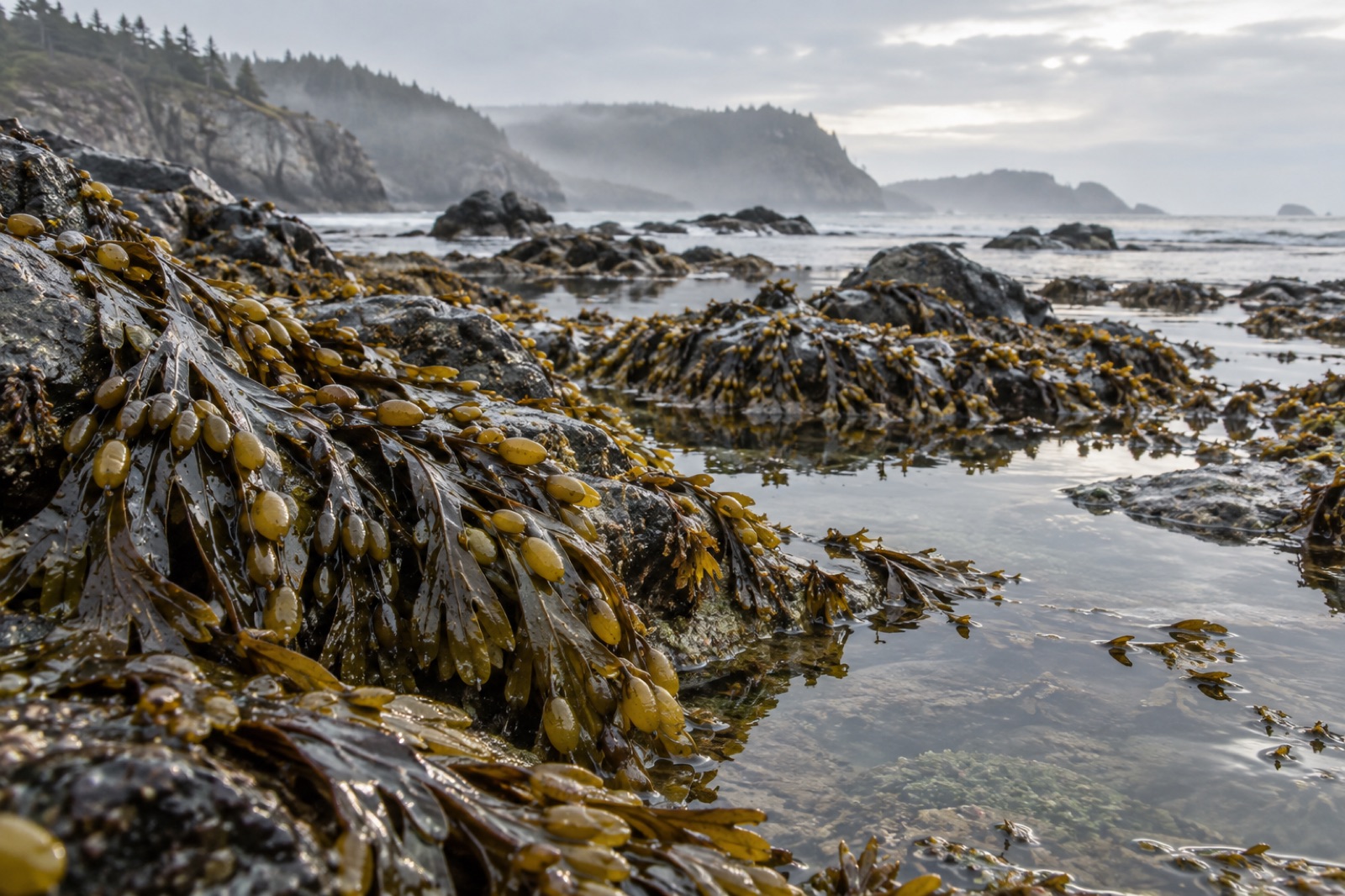
Stand on almost any sheltered Atlantic shore at low tide and bladderwrack is the seaweed looking back at you: olive-brown fronds strung with paired air bladders that pop pleasingly underfoot, draped over the rocks in ordered bands. Fucus vesiculosus is the most familiar rockweed in the North Atlantic — so familiar that most coastal people walk past the dinner. Bladderwrack is edible, flavourful and easy to prepare, though it asks more of the pot than the tender kelps: this is a seaweed for broths, brews and slow simmering, not salads. Here's how to cook it, where its folk-herb reputation comes from, and why sourcing and iodine deserve a moment of your attention.
Bladderwrack is a brown alga of the intertidal zone, growing on rocks from the Arctic down both Atlantic coasts — Scandinavia, the British Isles, Iceland, the Maritimes and New England. The diagnostic feature is right in the name: pairs of small, gas-filled bladders along the frond that lift the seaweed toward the light when the tide comes in. Ripe plants also carry swollen, bumpy tips — the reproductive receptacles — that feel distinctly warty.
It's a perennial, long-lived plant and the backbone of the mid-shore's ecology, sheltering periwinkles, isopods and juvenile fish. That ecological role matters for how you gather it: bladderwrack beds are living habitat, not dead standing crop.
Flavour-wise, set expectations honestly. Bladderwrack is not kombu. Where kelps offer sweet, mild umami, bladderwrack is mineral, briny and assertive, with a tannic edge that long cooking rounds into something rich and brothy — closer to a mushroom stock or a long-simmered shellfish liquor than to dashi's clear sweetness. Used correctly, that intensity is a feature.
Few seaweeds have a longer written relationship with people. Along Scotland's west coast, Ireland's Atlantic fringe and Norway's fjords, bladderwrack and its rockweed cousins were historical fodder, fertiliser and fuel ash — wrack was spread on lazy beds to sweeten poor soils, wintered sheep grazed it, and whole coastal economies once burned kelps and wracks to ash for soda and later for iodine extraction in the 19th century.
As food and folk remedy the record is real but modest. Coastal people ate rockweeds in lean times and fed them to livestock routinely; dried bladderwrack was steeped as a tea. In the 19th century bladderwrack became fashionable as a source of iodine after iodine's role in goitre was recognised — it was marketed (and eventually pharmacologised into tinctures) as a goitre remedy, the one folk use with a real biochemical basis. Passed down from that era comes a long tail of modern health-tonic claims around thyroids and weight. Treat those cautiously: bladderwrack's iodine content is real but wildly variable and often high, which is precisely why it's a food to enjoy in food quantities rather than a supplement to dose yourself with. If you're shopping for seaweed as medicine, read our seaweed nutrition and iodine guide first — it lays out honest numbers.
The cooking tradition worth reviving is humbler and better: bladderwrack as broth seaweed, lending ocean depth to soups, stews and bean pots the way a ham bone does.
Foraging is the classic route, and bladderwrack is a good species to learn on — common, easy to identify, and with no dangerous lookalikes worth the name. Our seaweed foraging guide covers the law and the ethics in full; bladderwrack's own rules are:
Buying is easier than it used to be: bladderwrack appears dried and flaked from Atlantic seaweed companies in Maine, Atlantic Canada, Ireland and Iceland, sold as tea, bath seaweed and seasoning. Dried bladderwrack from a reputable producer with water-quality testing is the lowest-friction entry point and entirely respectable.
Two preparations unlock nearly everything bladderwrack can do in a kitchen.
Fresh fronds are tough and squeaky raw. A blanch fixes both colour and texture:
Blanched bladderwrack is ready for soups, stews and beans — added early so it can give its flavour to the liquid — or chopped fine for fritters, breads and condiments. Blanched and frozen, it keeps six months.
The traditional and most useful form. Rinse, shake dry, and spread on racks or hang the fronds in a warm, airy place out of direct sun until completely brittle — or use a dehydrator at 40–50°C. Dried fronds snap cleanly, keep for a year in airtight jars, and grind to powder for seasoning or break into pieces for broth. Drying concentrates the tannic-mineral side, so dried bladderwrack is even more of a broth ingredient than the fresh.
The single best thing to do with bladderwrack. Per litre of water: a generous handful of dried fronds (or two of blanched fresh), a strip of kombu if you have it, a few peppercorns and a bay leaf. Simmer gently 45–60 minutes, then strain. Never boil hard — agitation pulls out harshness. The result is a dark, briny, strangely meaty stock that makes an extraordinary base for seafood chowders, lentil soups, risottos à la mer and ramen-ish noodle bowls. It freezes in portions like any stock.
This is the same tradition neighbouring Atlantic seaweeds feed into — our dulse chowder and the broader seaweed teas and broths piece both build on exactly this technique.
Add a 5 cm piece of dried bladderwrack to the pot when you cook dried beans, chickpeas or barley (kombu works the same trick — see kombu and beans) and remove it before serving. The legumes come out seasoned from within, the cooking liquid turns rich, and the long simmer tames the seaweed into full anonymity if that's what you want.
Grind brittle-dried fronds fine (a spice grinder), sieve, and store airtight. Use by the pinch—never the spoonful—as a finishing dust on roast potatoes, buttered fish, devilled eggs and popcorn; anywhere you'd reach for a mineral, sea-forward salt. Blended half-and-half with flaky salt it is superb. The powder is also the easiest, most controllable way to add bladderwrack's flavour to bread dough and savoury crackers.
Bladderwrack deserves its safety note, framed plainly.
Iodine. Brown seaweeds concentrate iodine, and bladderwrack sits at the high end with contents that vary enormously between plants, seasons and shores — from moderate to very high per gram. Broth-with-a-handful and pinch-of-powder quantities are food-level use for most healthy adults. Daily large doses, concentrated capsules, or use with existing thyroid conditions: speak to a doctor first. This is a kitchen, not a pharmacy, and the err on no-worse side is simply to enjoy bladderwrack the way coastal people always did — as an ingredient, occasionally, in moderation.
Inorganic arsenic is a smaller concern than in hijiki (which has its own honest guide: hijiki and arsenic), but bladderwrack can carry some, and the ancient advice holds: blanch fresh fronds and discard the water, source from clean open shores, buy from tested producers.
No, and expecting it to is the main route to disappointment. Kombu is sweetly umami; bladderwrack is briny, tannic and mineral, rounding into rich and meaty with long simmering. They're complementary rather than interchangeable — the best bladderwrack broth actually includes a strip of kombu for the sweetness bladderwrack lacks.
You can technically, but you won't want to twice: raw fronds are tough, squeaky and sharply tannic. A blanch of under two minutes transforms the texture and takes the bitterness down to a pleasant edge. If you want a raw seaweed experience, choose sea lettuce or fresh sugar kelp instead.
There's no single official number because iodine content varies so much between plants. Sensible kitchen practice: treat potent dried bladderwrack like a spice — a handful in a family's broth or a pinch of powder per dish — and rotate across seaweed species through the week rather than leaning on one daily. Anyone managing thyroid disease should check with their doctor before adding high-iodine seaweeds regularly.
No — different seaweed entirely. Sea moss in the food-trade sense means Chondrus or Gracilaria red algae, famed for their gelling carrageenan. Bladderwrack is a brown rockweed with negligible gelling power. They do share a folk-remedy history, and both are better cooked with than swallowed in capsules.
Look for Atlantic seaweed companies in Maine, Atlantic Canada, Ireland, Scotland and Iceland that sell it dried, flaked or powdered, and favour suppliers who publish heavy-metal and iodine testing. Small-batch, hand-harvested and tested beats anonymous bulk every time — see our guide to buying seaweed sustainably for the questions to ask any supplier.
How to cook dulse — the North Atlantic red seaweed that fries up smoky and crisp. Pan-frying, flakes, the DLT sandwich, and buying and storage tips.
Sofia Andersson ·
A complete guide to foraging seaweed responsibly: harvest technique, legal basics, species ID, water quality, and the rules that keep the forest standing.
Sofia Andersson ·
Kombu cha, kelp broths and seaweed sipping cups: recipes, extraction science, iodine limits and which species belong in a mug and which don't.
Sofia Andersson ·