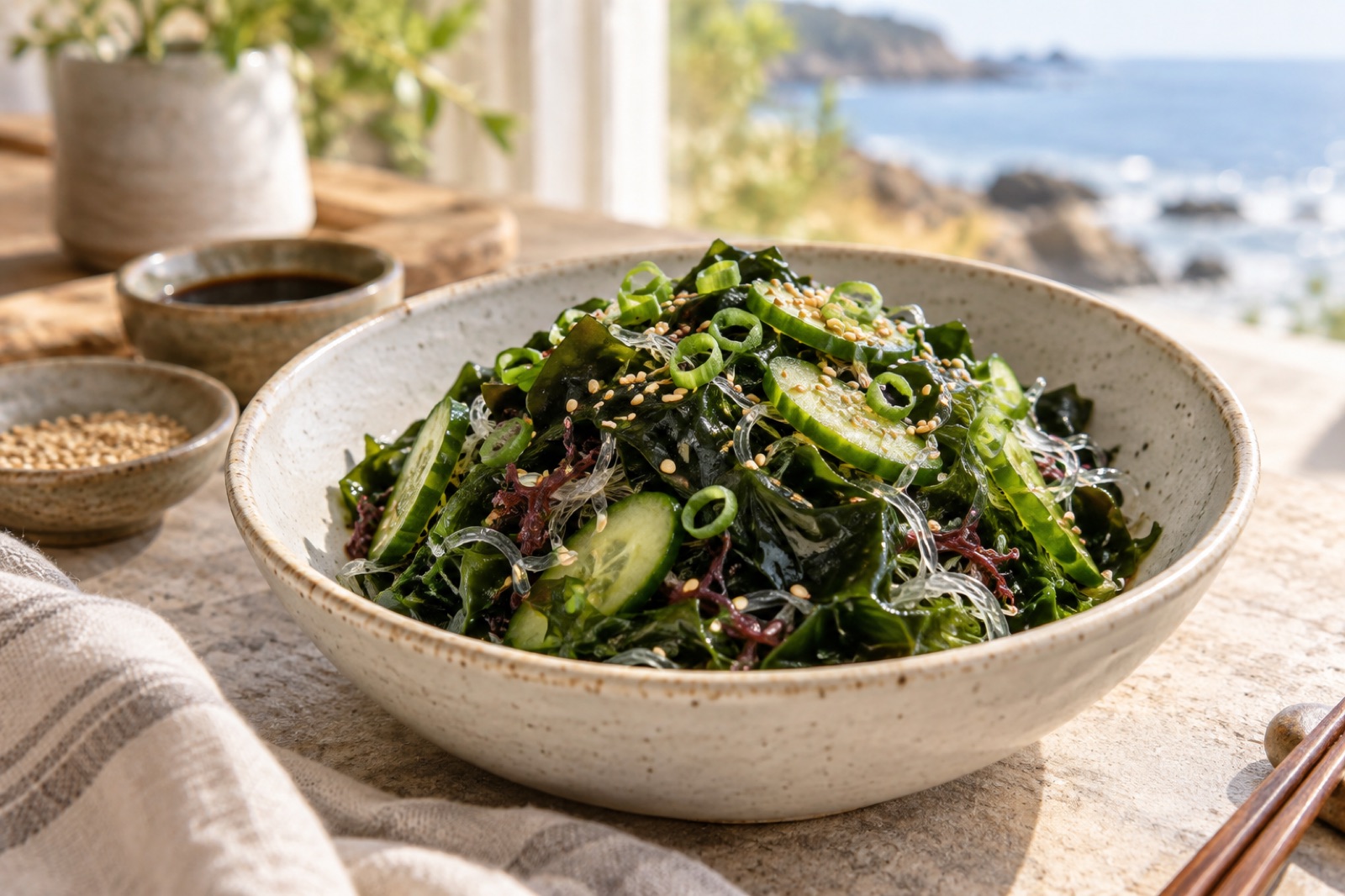
Walk into a good Japanese deli and there's a salad glistening in the cold case that most Western menus call simply "seaweed salad" — a tangle of slippery emerald strands, translucent ribbons and crunchy stems in a sesame-shoyu dressing. In Japan it's kaiso sarada: a mixed seaweed salad, and the word "mixed" is the whole point. What makes it compelling — and what the neon-green, uniformly-textured version in supermarket tubs gets wrong — is contrast: soft against crunchy, thick against hair-fine, mineral against sweet.
Building that contrast at home is entirely achievable with dried seaweeds from an Asian grocer or a decent online shop. It takes twenty minutes of soaking and a dressing you can whisk in a tea cup. This guide covers which seaweeds to combine, what each contributes, how to soak them without wrecking their texture, and the dressing that ties them together.
The principle: three textures, never one
A great kaiso salad is engineered around three textural roles. Aim for at least one seaweed in each:
The soft body — wakame. Silky, tender, deep green, yielding. This is the bulk of the salad (about half the rehydrated weight) and the flavour everyone recognises. Dried cut wakame rehydrates in five minutes and swells to ten times its dry weight. Buy the cut flakes, not whole leaves, unless you enjoy chopping.
The crunch — stems and roots. This is what most homemade versions lack and what makes deli salads addictive. Options, best first:
- Kuki wakame (wakame stems): crunchy, substantial, slightly sweet — the backbone of the professional version.
- Mekabu (wakame root): crunchy-shreddy with a pleasant sliminess that grabs dressing.
- Tosakanori: a red seaweed with a coral-like crunch, gorgeous on the plate.
- Blanched kelp stems, if you buy fresh seaweed — our pickled kelp stems technique shows how much crunch lives in a stem.
The fine tangle — reds and threads. Thin strands that wind through the salad, catching dressing and adding visual lace:
- Funori or agar strands (ito-kanten): translucent, mild, slippery.
- Sujinori or fine shredded nori: adds a roasted, dusky flavour note.
- Ogo or tengusa fragments, if your grocer stocks them.
A workable supermarket-basket version: cut wakame + one crunchy stem seaweed + agar strands. That alone beats 90% of bought tubs.
Soaking: the rules that protect texture
Each seaweed has its own clock, and soaking them together in one bowl is the classic beginner error — the wakame goes flabby while the agar is still brittle. Soak separately, in three bowls. The full timing logic is in our seaweed rehydrating guide, but for this salad:
- Cut wakame: cool water, 5–8 minutes. Drain the moment it's fully unfurled; over-soaked wakame loses its oceanic snap and turns cottony.
- Kuki wakame / stems: cool water, 15–20 minutes. Taste a piece — it should have a dense, clean crunch with no hard core.
- Mekabu: cool water, 10 minutes; shred or slice it after soaking.
- Agar strands: cool water, 15–20 minutes, until supple and translucent; snip the tangle a few times with scissors.
- Fine reds (funori, tosakanori): cool water, 5 minutes — these collapse if over-soaked.
Two universal rules: always cool water (warm water pre-cooks the surfaces and muddies the texture), and drain, then squeeze. Lift each seaweed out and press it firmly in your hands. A wet salad is a watery salad; the dressing can't fight residual soak water. One pass through a salad spinner after squeezing is not excessive.
For a 4-serving salad, start from roughly: 10 g dried cut wakame, 8 g dried kuki wakame or mekabu, and 5 g agar strands or fine reds — yielding close to 300 g of soaked seaweed.
The dressing: shoyu-sesame, balanced for seaweed
Seaweed brings its own salinity and a strong mineral bass note, so the dressing should be brighter and slightly sweeter than one you'd make for green leaves:
- 3 tbsp rice vinegar
- 2 tbsp soy sauce
- 1 tbsp toasted sesame oil
- 1 tbsp sugar (or mirin — a touch softer)
- 1 tsp grated ginger
- Optional: 1 tsp finely grated garlic, a dab of English or Japanese mustard for heat
Whisk until the sugar dissolves and the oil emulsifies into the vinegar. Taste it on its own: it should read as almost too sharp — the seaweed and vegetables will tame it. A neutral, unseasoned base needs dressing that over-delivers; the same logic as seasoning kelp noodles, which our sesame kelp noodle salad demonstrates from the salad side.
Assembly and the vegetables
Toss the squeezed seaweeds together first — you'll see immediately whether your texture mix is right; there should be visible variety, not a uniform tangle. Then add the vegetables. Keep them crisp and minimal; they're supporting actors, not co-stars:
- Cucumber, thinly sliced on the diagonal — near-mandatory; its watery crunch bridges soft and crisp textures.
- Daikon or radish, in fine matchsticks.
- Spring onion, sliced fine.
- Optional: a few rings of red chilli, blanched and shocked edamame, or thinly sliced reconstituted shiitake.
Dress two-thirds of the way — you can always add. Toss thoroughly with your hands or tongs; the slippery strands resist spoon-tossing. Rest the salad 10 minutes before serving: the dressing settles in, the agar strands absorb a little shoyu, and the whole thing comes into focus. Top with toasted sesame seeds just before serving (they go soft if dressed too early — or use gomashio for seasoning and texture at once).
Adjusting the balance
Run through this checklist after your first taste and correct before serving:
- Too fishy/mineral? Add more cucumber and a squeeze of lemon, or a pinch more sugar in the dressing. Fine reds are the usual culprit — reduce their share next time.
- Too soft, no crunch? You need a stem seaweed. Nothing substitutes for kuki wakame here; seek it out.
- Too slimy? Mekabu and some wakame are naturally viscous — rinsing soaked seaweed briefly under cold running water and re-squeezing removes surface slime without harming texture.
- Flat taste? Under-dressed or under-rested. Seaweed needs a full 10 minutes in the dressing; give it time and a second splash of rice vinegar.
- Watery bowl bottom? Inadequate squeezing. The fix is spinner time next batch.
Serving and keeping
Kaiso salad is a deli-case food, and it behaves like one: serve it well-chilled, as a side alongside grilled fish, rice bowls (it sits naturally among the elements in our seaweed rice bowls), or as part of a small-dish spread in the spirit of Korean banchan. A spoonful over warm rice with a soft egg is a complete lunch.
It keeps genuinely well — 2 days dressed in the fridge, 3–4 days undressed (store the squeezed seaweeds dry and dress to order). The agar strands hold indefinitely; the wakame softens slowly but stays pleasant. This makes it one of the best make-ahead dishes in the seaweed repertoire.
If you want to understand what each of these seaweeds is before buying, the wakame vs kombu vs nori guide orients the big three, and the seaweed pantry starter kit tells you which bags to keep permanently in the cupboard.
Key takeaways
- Build kaiso salad on three textures: soft wakame body, crunchy stems (kuki wakame or mekabu), and fine threads (agar strands or reds).
- Soak each seaweed separately in cool water; timing ranges from 5 minutes (wakame, fine reds) to 20 minutes (stems, agar).
- Squeeze soaked seaweed hard — residual soak water is the main cause of watery, bland salad.
- Dress with a shoyu-sesame vinaigrette slightly sharper and sweeter than you'd use on leaves; rest 10 minutes before serving.
- Cucumber is near-mandatory; sesame seeds go on at the last minute to keep their crunch.
- Keeps 2 days dressed, 3–4 undressed — a true make-ahead dish.
FAQ
Is the bright-green seaweed salad at sushi restaurants the same thing?
Usually not. Much of the mass-market version is a single seaweed (often a farmed wakame relative), pre-dressed, sweetened and dyed to a uniform neon green. A homemade kaiso salad with three seaweeds is deeper in colour and flavour, and you control the sweetness and the soy.
Where do I find kuki wakame and agar strands?
Japanese and Korean grocers stock both, usually near the wakame; online Japanese food shops carry them reliably. Agar strands are sometimes labelled ito-kanten or just "agar-agar sticks" — the same thing, and worth keeping for desserts too (see our agar-agar guide).
Can I make it spicy?
Very well. A dab of gochujang whisked into the dressing takes it toward Korean miyeok muchim territory, or simply dress with chilli oil and a splash of black vinegar. Both variations are excellent; the texture logic stays the same.
Is mixed seaweed salad healthy?
It's one of the better salads you can eat: high in minerals and fibre, very low in calories before the dressing, and modest in dressing terms. Iodine content varies by seaweed mix — check the seaweed nutrition guide if you track iodine — but a deli-portioned serving a few times a week sits comfortably within normal intake for most people.
Can I use fresh seaweeds?
If you have access to blanched fresh wakame or kelp, absolutely — they bring a brighter flavour than dried. Salt-preserved fresh wakame needs a 15-minute soak in several changes of water to shed its salt first, then treat it exactly like rehydrated wakame.