Kitchen6 min read
Wakame Salad: Restaurant Technique at Home
Make wakame seaweed salad the proper way: rehydrate, blanch to jade green, dress with sesame and rice vinegar. Recipe, technique and sourcing.
Sofia Andersson ·
Six Korean seaweed side dishes built from a single bag of dried wakame — master dressing ratios, proper soaking, and banchan that keep for days.
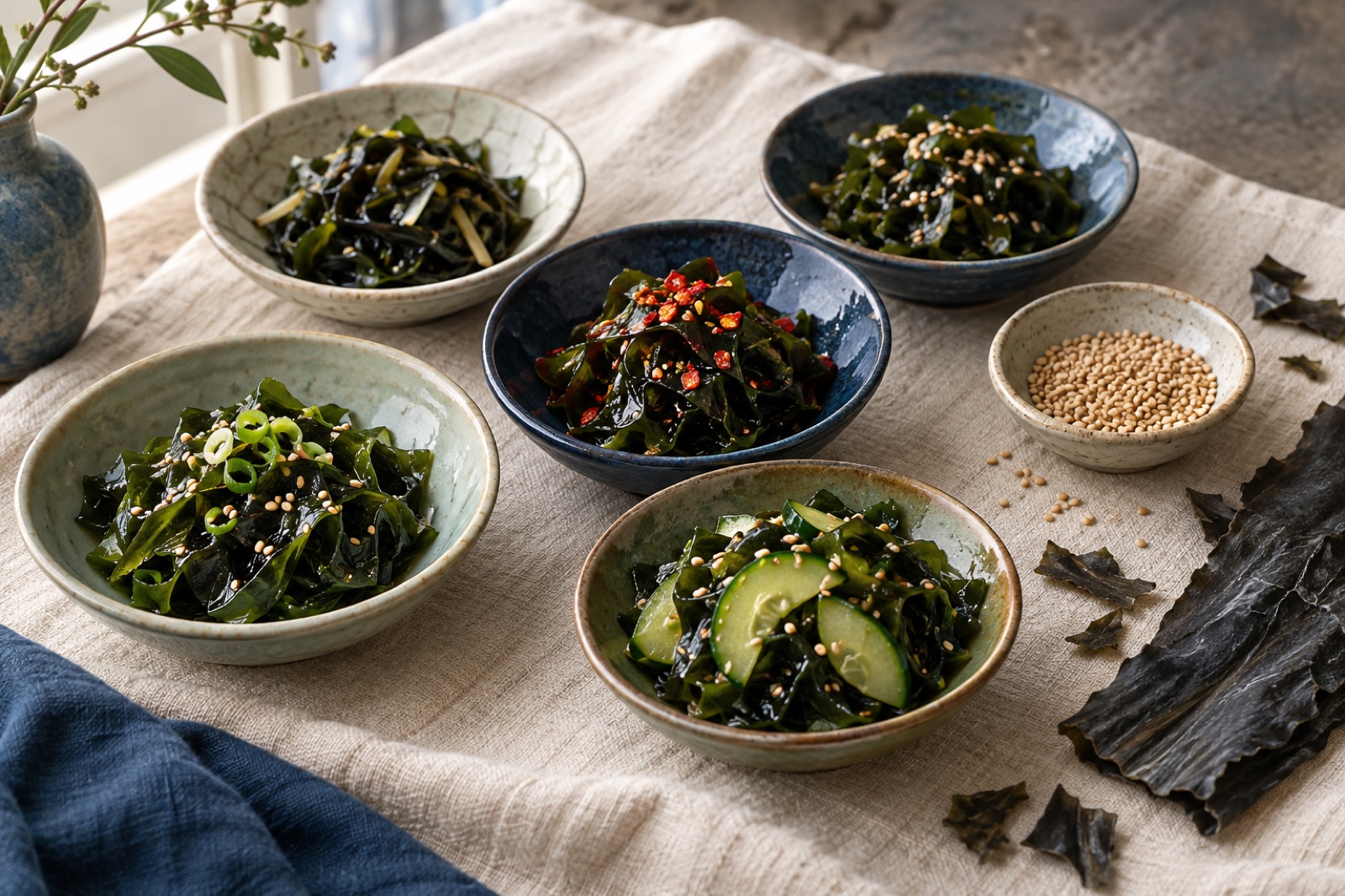
Open a 100-gram bag of dried miyeok — Korean wakame — and you are holding somewhere between six and eight dinners' worth of banchan. Dried seaweed economics are absurd in the best way: one handful, soaked for ten minutes, becomes a heaped bowl of dressed greens. Korean home cooks have known this forever; miyeok is the seaweed of birthday soup, of lunch boxes, of the small dishes (banchan) that make a bowl of rice into a meal.
This article gives you the master dressing, then six directions to point it. Every dish starts the same way — soaked, squeezed, cut wakame — and every one keeps in the fridge for days, which is the entire point of banchan: cook once, eat repeatedly, feel smug all week.
Dried miyeok expands to roughly ten times its dry volume, so portion with restraint: 10–15 g dried per dish serves two to four as a side.
Soak in plenty of cold water for 10–15 minutes until silky and fully unfurled. Swish to release any grit, then drain and squeeze hard in your hands — waterlogged seaweed dilutes dressing and spoils faster. Pull out any hard stem pieces, stack the leaves, and cut into bite-size strips. Miyeok naturally clumps into a slippery mass when soaked; cutting is easier under a little running water.
One refinement separates good banchan from great: a 30-second blanch. Drop the soaked seaweed into boiling water, count to thirty, drain and rinse cold. It brightens the colour, tames any raw-ocean edge, and firms the texture. Optional, but for the dressed cold dishes below I always do it. For more on wakame itself — the species, its double life as native food and global traveller — see our wakame species profile.
Nearly every seaweed banchan hangs off one backbone. This makes enough for one dish (about 300 g soaked seaweed):
Whisk and taste: it should be salty, nutty, gently sweet, with the acid present but not dominant. Korean banchan dressings are balanced to sit alongside rice, not to shock.
The canonical wakame banchan and the one to learn first. Toss 300 g soaked, blanched, squeezed seaweed in the full master dressing. Finish with a tablespoon of thinly sliced spring onion. Taste after five minutes — seaweed absorbs dressing fast, so season to just-shy-of-salty and let it settle. Keeps 3–4 days refrigerated.
Same base, plus 1–2 tsp gochugaru (Korean chilli flakes) bloomed for a minute in the sesame oil before mixing, and a teaspoon of gochujang whisked into the dressing. The chilli blooms against the seaweed's slip in a way that makes plain rice disappear alarmingly quickly. This is the version that converts people who claim not to like seaweed.
Seaweed's best friend is something crunchy. Halve one cucumber lengthwise, slice into half-moons, salt for ten minutes, squeeze, then toss with 250 g blanched seaweed and the dressing increased vinegar to 1½ tbsp for extra snap. The salt-pulled cucumber stays crisp against the silky miyeok. If you like this pairing, our wakame and cucumber sunomono is its Japanese cousin — lighter, sharper, five minutes flat.
A less common but genuinely excellent home-style version: add half a crisp apple, julienned, to the classic dressing. The apple's sweetness replaces the sugar in the dressing (drop it), and its acid carries part of the vinegar load. Serve the same day — apple softens overnight. This converts banchan skeptics at dinner parties with suspicious reliability.
True parae-muchim uses purple laver (a nori relative); rehydrated miyeok makes a fine everyday stand-in. For this one, skip the blanch — keep the soak at ten minutes for a softer texture — and add 1 tbsp of crumbled toasted nori to the dressing along with a minced spring onion and a small handful of julienned perilla or shiso leaf if you can find it. More nori wisdom lives in our nori beyond sushi article. Eat this one within two days; it softens fastest.
The only hot dish in the set, and my favourite alone-with-rice dinner. Heat a slick of neutral oil in a pan, briefly fry 2 minced garlic cloves and a thumb of ginger, add 300 g soaked, squeezed seaweed and toss for two minutes until glossy. Season with soy sauce and sesame oil only — no vinegar, no sugar — and finish with a heap of sesame seeds. This is close to the sauté that starts miyeokguk; indeed, if you pour in stock and simmer, you've made the birthday soup by accident, which is not a bad accident.
Banchan logic: small portions, several dishes, fridge longevity. All six keep 3–4 days covered and refrigerated, except the apple version (same day). Bring them out ten minutes before eating — cold mutes sesame. Serve in small saucers, not bowls; a couple of tablespoons per person is correct.
If you're building a Korean pantry from scratch, miyeok and its kombu cousin dashima are the two seaweed anchors — our dashima pantry guide covers the stock-making half of that pair. And for sourcing, choose farmed wakame from clean, managed waters; our sustainable buying guide explains what to look for on the label. Coastal farms working with Tidewright's Harvest programme grow exactly this kind of kelp on restoration-adjacent lines — dinner that funds a forest.
Yes — same species, Undaria pinnatifida, as detailed in our wakame species profile. Korean miyeok is usually sold in larger, less-processed fronds; Japanese wakame often comes pre-cut. Both work identically in these dishes.
You can — blanch fresh wakame for 30–60 seconds first and skip the soak. Quantities: about 100 g fresh replaces 10–15 g dried. Fresh miyeok is silkier and milder; dried keeps in the cupboard for a year, which is why the bag route is the practical one.
Two fixes: the 30-second blanch with a cold rinse, and a tablespoon of rice vinegar swished through the soaking water. Very strong-tasting seaweed can also mean an old bag — dried miyeok fades to a dull brown-grey with age.
Soup soy sauce (guk-ganjang) is saltier and lighter in colour, brewed for seasoning brothy dishes without darkening them. For banchan dressings, regular soy sauce is completely fine; if you have soup soy, use it in dish 1 for a brighter-coloured plate.
With tamari or a certified gluten-free soy sauce, yes — everything else here is naturally gluten-free. Check your gochujang label in dish 2; some contain barley.
Make wakame seaweed salad the proper way: rehydrate, blanch to jade green, dress with sesame and rice vinegar. Recipe, technique and sourcing.
Sofia Andersson ·
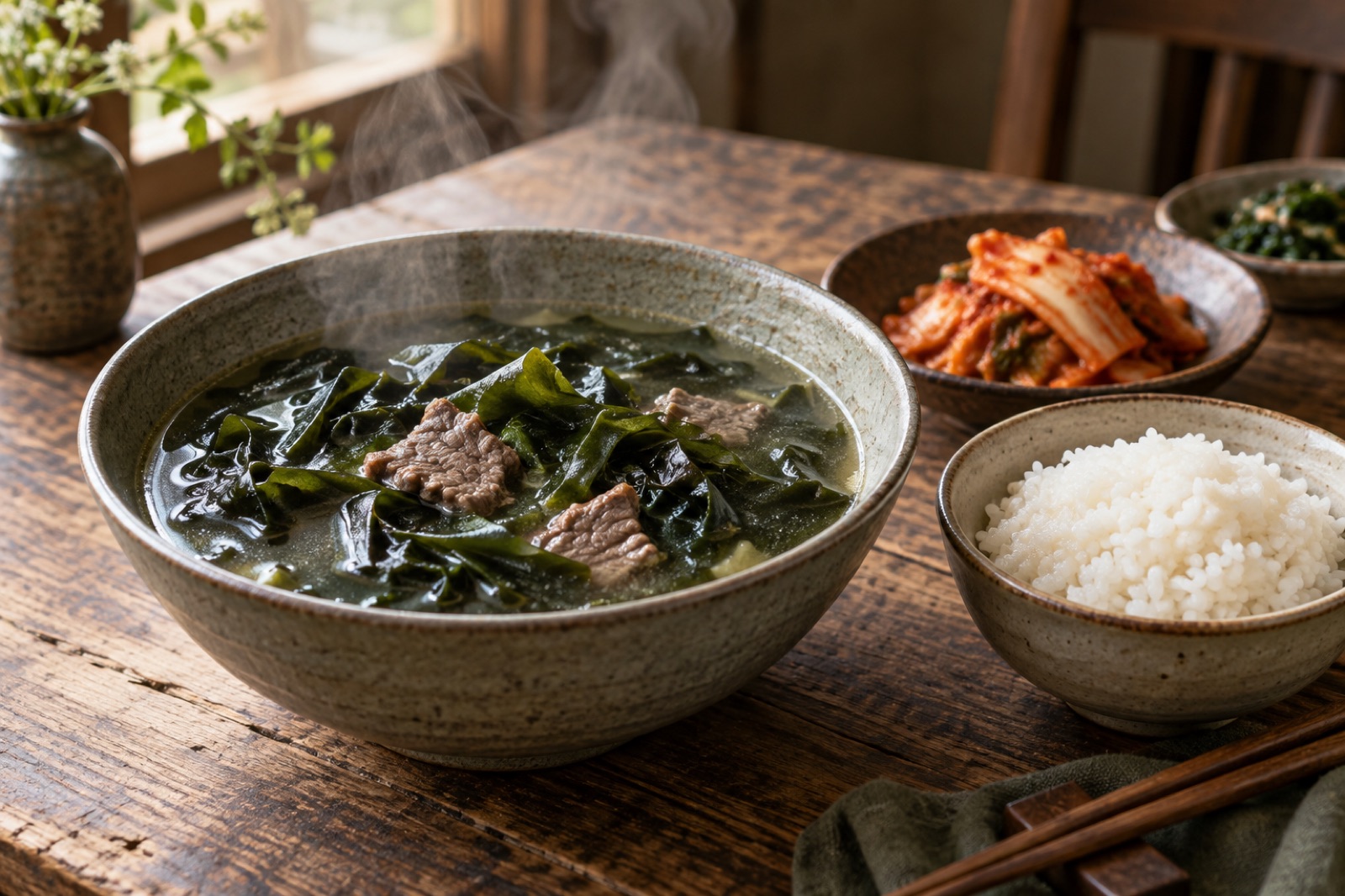
How to make miyeokguk, the Korean seaweed soup eaten to honour mothers and birthdays — with the culture, technique and common mistakes explained.
Sofia Andersson ·
Dashima is the dried kelp behind Korean stock, banchan and temple cooking. How to choose it, store it, and cook with it — from dasima yuksu to braised kelp.
Sofia Andersson ·