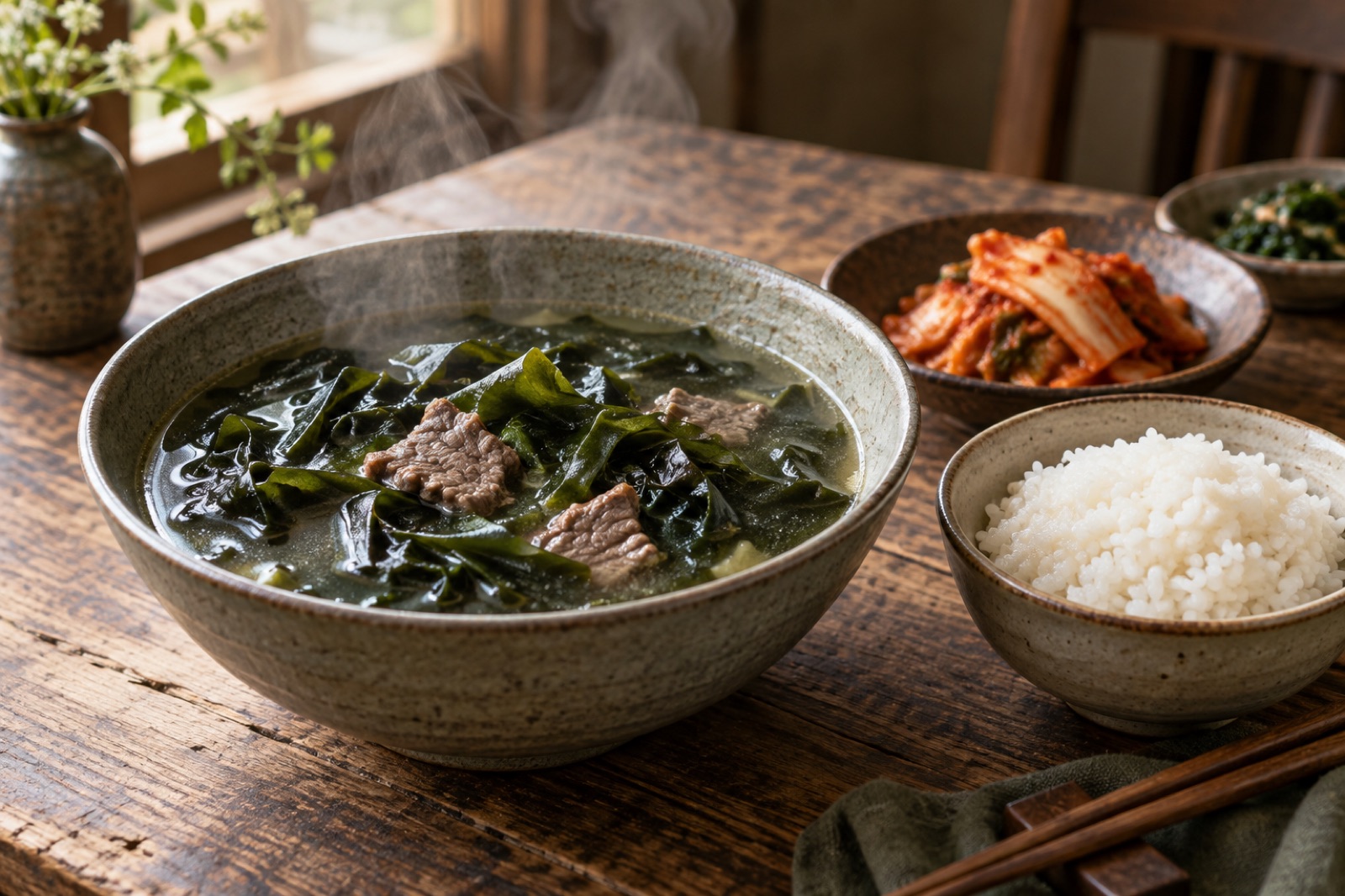
Kitchen7 min read
Miyeokguk: Korea's Birthday Seaweed Soup, Made with Respect
How to make miyeokguk, the Korean seaweed soup eaten to honour mothers and birthdays — with the culture, technique and common mistakes explained.
Sofia Andersson ·
Dashima is the dried kelp behind Korean stock, banchan and temple cooking. How to choose it, store it, and cook with it — from dasima yuksu to braised kelp.
Open the dry-goods shelf of a Korean kitchen and you'll find, between the boxes of seaweed and the bags of anchovies, a neat stack of dark, broad, dusted sheets: dashima (다시마). To a Japanese cook it looks like kombu — because it is. Dashima is Saccharina japonica, the same great brown kelp species behind Japanese dashi, dried into sheets exactly the way Hokkaido's fishermen learned to do centuries ago. Korea and Japan share this kelp the way their cuisines share the cold northern seas it grows in.
What differs is how the two kitchens treat it. Japanese dashi is exacting, minimalist, a stock of two ingredients timed to the minute. Korean cooking uses dashima more generously: boiled harder, simmered longer, and — crucially — eaten, not just steeped. A Korean pantry guide to dashima is therefore not a dashi masterclass with different spelling. It's a guide to a kelp the kitchen actually finishes.
Dashima is farmed kelp, overwhelmingly. South Korea is one of the world's largest seaweed farmers, and the longlines that hang in the cold, fast water off the southern and eastern coasts carry Saccharina japonica alongside wakame's botanical name-sake Undaria pinnatifida — the species that goes into miyeok, the soup seaweed. The two are not interchangeable in a Korean pantry: dashima is the stock kelp; miyeok is the soup seaweed. Our miyeokguk guide covers the soup side; this one is for the sheet.
You'll also meet the word dasima in transliteration and, confusingly, see kombu sold in Korean-American groceries as "kombu" and as "dashima" depending on the brand. They are the same ingredient. Buy whichever is better quality and cheaper.
Dried dashima sheets vary enormously, and the quality differences matter because the sheet is the stock. What to look for:
Thickness and size. Good dashima is broad and substantial — sheets over 20 cm wide, thick enough to feel like leather rather than paper. Thin, papery sheets give thin, papery stock.
The white dusting. A fine, pale powder on the surface is mannitol, a natural sugar alcohol that crystallises as the kelp dries. It's a mark of quality and part of the flavour — do not wash dashima before using it. At most, wipe it gently with a dry cloth if the sheet is visibly gritty. (The same rule applies to kombu for dashi.)
Colour. Deep olive-brown to nearly black. Sheets that have faded to light brown have usually spent too long on the shelf or in bright light.
Smell. Clean sea-mineral. Any sourness or mustiness means moisture got in at some point.
Grade labels. Korean brands grade by thickness and width; the top grades cost a little more and are worth it for stock. For snacking applications (fried dashima chips) the middle grades are perfect.
Dried dashima is one of the most forgiving pantry items there is: kept airtight, dry and dark, it keeps well for a year or more. Fold any broken-off shards into a jar — you'll want them for stock anyway. Full guidance lives in our seaweed storage guide, but the short version for dashima is: airtight box, away from the stove's humidity, and never the fridge, which invites condensation. If the surface white dust darkens or the sheet feels limp, the kelp has taken on moisture; the flavour will follow it down.
Dasima bugak — the fried chips — keep for a day or two in an airtight tin before the crisp dies, so fry what you'll eat.
The stock is where dashima does its primary work, and the Korean method is more forgiving than the Japanese one. Classic Korean anchovy-kelp stock (dasima myeolchi yuksu) is the quietly essential liquid behind jjigae, noodle soups, tteokbokki and most of the temple kitchen's repertoire.
Ingredients for about 1.2 litres
Method
For a fully plant-based version — standard in Korean temple cooking, one of the world's great vegetarian traditions — replace the anchovies with two or three dried shiitake and a piece of radish, and let the dashima carry more of the load.
This is where the Korean pantry departs from the Japanese one. In a Korean kitchen the stock sheet has a second life, or is bought to be eaten outright.
Cut dashima into bite-size diamonds, then braise gently in a small amount of water with soy sauce, a little sugar or oligo syrup, a clove of garlic and a thread of sesame oil until tender and glazed — twenty minutes of quiet simmering. The result is a glossy, sweet-salty banchan that keeps a week in the fridge and eats like a firm, briny treacle candy. It is one of the best answers to the question "what do I do with dashima besides stock," and a close cousin of the Japanese preserve in our kombu tsukudani recipe.
Cut dashima sheets into wide strips with scissors; fry briefly in a thin film of hot oil — a few seconds a side, until the surface puffs into fine bubbles but before it darkens toward bitter. Drain, salt lightly, and eat while shattering-crisp. This is the gateway seaweed snack and usually gone within minutes; a sprinkle of sugar instead of salt tilts it toward the traditional temple-treat version.
Soy-braised beef, eggs and garlic — jangjorim — often simmers with a piece of dashima in the pot, seasoning the braise with marine glutamate the way a European cook might slip in a bay leaf and a parmesan rind at once.
Dashima is one of the most mineral-dense foods in the dried-goods aisle, and one of the richest common food sources of iodine — which is the entire point of the caution in our iodine and seaweed guide. A 10-centimetre square of dashima in a pot of stock is a sensible everyday amount; simmering whole sheets into every meal, every day, would be too much for some thyroids. As with all sea vegetables, variety across the week is the comfortable strategy. Broader context for how kelp goes from domesticated lines to the pantry lives in the Holdfast nursery system and Tidewright Harvest pages.
Yes — both are dried Saccharina japonica kelp, prepared the same way. The words belong to different cuisines: kombu to Japanese dashi culture, dashima to Korean stock, banchan and temple cooking. Product grades and preferred sheet sizes differ slightly between Japanese and Korean brands, but the ingredient is interchangeable, and either will perform in the other's recipes.
It's mannitol, a natural sugar alcohol that crystallises on the surface as the kelp dries, along with some of the kelp's free glutamates. It's a sign of quality, and it's a big part of where the stock's savouriness comes from. Genuine mold is fuzzy, patchy and smells off; mannitol is a fine, even, pale dusting. Wipe with a dry cloth at most — never rinse or soak before stocking.
Absolutely, and Korean cooks often do. Slice the simmered sheet thin and season it — a drizzle of soy sauce, sesame oil and toasted sesame seeds is enough — or braise it in the jorim style for a firmer banchan. The texture is softer than freshly simmered dashima, and the flavour is quieter, but it's good food, and throwing it out after one steeping wastes what our tsukudani recipe exists to celebrate.
Any Korean grocery will carry several grades, usually at friendlier prices than Japanese-branded kombu at the same quality. Online Korean food retailers stock the top grades too. Whatever the source, buy from somewhere with a quick turnover and a tidy dry-goods shelf — the guidance in our sustainable seaweed buying guide applies here as anywhere.
A piece around 10 × 10 cm per 1.5 litres of water is the classic ratio for Korean anchovy stock, and roughly the same for dashi. More dashima doesn't scale the flavour linearly — past a certain point you mostly get a thicker, more mineral stock that can edge toward bitterness on a long simmer. If your stock tastes weak, extend the soak time rather than doubling the sheet.
How to make miyeokguk, the Korean seaweed soup eaten to honour mothers and birthdays — with the culture, technique and common mistakes explained.
Sofia Andersson ·
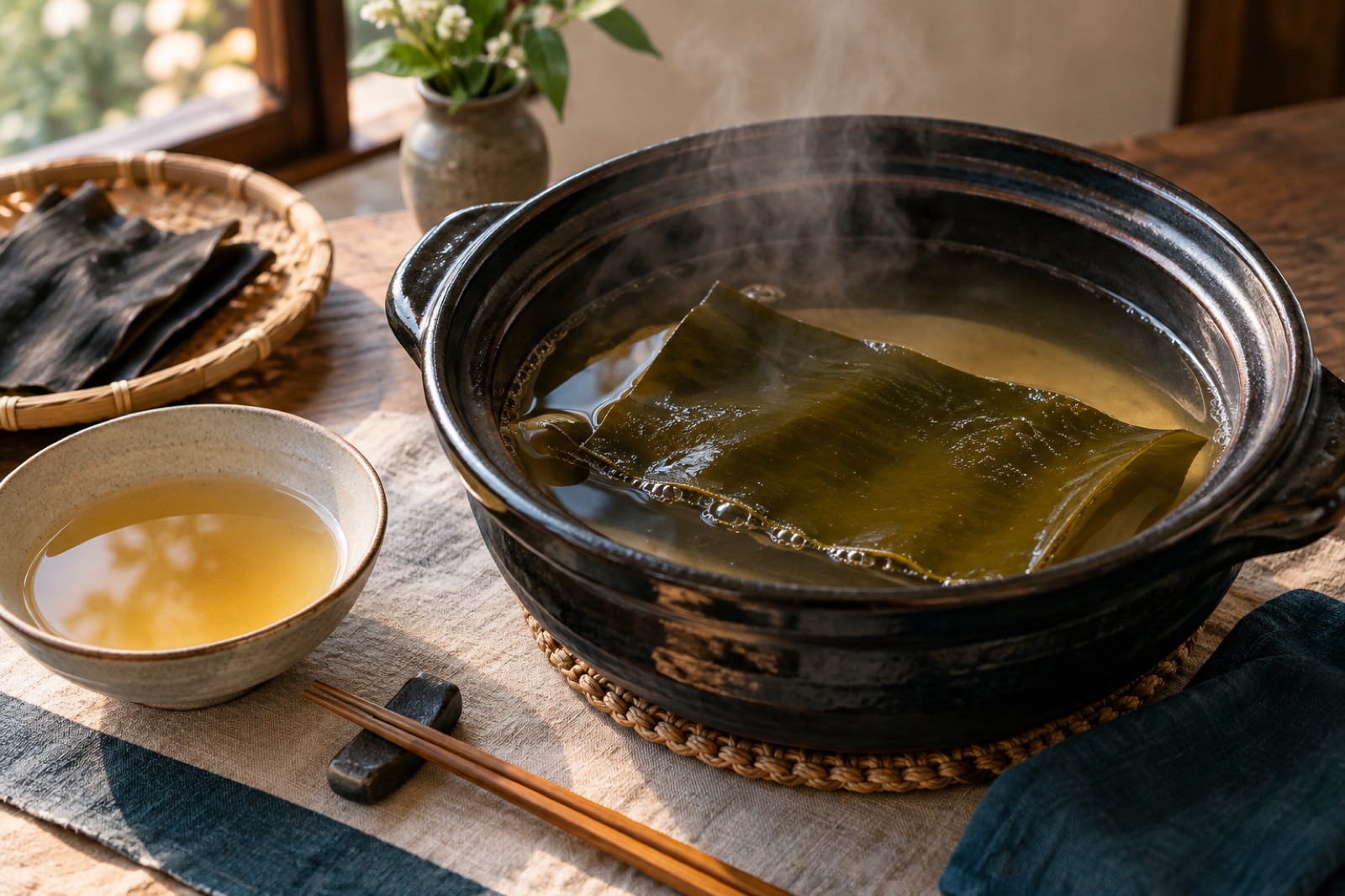
A deep, technique-first guide to kombu dashi: glutamate science, exact temperatures, ichiban and niban infusions, and how to fix every common mistake.
Sofia Andersson ·
Seaweed storage done right keeps flavour vivid and nutrition intact. How to store dried, fresh, frozen and fermented seaweed — plus how to rehydrate properly.
Sofia Andersson ·