Kitchen11 min read
Kombu Dashi Masterclass: The Broth That Built a Cuisine
A deep, technique-first guide to kombu dashi: glutamate science, exact temperatures, ichiban and niban infusions, and how to fix every common mistake.
Sofia Andersson ·
How to make seaweed stocks beyond Japanese dashi — Western vegetable broths, shellfish-kelp broths and ramen bases, with freeze-concentrates for the freezer.
Every serious stockpot wants the same three things: depth, savouriness and a clean finish. Seaweed delivers all three through a single mechanism — glutamates, the amino acids that make foods taste genuinely savoury rather than merely salty — and kombu carries a higher glutamate concentration than almost any other ingredient in any cuisine. Japanese cooks built an entire culinary grammar on that fact with dashi. But the molecule doesn't care about borders, and once you understand how to extract it, seaweed becomes the most efficient depth-builder in a Western or fusion stockpot too.
This guide assumes you can already make a basic kombu dashi — five minutes, two ingredients — and goes from there: the extraction science that governs every broth, a Western-style kelp vegetable stock, shellfish-and-kelp broths that taste like the shoreline in the best way, ramen-style tare-backed broths, and a freezer concentrate system that puts any of these ten minutes from dinner. If you want the pure vegetable broth in its own right, we have a dedicated seaweed vegetable broth recipe too.
Three variables decide what ends up in your pot, whatever style you're cooking.
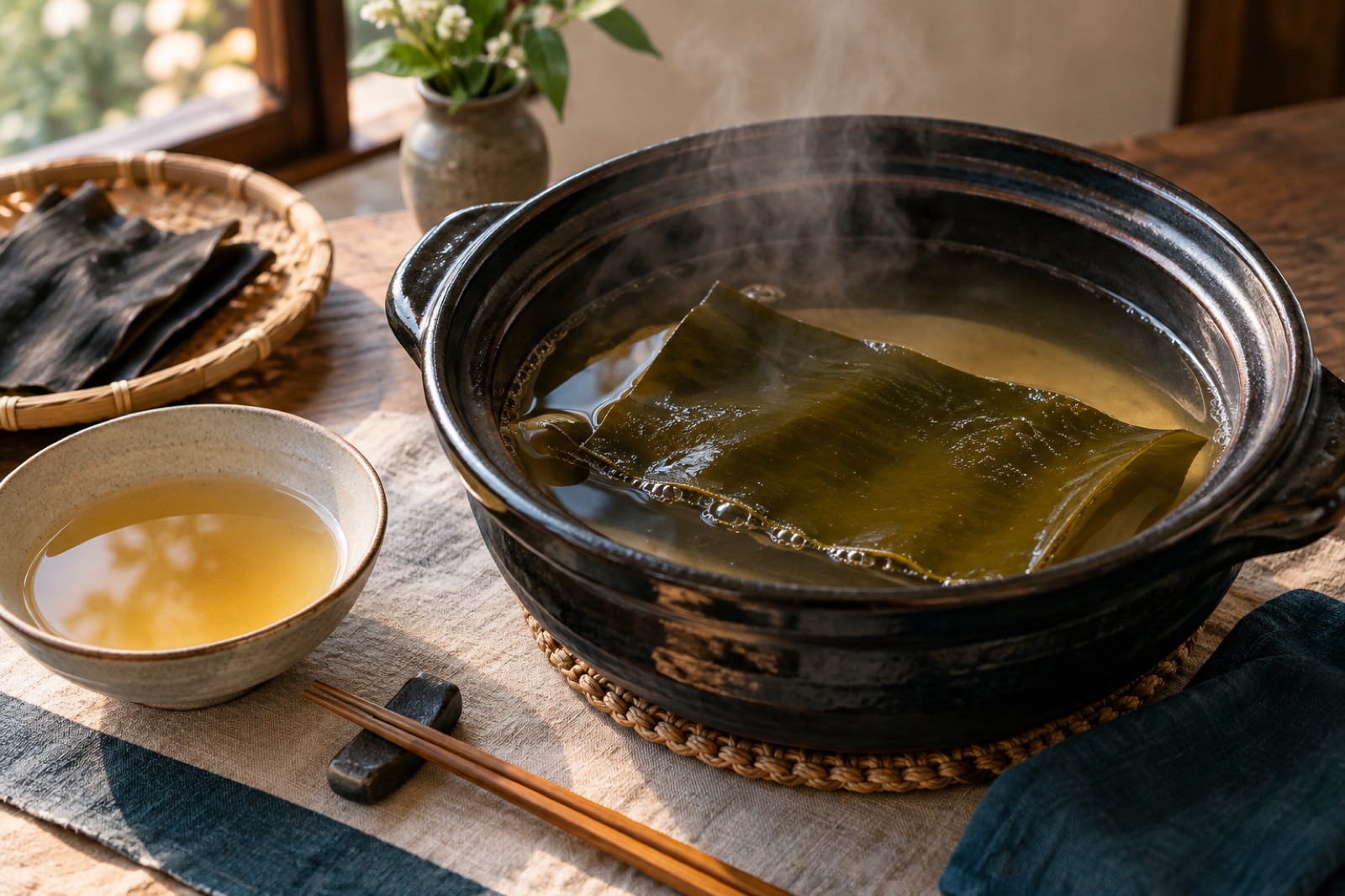
Temperature. Kombu's glutamates extract beautifully in cool water and freely up to about 60–70°C. Above that temperature — a trembling simmer rather than a boil — the alginates that make the broth muddy and slimy start dissolving out of the blade. Rule one of every kelp stock: bring to just below a simmer, hold briefly, remove the kelp, or never let it boil at all. The science behind this window is unpacked in the glutamate science of tasty water.
Time. Cold-soaked kombu releases glutamate over hours (the mizudashi method: a litre of water, 10 g kombu, overnight in the fridge, done). Hot extraction is faster but needs watching — 20 minutes at 60°C outperforms 5 minutes at 95°C on both flavour and clarity.
Synergy. Glutamate alone is pleasant; glutamate plus a nucleotide (inosinate from fish and meat, guanylate from dried mushrooms) multiplies perceived umami roughly eightfold — a genuinely measurable synergy, not kitchen folklore. Every great seaweed broth exploits this: dashi pairs kombu with katsuobushi, and the Western broths below pair kelp with dried shiitake, roasted bones or shellfish shells.
The workhorse: a European-style stock that happens to use the ocean's best trick. Deep enough for risotto, clean enough for poaching.
For ~2 litres:
Soak the kombu in the water for 30 minutes (or overnight, cold, if you're planning ahead). Add everything else, bring to the barest simmer, hold 45 minutes without boiling, then lift out the kombu. Simmer the vegetables 30 minutes more if you want the stock darker and more vegetal; strain, season lightly with salt only if the destination demands it.
Two judgements matter. First, charring the onion is what separates this from boiled-vegetable water — the caramelised surface gives the stock its backbone. Second, lifting the kombu early keeps the stock bright; left in for the full simmer it still tastes fine but turns a shade muddy in both colour and flavour.
The resulting stock is the right base for a winter kelp chowder, for cooking grains (the kombu rice method works on the same principle), and for a pan sauce after searing scallops.
The highest-value broth most home cooks never make, because it builds itself from things usually thrown away: prawn shells, crab or lobster bodies, mussel and clam steaming liquor, and fish frames (heads and bones of white fish only — oily fish like mackerel make bitter broths).
For ~1.5 litres:
Cold-soak the kombu in the water for 20 minutes while the shells roast. Combine everything, bring slowly to a bare simmer — skimming the foam once — and hold 25–30 minutes, no longer: shellfish shells turn chalky-bitter with extended cooking. Remove the kombu at the ten-minute mark if the pot trembles toward a boil. Strain through a fine sieve, pushing on the shells.
This is the base for chowders, cioppino, bouillabaisse-style soups, paella with real depth, and the single best poaching liquid for white fish you will ever use. The kombu doesn't make it taste of seaweed; it makes the shellfish taste more of itself.
Homemade ramen lives and dies on the tare (the seasoning concentrate) as much as the broth, and kelp is the natural anchor of both.
The broth: a hybrid — 1.5 litres of kelp-shiitake stock (the Western stock above, minus the tomato-family vegetables, plus a chicken carcass or 300 g chicken wings if you eat meat) simmered two hours and strained.
The kombu tare: simmer 100 ml kombu soaking water with 80 ml soy sauce, 40 ml mirin and a small piece of dried shiitake until reduced by a third. This dark, glossy concentrate keeps two weeks refrigerated and seasons each bowl individually — 2 tablespoons tare in the bowl first, then 300 ml hot broth, then noodles and toppings.
The point worth understanding: separating seasoning (tare) from liquid (broth) is what lets one pot serve miso lovers, shoyu lovers and the salt-shy at the same table. For the fully plant-based version of this architecture, our vegetarian dashi guide builds the same logic on kombu and dried mushrooms alone.
Stock is cheap; attention is expensive. The concentrate system solves it: make any broth above, then reduce it by half to two-thirds over a brisk simmer until intensely flavoured, cool, and freeze in ice-cube trays or 100 ml portions. A 60 ml kelp-stock cube sized portion plus 500 ml boiling water makes a bowl-ready broth; two portions anchor a risotto; one portion deglazes a pan.
Two cautions. Reduce after straining and after removing the kombu — concentrating with kelp still in the pot concentrates the alginates too, and you get a glossy, unpleasant viscosity. And season concentrates only lightly; reduction concentrates salt as well as flavour, and the final dilution ratio varies by dish.
Frozen, concentrates keep three months without flavour loss and are safe far longer. This is also the best use for the soaking waters and steaming liquors the week's cooking produces — kombu soak water, wakame soaking liquid, mussel liquor — all of which freeze into flavour cubes rather than going down the drain.
It is worth pausing on why this ingredient matters beyond flavour. The kelp in these pots increasingly comes from regenerative ocean farms — the same operations, like Tidewright's Harvest program, that fund the replanting of wild kelp forests with their culinary yield. A litre of stock made from farmed kelp carries a small share of that loop: restoration paid for by dinner. It is the rare case where the sustainable choice is also simply the better-tasting one, because farm kelp is harvested young, at peak glutamate content, and processed within days.
You can, and it won't be inedible — but above a simmer the blade releases alginate polysaccharides that make the broth slippery and cloudy, and the flavour turns rougher and more iodine-forward. Keep it at a shiver, pull it early, and the difference is immediately obvious.
Dashi is a specific Japanese technique family — cold-soak or gentle-heat extraction of kombu (often with katsuobushi or niboshi), prized for delicacy. "Seaweed stock" is the broader category: any broth where kelp provides the umami base, including heavier Western-style simmered stocks that dashi's clarity standards would reject.
Yes — it refrigerates four days and freezes three months like any stock. The one caution is iodine: if you drink cups of strong kombu broth daily, tally it against the intake guidance in our seaweed nutrition guide. Culinary quantities in soups and sauces are a non-issue for most people.
Usually one of three things: the kombu boiled, shellfish shells simmered past 30–40 minutes, or the vegetable stock included brassicas or artichoke trimmings, which don't belong in a kelp stock. Bitterness can't be removed once extracted; balance it with a little sweetness (mirin, a pinch of sugar) and lean on the tare.
Dried kombu (ma-kombu or hidaka for dashi-grade; any kitchen-grade kombu for Western stocks), farmed sugar kelp drying strips where available, or the kombu sold for Korean dashima. Save expensive dashi-grade blades for delicate broths; a rougher cut stock doesn't notice the difference.
Filed under
A deep, technique-first guide to kombu dashi: glutamate science, exact temperatures, ichiban and niban infusions, and how to fix every common mistake.
Sofia Andersson ·
A savoury vegetable broth built on kombu and dried shiitake — deep, clean, and versatile enough for soups, grains, braises and sauces.
Sofia Andersson ·
How to make vegetarian dashi from kombu and dried shiitake: cold-brew and hot methods, the glutamate-guanylate synergy, and what to cook with it.
Sofia Andersson ·