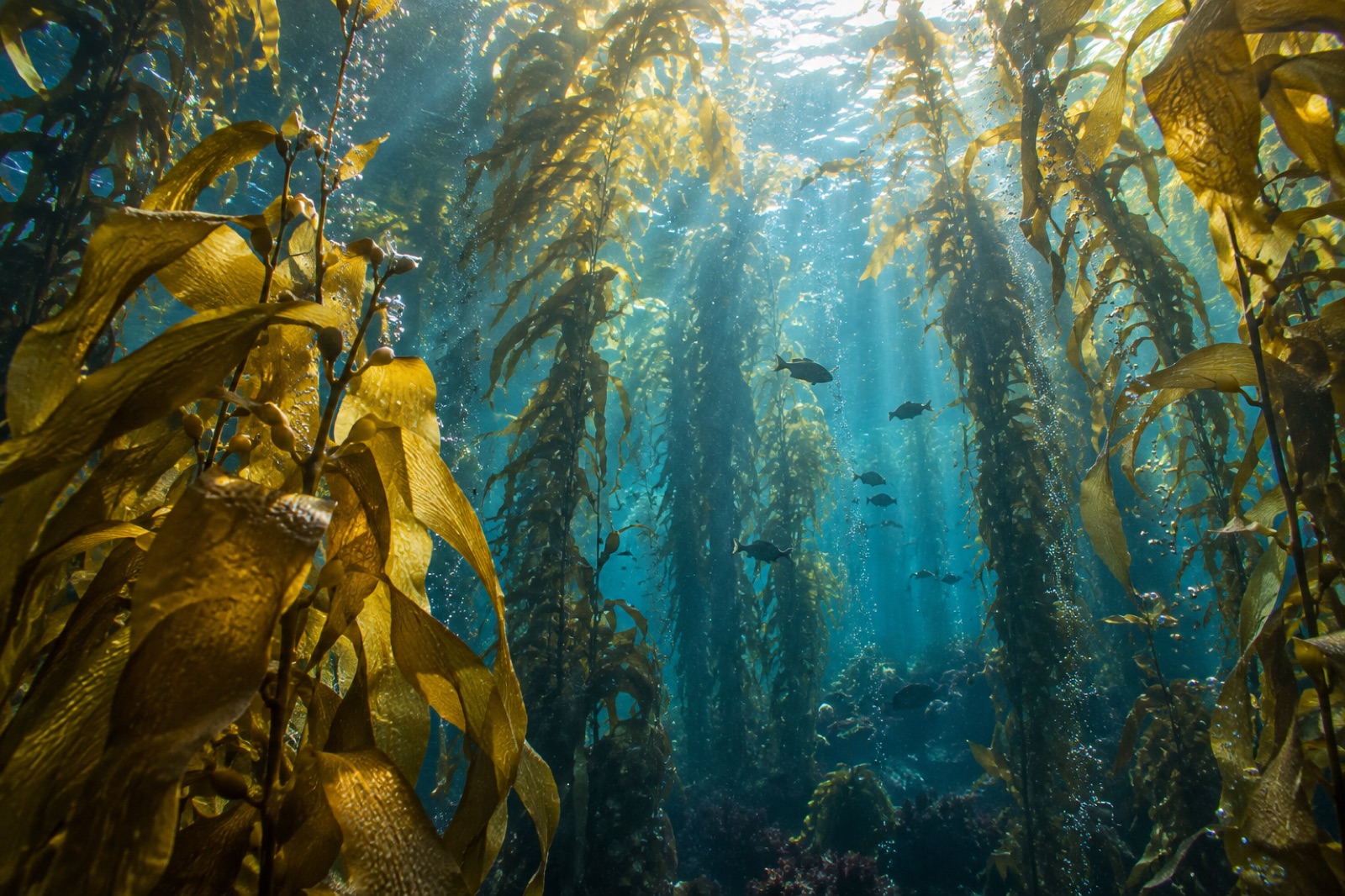
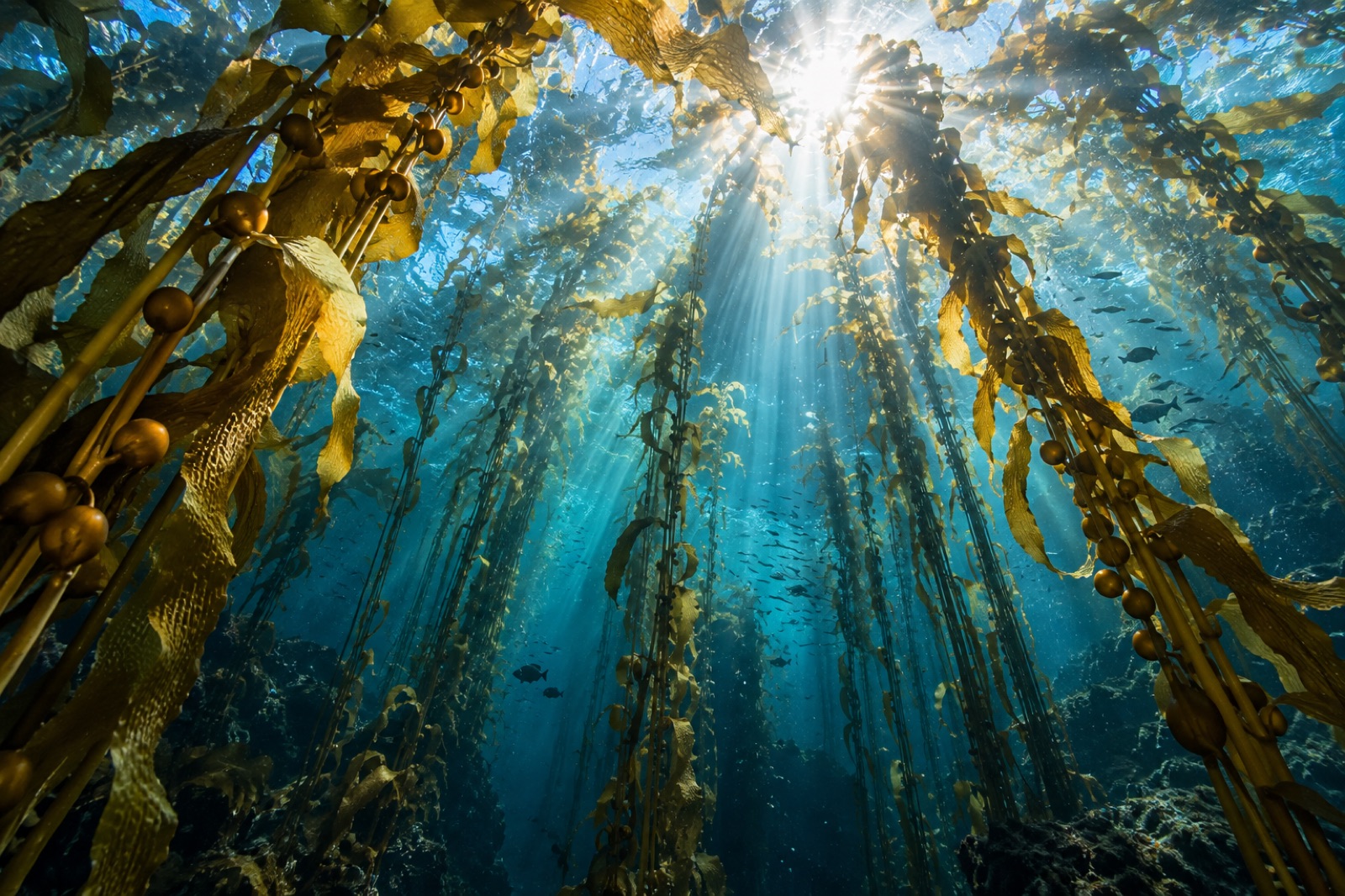
Type "do kelp forests" into a search box and autocomplete will finish the sentence with "...produce oxygen?" It is the question every kelp company gets asked first, and it deserves a two-part answer. Part one: yes, emphatically — a sunlit kelp canopy releases oxygen into seawater at rates that rank with the most productive ecosystems ever measured. Part two: almost none of it is destined for your lungs. The oxygen we breathe comes out of a budget with an enormous standing stock and near-zero annual flow, and kelp's line in that budget — though real — is small, local and mostly repaid within hours. Here is the accounting, from the human breath backward.
Two companion pieces carry neighbouring parts of the story: what kelp photosynthesis delivers to the water and the ocean's whole oxygen ledger. This one follows the air.
Your last breath was not local
Oxygen in the atmosphere behaves unlike almost anything else we track environmentally. The stock is enormous — the atmosphere holds roughly a fifth of its molecules as O₂, an inventory dwarfing every annual flow in or out — and it is extraordinarily well mixed. Winds and weather stir the whole atmosphere on timescales of weeks to years, far faster than oxygen sources and sinks could ever imprint a geography on it. Instruments at mountain observatories and coastal stations read essentially the same oxygen fraction, minus a thin seasonal ripple from hemisphere-scale photosynthesis.
The consequences are counterintuitive but liberating:
- There is no such thing as "coast air" richer in oxygen than inland air. The oxygen above a kelp forest is the oxygen above a wheat field is the oxygen above a city, to within tiny, instrument-grade differences. Sea air feels different because of humidity, aerosols and salt — not because of O₂.
- Your breath is a planetary blend. The O₂ molecules you just inhaled were released by a billion years' worth of photosynthesizers, stirred thoroughly: marine plankton, rainforests, grasslands, tundra, and yes, some kelp. No molecule carries a return address.
- The stock changes on geological time, not news-cycle time. Gross global photosynthesis is large enough to cycle the atmosphere's oxygen every few thousand years — but gross consumption cancels it almost exactly. What accumulates is only the sliver of organic matter buried before it can be respired, which is why atmospheric oxygen has crept, not leapt, across Earth history.
The language trap: produced versus breathed
The viral claims — "the ocean produces every second breath," "kelp forests generate X% of Earth's oxygen" — trade on a quiet swap between two words. Produced is a gross-flow statement. Breathed is a net-stock statement. Marine photosynthesis does account for roughly half of gross oxygen production on Earth (kelp a small share of that marine half, which is dominated by open-ocean phytoplankton). But nearly every produced molecule is claimed back by respiration — by the producers themselves, by grazers, and by microbes digesting the debris — before it can join the standing atmospheric bank.
So the defensible sentence is: half of gross oxygen production is marine, and the marine net contribution to the air you breath is approximately zero this year, next year and every year on human timescales. That is not an anti-ocean statement — it is simply how a balanced budget reads. The planet's oxygen is a legacy asset, built by burial over eons. Our lives run, oxygen-wise, on the interest-free use of an enormous deposit.
The kelp line item, scaled honestly
Kelp forests are productivity monsters per square metre — the mechanics are laid out in how kelp photosynthesizes — but they occupy a narrow ribbon of rocky coastline. Three multiplications shrink the claim:
- Area. Kelp habitat is a small fraction of one per cent of the ocean's surface; the phytoplankton engine runs over nearly all of it.
- Net versus gross. Like all ecosystems, kelp forests respire most of what they fix. The diel swing — supersaturated canopy water by afternoon, drawn down by a breathing forest before dawn — means the local water column gains oxygen episodically, not cumulatively.
- The only exit is export. Oxygen becomes net addition only if the carbon it accompanied is removed from respiration's reach — eaten, exported, buried. Kelp's distinctive talent is exactly this: abrasion and storms detach fronds that sink to canyons and abyssal plains, documented in where kelp carbon goes. That pathway is climatologically real and modest — and it is measured in carbon, which is why serious blue-carbon accounting tracks carbon fate rather than oxygen release.
Could industrial-scale seaweed cultivation move the dial? If humanity farmed seaweed at continental scales and sank or sequestered the biomass durably, the net oxygen production would be real — proportionate to the buried carbon. At any feasible scale, though, the change in the atmosphere's O₂ fraction would be detectable only by specialists' instruments. The carbon argument for seaweed is legitimate and worth having; the oxygen argument is a rounding error wearing a costume.
Where kelp oxygen genuinely matters
None of this erases the local story, which is magnificent. For water-breathers, dissolved oxygen is not a legacy stock — it is a minute-to-minute resource, and kelp forests are superb at locally recharging it. Daylight supersaturation inside a healthy canopy cushions juvenile fish, abalone and crabs precisely when they need it most: warm water holds less oxygen while cold-blooded metabolisms run faster, so a forest's photosynthetic surplus acts like a physiological subsidy during hot spells. Divers see it as pearl streams of gas rising off blades; instruments log the proof as afternoon maxima of dissolved oxygen above equilibrium. That habitat service — feeding the reef's breath, not ours — is reason enough to restore forests.
The honest claim is the stronger one
It is tempting to sell kelp restoration as an air supply. Don't. The ocean's real oxygen emergency is interior deoxygenation driven by warming and nutrient pollution in deep layers and along suffocating shelves — a problem of falling stocks, not of breathing supply. And kelp's own portfolio needs no oxygen myth: biodiversity and fisheries value, coastal protection, nutrient cycling, food and materials, and a measurable-if-modest carbon export that programs like Canopy Ledger exist to verify. Restoring a forest because it rebuilds a living coast is a claim that survives audit. "We make your air" is not.
Key takeaways
- Kelp forests produce oxygen vigorously but locally — into seawater, on a day-night cycle largely repaid by respiration before dawn.
- The atmosphere's oxygen is a vast, well-mixed stock built over geological time; there is no oxygen-rich "coastal air," and no ecosystem can claim a share of your next breath in any audit sense.
- Only exported and buried production yields net oxygen. Kelp's distinctive contribution runs through carbon export to depth — tracked in carbon units, not oxygen units.
- Scaled seaweed farming's oxygen effect would be instrument-grade at best; its carbon and food arguments are the real ones.
- Where oxygen matters for kelp is inside the forest: habitat quality for fish and invertebrates, especially under heat stress.
FAQ
Do kelp forests produce more oxygen than trees?
Per square metre, a healthy kelp canopy's gross photosynthetic rate rivals or exceeds most terrestrial vegetation — kelp grow fast because water delivers nutrients and CO₂ directly to the blade. But "more oxygen" needs the accounting qualifier: both systems respire most of their own output. Gross rate champions ≠ net suppliers; neither a forest of trees nor a forest of kelp is steadily topping up the atmosphere this decade.
If we restored all the planet's lost kelp, would atmospheric oxygen rise?
Measurably, no — meaningfully, no. Restoring kelp at any realistic scale increases gross coastal production, but the near-total cancellation by respiration means the atmospheric stock barely registers it. What changes — importantly — is habitat, fisheries, carbon export and coastal water quality. Frame restoration on those terms and the case stays rock solid.
Is the "ocean produces half our oxygen" claim wrong?
Half right, precisely. It correctly describes the ocean's share of gross global production. It misleads when listeners assume a steady net supply of breathable air, because marine respiration consumes nearly all marine production. The accurate wrapper: the ocean produces about half of Earth's oxygen and consumes nearly all of it itself.
Why do scientists care so much about the carbon, then?
Because carbon fate is where the ocean's living systems genuinely touch the planet's long-term ledgers. Organic carbon that escapes respiration through export and burial is simultaneously net carbon dioxide removed and net oxygen retained — the same bookkeeping event, viewed from two sides. It is slow, modest and geological in flavour, but it compounds. That is the ledger worth restoring toward.
Does breathing sea air give you more oxygen?
No. Barometric pressure and humidity change; oxygen fraction does not, within a whisker. The well-documented well-being effects of coasts come from other ingredients: negative-iodine aerosols remain scientifically contested, but light, sound, movement and clean cool air are not. Breathe deep at the shore for joy, not for O₂.