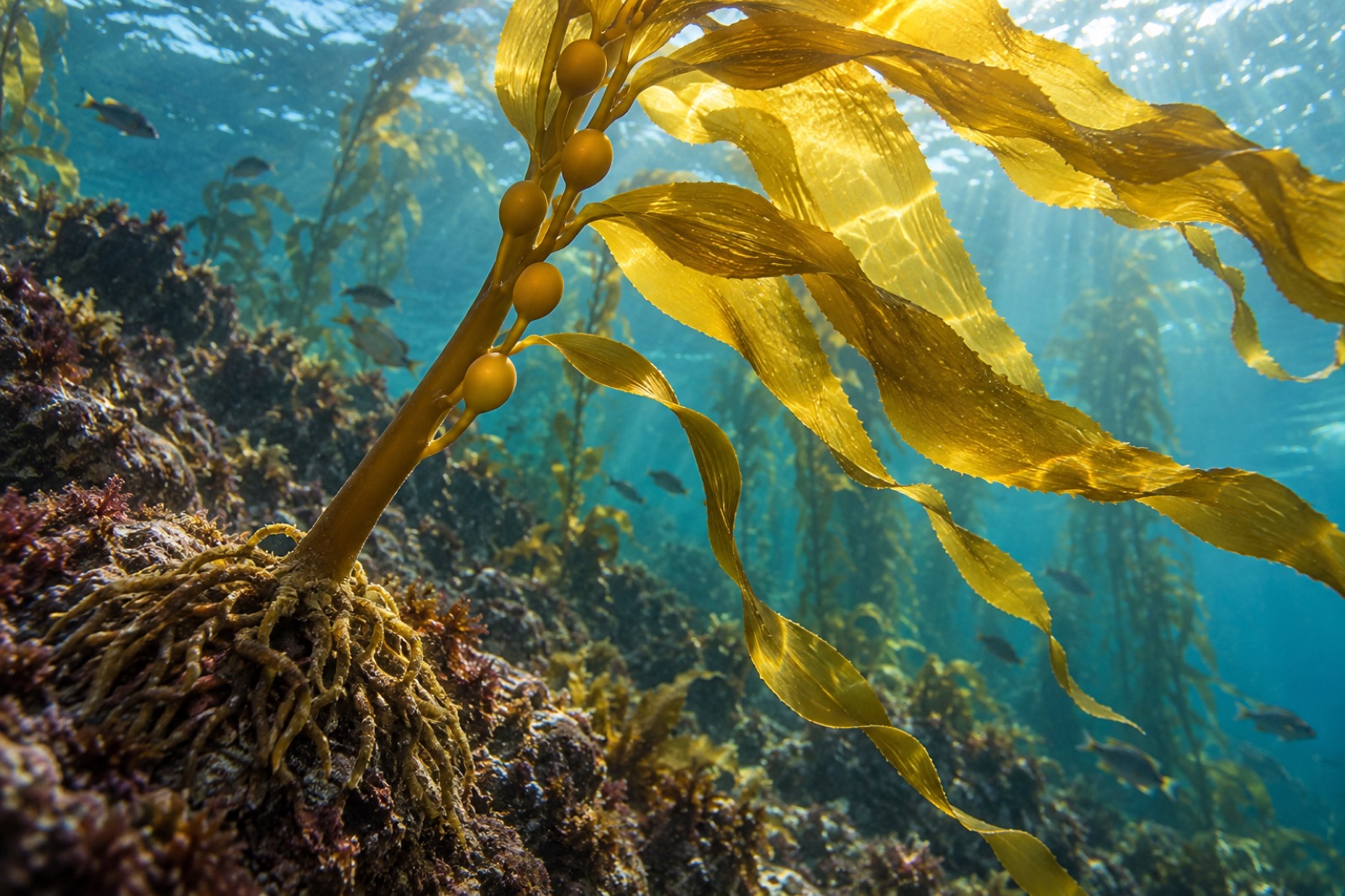
Of all the small snails that ride the kelp forests of the northeast Pacific, the blue-top snail (Calliostoma ligatum) is the one that divers notice first: a smooth, conical top shell the colour of wet slate and old coins, spiralled with fine ridges, moving deliberately across the surface of a living kelp blade. It ranges from Alaska to Baja California and is one of the few snails that grazes the kelp's own tissue rather than just its surface film — a small distinction with large consequences, in the forest and on the farm. This profile explains how to identify it, what it actually eats, and where it sits in the kelp-bed guild of topsnails.
Identification: the modest jewel
Calliostoma means "beautiful mouth," a nod to the pearly nacre that lines the aperture of every member of the genus. The blue-top is among the smaller topsnails of the coast, typically 1.5 to 2.5 centimetres across the base and a little taller than wide: a straight-sided cone with seven or eight gently rounded whorls, each crossed by a dozen fine spiral cords that catch the light in alternating gloss.
The living shell is the tell. Under a thin, olive-tan outer skin (the periostracum), the shell proper is a quiet blue-grey — the "blue top" of the name — often with a faint spiral banding of darker streaks. Worn shells can bleach toward silver; specimens long in weed can carry a mustard-yellow cast. The aperture is small relative to the shell, roundly angled, and deep mother-of-pearl within. The operculum is thin and horny, multi-spiral — not the heavy calcareous "door" of a turban snail.
Two similar relatives share its water. The purple-ringed topsnail (Calliostoma annulatum) — brighter, banded with a ring of violet at the aperture — is a canopy specialist of southern giant-kelp beds. And the Atlantic's painted topshell is its east-side counterpart in looks and habit. Confusion with Tegula species is common, but Tegula is matte, rough, black or brown and much less glossy.
Range and habitat: from blade to canopy
The blue-top snail runs the whole cold rim of the northeast Pacific: from Prince William Sound, Alaska, down through British Columbia and Washington to California, with records continuing into Baja California. It is common throughout Puget Sound, inside the Strait of Georgia, along the Vancouver Island west coast, and south through the Oregon and northern California bull-kelp beds into Monterey and beyond.
Its vertical range is broader than its reputation suggests. It lives from the low intertidal — where it is one of the more familiar snails of cobble and low-shore algae — well into the subtidal, and, crucially, it climbs. On kelp-forested coasts the blue-top is one of the more frequently encountered topsnails on the plants themselves: on the stipes and blades of giant kelp, on bull kelp, on the big laminarians, on almost any broad-bladed brown that offers a flat surface and a film of epiphytes. Densities on a single kelp plant are usually modest — a snail on this stipe, one on that blade — but a mature kelp bed supports them everywhere, and a trained eye reads their presence from the holes they leave.
A grazer that eats the kelp itself
Most "kelp snails" are not, strictly, eating kelp. The small, abundant mesograzers — lacuna snails, amphipods, tiny isopods — mostly strip the epiphyte film that grows on the blade: diatoms, filamentous microalgae, bryozoan crusts. They are the kelp's gardeners, keeping the light-capturing surface clean. The blue-top snail does that too, in part. But it also regularly rasps the kelp's own epidermis and soft blade tissue. The signature of its feeding is diagnostic: irregular holes and notches in the mid-blade, scalloped edges, and a network of pale, thinning streaks where the radula has worked the surface film down to the transparent membrane beneath.
In a wild bed with a full community of predators, blue-top grazing is a modest tax on a fast-growing plant. Kelp blades grow from their meristem so quickly that a grazed hole is a temporary wound, and a healthy snail population is simply part of the standing maintenance crew. The equation changes on the farm. In a monoculture longline of sugar kelp or another crop, where every blade is product and predator communities are thin, dense topsnail grazing is a quality problem: hole-pocked blades grade down at the packing table. It is one of the routine late-season pest guilds described in our guide to seaweed pests and diseases, handled the way the whole pest complex is handled — by watching, by harvesting on time, and by designing farms that let the small fish in to do their share of the pruning.
On the wild reef, the animal the blue-top most resembles in habits and address is the southern Norris's top snail: both are large-for-their-guild conical tops living permanently on living kelp. The comparison breaks down in diet — Norrisia is an epiphyte cleaner first and giant-kelp obligate — but the shape of the ecological niche, "large snail as canopy workforce," is the same from Alaska to the Channel Islands.
Life history: spawning into the weed
Like its topsnail kin, the blue-top is a broadcast spawner with separate sexes, and fertilisation is external. On the northeast Pacific coast, spawning is a cool-season to spring event in most populations; eggs and sperm go into the water column above the bed, and the larvae that result are small pelagic veligers that drift a period of days before finding a surface to settle on. Settlement for Calliostoma means algae: young snails come out of the plankton onto low, filamentous and coralline surfaces, and the juveniles that survive work up toward the kelps as they grow.
The larval window matters beyond reproduction. It is how a topsnail crosses water: a bed separated from the next reef by a kilometre of sand is no obstacle to a larva on the current, and the blue-top's population genetics — patchy but coherent across its enormous range — is the fingerprint of open water periodically re-stitching the beds together. It is the same dispersal arithmetic that lets a re-established kelp stand pick up its old grazing guild again after a heatwave.
Predators and defences
An exposed snail on a blade is food, and the blue-top is taken by the whole kelp-bed guild of benthic predators: sea stars (including the sunflower star and the common Pisaster species), which can engulf and digest it; crabs, which crack it; wrasse, surfperch and sculpins, which nip it off the blade; and the diving birds and sea otters of the shallower coast. Its defences are those of its family: a hard, thick-walled shell of tightly coiled form that resists crushing; a mucus-heavy foot that some crabs find difficult to grip; and, like so many kelp-bed snails, a fallback strategy of letting go. A heavily disturbed blue-top clamps, retracts and drops off the plant. Sand is survivable at small size; a patient foot carries it back to a stipe across the gap that would kill a limpet.
Where and how to see one
Any cool-water kelp or mixed-algae shore in range will serve. In the low intertidal, turn back weed-draped cobble at a spring low tide; in the subtidal, dive or snorkel a bed and work along the blades at eye level — the snails sit on the flat face of a blade or against the stipe. British Columbia and Washington hold them everywhere; so do the beds of the Haida Gwaii archipelago and the kelp forests south. Their art as a subject for a photographer is the light through a conical shell against the gold-brown blade — one of the small, perfect compositions the kelp forest offers patient eyes.
Key takeaways
- Calliostoma ligatum, the blue-top snail, is a small (to ~2.5 cm), slate-blue conical topsnail ranging from Prince William Sound, Alaska to Baja California.
- It lives in the low intertidal and subtidal and climbs freely onto kelp — giant, bull and other broad laminarians — where it grazes.
- Unlike the smaller mesograzers, it eats the kelp's own blade tissue as well as the epiphyte film, leaving diagnostic holes and streaks in blades.
- On wild reefs its grazing is a minor tax within the standing maintenance crew; on monoculture kelp farms it is a routine quality pest.
- Its broadcast-spawned, planktonic larvae are how the species re-assembles on reefs separated by sand and current.
FAQ
Is the blue-top snail the same as a topsnail or turban snail?
"Topsnail" and "turban snail" are both casual names for members of the families Calliostomatidae and Tegulidae (the top-shaped shells). Calliostoma ligatum is a true topsnail (Calliostomatidae), related to the purple-ringed topsnail; it is not a Tegula turbansnail, though the two are often confused in the field.
Does the blue-top snail kill kelp?
On wild reefs, essentially never: its grazing is a surface tax that kelp growth rates easily outpace. On farms, dense populations can badly downgrade crop blades; in the worst cases heavy combined grazing from blue-tops, lacuna snails and isopods can leave a longline crop unmarketable. Wild-balance versus monoculture-pest is the standard pattern for every blade-grazing snail.
Where is the best place to see blue-top snails?
Northern kelp beds and rocky low-intertidal shores. British Columbia's inside and outside waters, Washington's Olympic coast and northern Oregon all hold dense populations. Find a kelp bed with grazing signs on the blades and the snails are nearby — look along the midrib and at the blade base.
What eats blue-top snails?
Sea stars — sunflower stars and Pisaster among them — crabs, wrasse and other kelp-bed fish, octopuses, and the usual shallow-water predators that take shelled prey. Its defences are a thick shell, a chemically slippery foot and a willingness to drop off a plant when seriously disturbed.
Is it safe to handle one on the shore?
Yes; like most small kelp-bed snails it is harmless, and a brief look at the pearly mouth of the shell is half the pleasure of finding it. As with any intertidal animal, keep the visit short, keep the animal wet, and set it back exactly where and how you found it, foot down, on the same weed.
Are blue-top snails affected by ocean warming?
Like every northeast-Pacific kelp-bed snail they live at a kelp bed's frontier: south of the kelp's southern limit, the species fades with the plant. Prolonged marine heatwaves that strip canopy and blade abundance also strip the blue-top's forage surface; recovery follows the forest's return.