Encyclopedia8 min read
East Pacific Red Octopus: The Kelp Forest's Small Strategist
East Pacific red octopus Octopus rubescens: den middens, colour-flash camouflage, egg brooding and night hunting in California's kelp forests.
Dr. Theo Nakamura ·
Red octopus dens stitch a kelp reef together: midden maps, den real estate, Jervis Bay octopus cities and the reef's patchwork of night hunters.
Our full species profile of the East Pacific red octopus introduces the animal itself — thumb-length mantle, brick-red tweed skin, beak and ink. This article picks up where a single animal leaves off, because the most interesting thing about the red octopus is not the octopus. It is the patchwork: the geography of dozens of dens scattered across a reef, each with its rubbish heap of crab legs and shell chips, each holding one small, fierce, short-lived predator. Read the patchwork right, and you can read the whole reef — how much shelter it offers, how hard the night shift hunts, and whether the neighbourhood is thriving or thinning.
A red octopus without a crevice is a meal waiting to happen. With no shell, no spines and no bones, the species survives by being findable by nobody: hence the den, and hence a set of behaviours that ecologists can exploit like survey instruments.
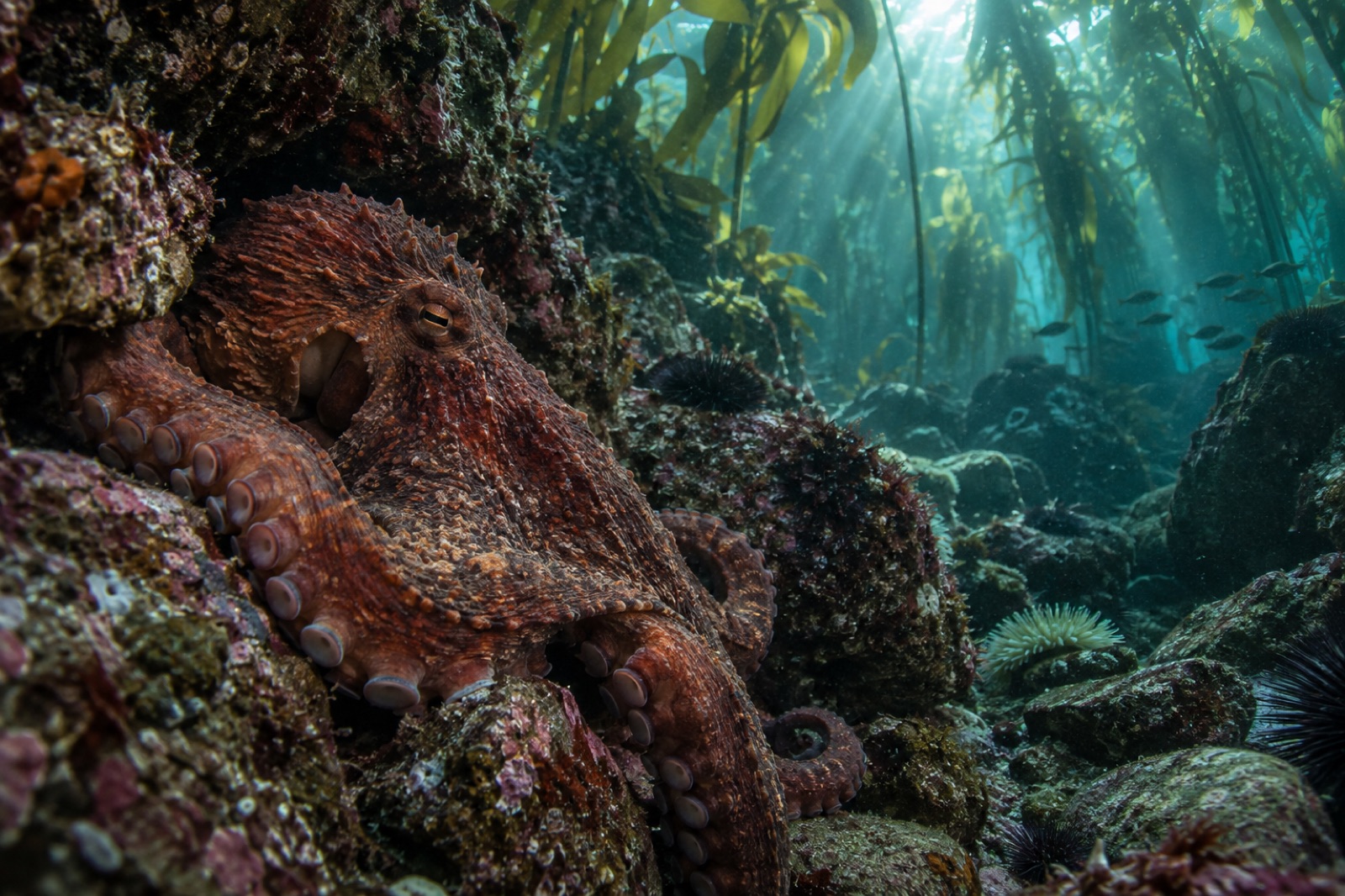
The first is fidelity. A settled adult holds one den as home base for weeks to months, hunting a circuit of surrounding rock by night and returning before full light. The second is housekeeping. Scraps from meals eaten at home are swept out of the entrance, accumulating into the famous midden — a glittering apron of red rock crab claws, turban snail opercula, clam plates and urchin spines that marks an occupied address as surely as smoke marks a chimney.
Between them, fidelity plus middens creates a map that divers can draw. Swim a 50-metre transect over broken rock anywhere from Monterey Bay to Puget Sound, note each shell-littered crevice, and you have a census of the reef's resident red octopuses accurate enough to compare year to year.
Experiments with artificial dens tell the deeper story: octopus numbers on otherwise suitable reef often climb when crevice space is added and plateau when it saturates. Shelter, more than food, commonly sets the carrying capacity of the patchwork — a lesson anyone who has watched the dens colonise wreckage, pipework and bottle piles already half-knows. Hard-bottom structure is octopus real estate, and on reefs where structure is lost to sediment scour or smothering, the midden map empties out block by block.
Most red octopus dens are pre-existing architecture: the crack under a ledge, the junction of two boulders, the hollow heart of an old shell bed. But an octopus is also a mason. Individuals excavate sand from crevices in sluicing jets from the funnel, roof over gaps with drifted shell and stone, and — famously in this species and its cousins — collect and arrange objects at the entrance. Bottle caps and shell fragments get stacked into small defensive walls; evening-built barricades often stand half-finished at dawn, the householder long since tucked away inside.
The engineering matters for temperature and safety alike: a well-drained crevice circulates oxygenated water over an animal that otherwise must pump hard to breathe, while the piled barricade frustrates the probing snouts of foraging morays and the long arms of hunting giant Pacific octopuses — the red octopus's most dangerous neighbour, one that will take reds when it meets them.
For most of the twentieth century, scientific textbooks described octopuses as strictly solitary. The red octopus fits that picture well enough on a bare reef; its patchwork is dispersed, den spacing set by hunting circuits and crevice geometry. But the concept buckled at Jervis Bay on Australia's east coast, where divers in 2009 documented Octopolis — a site where gloomy octopuses (Octopus tetricus, a different species) live at unusually high density around a scatter of human-made debris, interacting regularly, mating within sight of neighbours, occasionally hurling shell and silt at one another, and rebuilding the whole den complex year after year. A second aggregation site, Octlantis, followed nearby in 2017, this one built largely from a growing midden of scallop shells accumulated by the octopuses themselves.
The lesson Jervis Bay taught — sediment plains punctuated by shell midden and metal junk can support octopus neighbourhoods, not just dens — translates back to the red octopus as a spectrum rather than a rule. Where food is dense and shelter is artificial, solitary patches into semi-communal. The patchwork has edges defined by real estate.
Time, on a red octopus reef, is divided among the patchwork's occupants. Daylight hours belong to the fishes; hunts begin at dusk. A working red flows across open rock in cautious looms — smooth-armed, skin texture cranked to match each substrate it crosses — probing cracks arm by arm for crabs and shrimp, occasionally ballooning over a rock pool in what researchers call the parachute attack.
Predation pressure shapes everything about the tempo. Lingcod, cabezon, pile perch and hunting morays all take octopus when opportunity offers, and harbour seals work known den lines methodically. The red octopus's response is chronic caution punctuated by arithmetic: individual arms can be risked into gaps the whole body cannot enter, and a compromised den is abandoned the following night, not the same one. On night dives in kelp country, watch the reef long enough at the edge of your beam and the patchwork's residents begin to resolve — one arm-tip in that crack, one eye at the midden's edge, one silhouette flowing over open sand far bolder than daylight divers ever see.
The red octopus is a bellwether precisely because it is small, common, short-lived and home-fixed. Its two-year lifespan compresses climate signals: a cohort settling after a warm-water year can be read in the following season's midden map. Where marine heatwaves thin kelp canopies and shift prey communities, the crevice-dwelling patchwork records the change quickly — populations can crash within a single cohort, and recover on the same timescale, since each female leaves behind strings of several hundred eggs and larvae ride coastal currents to recolonise emptied rocks.
For monitoring programmes, that responsiveness is a gift. Unlike kelp canopy, which satellites can photograph, the octopus understorey rewards the slow, human work of transects and photographs. Repeat the same swim, count the same style of sign, and the patchwork becomes one of the reef's most sensitive thermometers-in-everything-but-name.
Typically yes — one animal, one den, held for weeks to months, with neighbours spaced apart by hunting ground. But solitariness is a spectrum: octopus species offered dense prey and artificial shelter have formed persistent aggregations with regular social interaction, suggesting the red octopus's spacing is set by habitat more than by instinct.
Look for the rubbish, not the octopus: a small crevice mouth ringed with crab claws, snail opercula, clam fragments and urchin spines is an occupied or recently occupied address. Approach gently, keep your light off the crack's throat, and let the animal decide whether to show an eye.
It can, because crevice space is often the limiting resource. Divers should never clear middens or pry open crevices; the midden is the survey data, and the den is the animal's entire security arrangement.
More than almost anything else on the reef: lingcod, cabezon, morays, larger rockfish, harbour seals and — most dangerously — giant Pacific octopuses. This predation pressure explains nearly every trait the species owns: den fidelity, camouflage obsession, and the night-shift schedule.
Around two years. Both sexes die soon after reproducing; the female broods her strings of eggs for weeks, then dies as they hatch. This short clock is why local populations can crash and rebound within a single year.
East Pacific red octopus Octopus rubescens: den middens, colour-flash camouflage, egg brooding and night hunting in California's kelp forests.
Dr. Theo Nakamura ·
Meet the giant Pacific octopus: the world's largest octopus, a kelp-forest den-dweller with three hearts, blue blood and one shot at motherhood.
Dr. Theo Nakamura ·
The lingcod is not a cod at all — a big-headed, voracious ambush predator of Pacific kelp reefs, famous for blue-green flesh and fiercely guarded nests.
Dr. Mara Ellison ·