Encyclopedia8 min read
Acid Kelp (Desmarestia): The Seaweed That Carries Its Own Acid
Acid kelp (Desmarestia) stores battery-strength acid inside its own cells — the strangest chemical defence in the kelp forest.
Dr. Theo Nakamura ·
No true kelp grows south of the Antarctic polar front, yet the Peninsula guards seaweed forests of its own. A guide to the frozen edge.
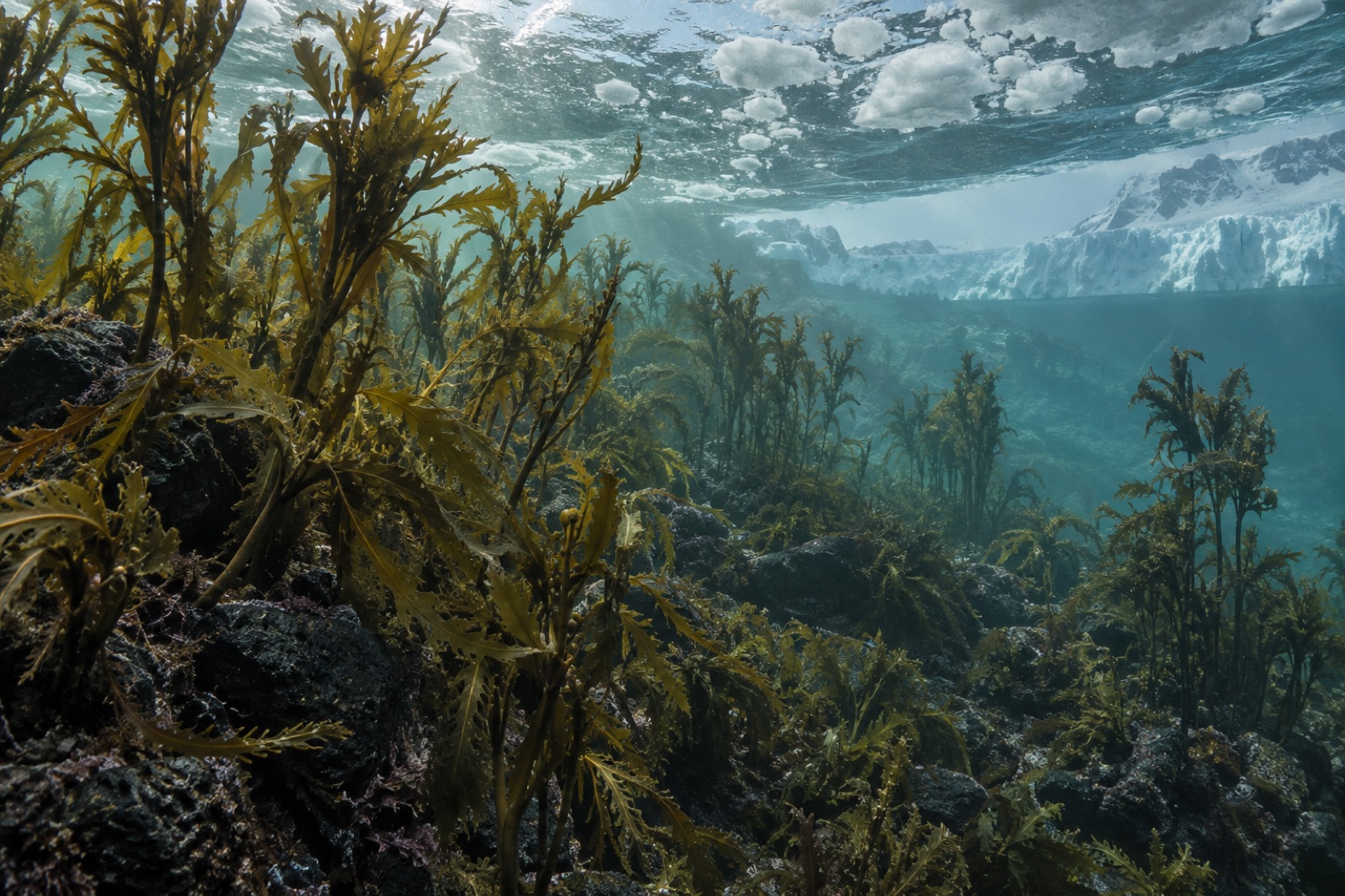
Sail south down the Antarctic Peninsula in February and the geography of kelp dissolves under you. Somewhere near the South Shetlands, the last giant kelp fronds of the subantarctic world fall astern — and yet, when the first expedition diver drops through an ice hole onto the granite of the peninsula's shallows, a forest is still there. It just isn't built of kelp. Here, in water that never warms much above the freezing point of brine, the forest is made of seaweeds stranger and, in some ways, hardier than kelp ever had to be.
True kelps are members of the order Laminariales, and their southern boundary is drawn sharply by the Antarctic Polar Front, the oceanic fence of converging currents and sudden cold that rings the continent. Giant kelp canopies sweep the sub-Antarctic islands north of that line — South Georgia, the Falklands, Kerguelen — and, on the American side, the last beds crowd the channels north of the Strait of Magellan. South of the front, for some 25 million years, the Laminariales have been locked out.
The peninsula's shallows answered the vacancy with a different order entirely. The forests here are dominated by Desmarestiales — above all Desmarestia menziesii, the acid kelp, which reaches the height of a two-storey building, and Himantothallus grandifolius, whose broad olive blades stream like banners in the surge. The architecture is recognizably a kelp forest — holdfast, stipe, canopy — converged upon independently, the way ichthyosaurs converged on the dolphin's shape.
The acid kelp earned its common name honestly: pack its tissue with granules of concentrated sulphuric acid — an outrageous, unique defence that freezes would-be grazers out with a pH close to 1. In an ocean where almost no other animal can afford shell-crushing speed or speed generally, chemistry has become the armour of choice, and the peninsula's seaweeds carry some of the most elaborate pharmacy of any marine flora known.
Three kinds of ice govern this forest's year, and none of them care that algae evolved in gentler latitudes.
First, scour. Icebergs calved from tidewater glaciers ground randomly across the shallows like ploughs gone feral, and their keels reset a reef to bare rock in a single pass. Shallow Antarctic communities are therefore a patchwork of every age since the last strike — the most fiercely disturbed benthic habitat on Earth.
Second, the seasonal dark. For months each winter there is essentially no light whatever, and then the tilt of the planet delivers continuous summer daylight. The peninsula's seaweeds bridge the gap as perennials do everywhere — holdfasts and stipes overwintering, blades regrowing on stored carbohydrate — but the window in which they must do a year's photosynthesis is ferociously short. Our longer explainer on how polar kelp survives months of darkness walks through the physiology; here, suffice it to say these are plants that budget sunlight the way survey crews budget oxygen.
Third, sea ice, which both shades and feeds the coast. While the forest sleeps, sea ice algae bloom on the underside of the floes and prime a food web that the summer forest inherits.
Drop below the canopy and the cast is pure Antarctica. Weddell seals rest on the bottom between kedging dives beneath the ice shelf's edge; leopard seals patrol inshore shelves like wolves of the tide line; crabeater seals — the most abundant seal on Earth — haul out on every pan. Along the tidewater glacier fronts gentoo and chinstrap penguins porpoise past; Adélies crowd the shingle colonies; and by late summer humpback, minke and fin whales are lunge-feeding through krill swarms so thick the water reddens.
The understory community is unlike any temperate reef: giant sun stars and ribbon worms graze the kelp's understory; Antarctic limpets and liquid-bodied nudibranchs dot the blades; notothenioid fishes — the icefishes, several of which swim with antifreeze in their blood and no haemoglobin at all — hang in the forest gaps like thoroughbreds built of polar glass. Every one of these communities is chilled to within a degree or two of freezing, permanently, and every one is a study we do not yet fully understand.
The Antarctic Peninsula is among the fastest-warming regions on Earth, and its glaciers are retreating at rates visible from space. As the ice pulls back, it exposes new rocky coastline — virgin seabed, untouched for millennia — and the seaweed forests are colonizing it. Where kelp-equivalents establish, benthic biomass follows, and the accumulating carbon locked in new Antarctic coastal ecosystems has begun to register in scientific accounting as a small but genuinely growing natural carbon sink fed by the biological carbon pump.
This is not good news to celebrate; it is a symptom with an interesting side effect, and ecologists are racing to document both. Tidewright doesn't operate in Antarctica — nothing about our projects, partnerships or products touches it — but the peninsula instructs every cold-water team we fund: it demonstrates how rapidly kelp carbon and habitat can change when a physical boundary moves, and it stands as the extreme end-member every polar monitoring methodology must be tested against.
There is no town, no harbour buoy, no dive shop. Antarctica is governed by the Antarctic Treaty system; tourism is self-regulated through the expedition operators' association, and the rules — biosecurity boot-washing, one ship at a site, no more than 100 souls ashore at a time, five metres from wildlife — are effectively enforced and rigorously observed.
Not of true kelp (Laminariales), which are blocked by the Antarctic Polar Front. But the peninsula does have large, canopy-forming brown seaweeds — Desmarestia menziesii, Himantothallus grandifolius and kin — that build structurally similar forest habitat, and some researchers quite reasonably call them "Antarctic kelp forests."
Seawater there sits near its freezing point year-round, from about −1.8°C in winter to roughly +2°C in sheltered summer bays. The seaweeds are adapted with cold-stable enzymes and antifreeze-adjacent chemistry; unprotected human tissue is not, hence expedition drysuits.
Snorkeling programs run on several expedition ships and are accessible to fit beginners in provided drysuits. Scuba is offered rarely and only to divers with documented cold-water and drysuit experience. This is not a learn-to-dive destination; it is a holy-grail dive after hundreds of temperate dives.
Both, depending on the bay — retreating glaciers expose new rocky habitat for colonisation even as melting freshwater and sediment smother other coasts. The balance appears to be toward expansion of benthic habitat overall, but the endpoint is among the continent's most closely watched measurements because it's also a carbon question.
By shutting down. As perennials, holdfasts and stipes ride out the dark on carbohydrates stored through the brief summer of continuous light, while ice algae under the floes take over the primary-production work of feeding the coast until the sun returns.
Acid kelp (Desmarestia) stores battery-strength acid inside its own cells — the strangest chemical defence in the kelp forest.
Dr. Theo Nakamura ·
A ring of giant kelp fringes South Georgia's glaciated mountains — and around it, whales, seals and penguins are crawling back from industrial ruin.
Dr. Lena Fischer ·
Kelp grows fast and dies young. Follow its carbon from sunlit blade to beach wrack, deep-sea fall and seafloor sediment — the full journey of kelp detritus.
Dr. Lena Fischer ·