Atlas13 min read
Ireland's Wild Atlantic Way: Kelp, Storms and Harvest Memory
Kelp forests of Ireland's Atlantic west — the species beneath the cliffs, two centuries of kelp ash money, and a hand-harvest tradition that never died.
Dr. Mara Ellison ·
A coastal atlas guide to Bantry Bay, West Cork — a drowned valley of kelp forest, shellfish farms and Ireland's great kelp-harvest battle.
Bantry Bay is the deepest bite the Atlantic takes out of southwest Ireland — a sea lough some 35 kilometres long, narrow-mouthed at the open ocean and broad-shouldered inside, sewn into the soft green fold of West Cork between two peninsulas like fingers on a folded map. It is a coast of immense calm and immense complexity: kelp forests harden its subtidal reefs, salmon pens and mussel lines work its middle water, an oil terminal of Cold-War vintage squats on Whiddy Island, and along its edges runs one of the more instructive environmental fights modern Ireland has had. This guide covers what grows here, the famous harvest battle, and how to get in and see the living forest for yourself.
Bantry Bay is a ria coast's masterwork — a river valley drowned when the seas rose after the last ice, fault-guided and rock-walled. Its two arms are the Beara Peninsula to the north, long and rough, and the Sheep's Head to the south, one of Europe's leanest walking-peninsulas. Inside the mouth — where the Atlantic swell first bends through a gap you could nearly throw a rope across — the bay relaxes: Glengarriff Harbour at the head, the Whiddy Island anchorage mid-bay, and a shoreline of farms, mussel rafts, and private slips.
The bay's scale is oceanographic as well as scenic. Its central channel drops to real depth — a working seaway with shipping draft — while the fringing reef is close, clear and, compared with the open Atlantic coast to the southwest, unusually sheltered. West Cork is famous for what gardeners call the "Gulf Drift microclimate" — the mildness that lets palm trees naturalise and gives Garnish Island, in the bay's head, its celebrated subtropical gardens. The same mild water — plus regular tidal mixing through the mouth — suits kelp. All the European kelps one expects on the Atlantic's Celtic edge live here, and the bay's calm arms host the sheltered-bay species too.
Bantry's kelp assemblage repeats the Irish pattern, tuned by the bay's gradient from open mouth to soft head.
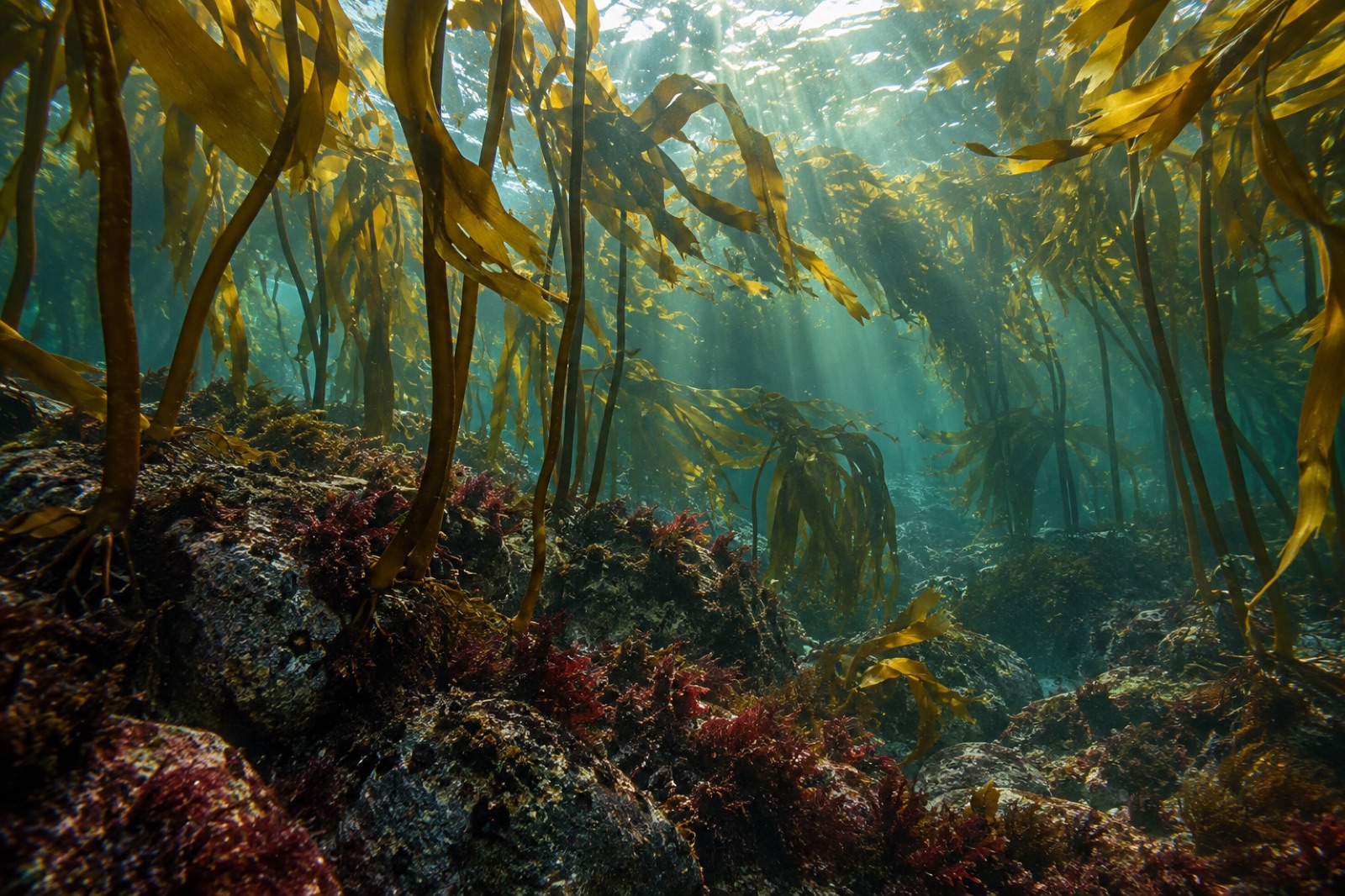
On the exposed reefs near the entrance and along the Sheep's Head outer shore, tangle kelp — Laminaria hyperborea — builds the true subtidal forest, its stipes held like walking sticks on the rock. Just above it, in the wave-washed band of the subtidal crest, oarweed (Laminaria digitata) takes the harder ground — the species the old ash-burners knew best. Sugar kelp fills the sheltered bays and inner arms, long and ribboned over quiet ledge, and sea spaghetti (Himanthalia elongata) drifts in button-and-noodle festoons over the mid-shore, threading the rock pools of almost every rocky point. In the sheltered inner reaches, maerl beds — loose, living coral-pink algae — have been recorded on the quiet floors, among the slowest-growing and most sensitive seabeds in the North Atlantic.
Under the canopy, the fish list reads like west-coast Idyll: ballan and cuckoo wrasse, pollack working the kelp line, conger in the rock moraine, and over the soft bottom, flatfish and the bay's famous sea angling marks. Seals haul out around the inner islands, and the otter reads Bantry as good country — it hunts the kelp fringe even in foul weather, as it does along the whole western Irish coast.
Bantry Bay holds a particular place in modern Irish environmental history, and any atlas entry that pretended otherwise would miss the bay's defining story.
In the mid-2010s, a Tralee-based biotechnology company proposed to harvest tangle kelp mechanically — by cutting blade growth at scale with a barge-mounted machine — across a large licensed area of Bantry Bay. The licence eventually granted was large enough to unsettle nearly everyone who loved the bay, and the response grew into one of the defining nature campaigns of recent Irish memory: fishers, artists, seaweed gatherers, hoteliers, scientists and thousands of petitioners argued that the kelp forest was not a standing crop but the bay's architecture — habitat, wave-damping, nursery and identity. After years of legal and political argument, the mechanical-harvest proposal effectively collapsed; the Oireachtas meanwhile moved slowly toward modern seaweed-licensing law, and the question of who may cut Ireland's kelp, for what, remains formally unsettled — which is itself a statement of values.
We wrote of this, and of what it says about kelp's modern place in Ireland's imagination, in our Irish west-coast atlas piece. What matters for Bantry specifically is how local the fight was: it was not an argument imported from outside but a community defending its own sea room. That is exactly the relationship the best seaweed economies honour — the tradition of hand harvest that survives here, small, soft-footed and genuinely sustainable. It is also, in full frankness, the principle Tidewright builds its own harvest story on: take the blade, never the forest, and quantify what you take.
Bantry is a working sea, and its industries sit nakedly visible on the water. Mussel longlines stripe the middle bays and inner harbours — rope-grown mussels are one of West Cork's quiet success stories — while salmon farms hold leases on licensed sites. On Whiddy Island, the oil terminal, first built in the 1960s and expanded in the 1970s, remains the largest bulk facility in Ireland: older residents still speak of the 1979 Betelgeuse disaster, in which 50 people died when a tanker exploded at the terminal jetty — a tragedy memorialised in the town. Ferries, workboats and angling charters use the same water as the kelp and the seals.
The bay is heavily scrutinised environmentally: baseline water quality, salmon-farm siting pressure and harbour-porpoise presence all find their way into the record. What it is not is a protected-area poster child. There is no comprehensive MPA here, though the bay lies near several — and the marine-protected-areas debate in Ireland, which lags farther behind most of the continent than campaigners would like, is its own ongoing story (see our explainer on marine protected areas for the wider context).
Bantry is not a famous dive coast — visibility here swims in the plankton bloom of an Atlantic summer — but a patient snorkeller is well rewarded.
Visibility is best from late spring into early summer, before the bloom peaks; winter storms strip kelp and murk the water. Read the weather, plan around the sea breeze, and treat tide flow at the mouth with respect. For general wisdom on safe entries on Ireland's rocky shore, our rocky shore entries guide applies everywhere on the Celtic edge.
Bantry Bay is Ireland's kelp question in miniature: the forest is here, the case for cutting it is here, the community's refusal to treat its sea as a field is here, and the slow, unresolved machinery of national licensing is here. What Bantry settled — in the negative, by refusing — may tell us more about the future of kelp in the North Atlantic than a hundred harvest feasibility studies. Forests, it turns out, are hard to see as raw material once a community has learned to see them as neighbours.
That is the thread Tidewright pulls wherever it works: the kelp forest is infrastructure, and the coastal community is its first client. Bantry Bay proved the converse first — the community is also the forest's first defender.
A licence was granted following years of process, but the project never proceeded — it was effectively defeated by community opposition, sustained legal and political pressure, and a national reckoning over seaweed-harvest licensing. No mechanical kelp harvesting operates in the bay, and the legislative question it raised remains only partly answered.
It is a fair-weather snorkelling coast rather than a famous dive coast. Plankton-rich water limits visibility through the summer; the most rewarding entries are the sheltered rocky points and Glengarriff Harbour on calm mornings. Divers wanting the rugged western-Ireland kelp experience usually look to outer coasts — but patient snorkellers find kelp, wrasse, seals and maerl here without a boat.
Complicated in the best way: the same shelter that suits the salmon pens and mussel lines suits the kelp, making Bantry a candidate for integrated multi-trophic aquaculture — farming shellfish, fish and seaweed together so waste from one feeds another. IMTA pilot interest in Ireland is real, and bays like Bantry are exactly the water it was designed for.
Bantry town at the head; Glengarriff on the north side; Adrigole and small Beara villages on the north arm; Kilcrohane and the Sheep's Head settlements on the south. It is farming, fishing, tourism and commuting, with more English and German accents than you might expect — West Cork has been an artists' coast for a century.
No comprehensive MPA covers the bay itself. Ireland's broader MPA programme is piecemeal compared with much of Europe; several special areas of conservation touch the surrounding coasts, and marine-conservation advocacy remains strong here, formed partly by the fight over mechanical kelp harvest.
Kelp forests of Ireland's Atlantic west — the species beneath the cliffs, two centuries of kelp ash money, and a hand-harvest tradition that never died.
Dr. Mara Ellison ·
Storm kelp, the highest sea cliffs in Europe and a working fishing coast — a guide to County Donegal, the rawest corner of Ireland's Wild Atlantic Way.
Tom Okafor ·
Oarweed is the digitate kelp marking the low-water line of North Atlantic shores. Learn its biology, industrial past, and the warm-water rival now replacing it.
Dr. Theo Nakamura ·