Atlas8 min read
Baja California: The Southern Frontier of Giant Kelp
Baja California's Pacific kelp beds mark giant kelp's warm-water frontier — a coast of El Niño crashes, fast recovery, red urchin fisheries and hard-won lessons.
Dr. Elias Brandt ·
Bahía Magdalena on Baja's Pacific coast shelters gray whales in mangrove lagoons — and hides giant kelp at its southern limit on the ocean shore outside.
On the Pacific flank of Baja California Sur, behind two long sand islands that almost nobody can name, the desert hides a garden of water. Bahía Magdalena — together with Bahía Almejas to its south — is one of the largest protected lagoon systems on the American Pacific: hundreds of square kilometres of mangrove channels, eelgrass flats and tidal creeks, fed by barely any rivers, ringed by dunes, and famous for a few winter weeks when it fills with gray whales. Outside the lagoon mouths, on the open-ocean shore the tourists never see, grows the other half of the story: giant kelp clinging to the southern edge of its world. This is a guide to both — the sheltered lagoon and the exposed forest that faces it.
For the wider kelp-coast context, start with our overview of the Baja California kelp frontier; this piece zooms into the one bay where kelp's southern boundary and the gray whales' nursery overlap.
The bay owes its existence to Isla Magdalena and Isla Santa Margarita, narrow barrier islands separated by desert gaps that screen the inner water from Pacific swell. Between them and the mainland lies a labyrinth: deep tidal channels carved through mangrove forest, shallow flats sparkling with eelgrass, and bocas — mouths — where the whole system breathes with the tide.
The hydrology is strange and important. This coast has almost no runoff; the lagoons are effectively inverse estuaries, where evaporation exceeds freshwater input and salinity inside can run slightly higher than the sea. That makes the innermost basins warm, clear and extraordinarily productive — and supremely sensitive to temperature, since there is no river plume to buffer heat or cold.
From roughly January to March, Bahía Magdalena becomes what it is globally known for: a gray whale calving lagoon, one of three great nurseries on the Baja peninsula alongside San Ignacio and Ojo de Liebre. Pregnant females complete one of the longest migrations of any mammal — from Arctic feeding grounds down the whole west coast of North America — to give birth in the warm, shallow, predator-protected inner channels.
The biology is beautifully practical. Newborn gray whales lack the blubber to survive cold water; the lagoon's heated shallows are a thermoregulatory cradle. Orcas, the calf's main predator, hesitate in shallow, confined channels. And the mothers themselves feed little and rely on the lagoon's calm to nurse and wean. The famous "friendly whale" encounters of these lagoons — animals approaching small boats — occur here under one of the world's more carefully managed whale-watching frameworks, run with Mexican cooperatives.
Our gray whale profile covers the animal's remarkable natural history in full, including its deep dependence on the kelp forests it migrates past — explored further in gray whales and the kelp highway.
Strip away the whale spectacle and the lagoon still ranks among Mexico's most important coastal wetlands. Mangrove forests — red, black and white mangroves thriving improbably at this arid latitude — line hundreds of kilometres of channel. They are fish nurseries for species that recruit into the Pacific fishery, roosts for pelicans, cormorants and frigatebirds, and stall walls against erosion. As we outline in mangrove blue carbon, desert mangroves like these are disproportionately valuable per hectare: slow-growing, hence slow to replace, and storing carbon in sediment that accretes for centuries.
Between the mangroves, eelgrass beds (see our Zostera profile) green the channel margins, and the flats support fisheries that matter deeply to the local economy. The communities of Puerto San Carlos, Puerto Adolfo López Mateos and Puerto Chale live on this system: scalefish and shellfish co-ops, seasonal whale-watching, and one of Baja's more instructive experiments in fishing communities governing their own lagoon.
Now step through the lagoon mouths and the world changes character. On the open ocean shore and around headlands near the bay's entrances, the bottom rises into rocky reef — and here, in water made cool and rich by the California Current, grows giant kelp (Macrocystis pyrifera) at or near the southern limit of its continuous Pacific range. Our regional overview of Baja's giant kelp frontier maps the full picture south of the border; Bahía Magdalena sits essentially at the far end of the line.
South of here, the warm influence of the Mexican tropical Pacific wins, and the big brown canopy gives way to sparse pockets and then to tropical algae. The reefs immediately around the bay's mouths are therefore among the warmest real giant kelp habitat anywhere on Earth — a living laboratory of the species' thermal ceiling, intermixed in places with warm-water species like the southern sea palm (Eisenia arborea) on the wave-torn edges.
Southern-range kelp is, by definition, kelp that can least afford a warm year — and this coast gets the warmest years of all. During strong El Niño events the California Current's cool influence relaxes, warm water pushes north past the peninsula, and kelp is hit by the double penalty we explain in El Niño and kelp: heat stress and nutrient starvation arriving together. The marine heatwave years of the mid-2010s stripped southern Baja's giant kelp to remnants in many places, followed by genuine, patchy recovery in cooler La Niña years — the seesaw pattern described in our marine heatwaves explainer.
What's important — and hopeful — is that the refuges matter. Within Bahía Magdalena's reef system, kelp persists in the coldest micro-sites: deeper fronts, upwelling shadows, current-cooled headlands. Those survivors, not the broad average, are the seed bank that re-grows the forest when conditions swing back. For restoration geneticists like Dr. Elias Brandt and I, they are also the most interesting kelp on the peninsula: trees already voting for thermal tolerance with their existence.
The lagoon's main protections are pragmatic rather than park-brochure: regulated whale-watching zones in the nursery season, fishing cooperatives with concessions over local shellfish grounds, and an emerging consensus that mangrove channels are worth more standing than filled. The pressures are equally specific: shipping traffic through the lagoon mouths, coastal development schemes that resurface every few years, and — above everything — ocean warming, which touches lagoon and kelp forest from opposite sides of the same island chain.
January to March for gray whales in the lagoon. For the kelp and open coast, late spring through autumn offers the calmest seas and best underwater visibility — though the outer coast is cold, swell-exposed and only for experienced ocean swimmers and divers.
Yes — giant kelp's continuous range runs down the Baja peninsula to roughly this latitude. South of the bay the canopy fragments and thins into isolated stands before yielding to warm-water species. The reefs near the lagoon mouths are among the warmest kelp forests on Earth.
Warmth and safety. The shallow, enclosed inner channels are warmer than the open Pacific — a survival need for calves with thin blubber — and hard for orcas to hunt in. The trade-off is food: mothers fast through most of the lagoon season and refuel on the return migration north.
Parts of the whale nursery are managed under Mexico's regulated whale-watching framework, and fishing cooperatives hold local concessions — but the system is not a comprehensive no-take park. Shipping, development proposals and climate warming are live pressures.
The mid-2010s heatwave years stripped much of southern Baja's kelp severely. Recovery in cooler years has been real but uneven, led by kelp persisting in the coldest micro-refuges — which is why those pockets now attract so much scientific attention.
Baja California's Pacific kelp beds mark giant kelp's warm-water frontier — a coast of El Niño crashes, fast recovery, red urchin fisheries and hard-won lessons.
Dr. Elias Brandt ·
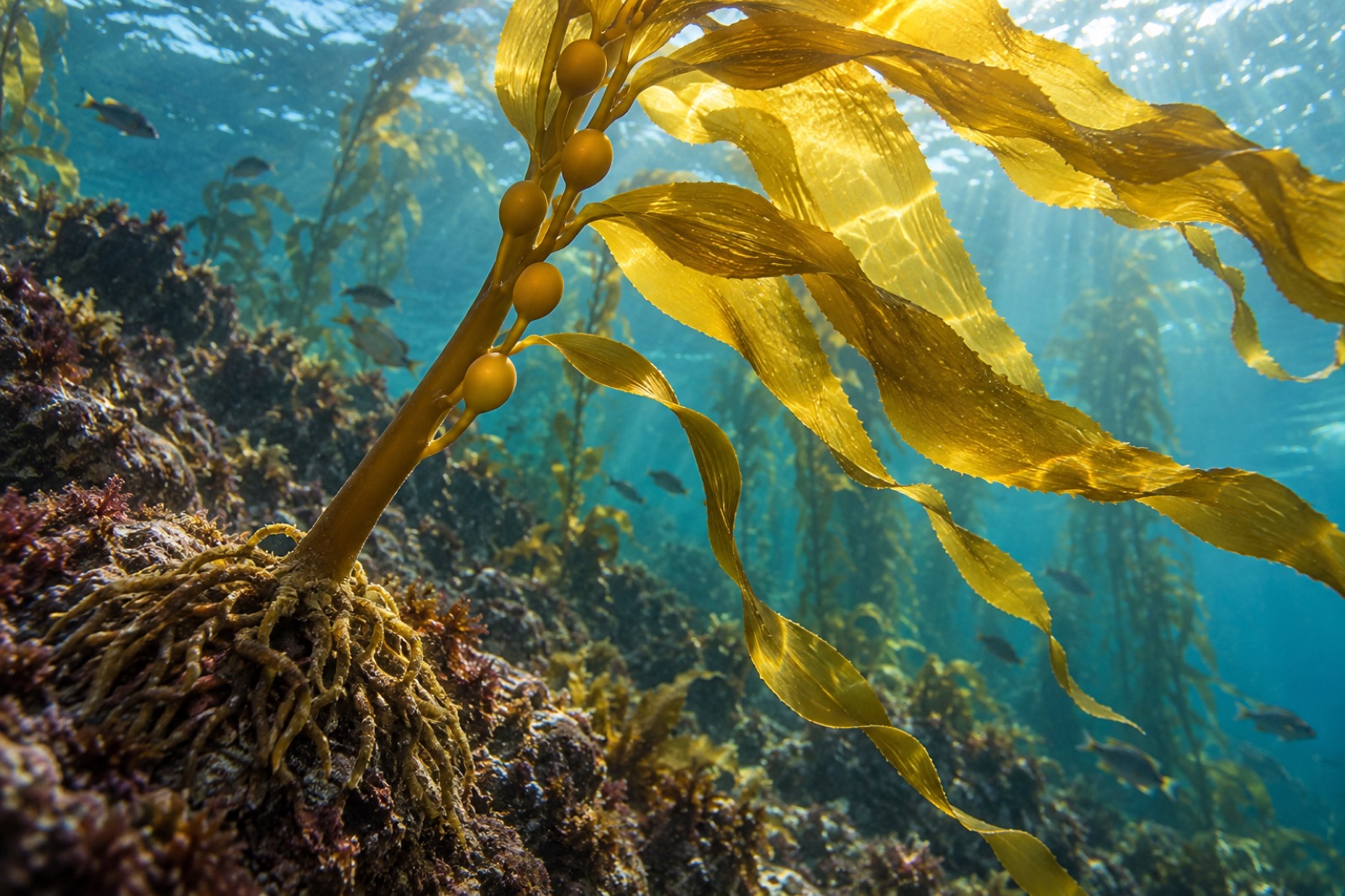
Giant kelp is the fastest-growing organism on Earth and the architect of undersea forests. Learn its biology, life cycle, range and why it matters.
Dr. Theo Nakamura ·
Every few years the Pacific reorganises itself and kelp forests pay the price. How El Niño starves kelp — and how La Niña's cool afterwash lets it recover.
Dr. Mara Ellison ·