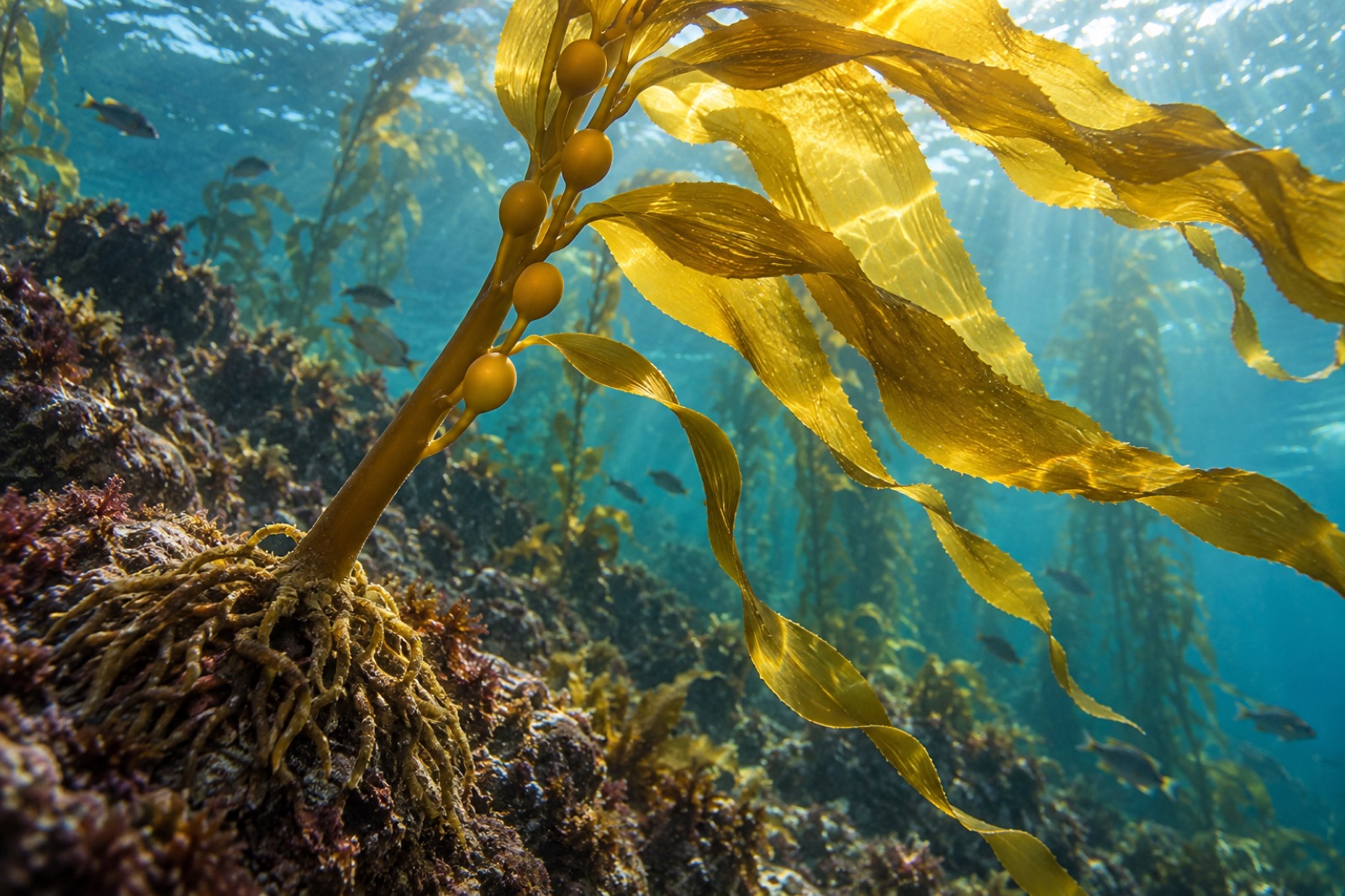
The south of Chile does not end gradually. The Andes walk straight into the Pacific, and beyond them the coast dissolves into water: ten thousand islands, drowned valleys, tidal channels and ice-fed fjords running for fifteen hundred kilometres between Puerto Montt and Cape Horn. From the air it looks like a mountain range that has been sunk and left to green over; from the water it feels like sailing inside a stone forest. Beneath the channels' surface, where the swell of the Pacific dies against the outer islands, the water grows some of the most extensive sheltered kelp forests on Earth — and one of the great industrial and ecological struggles in modern aquaculture.
Reading this atlas entry
By "the Patagonian channels" we mean the inner waterway of southern Chile: the maze of protected passages, sounds, senos and gulfs lying between the open Pacific and the mainland cordillera, from the Reloncaví Sound near Puerto Montt down through the Corcovado Gulf, the Chonos Archipelago, the Aysén fjords and the great channels of the far south to the Magellan Strait region. It is the southern continuation of the Humboldt system described in our guide to Chile's Humboldt coast, but the character changes south of the open shore: the coast gives way to islands, the surf to still or slowly sliding water, the desert north to rain-forested green.
Drowned mountains and brackish seas
The channels are the work of ice. Glaciers carved the coast; glacial retreat let the sea in. The result is a marine-estuarine hybrid: deep, cold, narrow waterways thousands of metres high on either wall, with turbid fresh and brackish surface water sliding seaward over heavier, saltier, deep water. A warm rain falls on temperate rainforest and drips off waxed leaves into the sea; rivers bleed glacial flour and tannin; surface salinity in head-of-fjord waters can drop to near-fresh after rain. Our explainer on ocean stratification supplies the physics of that layering — and the cold low-salinity lens floating on the sea is exactly the world in which a very distinctive community of life has learned to operate.
The channels' most remarkable resident is not a kelp at all but a coral. Cold-water corals — led by the orange-and-white cup coral Desmophyllum dianthus — carpet the rocky walls of some channels at scuba depth, among the shallowest these animals grow anywhere in the world. They thrive only here because the dark, low-salinity, low-light surface layer pushes the light-hunger of the water column down, in effect lifting the deep sea to within a diver's reach. Researchers based at a small station in Comau Fjord documented this decades ago; it turned the channels from a blank blue wall into an internationally watched observatory of the deep.
The forests inside the islands
Where there is hard bottom, moderate light and shelter from the Pacific's heave, giant kelp (Macrocystis pyrifera) builds the forests. The beds of the channels are among the densest, least disturbed giant kelp in the Southern Hemisphere, and Patagonia is now understood to hold one of the world's major strongholds of the species — deep, cool, perennial, immune to the heat-wrecking summers that have undone forests further north, and as our kelp thermal tolerance explainer shows, cushioned against the marine-heatwave risk that stalks kelp elsewhere in South America. On the outer islands, where the Pacific still combs the rock, the big fleshy cochayuyo (southern bull kelp) stands in the surf as it does right around the subantarctic rim.
Inside the kelp, the animal cast wears a southern accent. South American sea lions haul out by the ton on channel rocks — big dog-maned bulls roaring over the traffic of up to tens of thousands of seabirds. Chilean and Peale's dolphins cut bow-waves in green water; Magellanic penguins stand in colonies on the outer approaches; southern right whales and humpbacks deepen in through the sounds, and the Corcovado Gulf — the junction of channels just south of Chiloé — has become one of the most important feeding grounds for blue whales in the Southern Hemisphere, a nursery of the largest animal that has ever lived inside what feels like an inland sea.
The salmon question
No honest account of these waterways can skip the industry that has grown through them. Chile is one of the world's two largest producers of farmed salmon, and the sheltered channels — still, deep, cold, with tide-flushed water — turned out to be near-ideal for floating net-pens. The results have been spectacular in both directions. The industry employs tens of thousands and has made salmon a geopolitical industry in a region that few multinationals used to notice. It has also brought the classic costs of concentrated aquaculture to a fjord: escaped salmon competing in rivers, sea-lice and antibiotic use, nutrient-loading under pens, and a rolling tension with algal blooms — which in 2016 produced a catastrophic red-tide event around Chiloé, massive marine mortality and a social crisis that put the island's small-scale fishers on the world's front pages.
The conversation is not simple. Many of the same communities that protest the industry work in it; the channels are lined with pens that pay for much of the shipping, schooling and logistics of southern Chile. What the region has clearly taught the world is that sheltered water is not empty water — that stillness, in ecological terms, means slow flushing, and that the carrying capacity of a fjord is real whether or not a business model acknowledges it. The lesson matters globally: our explainer on marine protected areas describes the governance tools coastal regions use, and Chile has been expanding its marine-protection network in Patagonia, including a large national park and marine protected areas in the southern channels, in parallel with the industry's search for better practice.
Working it: boats, weather and expedition country
The channels are boat country. The essential the-road is the water, and for a century the lifeline of southern Chile has been the ferry: Puerto Montt's ferries still steam overnight through the Corcovado Gulf into the channels, and passenger vessels make the four-day journey south past glacier tongues to Puerto Natales — one of the great neglected voyages on Earth. Chiloé, the pastoral green island guarding the mouth of the channels, is the region's cultural capital: palafitos, wooden churches and a myth-forest of sea-legends, with markets that sell cochayuyo, piure and mussels much as they have for two hundred years.
Farther south the region becomes true expedition territory. Kayakers cross the Pumalín fjords to blue-glacier walls; small expedition ships run the channels of Aysén to tidewater glaciers; divers find that the winter water — around eight to ten degrees, flat calm under the low-salinity lens — holds the best visibility and the closest thing the world offers to a cold-coral wall dive. Weather is the rule: the channels get hundreds of rainy days a year, and the deep channels' reward — silence, fog lifting off green mountains, sea lions materialising around an island like the rising of an orchestra — cannot be hurried. If you are planning an extended saltwater trip in this part of the world, the preparation mindset in our cold-water dive gear guide translates directly.
Key takeaways
- Chile's inner channels are a drowned Andes: more than 1,000 km of islands, fjords and sounds shielded from the Pacific swell.
- The channels' calm, cold, layered water grows among the Southern Hemisphere's strongest giant kelp forests and the world's shallowest cold-water coral reefs.
- This is also blue-whale country, sea-lion country, and one of the world's biggest farmed-salmon regions — making it the hemisphere's sharpest case-study in the trade-offs of sheltered-water aquaculture.
- Chiloé is the cultural gate; ferries, expedition ships and kayaks are the practical transport; weather, not distance, sets the pace.
- The region shows why calm water is not empty water: stillness concentrates both productivity and industry's footprint.
FAQ
Are there kelp forests in Chile's channels, or only in the far south?
The channels themselves are strong kelp country, especially for giant kelp (Macrocystis), which forms deep, sheltered forests through the inner waterways from the Chonos Archipelago south. The far south hosts the region's other signature kelp, the fleshy southern bull kelp (cochayuyo) — see our Strait of Magellan atlas guide.
Why do cold-water corals grow at scuba depth here?
A dark, low-salinity, light-absorbing surface layer — fed by rain, rivers and glacial melt — reproduces the low-light conditions of the deep ocean in water only tens of metres deep. Cold-water corals such as Desmophyllum dianthus, normally deep-sea animals, carpet shallow rocky walls under this lens.
Is the salmon industry banned or welcomed in the channels?
Neither, in simple terms. The industry is enormous, employs entire towns and continues to operate and expand regulation, while science, communities and government argue over density, disease and cumulative impact in slow-flushing water. Marine protection in Patagonia is expanding alongside the industry rather than instead of it.
What is the best way to visit the channels?
By boat. The Puerto Montt–Puerto Natales ferry, small expedition ships and guided kayak trips out of Chiloé or Pumalín are the established ways in. Expect rain, prepare for winter-cold water and ride the slow pace — the region is not built for the hurried.