Atlas7 min read
Mendocino: Life on the Lost Bull Kelp Coast
A field guide to Northern California's bull kelp collapse — the heatwave, the urchin explosion, the closed fisheries, and the difficult road back.
Dr. Mara Ellison ·
Where Highway 1 quits and the King Range rises from the surf, California's Lost Coast keeps its secrets — black sand, bull kelp and a hard-won wilderness.
Everyone knows the shape of the California coast road: Highway 1 stitched to the cliffs from San Diego to the redwoods. Then, at Rockport in Mendocino County, the road does something strange. It gives up. It turns inland, dithers among the fir ridges, and refuses to come back to the beach for a hundred miles. Between Rockport and the little fishing enclave of Shelter Cove, the mountains — the King Range, cresting at over 1,200 metres barely three miles from the surf — simply drop too steeply for pavement. This is the Lost Coast: the longest roadless shoreline in the continental United States, and one of the wildest kelp coasts in California.
The name has several origins, and all of them are true. It was lost to the road builders first: surveyors in the 1930s watched the King Range shrug off every alignment and declared the coast impractical. It was lost to the economy later: the mill towns and homestead landings of the early twentieth century — Bear Harbor, Wheeler, Needle Rock — dissolved once redwood trucking moved inland, leaving the coast quieter than it had been in sixty years. And it is still, legislatively, lost: in 1970 the King Range became America's first National Conservation Area, anchoring protections later extended into the Sinkyone Wilderness State Park to the south. A coastline where the modern world never quite arrived is a rare piece of the American West.
The Lost Coast shore is black sand and cobble against a wall of sandstone and compressed Franciscan rock — the same chaotic, subducting seafloor that makes California shake. Beach walking runs in 20-kilometre stretches without a road in hearing distance. Creeks drop off the range in thin falls. Roosevelt elk wander out of the Sitka spruce forests onto the sand. And out beyond the low-tide terraces, offshore in the swell zone, the kelp begins.
The kelp of the Lost Coast is overwhelmingly bull kelp, the golden annual that races from zoospore to twenty-metre canopy between spring and autumn, then dies back with the first big storms. On the Lost Coast it prospers in the gaps: the short, sheltering coves where the King Range's headlands cut the northwest swell into smaller seas, and the shallow ridges off every headland. In July the canopies lie flat as rafts; by December the winter ground-swells have torn them down and flung them onto the black sand, and the beach is dressed in bull-whips of stipe and bladderwrack-like drift.
The upwelling cycle — the spring northerly winds pushing cold, nutrient-rich bottom water to the surface — is the engine, and it's the same engine that feeds the whole of northern California's coast. What changes here is the human absence: no harbours, no piers, no kelp-cutting boats, no mooring fields. The Lost Coast is what a northern California kelp coast looks like with almost nobody looking.
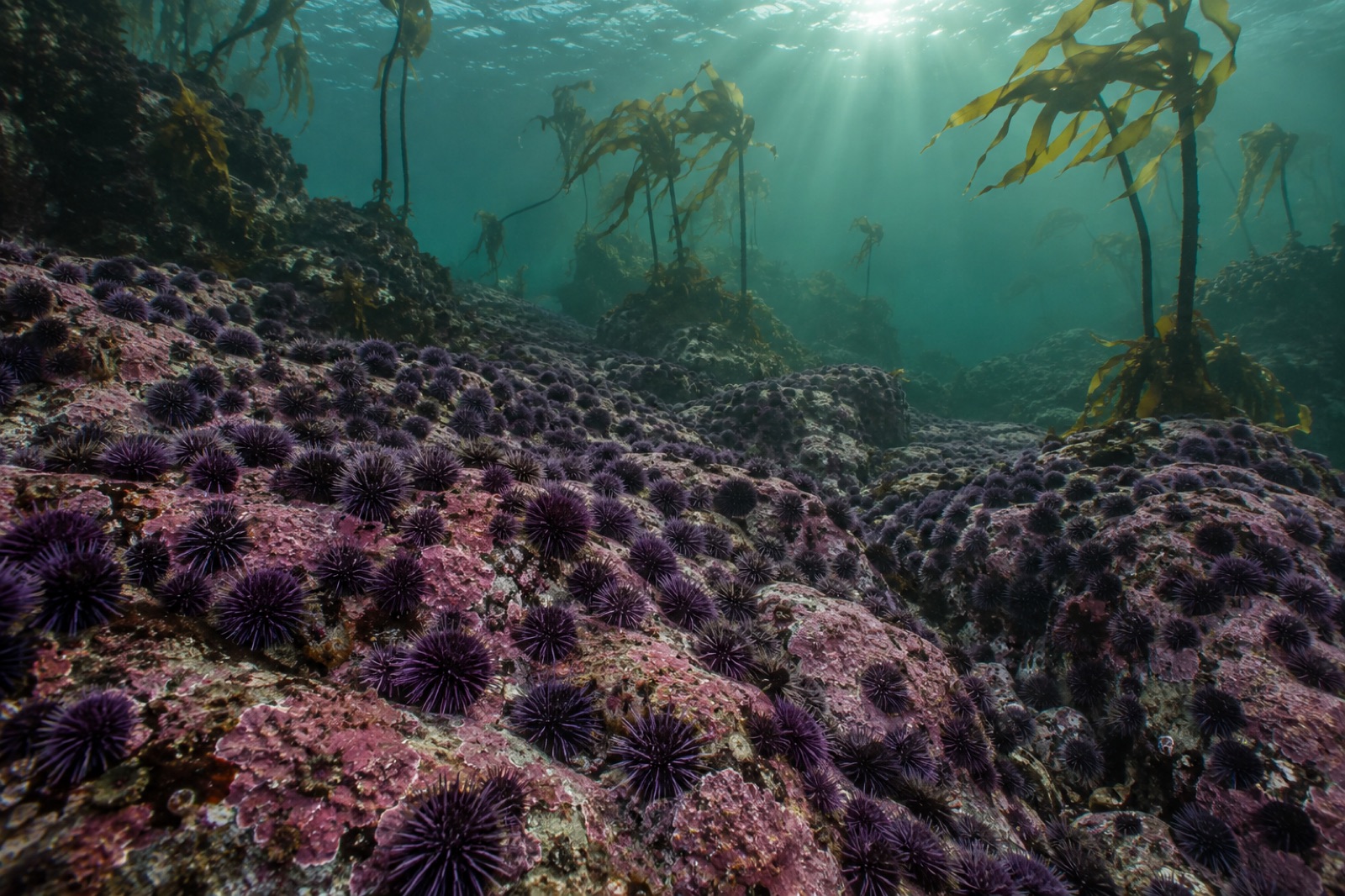
The Lost Coast was not exempt from catastrophe. When the great North Pacific warm Blob piled up off the shore through 2014–2016, the same triad that shattered the kelp south at Mendocino — a marine heatwave, a sea-star epidemic that removed the urchin's chief predator, and a bloom of purple urchins — worked this wilderness too. In coves the total canopy was lost; urchins polished the understory reefs bare in some coves and not others, in a patchwork we still can't fully explain.
The difference from Mendocino was not the absence of loss but the absence of witness. Very few divers know this coast; there is no resident research station watching it year-round, no charter fleet, and almost no road access to count what happens to the canopy. The kelp came back, in spurts, as it has begun to further south — 2019 and 2020 brought real recovery, and the early 2020s have seen runs of good and bad years in alternation, which is what recovery under an unstable climate looks like. But the coast's capacity to absorb disaster is also its vulnerability: when you're the forgotten shore, no one is standing by with spores and lines.
The coast is best experienced on foot, on the classic Lost Coast Trail. The route is usually walked in two sections:
The northern half — roughly 40 kilometres from Mattole Beach south to Shelter Cove — follows the beach and bluffs below the King Range and is the standard section, crossing watershed after watershed, with three long stretches that flood at higher tides and must be timed against the charts (carry the 2026 tide tables, plus bear canisters; the regulations require both).
The southern half — in Sinkyone Wilderness State Park, from the Sinkyone coast trailhead down to the Usal Beach road-end — is rougher, muddier and less-trodden, buckling over the headlands rather than along the sand. South of Needle Rock the shore merges with the Mendocino coast.
Water is plentiful but must be filtered; there is no mobile coverage; and the classic mistake is treating this like a beach walk. It is a wilderness excursion through a marine sanctuary's shallows — and the wildlife knows it.
The intertidal benches on the gentle lee sides of headlands are this coast's draw for the shore naturalist: giant green anemones the size of saucers, ochre stars massed on the surge rocks, black and red rock crabs, and, in the right bays, the remaining colonies of black abalone — a marine snail whose mass die-off from withering syndrome in the 1980s and 1990s pushed it onto the U.S. Endangered Species List and closed all abalone harvest on this coast. The Lost Coast's tide benches were among the very last places in California where the species hung on. Our black abalone species profile tells that story in full.
Below the low-tide line, the reefs grade into the kelp zone: bull kelp stands, patches of the smaller stalked kelps, caves full of gumboot chitons and red sea cucumbers. The grey whales swipe past in their thousands on the spring migration; elephant seals haul at Punta Gorda, guarded by the lonely lighthouse that once turned here in the fog.
The Lost Coast is a control plot for the rest of northern California: what happens to bull kelp forests when the people pressure is removed and the heat and disease are the only signals left? That uniqueness is why the Mendocino restoration frontier — where Tidewright's Mendocino Urchin Barrens program applies Drifter vessels and Holdfast seed lines against the barrens — reads the Lost Coast as its reference state. A wilderness shore that can fail and recover without human hands shows us what our hands are actually doing further south.
Yes. The shore's subtidal reefs carry bull kelp forests from spring through autumn, with the biggest canopies in the lee coves. The canopy thins and dies back with the winter swells, as bull kelp always does — though warmer winters now bring earlier losses than in the past.
Physically the walking is moderate, but the logistics are the challenge: two lengthy tide-locked sections, no resupply points for the full length, creek crossings that can flood quickly after rain, and black bear canister requirements. It is very achievable with planning and is not a good first backpacking trip.
Late May through early October. Spring brings wildflowers and whales; midsummer the thickest fog and calmest swell windows; early autumn the clearest skies and warmest water. Winter storms are magnificent but dangerous, and many trailheads close.
A committed few do — there are surf breaks in Shelter Cove and at a handful of beaches — but there are no dive boats, charter operations or fill stations for a great distance. The coast is for self-reliant travellers, not guided tourists.
There is no project currently operating on the Lost Coast itself; the nearest live restoration is in Mendocino County, where volunteer urchin-removal days and kelp monitoring are occasionally available — see our projects page for current programs and how they work.
A field guide to Northern California's bull kelp collapse — the heatwave, the urchin explosion, the closed fisheries, and the difficult road back.
Dr. Mara Ellison ·
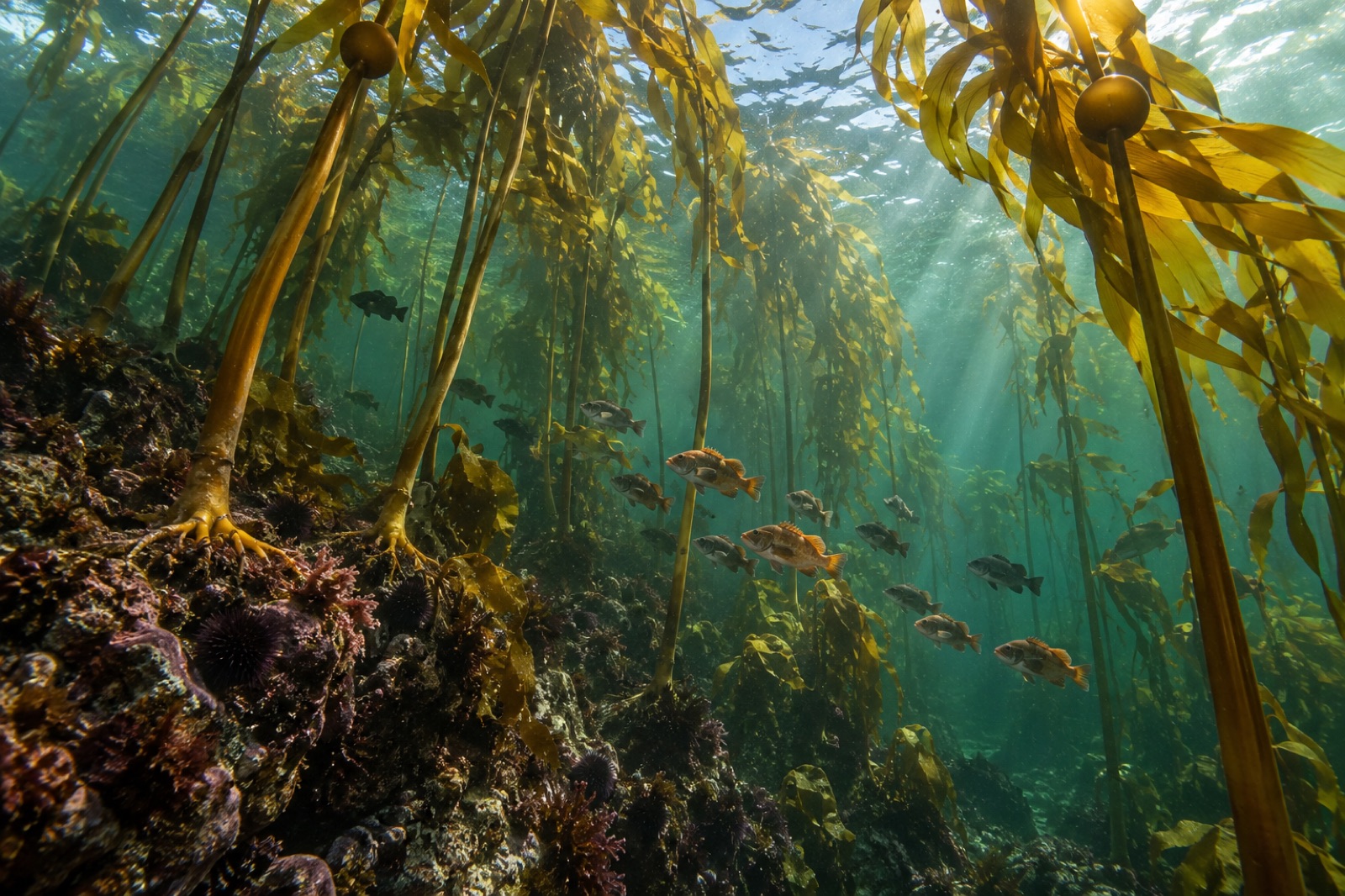
Meet bull kelp, the fast-growing annual giant of North America's Pacific coast — its biology, Indigenous heritage, dramatic decline and the race to restore it.
Dr. Mara Ellison ·
Oregon's bull kelp rides one of the wildest upwelling coasts on Earth — and its southern forests are on the edge. A guide to the reefs and the fight back.
Dr. Theo Nakamura ·