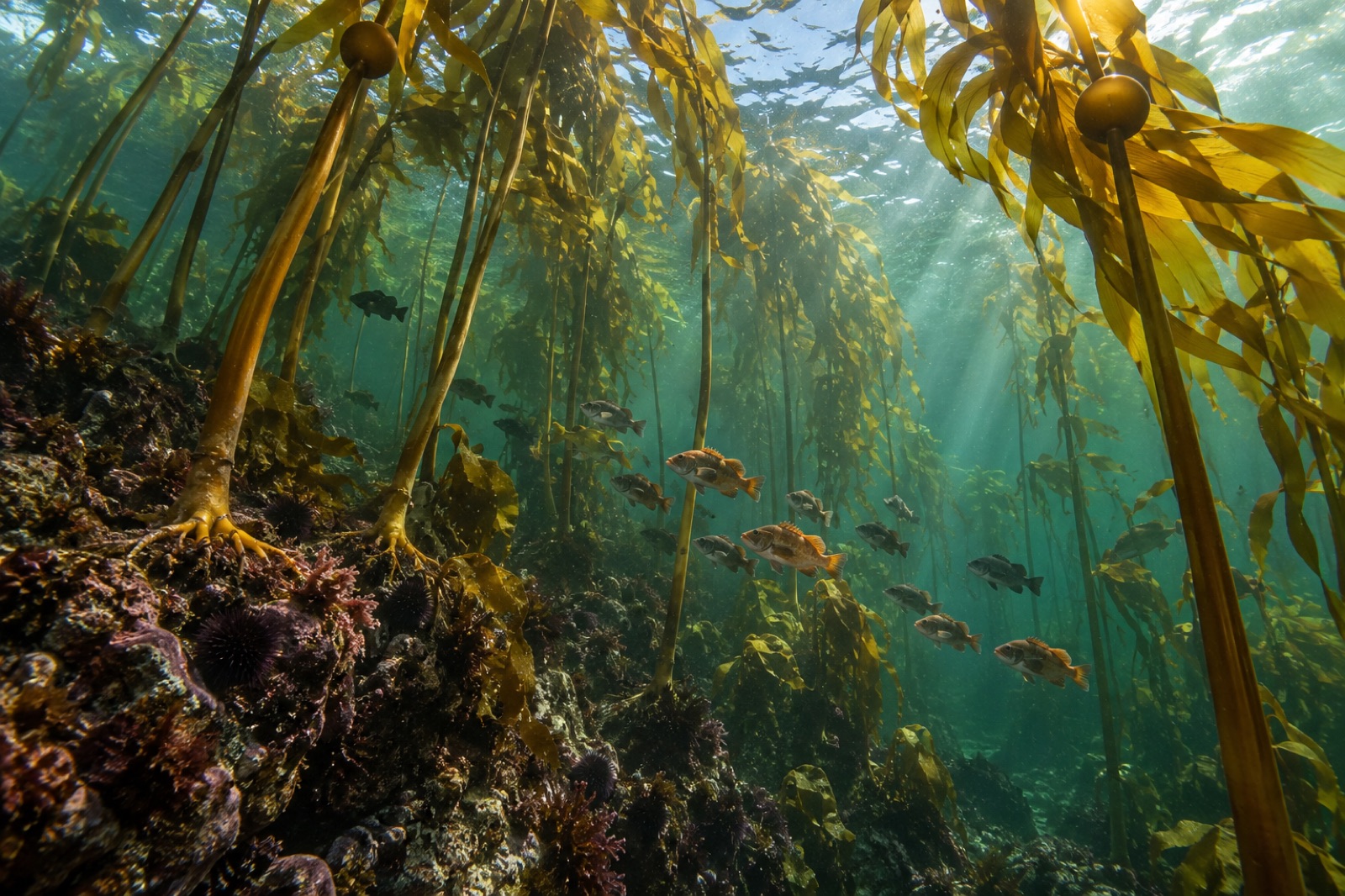
Stand on the cliffs at Port Orford on a late-summer evening and you can watch the Pacific's most charismatic kelp do its annual trick: golden rafts of bull kelp canopy, blades the length of a boat lying flat on the swell, riding one of the most biologically explosive coastlines in the temperate world. Oregon sits at a hinge — south of the familiar sea-otter-and-surf-grass Puget sound world, north of California's famous Macrocystis beds — and its forests are built almost entirely on bull kelp, an annual that must regrow from microscopic spores every single year. That design makes Oregon's kelp spectacular in good years, terrifyingly vulnerable in bad ones, and the clearest case study anywhere of how a coast moves between forest and barren. This guide covers the engine, the geography, the crisis and the recovery work now underway.
The engine: upwelling on a ragged shore
Oregon's kelp runs on wind. From spring into summer, northerly winds drive surface water offshore, and cold, nutrient-loaded deep water wells up in its place — upwelling in its purest form. Add hard basalt and sandstone reefs, a great tide exchange, and the long glassy ground-swells of the summer Pacific, and you have the recipe for dense bull kelp canopy. The ocean off Oregon is so productive it feeds gray whales on their migration and some of the richest rockfish and crab grounds in the United States; kelp sits inside that system, not apart from it.
The catch is flipside weather. When El Niño warms the Pacific — we covered the mechanics in El Niño and kelp — the upwelling engine stutters, the surface layer thickens and starves, and bull kelp, which lives fast and dies in a year, feels it immediately.
Reading the coast: the five regions of Oregon kelp
Oregon's 362 miles of public coastline are not one kelp story but several, divided by headlands and the bays between them.
The North Coast: Cannon Beach to Cape Falcon
The north coast, under the shadow of the Columbia River plume, has long been the least kelpy stretch — sediment and brackish outflows thin the forest. Cape Falcon, at the north end of the Oswald West State Park, is the exception: hard reef, decent canopy, and one of the state's five marine reserves.
The Central Coast: Cascade Head, Otter Rock and Yaquina Head
The central coast has Oregon's most reliable public kelp experiences. Cascade Head, north of Lincoln City, rises straight from the surf and shelters real canopy; Otter Rock and the reefs around the Yaquina Head Outstanding Natural Area give shore-side views over kelp-fringed tidepool systems. Yaquina Head's wave-carved basalt, with the kelp zone fringing it, is among the best places in the state to stand over living bull kelp without a boat.
Cape Perpetua and the Florence reefs
South of Newport, the Cape Perpetua marine reserve preserves forest and reef along a basalt headland famous for its churning spouting horns. The canopy here historically ran strong in upwelling years.
Port Orford and Redfish Rocks
Port Orford is Oregon's kelp capital: a working fishing town on an open roadstead, with the state's most-studied reef complex actually inside the Redfish Rocks marine reserve. The local field station at Port Orford has made these reefs among the best-documented kelp systems in the Pacific.
The South Coast: Brookings and the California line
The wild, forested coast of Curry County was once among Oregon's thickest kelp country. It is now the hardest-hit zone in the state, and the centre of the story below.
The crash: heat, a missing sea star and an urchin engine
Between roughly 2013 and 2016, Oregon's kelp was hit by three forces at once:
- The Blob and El Niño. A vast warm-water anomaly — "the Blob" — filled the northeast Pacific in 2014–15, merging into an El Niño. Warm water starved the annual kelp at exactly the point in the life cycle when it cannot afford to stall. Marine heatwaves of this kind are the forecast problem for Oregon kelp, not a historical one.
- The wasting epidemic. Sea star wasting disease took out the sunflower sea star along the entire West Coast — the great predator of sea urchins. Oregon reefs lost their most important control on urchin numbers almost overnight.
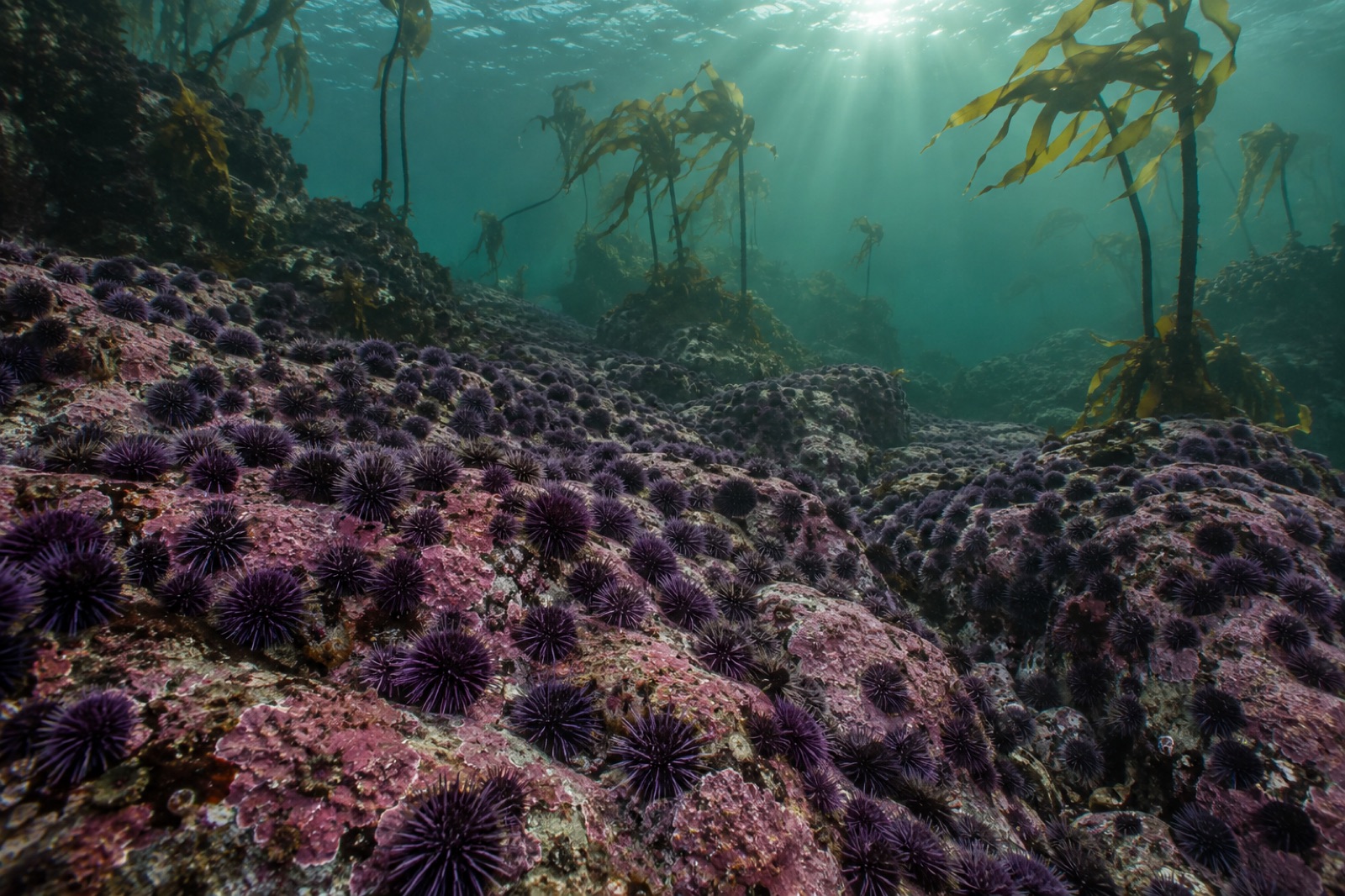
- The purple urchin explosion. Purple sea urchins, unchecked and growing through warming years, multiplied into densities far beyond any fishery market could pay for. They ate the kelp forests down to rock, then persisted in the barrens as starch-filled shells — too starved to harvest, too alive to ignored.
The result on the south coast was dramatic: at some reefs off Brookings, bull kelp canopy effectively vanished by the late 2010s, and large urchin barrens — the state where reefs "flip" and stay flipped, detailed in our explainer on urchin barrens — took over. The same pattern had just played out catastrophically in Mendocino, California, forty miles south.
The fight back: reserves, research and removal
Oregon's response rests on three pillars.
The marine reserves. Oregon's no-take marine reserve system — Cape Falcon, Cascade Head, Otter Rock, Cape Perpetua and Redfish Rocks — was designated between 2012 and 2016. Reserves don't plant kelp, but they protect the full food-web machinery around surviving forests and give scientists an unharnessed baseline to compare against fished reefs.
The science. Long-running kelp and urchin surveys out of the state's universities, the local field stations and agencies have mapped the collapse reef by reef, tracked spore supply and settlement, and pinned down exactly which urchin densities keep a barren locked versus which let recovery through.
The urchin work. The hands-on restoration in Oregon is urchin removal: commercial and volunteer divers culling purple urchins from priority reefs, testing which reefs can be flipped back to forest and at what cost. Combined with the state's red urchin fishery on the deeper reefs and the long hope of sunflower star recovery, it is one of the most direct active-restoration efforts on the entire US coast.
Seeing the forest: where and how
You do not need a boat to meet Oregon kelp.
- Yaquina Head outstanding natural area. Towering basalt, tidepools at the black-cobble base, and kelp fringing the reef — best on a summer low tide.
- Cape Arago and Simpson Reef. South of Coos Bay: offshore rocks, seals and sea lions hauled out by the hundred, and kelp beds laid out below the overlook.
- Port Orford Heads. The headlands above the working port; on calm summer days you can watch the canopy rafts off the dock from the bluff trail.
- From a kayak. Guided summer paddles from Port Orford and the central coast get you inside the canopy edge. Cold water: a wetsuit on the paddle is wise in any month.
- Post-storm wrack. After autumn and winter gales, the beaches collect giant drifts of bull kelp — the carbon export process in action, and the best free natural-history walk in the Northwest.
The best season for the forest itself is late summer, when the canopy is at full height and the water is clearest — the same season as any best-season kelp diving guide will recommend for this entire coast.
Key takeaways
- Oregon's kelp forests are built almost entirely on bull kelp (Nereocystis luetkeana), an annual species: the forests regrow from spores every year, making them fast to collapse and fast to recover.
- Summer upwelling is the engine; El Niño warming is the brake. The 2014–16 warm-water event stalled the forest just as a new enemy multiplied.
- Sea star wasting disease removed the sunflower star — the urchin predator — and purple urchins then built large barrens on the south coast, ending most kelp off Brookings by the late 2010s.
- Oregon's five marine reserves, its research institutions and an active urchin-removal movement are leading the recovery effort.
- Visitors can meet the forest without a boat at Yaquina Head, Cape Arago and Port Orford Heads; kayaking puts you in the canopy edge.
FAQ
Are there kelp forests left in Oregon?
Yes — substantially so on the north and central coast, where the forests came through the heat and the urchin explosion in much better shape. The south coast around Brookings lost most of its canopy by the late 2010s and is now the frontier of the restoration effort. Even the barrens there are not dead reefs: spores, surviving kelp patches and active management mean individual reefs have shown encouraging re-growth in cooler recent years.
What killed the bull kelp in southern Oregon?
Not one thing. A marine heatwave (the Blob plus the 2015–16 El Niño) starved the annual kelp, sea star wasting disease had already removed the sunflower stars that eat urchins, and purple urchins then multiplied into densities that grazed the surviving kelp down. It is a classic trophic cascade working in reverse — remove the predator and the grazers take the forest.
Where is the best place to see kelp on the Oregon coast?
Yaquina Head Outstanding Natural Area and the tidepool reserves around it are the safest answer for shore viewing. For the full working-kelp-coast experience, Port Orford on a calm summer evening — the buoyed crab fleet inside the canopy rafts — has no equal on this coast.
Can you snorkel or dive in Oregon kelp forests?
You can, but with respect. Water is cold year-round (roughly 9–13°C), swell runs hard even in summer, and the central coast has sharp rocks and surge. Join a local dive operation, dive on the calmest summer days, and treat the shallow reefs as exposed open-ocean habitat. The kelp experience from a guided kayak is the best choice for most visitors.
Will the Oregon kelp forests come back?
Evidence suggests the system is recoverable: bull kelp's annual life cycle means a forest can regrow from regional spore supply in a single good year if grazing pressure drops, and urchin-removal pilots have shown local reversals. The honest uncertainties are whether cool, upwelling-favourable years arrive often enough under a warming climate, and whether sunflower stars recover. The coast's researchers and communities are working on both.