Atlas6 min read
Dive Guide: Point Lobos — The Slot in the Reserve That Fits You
Point Lobos limits divers to a handful of reserved buddy teams a day. How to get a slot, dive Whalers Cove's kelp, and respect California's oldest rules.
Tom Okafor ·
A field guide to Point Lobos State Natural Reserve — its kelp canopy, whaling past, cypress groves, dive rules and the trails that read like a textbook.
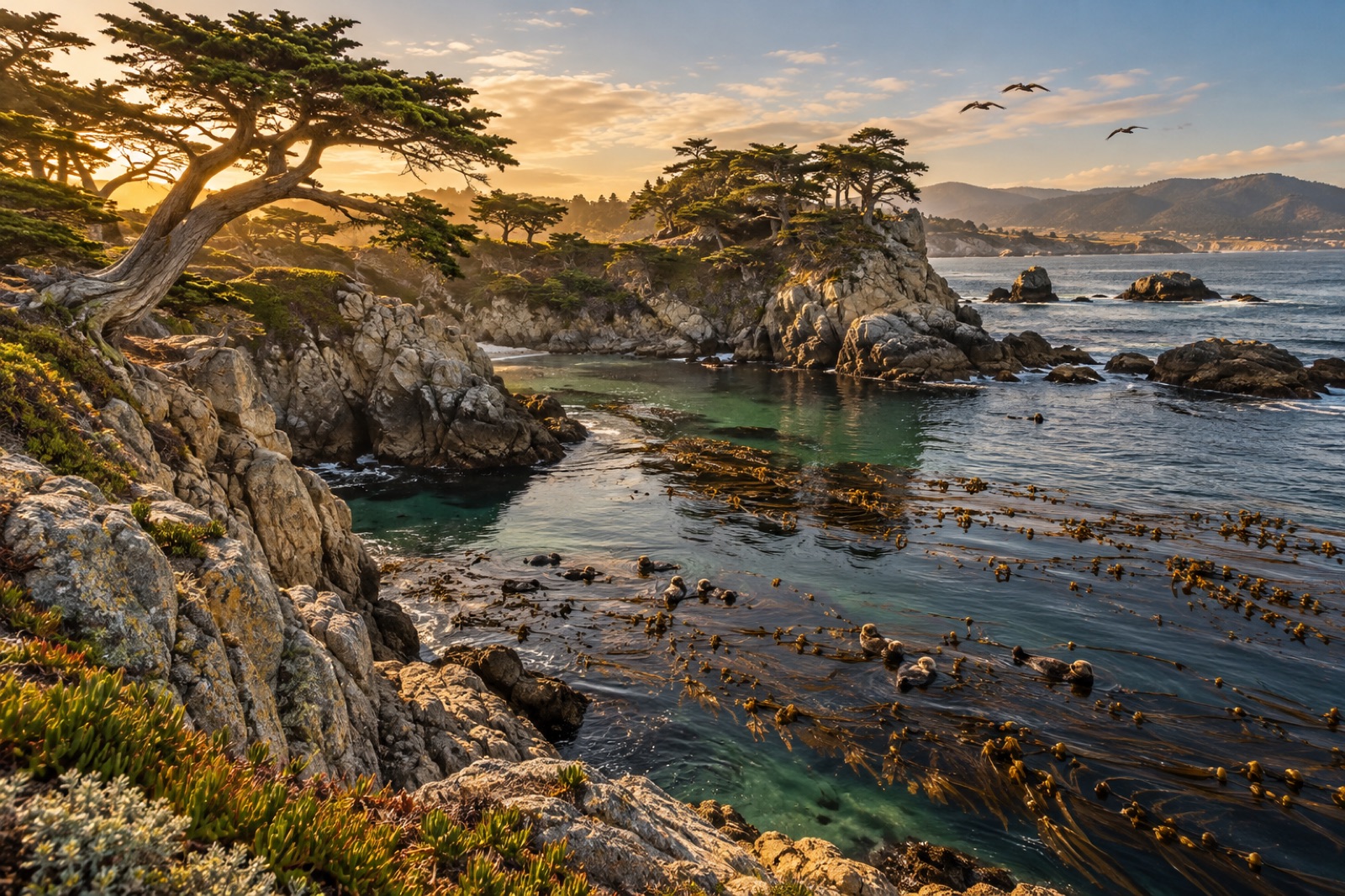
Point Lobos earns its nickname the moment the fog lifts. Below the cliff path at Sea Lion Point, the water of Headland Cove is doing something normal people don't expect from ocean — it is standing still, green, deep-lit, and organised into waves of kelp fronds combing themselves with the swell. Sea otters roll on their backs inside the kelp fringe. Pelicans raft the calm lanes between patches of canopy. On a good morning the visibility from the cliff rim reaches past the canopy to the otter-brown carpet of kelp anchoring itself to granite below.
This is the reserve that conservationists and resort developers have fought over since the 1890s, that Ansel Adams and Edward Weston made the anchor of American landscape photography, and that today earns the title of California's most-visited small state natural reserve for a reason everything in its perimeter is visible from the water's edge.
Point Lobos is a promontory on the Carmel-side of the Monterey Peninsula, at the southern mouth of Carmel Bay — the bottom edge of Monterey Bay's canyon-water system. Two protections overlap at its heart: the terrestrial State Natural Reserve (established in 1933 by the state after decades of private acquisition aimed at protecting the cypress and the coastline) and the adjoining underwater components in Whalers Cove and Bluefish Cove, carved out as one of California's earliest marine protection zones in 1960.
The geology is granite — hard Salinian granite carried up the coast on the Pacific plate, kerb-stopping just north of the Carmel River — and the combination of hard rock, canyon-fed nutrient water and strict protection makes for a forest unusually capable of recovery. Sea otters, absent from the coast for half a century, reappeared in the 1960s; their resurgence here helped drive the kelp's return to adjacent shorelines where urchin grazing ran unchecked for decades.
The reserve's trails are, at heart, a continuously operating kelp forest observatory. The viewing rule: look for smooth, dark slicks on the water — the canopy surface — then read backwards. Each slick marks a frond-lane where the kelp has damped the wind's effect on the surface; between slicks, the water chops in whitecaps. On calm autumn days the canopy mat is continuous across Headland, South and Bluefish Coves, reaching the surface like a roof combed flat.
Below that roof, the forest is stacked: canopy, mid-water rockfish and kelpfish, the herbivore band (abalone, urchins, snails) on the rock, and predators in the root zone. Visitors can't see the whole cathedral from the cliff, but you can read its weather — size of the canopy rafts, number of otters rafted in them, whether sea lions are porpoising through — from a dozen overlooks in an hour's walking.
Every trail at Point Lobos is short, but they stitch into a full day:
In any of these walks, the eye rarely leaves the water for long.
Point Lobos runs what is probably California's most controlled shore-dive program, and for good reason: the reserve's waters are small, heavily visited by non-divers, and contain wildlife that does not need additional pressure. Divers register in advance for a limited number of daily team spots, dive in registered buddy teams (no solo diving), and are restricted to Whalers Cove and Bluefish Cove. Even so, the diving is unforgettable: sunbeams through canopy, walls of giant kelp, wolf eels curled in dens, octopus under ledges, sea lions working at fin level.
The details — booking, conditions, etiquette, the sites themselves — are in our companion piece, Dive Guide: Point Lobos — The Slot in the Reserve That Fits You. Divers new to kelp forests in general should spend a couple of hours with Beginners' guide to diving in kelp before they arrive; kelp etiquette and manoeuvring need to be second nature before the water gets cathedral-quality.
Point Lobos gives you the full Monterey canyon ecosystem in a compact block:
The human history stacks in layers: Indigenous stewardship by the Rumsen Ohlone, whose middens still trace the coves; a phase of shore whaling run largely by Japanese and Portuguese crews from the 1850s; a coal-oil and abalone-packing industry that nearly ate the cove; and finally the conservation push — led initially by local residents and later by a mix of photographers, scientists and legislators — that shielded Point Lobos from subdivision. The reserve's status as a State Natural Reserve (the state's highest protection tier) carries rules that read strict on paper — no pets, no drones, no collecting, no walking off-trail — and feel perfectly calibrated once you see what is being protected.
General visitors do not need a reservation; entry is through a gate with a parking fee, and trails are open first-come. Diving, however, requires an advance reservation for one of the limited daily buddy-team spots in Whalers or Bluefish Cove. Book as far ahead as the park system allows, especially for autumn weekends.
Snorkelling is allowed within the parameters of the diving rules — in practice that means registered snorkellers are treated like dive teams: reserved spots, buddy requirement, and the two-cove boundary. Kayaking and swimming outside those coves is not permitted within the reserve's marine area.
Late summer and autumn for peak canopy height and calm water visibility; spring for pupping harbor seals and migrating gray whales; winter for empty trails and storm-watching off the south shore. The canopy never fully disappears here, but its presence on the surface is seasonal.
Essentially yes — two natural stands, at Point Lobos (Allan Memorial Grove) and nearby Cypress Point, separated by a few miles of shoreline. Ornamental Monterey cypress has been planted around the world, but the wild species is that restricted.
It sits at the southern mouth of Carmel Bay, contiguous with the Monterey Bay National Marine Sanctuary that stretches north past Santa Cruz. The reserve is the tightly-managed core; the sanctuary is the giant protective umbrella over the region's kelp, canyon and upwelling system — see the broader story in Kelp Forests of Monterey Bay.
Point Lobos limits divers to a handful of reserved buddy teams a day. How to get a slot, dive Whalers Cove's kelp, and respect California's oldest rules.
Tom Okafor ·
Monterey Bay holds some of North America's most accessible giant kelp forests — a canyon-fed, otter-patrolled ecosystem you can dive, kayak or watch from shore.
Dr. Theo Nakamura ·
A coastal atlas guide to Big Sur's kelp: cliff geology, upwelling and otters, where the canopy grows, and realistic access on California's wildest coast.
Tom Okafor ·