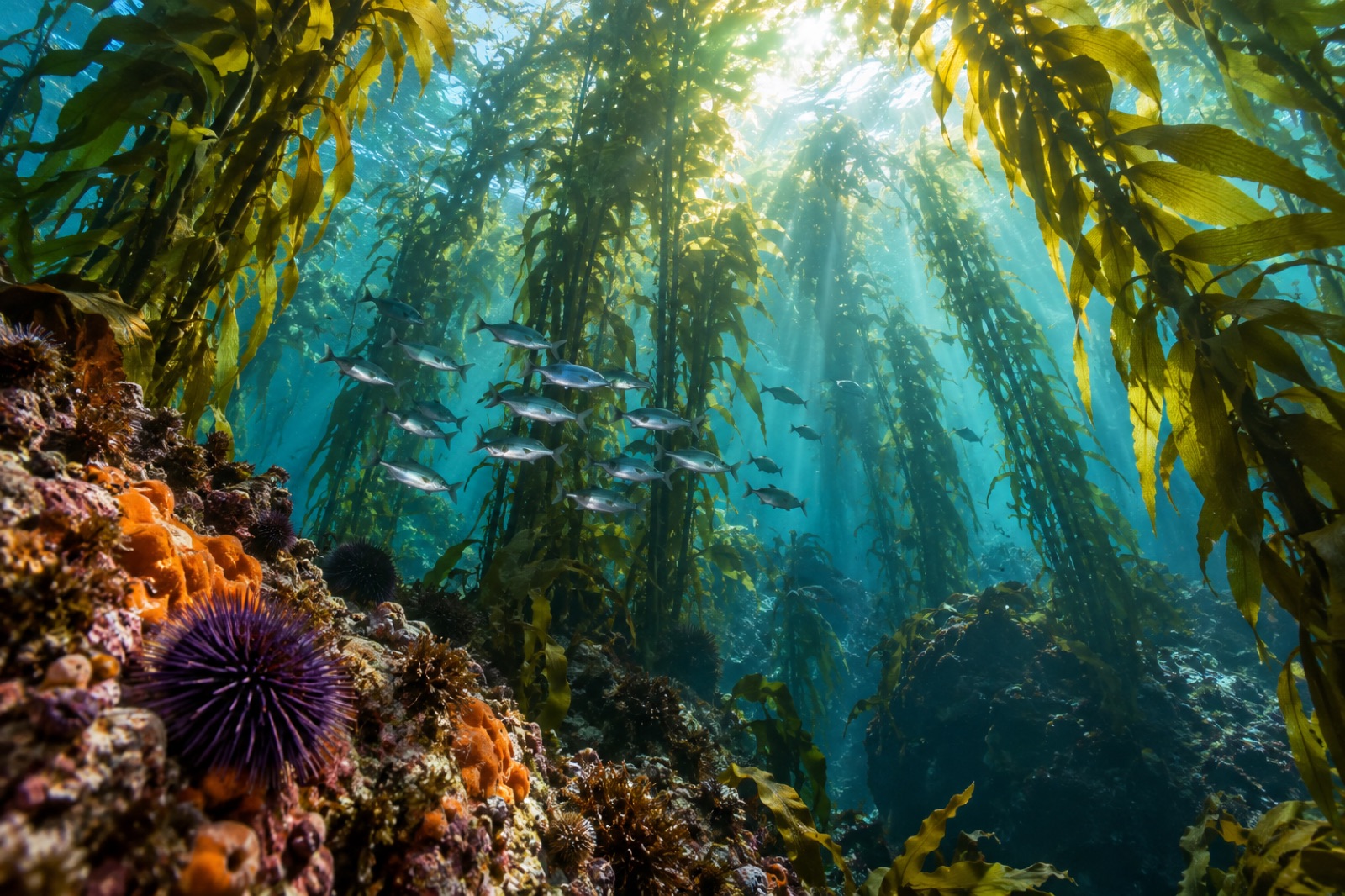
A tonne of carbon is a tonne of carbon — but a hectare of restored kelp forest is much more than its carbon budget. It is fish habitat and nursery ground, a wave-breaker, a water filter, a dive destination, and a place where people earn their living and practice their culture. These "co-benefits" are increasingly what buyers, governments and communities actually care about. The hard question is how you count them honestly.
What counts as a co-benefit?
Co-benefits are the positive outcomes of a carbon project beyond the carbon itself. For coastal restoration they tend to cluster in five families:
- Biodiversity — species richness, habitat area, recovery of threatened populations.
- Fisheries and food — fish biomass, recruitment to adjacent fisheries, harvest opportunities.
- Coastal protection — wave energy attenuation, erosion reduction.
- Water quality — nutrient capture, local pH buffering, turbidity reduction.
- People — employment, training, cultural continuity, recreation, community wellbeing.
Carbon is easy to trade because it's fungible: a tonne anywhere equals a tonne everywhere. Co-benefits are stubbornly non-fungible. A dugong meadow and a lobster reef cannot be swapped on a spreadsheet. That is precisely why measuring them carefully matters.
Biodiversity: from species lists to structured metrics
Biodiversity is the most developed co-benefit family, thanks to decades of ecological monitoring practice and the recent rise of biodiversity credits and marine biodiversity net gain policy.
Metrics that survive scrutiny
The credible ones share three traits: they are measured against a baseline, compared to a reference or control site, and repeatable by third parties. In kelp restoration, the workhorse metrics include:
- Canopy area and persistence, mapped by satellite and drone — the foundation habit metric.
- Species richness and community composition from dive surveys, and increasingly from eDNA sampling, which reads biodiversity directly from seawater.
- Fish biomass and size structure from visual census or acoustic surveys.
- Habitat-forming species recovery — the kelp itself, plus understory algae and encrusting communities.
Good practice also tracks acoustic signatures (reef soundscapes) as a cheap, continuous proxy for biological activity. No single metric tells the story; credible projects report a dashboard, not a number.
Fisheries: the benefit people can eat
For fisheries communities, the value proposition is concrete. Kelp forests support higher fish and invertebrate biomass than degraded urchin barrens, and trophic cascade recovery can rebuild populations of abalone, lobsters and finfish that adjacent fisheries depend on.
Measurement here means fishery-independent surveys (transects, baited cameras, acoustics) inside and outside the restoration area, plus — where communities agree — fisheries catch and effort data. The honest difficulties:
- Attribution. Fish move. Did the restored reef produce biomass or merely attract it? Before–after control–impact designs help but rarely settle it completely.
- Time lags. Fish response can take years longer than kelp canopy response.
- Displacement. Benefits inside a no-take reef may partly come at the cost of displaced fishing effort elsewhere — a leakage-like problem in social form.
Coastal protection and water quality: physical services
Kelp forests measurably damp wave energy and canopies capture nutrients as they grow. These services are genuinely quantifiable — wave sensors and water sampling give real numbers — but two honesty checks apply. First, magnitude is highly site-specific; a forest's sheltering effect depends on depth, fetch, season, and canopy structure. Second, the service is only as permanent as the forest, which ties these co-benefits to the same permanence questions that haunt carbon.
Social and cultural value: the hardest and most important
Jobs and training are countable — full-time equivalents created, wages paid, certifications earned, local procurement share — and any serious project should report them. Cultural and wellbeing value is deeper and harder. On Indigenous sea country in particular, a restored reef may be measured by rangers' own indicators: the return of culturally significant species, the ability to practice harvest, intergenerational knowledge transfer. These deserve to be defined, measured and owned by the communities themselves, under free, prior and informed consent — not translated into a proxy invented by an accountant far away.
How co-benefits get valued — and who pays
Three mechanisms are converging:
- Premium credits. Buyers pay more per tonne for carbon projects with verified co-benefits; certification add-ons in the voluntary market formalise this. Price dispersion studies consistently show nature-rich credits commanding substantial premiums.
- Separate ledgers. Some projects sell carbon on one ledger and biodiversity on another, keeping claims clean. We compare the approaches in stacking credits and nature credits vs carbon.
- Public payment for ecosystem services. Governments increasingly fund restoration directly for fisheries, tourism and coastal protection outcomes, with carbon as a bonus — policy described in our blue carbon policy overview.
The risk of double-counting co-benefits
The same reef cannot sell its fish-recovery benefit three times to three different buyers. Co-benefit claims need the same discipline as carbon: one claim, one owner, one registry-style record, with clear rules about what bundling is allowed. Projects that sell "carbon + biodiversity + fisheries + jobs" in a single premium credit must be able to show they are not also selling the biodiversity separately.
What a buyer should actually ask for
If you're evaluating a coastal restoration project — through our carbon buyers solution page lens or anyone else's — ask for a co-benefits report with: a defined baseline year, paired control sites, metric definitions that a third party could re-implement, uncertainty ranges rather than point estimates, community-defined social indicators, and a reconciliation statement showing none of the benefits are claimed elsewhere. At Tidewright — a fictional company, built for this demonstration — our imaginary Canopy Ledger platform embodies exactly this reporting shape: canopy maps, eDNA diversity indices, fish biomass surveys and employment data reported alongside the carbon, with methods published openly.
Key takeaways
- Co-benefits span biodiversity, fisheries, coastal protection, water quality and human wellbeing — and they are non-fungible, so dashboards beat single scores.
- Credible measurement means baselines, control sites, and repeatable third-party methods: canopy mapping, eDNA, fish surveys, acoustics.
- Fisheries benefits are real but attribution, time lags and displacement require honest treatment.
- Social and cultural indicators should be defined and owned by the communities they describe.
- Value flows through premium credits, separate nature ledgers, and public ecosystem-service payments — never through triple-counted claims.
FAQ
Are co-benefits included in the price of a carbon credit?
They are embedded: a credit is a tonne of CO₂, but buyers pay premiums for credits from projects with strong verified co-benefits. Increasingly, co-benefit certification add-ons make the value explicit rather than implicit.
Can co-benefits be sold separately from carbon?
Yes — biodiversity credits and nature markets are emerging ledgers for exactly that. The governance question is overlap: the same outcome shouldn't be claimed on two ledgers at once.
How do you measure biodiversity quickly and cheaply?
eDNA metabarcoding from water samples, passive acoustic monitoring, and satellite/drone canopy mapping have dramatically cut costs. They complement, rather than replace, dive surveys that provide species-level detail.
Who decides which social benefits count?
Best practice: the affected community does, through consent-based processes. Community-defined indicators are more legitimate and often more decision-useful than external proxies.
Do co-benefits make a project more bankable?
Generally yes. Verified co-benefits widen the buyer pool (governments, food companies, development funders), support premium pricing, and build the local support that keeps projects durable over decades.