Explore9 min read
The Beginner's Guide to Kelp Forest Diving
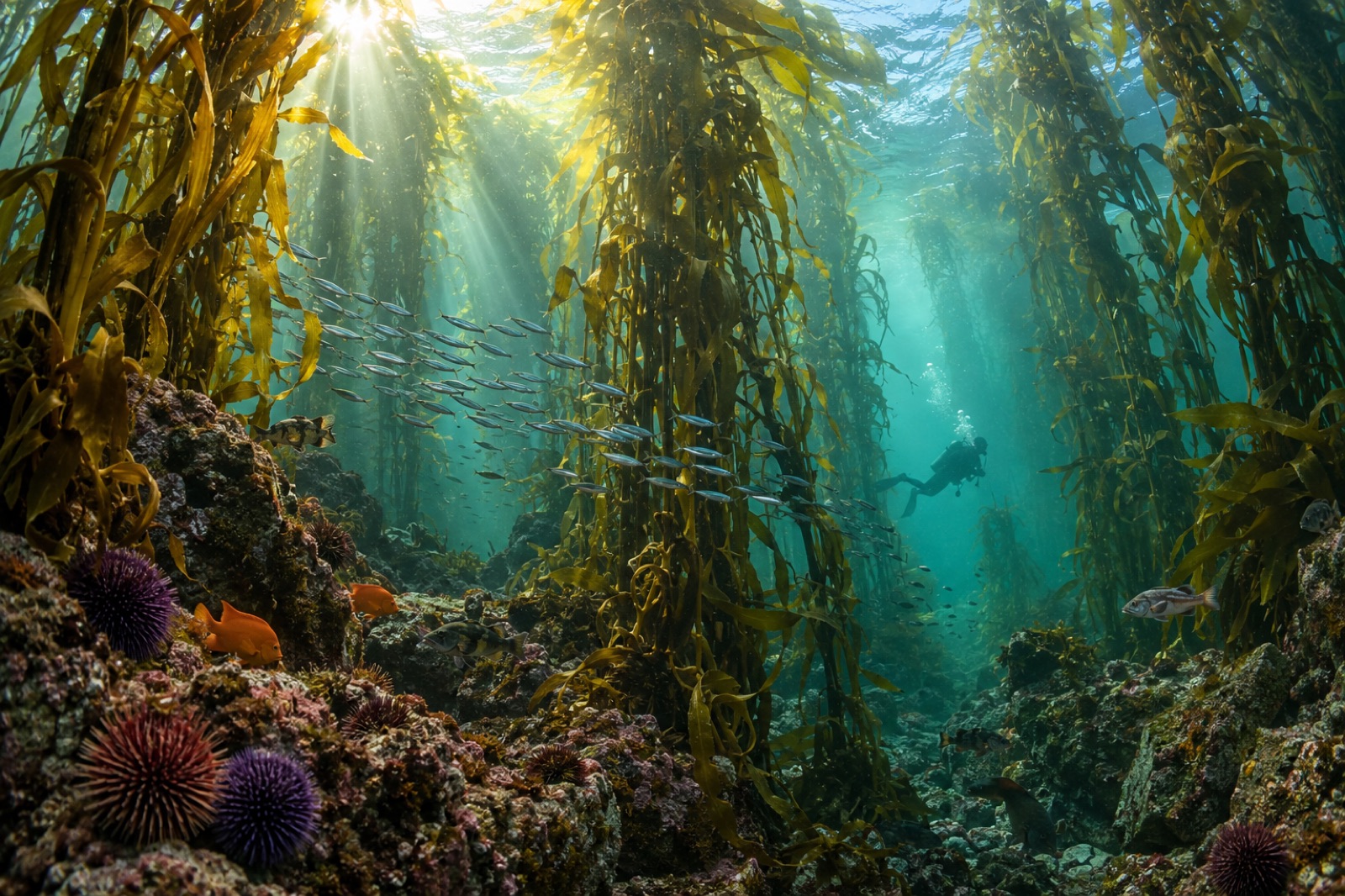
Your first kelp forest dive is easier — and more magical — than you think. Gear, skills, marine life and etiquette for new divers entering the green cathedral.
Tom Okafor ·
A complete pre-dive briefing framework for kelp forests — the headings that matter, kelp-specific hazards, and the minutiae that make briefings real.
A kelp forest briefing is the five minutes that decide whether a dive is a glide through sunlit columns or a quiet mess of lost buddies, grazed knuckles and a compass out at anchor. Tropical-boat habits survive poorly here: the canopy hides the surface, surge moves you a body-length per breath, and the exit point — not the entry — is the thing that bites people who didn't listen. This guide gives dive leaders and self-organising buddy teams a complete briefing framework tuned to kelp country, with the site minutiae that separate a real briefing from a recital.
If you're new to this environment, read the beginner's guide to kelp forest diving first; this piece assumes you're now briefing one.
Three features of kelp diving make briefing gaps expensive. First, the canopy is a visual curtain: the forest can split a buddy pair in two fin kicks, and the surface — where reunions happen — is invisible from below the canopy. Second, bottom topography is rarely the friendly sand-and-obvious-bommie layout of a resort dive; rocky reef runs in gullies and walls that defeat casual navigation. Third, entries and exits are the hazard: kelp coasts offer surge channels, slippery rock, surf and boat traffic, and a briefing that dwells on depth and skips the exit is briefing the easy half.
A good kelp briefing therefore weights its content differently: depth and time limits get a sentence; exits, separation protocol and hazards specific to today's water get paragraphs.
Run the headings the same way every time so divers learn the shape and know what to listen for. The order below moves from the big picture to the personal.
Start one hand-span above the water: where we are, which way the reef runs, where the kelp canopy sits relative to our anchor or our entry point, and what the bottom does — depth range, walls versus gullies, sand channels that make useful navigation highways. Draw it in the air or on a slate. Mention the compass headings that matter (the reef runs roughly east–west; the wall is on your left going out). This is where the material in underwater navigation in kelp becomes briefing content rather than theory.
Swell height and period, surge expectation at working depth, current direction at entry versus depth, visibility, water temperature. Never brief yesterday's conditions. State explicitly what the day changed: swell is up half a metre from the forecast, so the exit channel will have a faster drain than yesterday.
Describe the entry in one breath and the exit in three. For shore dives, the exit point, its hazards, the handholds, the timing against surge cycles, and the abort point where you accept a longer swim rather than a wrong exit. For boats, the pickup procedure, the current line's position, and the rule about hanging on rather than swimming for the ladder.
Kelp-specific, then general. Entanglement behaviour (stop, don't thrash, back the way you came); surgy rock contact at high spots; boat traffic overhead if the site is inside a transit lane; cold-water realities at the surface interval. Add any animal watch-outs for the season and region. Compare notes against realistic hazard lists — the catalogue in boating etiquette around kelp dive sites is useful because it names what not to brief complacently.
Name the pairs out loud and have them look at each other. Assign lead and follow, navigator and time-watcher. In a group, state the guide's role and whether the dive is guided or led-from-the-front with free buddies inside limits.
Maximum depth, planned profile shape, total time, turn pressure and reserve on surfacing. In cold water with thick suits, honest gas planning matters more than ambition — the kit list in cold-water dive gear for kelp forests exists because the cold drives the gas budget that drives the plan.
The single most skipped item in kelp briefings, and the most important: if separated, look around where you are for one minute — checking up into the canopy light — then surface, establish eye contact, and reunite or descend together. Brief the procedure positively and briefly; brief it every time, because in the forest it will be used.
Hand signals plus revisions, because cold hands and kelp modify them: the "look up" signal for canopy checks, the branch-in-the-way gesture for entanglement assistance, light-signal protocol if any torches are carried in daylight. Brief the recall signal — boat siren, rattle, or hand-over-head — and what it means: return along the bottom, not a panic ascent.
No kneeling on reef, no grabbing kelp as a handrail, neutral trim over canopy gaps, look-up discipline in surge. Brief why in one sentence: the forest is a living nursery, and fins in the canopy tear juvenile fronds and disturb the species the dive came to see. These are not soft suggestions; they are the agreement.
Experienced leaders can be heard adding details novices never think to include. Worth stealing:
Shore dives compress the boat sections and expand the exit; night dives add light signals and hard limits; guided commercial dives fold in group-integrity rules and a stricter recall. The framework stays — the weight slides. And whatever the audience, the test at the end is the same: ask one diver to tell the group the separation procedure, and another to point at the exit. If they can do both, the briefing worked. This is the standard our guide partners at Tidewright's dive-operator program are held to, and it transfers to any team of two or twenty.
Five to eight minutes for a boat charter group, three to five for a trained buddy pair. Longer briefings don't hold attention; the discipline is repeating a tight framework every dive so nothing degrades to assumption.
The separation procedure. Surface reunions work differently when the canopy hides the boat or shore, so the rule — search one minute, surface, reunite — must be explicit and freshly briefed, not inherited from last year.
The framework doesn't change; the emphasis slides. Shore dives weight entries, exits and surf timing; boat dives weight recall signals, pickup and the anchor reference. Kelp-specific hazards — entanglement, canopy separation — are constant.
"Look up" for canopy checks, an entanglement-assistance gesture, an agreed recall signal, and compass-heading signals for the reef's orientation. In average visibility with hands cold, brief each one physically before entry.
Briefly and factually: what to expect, spacing rules, and the no-contact baseline. Long anecdotes displace safety content; the ethics are covered in our wildlife ethics guide and can be pointed to before the dive.
Your first kelp forest dive is easier — and more magical — than you think. Gear, skills, marine life and etiquette for new divers entering the green cathedral.
Tom Okafor ·
Kelp forests make navigation both easier (vertical landmarks) and harder (featureless canopy walls). Learn compass discipline plus natural navigation by light and surge.
Tom Okafor ·
How to assess a shore dive site step by step: wind, swell, entry and exit points, surge and kelp layout — plus the bailout plan every beach dive needs.
Tom Okafor ·