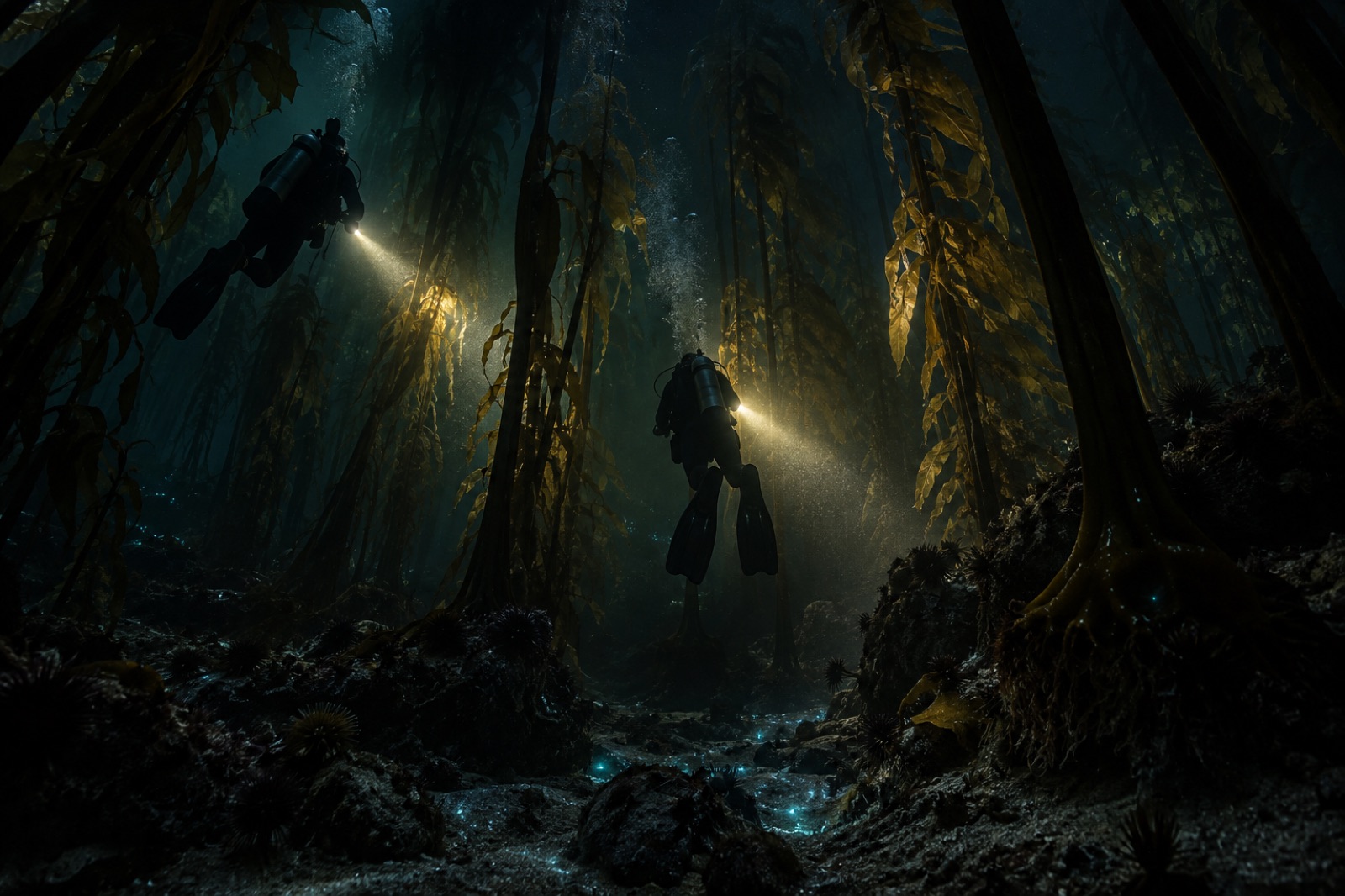
Snorkelling a kelp forest after dark is the cheapest ticket to the ocean's second shift. The daytime fish pack up and tuck into the reef; the torch beam finds octopus out hunting, lobsters walking the open sand, sleeping parrotfish-and-wrasse relatives wedged in crevices, and — on the right nights — the water itself lighting up blue with every sweep of your arm. It is also the highest-consequence version of snorkelling: everything familiar looks different, and the walk back out of the water is where most nights go wrong. Done with discipline, though, a night snorkel in knee-to-chest-deep kelp country is one of the great small adventures a coast offers.
What changes after dark
A reef does not sleep; it rotates. As light fades, the kelp forest's day shift — the surfperches, wrasses, kelp bass and other visual hunters — becomes sluggish and shelters against rock and frond. The night shift emerges from holes and from the sand:
- Cephalopods. Octopus that spent the day in dens now hunt openly across the reef edge. On Pacific kelp coasts that can mean a red octopus the size of your fist or, with luck, a young giant Pacific octopus flowing along the bottom.
- Crustaceans on foot. Spiny lobsters, rock crabs and decorator crabs abandon shelter and walk. A lobster crossing open sand in torchlight looks like machinery from a more confident century.
- Hunting sharks of the harmless kind. On temperate Pacific reefs, nocturnal little sharks — swell sharks, horn sharks — patrol slowly at ankle-depth where the reef meets sand.
- The plankton show. Comb jellies drift through the beam trailing rainbow diffraction. And on dark, warm, calm nights, bioluminescent dinoflagellates turn every disturbance — your fins, your hands, a seal's torpedo wake — into blue-green sparks.
- Sleeping fish. The day's bold residents lie still and pale against the reef, sometimes colour-shifted into their night pattern. You are seeing the forest's population honestly counted for once, because half of it was hiding all day.
Snorkel, not scuba: why the shallow night works
Our night diving guide covers the forest after dark on tanks. Snorkelling the night forest is a different proposition with its own logic: you stay at the surface, the gear is trivial, and — because most nocturnal action happens along the reef edge in two to five metres of water — a duck-dive gets you to eye level with nearly all of it.
The constraints are real. You cannot linger at depth, so sightings are snapshots. You are colder, faster, without a buoyancy compensator — the top metre of the sea is the wave-swept metre. And you have no backup air, which is exactly why night snorkelling belongs in shallow, sheltered, well-known water rather than ambitious sites. Think of it as tidepooling with a mask and a torch, at the tidepool's outer suburbs.
Choosing and preparing the site
The first rule of night snorkelling: never night-snorkel a site you have not snorkelled in daylight. You need to know where the entry and exit are, where the reef gives way to sand, where the surge pushes, and what "normal" looks like — because at night, spatial memory replaces visibility.
Pick sites with three properties: a protected cove or bay with minimal swell, a simple unambiguous exit (a beach, never a rock shelf you have to time), and shallow structure within a short swim. Harbours, sheltered reserve coasts and kelp-fringed bays are ideal; exposed points and surf-adjacent reefs are not, at night, ever.
Prepare the exit like a professional. Mark it with a light you will see from the water: a lantern, a headlamp hung on a rock, a chemical glow stick taped to a float at ankle depth at the exact waterline exit point. Two markers are better than one — a single light can be mistaken for a house behind the beach. Walk the exit route once with your torch before you get in, noting holes and slippery zones, because you will walk it cold, dripping and night-blind an hour later.
Lights and light discipline
Carry two torches, minimum: a primary (500–1,000 lumens is plenty; more lumens mostly means more backscatter) clipped or lanyarded to your wrist, and a small backup in a pocket. Flooding a torch at night without a backup ends the swim and starts the anxious part, so test both before entry.
Then learn the counter-intuitive discipline of night light:
- Sweep, don't stare. A torch beam held on an animal is a predator's gaze. Sweep the beam, find life at the edges of it, and when you want a better look, illuminate from the side rather than head-on — you'll see more behaviour and cause less flinching.
- Kill the light to see the magic. Bioluminescence — and the deepwater-winter constellations of the canopy's drifting life — only appear in darkness. Regularly turn the torch off entirely: thirty seconds of black stillness over a plankton-rich bay, then one slow arm-sweep of blue sparks, is the memory the whole night is for. Do this only when calm, stationary, in known depth, with your buddy beside you.
- Manage your night vision. Your eyes adapt over twenty minutes; every look at a bright torch resets the clock. Dim red modes on headlamps are for reading your compass on the surface, not for the reef.
The safety rules that matter more at night
Most of general snorkel safety holds, but these rules sharpen after dark:
- Never alone. Night snorkelling is a buddy activity without exception — and buddies stay close enough to see each other's lights at all times. Agree light signals on the surface first: torch circling overhead means "come here"; rapid horizontal sweeping means "problem, surface now".
- Shallow and sheltered only. Set a depth ceiling in metres and a swim boundary in landmarks before entry. Two to five metres over known reef in a sheltered cove is the night snorkel's whole territory.
- Calm or nothing. Surge you would manage by day is disqualifying at night. Wind chop destroys both visibility and orientation. Cancel early and happily; the forest will be there next week.
- Warmth is capacity. At night, air and wind chill the wet body hauling itself along the surface. Wear a thicker suit than the same water demands by day — see the cold-water snorkel kit guide — and set a time limit, not just a cold limit. Forty-five good minutes beats ninety shivering ones you won't remember fondly.
- Getting out is the crux. Reconfirm your marked exit from the water before you think you need it. Carry boots that handle rock. End the swim while everyone is still warm enough to think.
What to watch for, and how
The techniques that reward a night snorkeller:
Hover the edge. The reef–sand boundary is the night shift's motorway. Float motionless over it, torch sweeping low, and let the traffic come through: lobsters out walking, crabs in transit, sleeping fish in the lee of the first rocks.
Look into the canopy, gently. Fronds at night host different life than by day — kelp perch sleeping nose-down among the blades, shrimp and mysids up from the bottom, squat lobsters filter-feeding in the current. On some coasts, juvenile fish shelter so densely around fronds that a slow beam-sweep through canopy looks like a lantern-lit blizzard.
Duck-dive briefly and quietly. One calm drop to the reef gives you the level view — the octopus mid-hunt, the fish asleep in its night colouration. Come up through your exhale and make no splash; splashing is the sound day-tourists make.
Notice the sky. Half of a night snorkel happens face-up. Raft quietly at the end with the torch off: on genuinely dark coasts the canopy's own stars are mirrored overhead, and seals passing beneath you trail meteor-streaks of light in plankton season.
Key takeaways
- Kelp forests rotate shifts at dusk: octopus, lobsters, night sharks and sleeping fish replace the daytime community, and some nights the plankton itself glows.
- Night snorkelling works because the action is shallow — stay at the surface, duck-dive for snapshots, and never attempt sites you don't know in daylight.
- Mark your exit with two lights before entry; most night-snorkel trouble happens at the waterline, not in the water.
- Light discipline is the craft: sweep rather than stare, illuminate from the side, carry a backup torch, and turn everything off sometimes to see the bioluminescence.
- Buddy always, shallow and sheltered only, cancel at surge, dress warmer than daytime, and leave while you're still warm.
FAQ
Is night snorkelling in kelp dangerous?
It carries the same hazards as daytime snorkelling in worse light, plus disorientation — which is why the discipline exists: known sheltered sites, calm seas, a buddy, marked exits and time limits. Within those bounds it is a moderate, manageable adventure; outside them it genuinely is dangerous, and kelp itself is the least of it.
Can I get tangled in kelp at night?
Kelp fronds are flexible and slide off a calmly swimming person; panic is what wraps things around limbs. Snorkel slowly, avoid powering through canopy, and never wrap fronds around yourself for a photograph. If my torch finds me wrapped anyway: stop moving, surface, and unwrap by hand.
What's the best time of year and night to go?
Warm, calm, dark nights in late summer and autumn are the classic window — warmest water, long dark hours, and the best odds of plankton blooms that produce bioluminescence. A new moon darkens the sky for the glow; a bright moon makes navigation and orientation easier for a first-timer. Choose according to which show you want.
Do I need a wetsuit for night snorkelling?
Almost always, yes, even in summer — at night you lose the sun's warmth, radiate heat into cold air at the surface, and can't rely on adrenaline to stay warm. Use a thicker suit than the same site demands at midday, and end the swim on schedule, not on shivering.
Will sharks be a problem at night?
The nocturnal sharks of temperate kelp reefs are small, slow benthic hunters — swell sharks, horn sharks, catsharks — interested in snails, not snorkellers. The standard rules cover the rest: don't snorkel at night where large predators actively feed (river mouths at dusk, seal colonies at dawn), don't carry speared fish, and let any animal that seems interested in you end the encounter its own way, which it will.