Science8 min read
Drift Kelp and Wrack: The Forest's Gift to the Beach
Kelp forests export a share of everything they grow. Here's how drift kelp feeds open water, beach wrack feeds the shore, and why leaving wrack alone matters.
Dr. Mara Ellison ·
A Tidewright field note: twice a year, volunteers walk Tasmania's beaches counting cast kelp — because the wrack line tells us what the reef can't.
Field Notes are Tidewright's own dispatches from our sites and sheds. They describe our fictional projects, crews and results — told the way they happened to us. This one comes from two mornings a year on the beaches near our Tinderbox pilot site, when we walk the wrack line with volunteers and let the sea's outgoing mail tell us how the reef is doing.
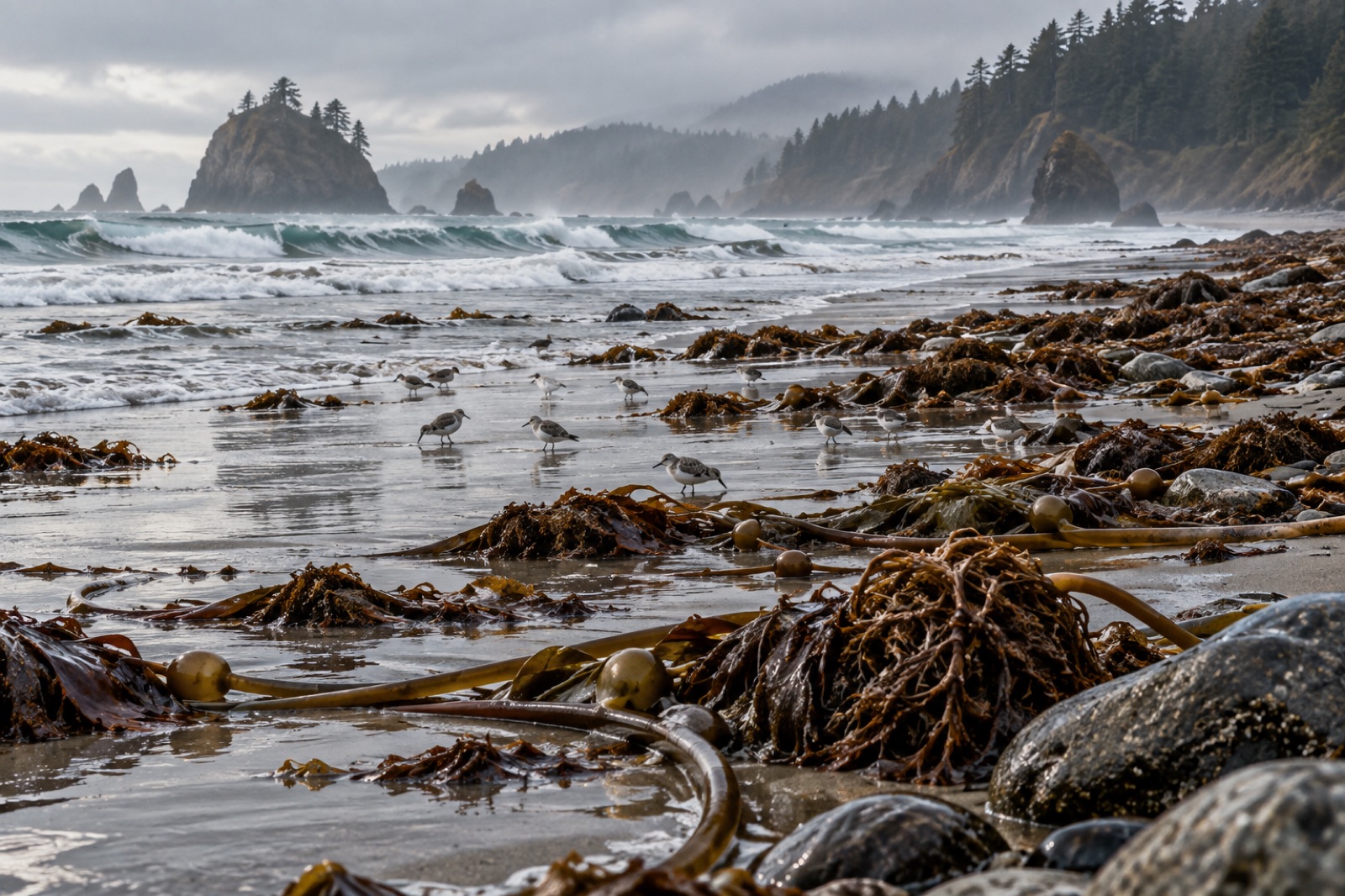
Every kelp forest keeps a ledger, and twice a year it washes up on the beach. Storms and swell tear fronds, stipes and whole holdfasts off the reef, currents sort them, and the tide lays the result in a long dark ribbon at the top of the sand — the wrack line. Divers see one reef at a time. The beach shows you the whole district's catch, condensed into a line you can walk in an hour.
That is why, every March after summer's cast and every October after the winter storms, thirty-odd volunteers meet us at a car park in the cold half-light with clipboards and gloves, and we count what the ocean threw away. It is the cheapest, oldest and quietly most informative survey we run. This is the note on how it works and what three seasons of it have taught us.
Wrack is beach-cast seaweed — everything the water has detached and delivered. If you want the full ecology of it, our explainer on drift kelp and wrack covers how detached kelp keeps travelling, feeding amphipods and shore birds on the beach and filter feeders offshore for weeks after it leaves the reef. The survey version is simpler: the wrack line is a sample. It is biased, weather-dependent and incomplete — but it is drawn from a far larger area than any single dive, and it is free.
A good cast morning here delivers mostly southern bull kelp, bullwhip-thick stipes and leathery blades, some torn to fist-sized rags, some arriving whole with the holdfast still gripping a stone. Mixed through it: epiphyte-furred fragments, drift eelgrass from the bays, the odd cray pot fragment wearing last season's growth. Each piece carries evidence of how it came off — and that evidence is what we are really counting.
We dive constantly; the Canopy Ledger monitoring program runs transects and drone passes across every site. So why add a beach walk?
Nothing that needs charging: clipboards, data sheets, gloves (the cast crawls with kelp flies by mid-morning), a 10-metre rope for quadrats, spring scales, species photo cards, and a flag-tape roll. Each pair carries one camera. The whole kit for a thirty-person survey fits in two tubs and costs less than one dive cylinder fill.
Each pair of volunteers takes a fixed 200-metre beach section — the same sections every year, marked by landmarks, not GPS, so no one needs an app. They walk the wrack line twice. First pass: count and sort by species and form (whole plant, blade only, stipe section, holdfast with stone). Second pass: every 25 metres, lay the 10-metre rope as a quadrat along the wrack and record everything inside it in detail — stipe lengths on the bull kelp, presence of epiphytes, and the crucial one: holdfast scar type.
A holdfast torn free by wave force shows ragged, ripped tissue and often still holds its stone. A holdfast abandoned after urchin grazing shows a smooth, rasped base. That one distinction, counted across enough plants, is a regional grazing-pressure signal collected by people who learned to spot it twenty minutes earlier. Staff resurvey one section in twenty as a quality check; agreement between volunteer and staff counts has sat above ninety per cent since we tightened the photo cards.
By ten o'clock everyone is at the surf club rooms with their sheets, and we do the tally out loud, section by section, over breakfast. This part is not optional and not a courtesy. Volunteers who never hear what their numbers meant don't come back, and they shouldn't. The tally sheet for the morning goes up on the wall next to last year's.
These are our records from our own sites — a small, local dataset, and we treat it with appropriate modesty:
Wrong, at first: rotting cast smells, kelp flies are legion by nine, and the temptation to record a specimen as its more interesting relative is real — everything wants to be a bigger species than it is. The photo cards and the resurvey checks exist for exactly these failure modes.
Right, almost immediately: pattern-reading. By the second pass, most pairs are narrating the cast like detectives — "this lot came off whole, in one event, from shallow water" — because the wrack rewards exactly that kind of attention. Several of our regulars arrived through the very walks described in our guide to citizen science beach walks, and the diehards graduate to beachcombing wrack finds level of expertise within a season. One volunteer now pre-walks "her" beach the evening before each survey and greets us with a prediction. She has not been wrong this year.
Start small and permanent: three fixed sections, one photo card set, two mornings a year, forever. Fixed beats fancy — comparability across years is worth more than coverage in any single year. Build the resurvey check in from day one, keep the datasheets to what fits in a glove, and always, always feed the numbers back to the people before they drive home. The science is the excuse; the coastline getting thirty new careful readers is the achievement.
No, and they don't try to. Wrack surveys trade precision for breadth and continuity: they sample a much larger area, indirectly, at almost no cost. Used alongside transects and canopy mapping, they catch district-scale signals that dive programs can miss.
Twice-yearly works well: once after the main summer growth-and-cast season, and once after the winter storm season. What matters most is repeating the same windows each year so seasons can be compared.
Generally yes, with gloves — cast kelp hosts swarms of harmless but enthusiastic sandhoppers and kelp flies, and decomposing wrack can smell fierce. Avoid handling anything in or near polluted runoff and wash hands before eating. Never collect live wrack for removal without checking local rules; it is habitat and food for beach ecosystems.
A surprising amount: it detached with force, recently, from shallow rocky reef — and the scar at the holdfast base tells you whether waves ripped it or grazers undermined it. A beach full of those is a reef talking about a storm, a heatwave or an urchin front.
Staff resurvey roughly five per cent of sections immediately afterward and compare counts category by category. Agreement above ninety per cent is achievable with good photo cards and clear categories; categories that fail the check get simplified or dropped.
Kelp forests export a share of everything they grow. Here's how drift kelp feeds open water, beach wrack feeds the shore, and why leaving wrack alone matters.
Dr. Mara Ellison ·
How shoreline citizen science — from iNaturalist to kelp-cast surveys — feeds real kelp forest research. What to record, how to join, and why it matters.
Tom Okafor ·
A field guide to the wrack line — identifying kelp holdfasts, blades and pneumatocysts, finding egg cases and drift treasures, and knowing what you may keep.
Tom Okafor ·