Field Notes are Tidewright's own dispatches from our restoration sites. They describe our fictional projects, crews and results — told as we live them. Numbers in this one are illustrative; the light at 68° north is exactly as described.
The light is leaving Lofoten at the rate of about twenty minutes a day, and you can feel the whole archipelago leaning toward the dark. I am writing this from a rented table in Svolvær at the end of a two-week preparatory trip — the harbour-front hotel again, the same coffee, the same view of the masts. In eight weeks the Lofoten Sugar Kelp Belt starts its second winter seeding season, and this note is both a report and a promise: what the first 109 lines did through their first Arctic summer, and what changes when a program goes back into the dark knowing things it didn't know the first time.
A quick recap of season one
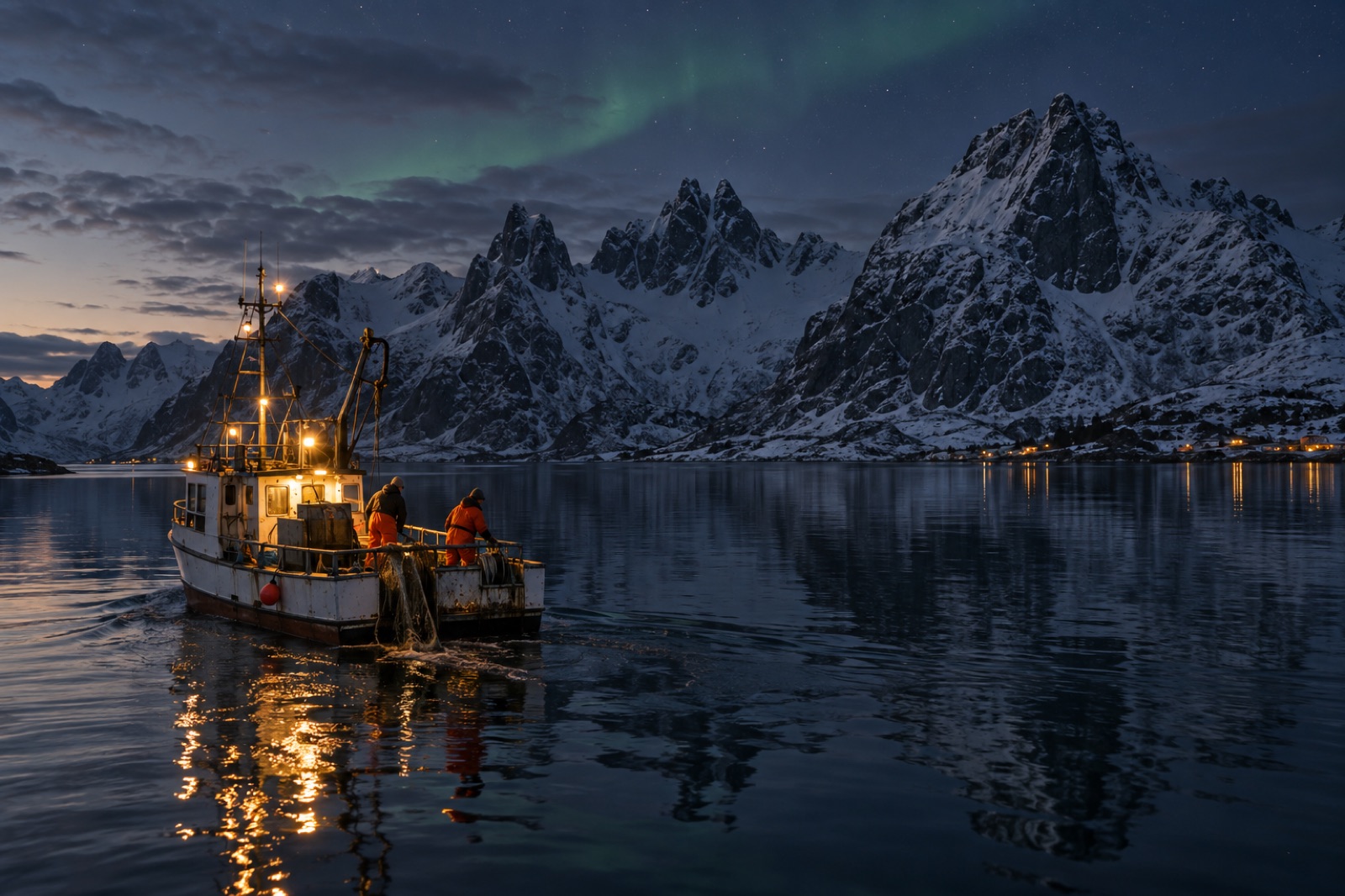
Last November through February, working with the Lofoten Small-Boat Fleet Association out of Svolvær, we put 109 spore-seeded Holdfast lines across 85 hectares of reef flat on six islands — the log of that seeding, in full headtorch detail, is First Lines in Lofoten. The short version: sugar kelp runs on a cold-water clock, juveniles must grip through the polar night to explode in the spring light, and at this latitude you do the hardest work of the year in the darkest weeks because the kelp wrote the calendar, not us.
Then we left, and the ocean had seven months of unsupervised possession. Restoration is an exercise in handing your work to the wild and finding out, a season later, what the wild thought of it.
What the summer survey found
We came back for the assessment in June and again in late August — diver quadrats on twenty of the lines, eDNA bottles over all six blocks, drone and satellite passes timed to the long days. Three findings, in descending order of how much they mattered to the room when I presented them in the fleet association's hall.
The juveniles held. Across the surveyed lines, roughly nine in ten carried established sugar kelp going into summer — blades of forty to sixty centimetres by late August (illustrative figures, but that is the shape of it). The winter seeding had done its job: the crop was gripping before the spring fouling window opened, and by the time the epiphytes arrived the kelp was already too big and too fast to be smothered. Season one of the calendar argument — the whole reason for headtorches in January — is settled in our favour.
The cold kept its promise on fouling. The water column stayed cold enough, long enough, that the summer fouling algae never built the felt layer that strangles seeded lines further south. If you want the physiology behind that window, our kelp phenology explainer is the season-by-season version. Restoration's dirty secret is that you're mostly running a race against weeds; at 68° north, the race is rigged your way.
The buffers earned their keep. Readers of the first log will remember the skipper who shut down the winch over a patch of "ordinary rock" because cod had held there since his grandfather, and how it became a permanent protected buffer in the plan. This March, drifting the block edges in the spawning weeks, the survey logged juvenile cod over exactly those held-wide grounds — including, in a moment of almost unbearable on-the-nose justice, directly alongside the unset line corridor. The fleet hall did not need the sonar printout. They took the printout anyway. It's going on a clubhouse wall in Kabelvåg.
What we're changing for season two
A first season is a hypothesis; a second season is a hypothesis that has been fisked by an Arctic winter, a fishing fleet and a spreadsheet. Four changes go into the November mobilisation.
Scale, carefully. Forty additional hectares, on two of the six islands only. Expansion is confined to blocks whose season-one mentorship lines performed — we don't seed new ground from our own enthusiasm, we seed it adjacent to proven neighbours. Marine connectivity is local; the science of how reefs link by currents is the reason the expansion map looks like a family tree, not a land grab.
The wharf becomes a factory. Last season we learned, the cold-numbed way, that boat work must be connect-and-drop. This winter the entire shackle-and-splice inventory gets assembled under lights in Svolvær before a single line goes out — tripling the pre-shackled stock, adding heated splice benches, and classifying hot drinks as personal protective equipment from day one rather than as a morale item, which is what it was all along.
Weather float gets honest. Nineteen of thirty-one scheduled days seeded last season. The plan this winter carries the buffer weeks up front instead of as apologies afterwards, and the mobilisation calendar is built around the models that perform best at this latitude — which, at 68° north, has its own literature and its own humility.
More of the fleet's ideas, fewer of ours. The skippers' suggestion list for season two ran longer than our budget, which I wrote in the first log was the correct ratio. It still is. This winter the fleet association nominates half of all new line corridors, and our survey team scores them rather than originates them. The Lofoten atlas guide calls these islands "knowledge-dense water." We have simply decided to act like it.
The thing I'm carrying back into the dark
Mid-August, last working dive of the summer assessment, on a line laid last January on the reef flat east of the channel. The kelp stood at waist height in ten metres of glass-green water, blades moving slow in a tide so light you could ignore it, and the light itself was doing that high-latitude thing of arriving at an angle that makes everything look remembered rather than seen. An oarweed forest — the wild, original stand we've measured ourselves against all along — lay two hundred metres further out, and from where I hung in the water, finning gently to hold position, the two forests were the same colour doing the same thing.
That's the whole report, really. Nineteen months ago this reef flat was a thinning edge of a thinning system. There is a young sugar kelp forest on it now that was put there in the dark by fishing boats, and this winter the dark gets a second helping. The light is leaving at twenty minutes a day, and we're going to meet it halfway.
Key takeaways
- Season one delivered: roughly nine of ten surveyed lines carried established sugar kelp into their first summer, validating the polar-night seeding calendar.
- Arctic cold suppressed the summer fouling algae that strangle seeded lines further south — the race against weeds is rigged in your favour at 68° north.
- A skipper's inherited cod ground, cordoned off as a no-line buffer in season one, logged juvenile cod at its edge this spring — local knowledge confirmed as operational data.
- Season two adds forty hectares on proven blocks only, shifts all splicing ashore to a lit wharf, and prices weather losses into the calendar up front.
- The fleet association now nominates half of all new line corridors; Tidewright scores rather than originates them, and considers that the correct division of labour.
FAQ
How dark is it, really, in a Lofoten winter?
Not black — the polar night here means several hours of deep twilight around solar noon, plus moonlight, aurora and hard deck lighting. The light does the strangeness; the cold and the compressed weather windows do the actual work. The atmosphere of it is captured in First Lines in Lofoten.
Why is the second season harder to get right than the first?
Because a first season runs on preparation; a second runs on evidence, and evidence always contains disappointment. You're no longer testing a plan, you're bound by what the reef actually did — which blocks took, which sled away genetics lines failed, which fleet ideas were better than yours. Scaling what worked, and only what worked, is a discipline first seasons never face.
Does the public get to see these forests?
In the warm weeks, yes — from the water, in a kayak or on a snorkel, the kelp edges of the islands are spectacular, and the Lofoten coastal atlas guide covers where, when and how cold. The seeded restoration blocks are working fisheries; we ask people to admire them from well clear.
Is sugar kelp restored for the ecosystem or for the harvest?
Both, deliberately — sugar kelp is a native forest-builder that is also a food crop, and the program's second phase pairs reef seeding with a winter harvest protocol so the fleet earns between seasons. The species profile is here; the point is that restoration that pays wages lasts longer than restoration that only asks for patience.
What would make you cancel season two?
A record-warm autumn pushing water temperatures past the germination window in November, or a breeding failure in the hatchery stock — either would mean seeding into a calendar the kelp itself had abandoned. We watch the temperature record like a finance desk. So far, the Arctic winter is still holding its side of the bargain, and that's the sentence I most want to write again next September.