Kitchen9 min read
Wakame vs Kombu vs Nori: When to Use Which
Wakame, kombu and nori do three different jobs in the kitchen. Flavour, texture, buying forms, substitutions and storage, side by side.
Sofia Andersson ·
Learn the logic of pairing seaweeds — texture, salinity and umami balance — so kombu, wakame, dulse and nori deepen a dish instead of muddling it.
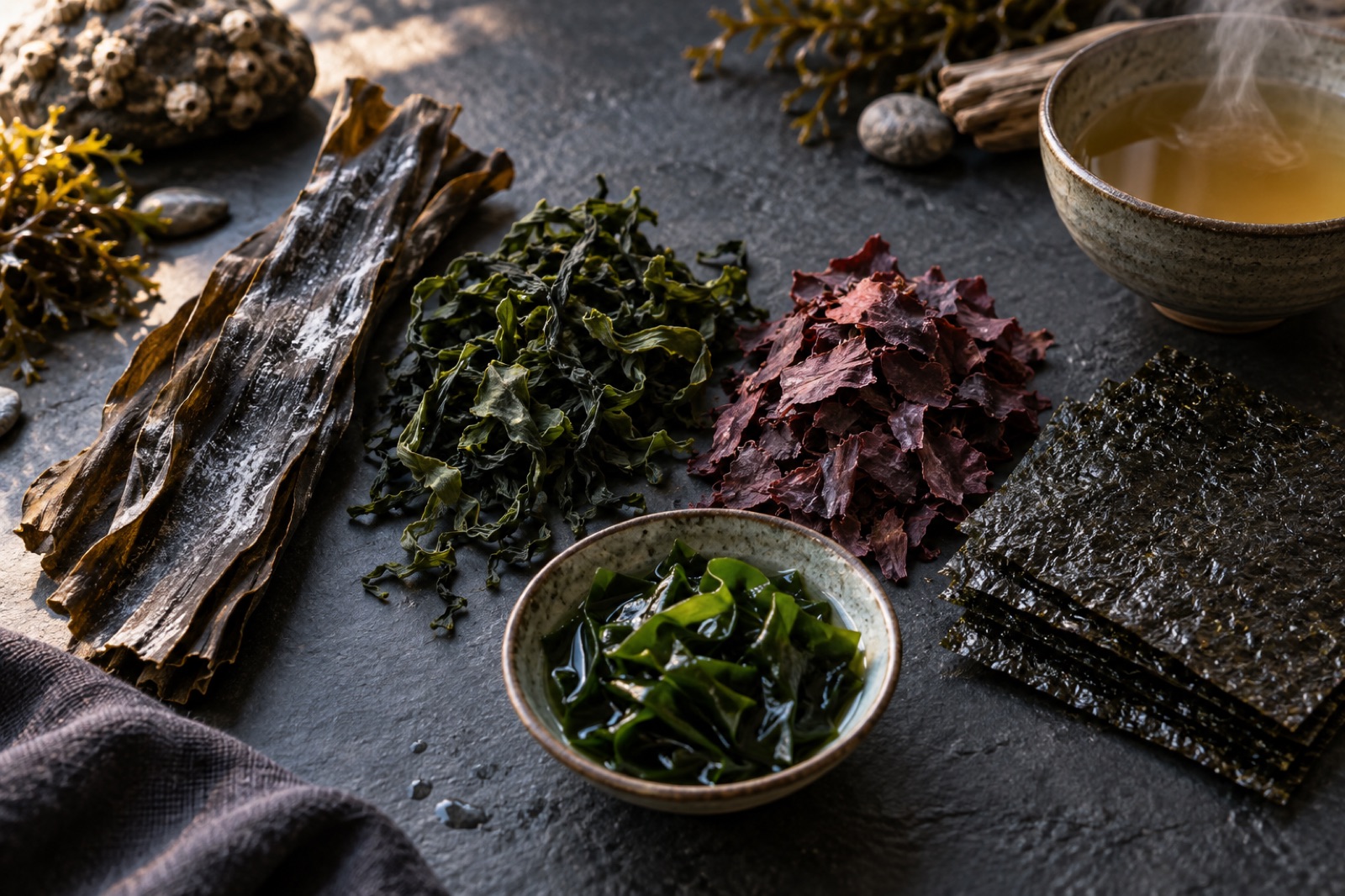
Most home cooks use seaweed one species at a time: kombu in the stockpot, wakame in the soup, nori around the rice. That works — but the cuisines with the longest seaweed traditions almost never stop at one. A Japanese kaiso salad might hold five species in a single bowl. A Korean broth can layer dashima under myeok under a final scatter of crumbled gim. The result is not confusion; it is depth, the same kind of depth a good cook gets from combining two mushrooms or three onions.
Pairing seaweeds well is a skill you can learn in an afternoon and refine for years. It rests on three dials — texture, salinity and umami — plus one instinct about when to stop. This guide gives you the logic first, then the pairings that reliably work, then a few combinations to avoid. If you are still building your pantry, start with our edible seaweeds field guide and the classic comparison of wakame, kombu and nori; come back here when you are ready to cook with two bags open at once.
Every seaweed you cook with sits somewhere on three axes. Pairing well means knowing where each species sits, then choosing partners that occupy different positions — contrast, not duplication.
Seaweeds range from shattering-crisp (toasted nori) through snappy (pickled kelp stems), silky (rehydrated wakame) and slippery-slick (mozuku) to dense and chewy (slow-braised kombu). A dish with two seaweeds of identical texture reads as one ingredient, doubled. A dish with a soft element and a crisp element reads as composed.
The practical rule: one soft anchor, one crisp or chewy accent. Silky wakame in a salad wants toasted nori shards on top. A tender braise of root vegetables in kombu stock wants a frill of pan-crisped dulse at the table.
Dried seaweeds vary enormously in how salty and how "sea-forward" they taste. Nori is mild and almost sweet. Dulse is briny with a faint smokiness. Kombu leans mineral and savoury rather than salty-salty. Some wracks and hijiki are intensely oceanic and can dominate a dish at a teaspoon's dose.
Treat strong sea flavours the way you treat smoked meat or fish sauce: an accent, not a base. If one seaweed in the pairing is loud, the other must be quiet — and your added salt must drop accordingly. Many beginners oversalt seaweed dishes because they season to the recipe's habit rather than to the actual brine in the bowl.
Kombu is the world's richest natural source of free glutamate, which is why it anchors dashi. Other seaweeds carry glutamate too, but at lower levels, and red seaweeds like nori additionally carry inosinate-like compounds that synergise with glutamate — the reason nori and kombu taste like more together than either does alone. Our explainer on the science of seaweed umami walks through the chemistry; the kitchen takeaway is simple: a kombu base plus a red-seaweed garnish multiplies savouriness without adding salt.
Four seaweeds cover nearly every pairing situation. Know their defaults and the combinations write themselves.
Kombu (Saccharina japonica and close relatives) is almost never eaten as the star; it is infrastructure. Steeped or gently simmered, it builds the savoury water everything else stands in. Our kombu dashi recipe is the five-minute version. The spent kombu from dashi is itself an ingredient — slice it thin for tsukudani, or dice it into salads as a chewy, umami-dense element. In any pairing, ask first: can kombu be in the liquid rather than on the plate?
Wakame (Undaria pinnatifida) rehydrates in five to ten minutes into tender, deep-green ribbons with a gentle, almost grassy flavour. It is the seaweed version of a soft green vegetable: it carries dressings, softens salty broths, and gives a salad body without chew resistance. Wakame pairs upward — it wants a crisper or brinier partner on top, not another silk beside it.
Dulse (Palmaria palmata) is the Atlantic's great red seaweed: salty, faintly smoky, and radically transformable by heat. Raw or flaked, it behaves like a seasoning — see our dulse cooking guide. Pan-fried in a dry skillet it turns crisp and bacon-adjacent. In pairings, dulse is the charred edge, the salty highlight. Use it where you would use smoked paprika, bacon bits or anchovy — sparingly and late.
Nori (Pyropia species, farmed as Porphyra historically) is the most processed of the four: shredded, pressed and toasted into sheets. Its flavour is mild, toasty and faintly sweet, and its aroma collapses within minutes of contact with moisture. Nori's role in any pairing is aromatic — scattered, crumbled or wrapped at the last moment. If you add nori early, you have added nothing; the volatile toasted notes are gone by the time the dish reaches the table. There are at least ten uses for nori beyond sushi, and nearly all of them observe this rule of lateness.
The oldest pairing in the playbook, and still the most useful. Kombu builds the broth; wakame swims in it. Miso soup is the canonical form, but the same logic builds a Western vegetable soup: steep kombu while your vegetables soften, remove it, then add rehydrated wakame in the last two minutes so it stays silky rather than boiled-flat. One pot, two seaweeds, and the broth tastes like it simmered all afternoon.
For ramen, noodle bowls and sipping broths, toast a sheet of nori and either steep it briefly in hot kombu dashi or crumble it over the finished bowl. The nori contributes roasted aromatics and a faint sweetness that kombu alone never has. This is the fastest way to make a vegetarian broth taste complete.
A mixed seaweed salad needs contrast, and this pair delivers it in two ingredients: cool, slippery wakame against chewy, briny dulse. Dress with rice vinegar, sesame oil and a little grated ginger. If you want to go further, our kaiso salad guide builds the full Tokyo-deli version with three or four species — but wakame and dulse alone are 80 percent of the effect.
Two red seaweeds, two textures, one job: finishing. Crumbled toasted nori plus crisped dulse flakes over rice, eggs, roasted potatoes or chowder gives you toast, smoke and brine in a single scatter. Keep the blend in a jar and it will quietly replace your salt habits.
When you want a broth with real architecture — for a hot pot, a noodle soup or a sauce base — think in layers: kombu for glutamate depth, a red seaweed (nori or dulse) for aroma, and a small amount of wakame for body if the broth will carry vegetables. The discipline is restraint: each layer at roughly a third of the dose you would use alone.
If this all feels abstract, cook through these five in order and the logic will become instinct:
Buy modestly, store well — see our guide to storing dried seaweed — and taste each seaweed alone once before combining. Ten minutes of single-note tasting saves a hundred confused dinners.
Pairing assumes ingredients worth pairing. Look for seaweed that is traceable to clean water and harvested or farmed with restraint — our guide to buying seaweed sustainably covers certification, labels and red flags. It is worth knowing, too, that kelp aquaculture done well is not merely low-impact; farms on restoration-adjacent sites, like the ones Tidewright runs through Tidewright Harvest, fund the regrowth of wild kelp forests. A well-paired bowl can do quiet good.
You can, but you will get a better result staging them. Kombu wants a long, gentle steep — 20 minutes at sub-simmer for dashi, or an overnight cold brew. Wakame needs only the last two minutes of heat. Add wakame too early and it loses its colour, its silky snap and much of its aroma.
The total iodine depends on the species and the total weight, not the number of species. Kombu is by far the densest source; wakame, nori and dulse are far lower. If you keep kombu to broth-building duty (and remove the frond before serving), a two- or three-seaweed dish is comfortably within sensible daily intake for most people — our iodine guide above has the numbers, and anyone with a thyroid condition should check with their clinician.
Nori plus wakame. Both are mild, neither is aggressively salty, and the contrast — toasty and crisp against cool and silky — is immediately understandable. A simple rice bowl with rehydrated wakame, a soft egg and crumbled toasted nori converts most sceptics.
Yes, and it is often excellent: fresh sugar kelp has a crunchy, green-beans quality that dried species lack. Blanch fresh kelp briefly, then pair it with a dried accent like dulse flakes. Just remember that dried seaweeds rehydrate to roughly six to ten times their dry weight, so a "small" handful of dried is never small.
Roughly: pair delicacy with delicacy and intensity with intensity, and let one partner lead. A subtle white-fish dish wants kombu in the poaching liquid and a whisper of nori. A grilled steak can carry crisped dulse, which would flatten a scallop. Match the loudest seaweed to the loudest thing already on the plate.
Wakame, kombu and nori do three different jobs in the kitchen. Flavour, texture, buying forms, substitutions and storage, side by side.
Sofia Andersson ·
Kombu led chemists to discover umami in 1908. How glutamate, ribonucleotides and salt work together — and how to use seaweed umami in everyday cooking.
Sofia Andersson ·
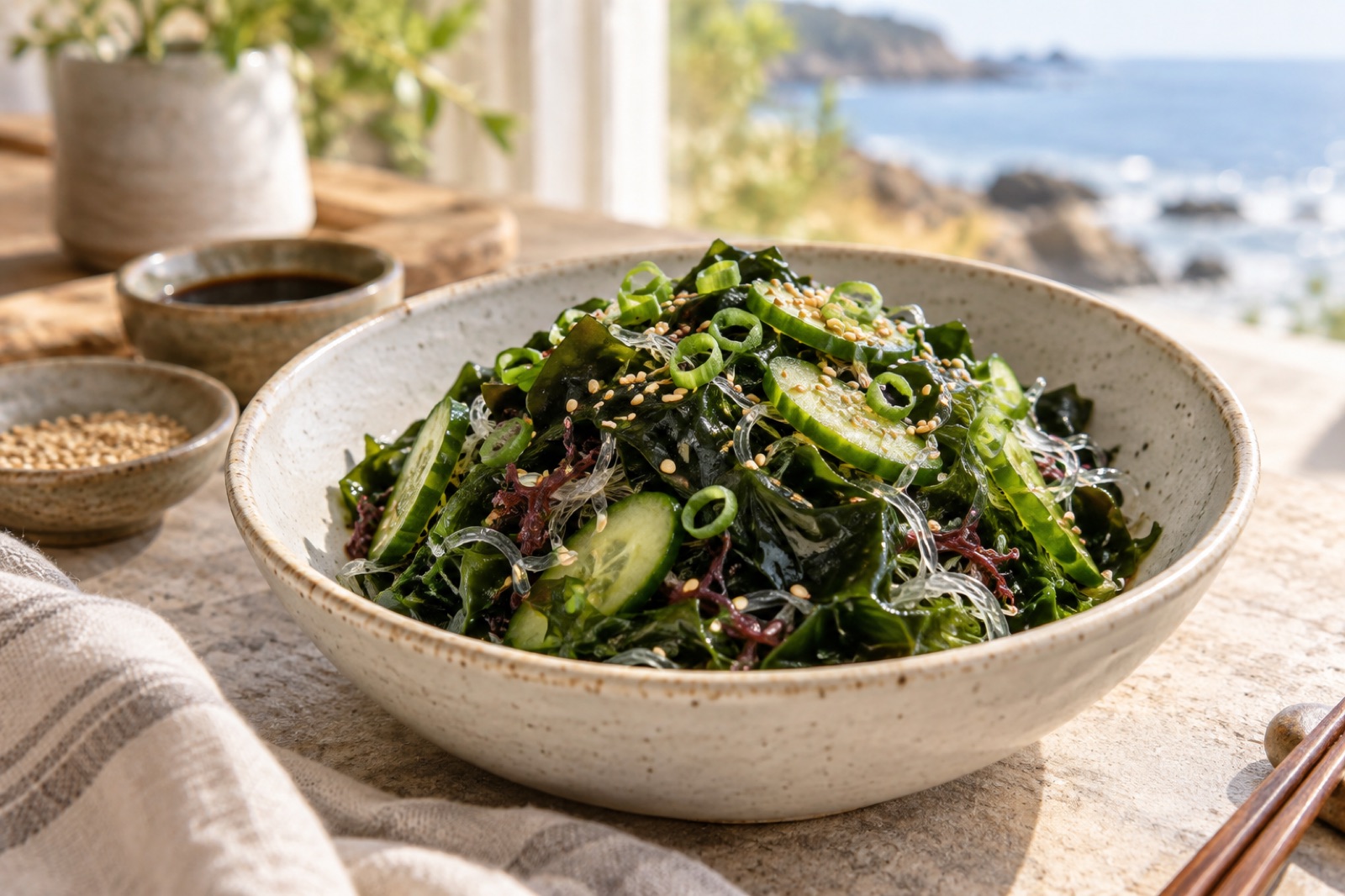
How to combine wakame, agar strands and other dried seaweeds into a balanced kaiso salad — soaking ratios, the shoyu-sesame dressing, and texture rules.
Sofia Andersson ·