Kitchen9 min read
Seaweed Stocks and Broths: Building Depth Beyond Dashi
How to make seaweed stocks beyond Japanese dashi — Western vegetable broths, shellfish-kelp broths and ramen bases, with freeze-concentrates for the freezer.
Sofia Andersson ·
Reduce a slow kombu and seaweed stock into frozen cubes for instant dashi, risotto liquid and sauces. Ratios, reduction targets, storage and uses.
If you cook with seaweed more than occasionally, the bottleneck is never the cooking — it's the stock. Dashi takes five minutes once you have a routine, but on a wet Tuesday with rice already on, you do not want a routine. You want a cube. Drop it in a pot of hot water, stir, and you have a clean, mineral, ocean-scented broth in the time it takes to boil a kettle.
This is the technique restaurants have used forever: make a large, careful batch of stock, reduce it to a concentrate, and freeze it in portions. Nothing about it requires special equipment — a wide pot, an ice cube tray, and freezer space. What it does require is restraint at the reduction stage, because a reduced seaweed stock concentrates everything, including bitterness and iodine, and the line between "intensely savoury" and "medicinal" is about ten minutes of inattention.
Here is the full method, with the ratios I've settled on after many trays.
A stock cube should be a generalist. You want a broth that behaves in miso soup, in a risotto, under poached fish and in a pan sauce — so build it on the mild, glutamate-rich seaweeds rather than the assertive ones.
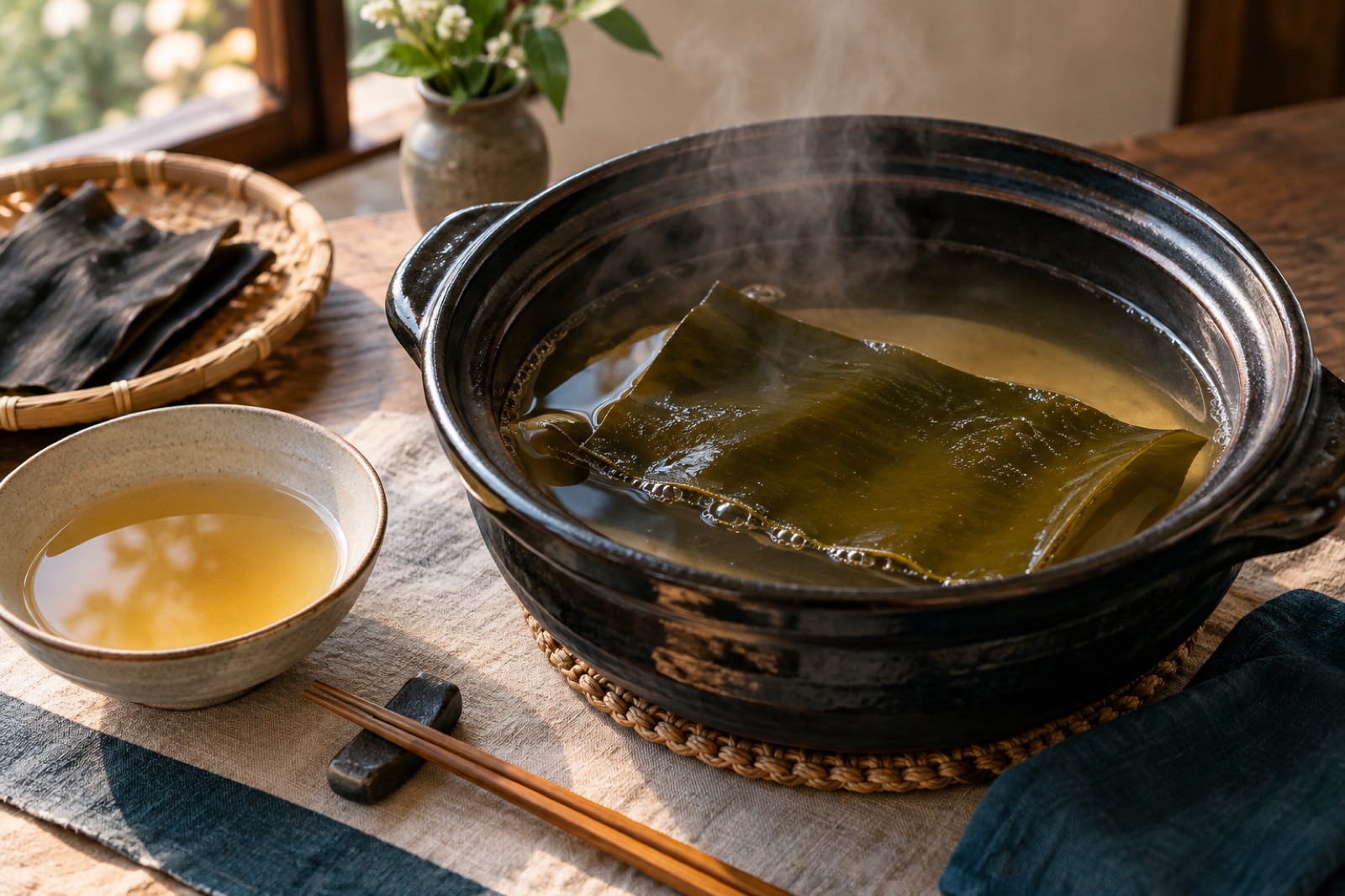
The base: kombu. Sugar kelp kombu or Japanese ma-kombu gives you the glutamate backbone. Use it generously — this is the one ingredient you cannot overdo at the soaking stage, only at the boiling stage. If your kombu knowledge needs refreshing, the kombu dashi recipe covers the fundamentals of temperature and timing.
The depth: a small amount of a second seaweed. A piece of dried wakame root (mekabu if you can find it), a few dulse ribbons, or a strip of alaria adds body and a rounder mineral note. Keep the second seaweed under 20% of the total weight — dulse especially will take over a concentrate if you let it.
What to avoid in cubes. Hijiki is too strongly flavoured (and carries the inorganic-arsenic concerns covered in our hijiki safety guide) for something you'll use daily. Nori goes slimy and sulphurous when reduced. Ulva (sea lettuce) turns bitter. Save those for fresh cooking.
This yields roughly 2 litres of stock, which reduces to about 500 ml of concentrate — enough for 25–30 standard ice-cube wells, each cube making a 250 ml bowl of broth.
Pour the strained stock into your widest pot — surface area speeds evaporation and shortens the time the stock spends at heat, which protects flavour.
An instant-read thermometer is a useful check: a lightly simmering reduction sits around 95–98°C; if the pot climbs hotter as it thickens, lower the heat — you're approaching a syrup and the flavour will tighten.
Let the concentrate cool to room temperature, then refrigerate until cold — warm liquid melts neighbouring wells and gives uneven cubes. Pour into a standard ice cube tray (most wells hold 20–25 ml) and freeze overnight. Pop the cubes into a labelled freezer bag; they'll keep their flavour for about three months, and remain safe well beyond that, though aroma fades.
Dosing guide:
This whole system slots naturally into a broader preserving habit — our guide to freezing, drying and fermenting seaweed covers the rest of the home-preserver's toolkit.
Dashi-plus cubes. Fold in a small handful of katsuobushi (bonito flakes) for 30 seconds off the heat before straining the master stock, if you're not keeping it plant-based. The smoked-fish note survives freezing well.
Roasted kombu cubes. Toast the kombu in a dry pan for 60 seconds before soaking. The stock darkens and gains a nutty edge that suits ramen broths and mushroom dishes.
Scrap-stock cubes. If you already make dashi regularly, the spent kombu and wakame have a second extraction in them — the niban dashi technique is essentially free stock, and it freezes into perfectly good cooking cubes even if it isn't delicate enough for clear soup.
Mushroom-forward cubes. Double the shiitake and add tomato trimmings for a Western-leaning concentrate that stands in for vegetable bouillon in any recipe.
Cubes taste bitter. Over-boiled kombu or over-reduction. Pull the kombu earlier and stop the reduction at one-third rather than one-quarter next time.
Cubes are slimy or ropy. The kombu boiled. Texture is harmless but unpleasant in clear broths; fine in risotto.
Flavour is flat. The stock was too weak to begin with — increase kombu by 25% rather than reducing harder. Reduction concentrates what's there; it can't create flavour.
Weird freezer taste. Cube trays absorb freezer odours. Use a covered tray if you have one, and always transfer frozen cubes to a sealed bag.
For a wider view of seaweed-based liquid building — vegetable broths, shiitake kombinations, and Western-style stocks — the seaweed stocks and broths guide is the companion piece to this one.
Yes, though dried kombu gives a cleaner, more predictable stock. If using fresh blanched kelp, double the weight (fresh is mostly water), keep the same no-boil rule, and expect a greener, more vegetal broth that's excellent for fish dishes and chowders.
Safety-wise, indefinitely at a steady -18°C, like any frozen food. Flavour is the limit: the delicate marine aromatics fade noticeably after about three months, so label the bag and rotate batches.
Stock concentrates can be pressure-canned, but the heat treatment dulls the fresh, bright top notes that make a seaweed broth special, and kombu's glutamate character survives freezing far better. Freezing is the better tool here.
Kombu is the iodine heavyweight of the kitchen seaweeds. For a milder concentrate, build the stock on wakame and dulse with a single small strip of kombu for structure — or read our seaweed nutrition guide for per-species iodine context before deciding what "too much" means for you.
Absolutely — one cube melted into butter, mashed into mashed potatoes, or stirred into a lentil pot works like a savoury bouillon. That's also an elegant way to use a batch that came out slightly too bitter for clear soup; fat and starch soften the edges.
Filed under
How to make seaweed stocks beyond Japanese dashi — Western vegetable broths, shellfish-kelp broths and ramen bases, with freeze-concentrates for the freezer.
Sofia Andersson ·
How to preserve fresh seaweed at home: blanching and freezing kelp, drying without a dehydrator, quick ferments, storage times and texture expectations.
Sofia Andersson ·
A deep, technique-first guide to kombu dashi: glutamate science, exact temperatures, ichiban and niban infusions, and how to fix every common mistake.
Sofia Andersson ·