Science6 min read
Marine Protected Areas: What They Protect and How
MPAs, marine reserves, no-take zones explained — how protection levels differ, what the evidence shows, and what MPAs can and can't do for kelp forests.
Dr. Mara Ellison ·
Marine reserve spillover explained: how protected waters export adult fish and larvae to fishing grounds, what the evidence shows and when benefits appear.
Fishermen have understood the basic logic of marine reserves longer than marine biology has. Set a patch aside, let it fill, and fish will find their way out across the boundary to where hooks wait. The question science has spent four decades trying to answer is the harder one: how much? "Spillover" — the net export of fish and larvae from a protected area into fished water — is the mechanism by which reserves can pay the fisheries that grumble about them rather than merely cost them water. The answer, painstakingly assembled from dozens of countries and hundreds of studies, is real but nuanced: spillover is genuine, measurable and sometimes economically significant; it is also uneven, often slow to build, and not a universal subsidy for any reserve shape or management regime anywhere.
Two distinct flows carry life out of reserves. Adult spillover is the famous one: older, larger fish that have grown past catchable size inside the reserve wander, drift and home-range over the boundary and into the fishery. Because reserves let fish live longer and grow bigger, a reserve can harbour fish several times the size of the fished population outside, and some of those big animals cross the line. "Fishing the line" — boats working just outside reserve boundaries — is observable, global corroboration that the fishers expect the flow and position their gear to catch it.
Larval spillover is the larger ecological engine. Most coastal fish and invertebrates reproduce as broadcast spawners whose offspring drift as larvae for days to months before settling — the oceanic lottery covered in our explainer on larval dispersal. Because bigger fish produce disproportionately more eggs — in many species an old, large female's output dwarfs that of many small females — a reserve that keeps fish alive into their big years can seed the surrounding coast with larvae far out of proportion to its area. Adult spillover matters locally and quickly; larval spillover matters regionally and slowly, and is the strongest argument that reserves can rebuild entire fisheries beyond their borders.
The core finding is remarkably consistent. Where reserves are well-enforced, old enough, and hold structurally complex habitat (kelp forests, reefs), fish inside the boundaries become denser, larger and more numerous — often by multiples, within five to ten years. The biomass difference can be dramatic in heavily fished regions: reserve rockfish, lobsters and sea bream repeatedly reach several times the abundance and many times the individual size of their fished neighbours. And near reserve edges, the evidence for adult spillover is clear: catch per unit effort just outside well-established reserves often climbs, is highest near the boundary, and declines with distance — the signature of fish walking out.
Two caveats are serious. First, spillover measures vary wildly between studies — from modest percentage gains to transformative ones — depending on the species (highly mobile fish spill differently from resident lobsters), the reserve's size and shape, enforcement quality, and how long it has been in place. Second, the evidence for fishery-wide benefits — total catch going up across the whole region — is harder to establish than the evidence for local edge effects, because the ocean is not a controlled tank and scaling up is where measurement gets noisy. The honest summary is that reserves reliably rebuild within their borders, often feed adjacent fisheries measurably, and are a strong complement to — not a wholesale substitute for — catch limits and gear rules.
Kelp forests make the case visible because the fish are obliging and the predators are charismatic. In kelp-bordered reserves, the California spiny lobster — a nocturnal, habitat-faithful hunter — shows the classic pattern: bigger, denser populations inside protected water and caught animals near boundaries that trace back to reserve origin. Wrasse and groper, such as the ballan wrasse and other kelp-forest predators, behave similarly, with resident adults growing to sizes unknown in fished water and, in tagging studies, crossing boundaries in ones and twos rather than schools. The structural complexity of the kelp bed itself seems to focus the effect: on flat sand the reserve boundary is just a line on a map, but at the edge of a kelp forest it is a wall of cover, and fish held inside that wall grow to the sizes the fished population can never reach. The restoration logic behind growing kelp forests and the reserve logic are, in this view, the same logic: add structure, protect it, and let time do the biology.
There is also a subtler benefit the biomass graphs miss. Older, bigger animals seed larvae more strongly, and kelp-forest residents convert that larval seed into higher local recruitment: the canopy and understory supply the settlement habitat the larvae need to land. A reserve is not just a bank of fish — it is a functioning ecosystem engineer compound, and spillover is partly the system exporting not just adults but the conditions for juvenile survival.
Spillover is not automatic. The failures teach as much as the successes. Reserves too small relative to species' home ranges leak everything they grow. Reserves that are "paper parks" — legally protected, practically unpatrolled — produce no building biomass to spill. Reserves in eroded habitat — an urchin barren standing where the forest should be — protect a water column instead of a food web, and the export is thin. And reserves designed as isolated dots in an otherwise hammered seascape can be swamped: the fishery concentrates effort at their borders, catch rates there spike and then fade, and the apparent early "spillover boom" reveals itself as a drain on the reserve's edge population rather than a sustainable subsidy. The lesson is structural. Reserves work as networks, embedded in habitat worth protecting, inside a management regime that also limits total catch. Science's contribution is to say plainly what fishermen have always suspected: you can fish the line, but only if the line was drawn around something real.
Yes — adult fish and invertebrates cross reserve boundaries constantly, and "fishing the line" just outside reserves is a global industry precisely because the flow is reliable. The bigger and better-enforced the reserve, the stronger the edge effect. Adult spillover is the local, fast-moving part; the slower, larger export is larval.
Big enough to hold the target species' home range with margin to spare, and in habitat worth protecting. Sedentary species like lobsters spill from small reserves; roaming fish need larger ones. Most analyses suggest networks of medium reserves outperform single small ones for fishery benefit — though any enforced reserve in good habitat outperforms none.
No, and the studies are consistent about this. Reserves rebuild stocks within their borders and provide local subsidy at their edges, but without complementary catch limits the fishery simply concentrates effort at the boundary line. Reserves and quotas are complements; the strongest fishery recoveries combine both.
Years, not months. Density within reserves typically rises measurably in five years; the bigger, habitat-faithful fish that drive adult spillover may take a decade. Larval effects on regional recruitment take longer still and are harder to measure — one reason reserve evaluations that stop at year three systematically undersell the result.
Much more weakly. A reserve drawn around an urchin barren protects a water column, not a food web; the fish have little to grow on, and spillover is thin. This is why kelp forest protection and active restoration are the two halves of the same proposition. Protect the forest you have; rebuild the forest you lost; only then are the reserves banks with anything in them.
MPAs, marine reserves, no-take zones explained — how protection levels differ, what the evidence shows, and what MPAs can and can't do for kelp forests.
Dr. Mara Ellison ·
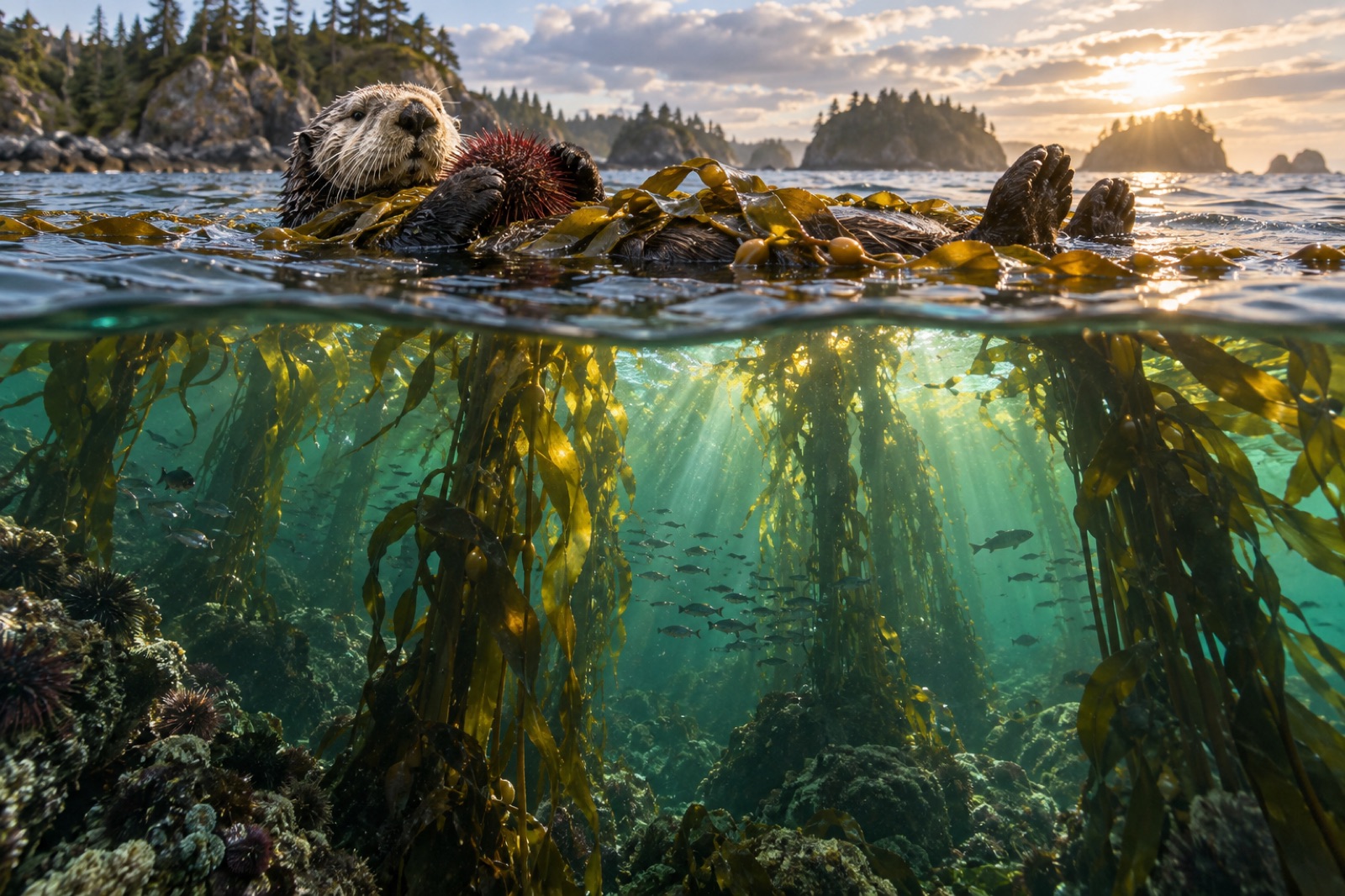
A trophic cascade happens when a predator's removal rewrites an entire ecosystem. The sea otter–urchin–kelp story is ecology's classic case — here's how it works.
Dr. Mara Ellison ·
A map of the kelp forest food web — from drifting fronds and grazing urchins to otters, octopus and rockfish — and why detritus powers most of it.
Dr. Mara Ellison ·