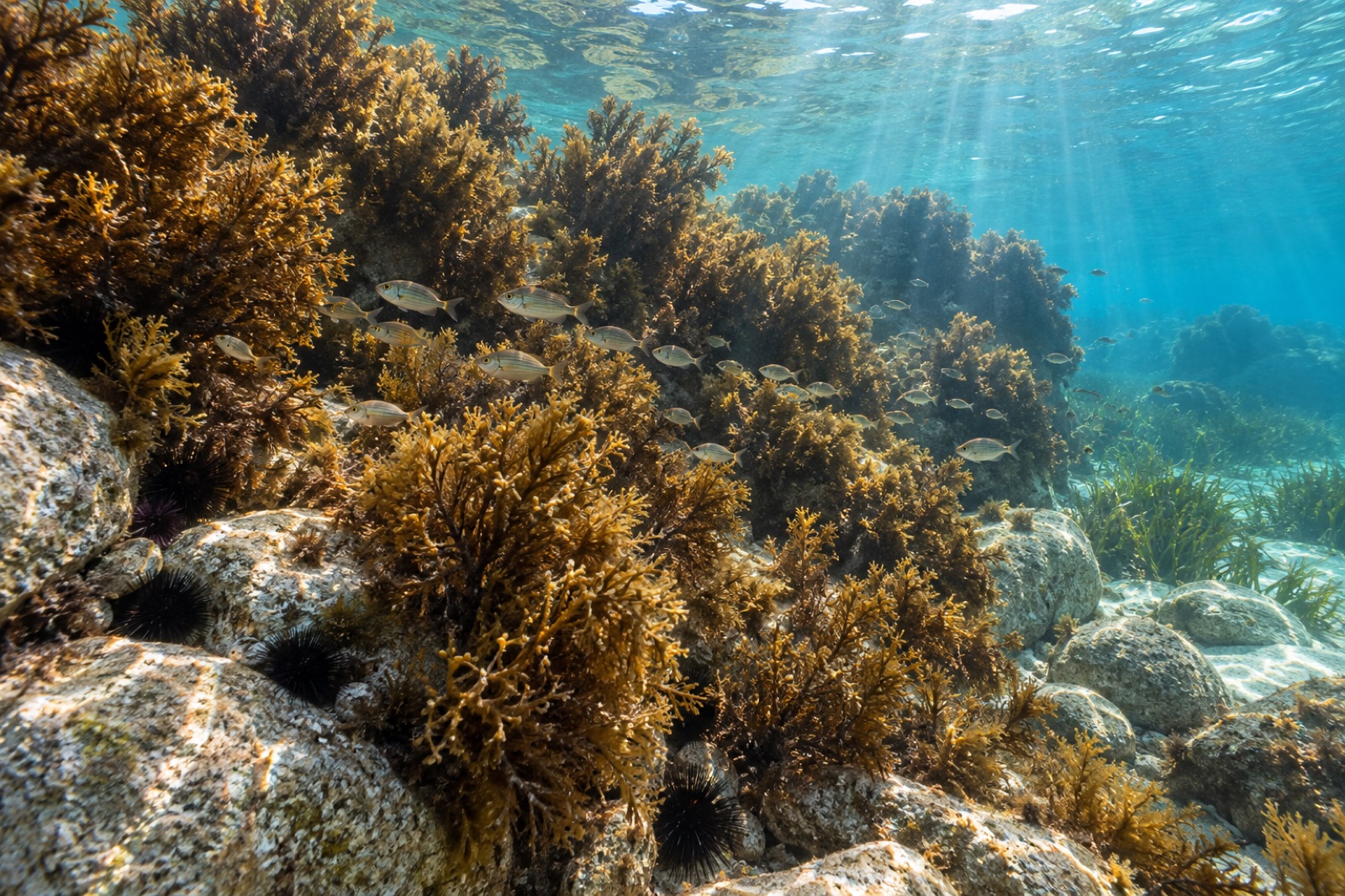
South of Vlorë, Albania's coast turns a corner that still feels, underwater, like a country few have really looked at. The Albanian Riviera drops south along the Ionian through limestone karst cliffs, small bay beaches and the steep-sided Karaburun Peninsula to the border with Greece — a shoreline where the Mediterranean's canopy algae, seagrass meadows and fish communities persist in fragments, poorly surveyed and increasingly visited. There is no true kelp here, but there is the Mediterranean's own version of a kelp forest: Cystoseira and its relatives, the canopy algae that occupied Europe's warm rocky coastlines for longer than Atlantic kelp forests have existed in their modern form. Albania holds some of the least-described remaining stands, and one pioneering marine protected area.
Geography of a steep, quiet coast
Albania's Ionian shoreline falls naturally into three parts:
- Karaburun Peninsula — the great limestone horn that closes the Bay of Vlorë to the west. Steep cliffs, sea caves, clear water, and the most complex underwater terrain on the coast. The peninsula's western face, completely roadless, is the best of Albania's coral-line reef and canopy country.
- The Riviera proper — south of Karaburun, headlands of limestone and flysch alternate with small gravel-and-sand coves: Dhërmi, Jale, Himarë, Borsh. The underwater structure varies with the rock; the clean limestone coves tend to hold the densest algal cover.
- Sarandë and the Greek border — the coast flattens and opens near the Corinthian edge; Corfu sits within sight offshore, and the water takes on the open-Ionian character.
The Cystoseira canopy species profile covers the alga itself; here the story is the coast it grows on. And for an adjacent comparison, the Montenegro coast guide describes the same karst ria country continuing north into the Adriatic proper.
The algal forest: Cystoseira, Padina, and the Caulerpa question
The eastern Ionian's canopy-former guild reads like a Mediterranean greatest-hits list. On the cleanest rock, the algae that actually build structure are the fucale canopies — species like those now divided among genera including Ericaria, Gongolaria and Cystoseira proper (the taxonomy was revised repeatedly in the last decade, so the field names move). Below and between them, dense bands of Padina pavonica — the peacock's tail alga — set the shallow zone, while in more sheltered, nutrient-tinged water the soft-turf genera, including the invasive Caulerpa racemosa, spread into the algae's open ground.
The Caulerpa point is worth dwelling on for a minute because it demonstrates a pattern repeated across this whole corner of the Mediterranean: a canopy system already stressed by silt and urchins is then colonised by an efficient invader. The invader doesn't replace the forest's function. It flattens it. Where Caulerpa covers the rock thickly, the small reef fish guild — wrasse, damselfish, gobies — still occupies the water, but the structural habitat, the three-dimensional complexity in which juveniles hide and nest, is largely gone. The closest thing to a documented replacement story in the Adriatic is in Croatia; the eastern Adriatic's study coast is far better mapped than the ionian side. If you want to understand the dynamics, the trophic cascades explainer gives the framework.
Karaburun-Sazan: Albania's one marine park
Albania's first and so far only formally declared marine protected area covers the Karaburun Peninsula and the island of Sazan, which sits just offshore in the strait feeding the Bay of Vlorë. The park, established in 2010, covers submarine karst cliffs, sea caves (some of them historical Mediterranean monk seal habitat), underwater ridges and the fringing rocky coast of the peninsula.
The park's significance goes beyond its hectares. Karaburun-Sazan made Albania the last country on the European Mediterranean to designate a marine protected area — and simultaneously one of the Ionian's best-preserved: what protection kept from being built on the cliff faces kept, mostly, from being built underwater too. Enforcement has been a work in progress, as is always true; frameworks for anchoring, visiting and research access have tightened gradually. Visitors should check current rules, and, critically, never anchor on the seagrass meadows between the peninsula and Sazan: the meadows there are the park's slower-growing core habitat, and a single anchor drag scours holes that take a decade or more to close. The damage done by casual anchoring to Mediterranean Posidonia is a tragedy told across this coast, from Sardinia's granite and karst to the bays of the Peloponnese.
What the fish say
The fish community on Albania's Ionian reefs follows the Mediterranean pattern, with variations worth noting:
- The small-fish guild is dense and conspicuous: ornate wrasse, Mediterranean rainbow wrasse, damselfish (Chromis chromis), and the ubiquitous salema and bogue schooling over the canopy.
- Dusky grouper and brown meagre are the two species every diver over fifty remembers being more common. Groupers still turn up on deeper Karaburun walls; brown meagre are more often encountered as machinery-quiet shadows than as a fishery of account. Both are recovering where protection holds and where spearfishing pressure is low.
- Invasive species from the Suez — the rabbitfish, bluespotted cornetfish and their kin — are the Ionian's slowly lengthening list. The eastern Mediterranean receives them first; Albania's shore, one degree further along, has so far seen fewer invasives than the coasts of Greece and Turkey, but the count ticks up year by year. The same story plays out at the Canary Islands' kelp edge, where a warm-temperate marine province watches species from the south move in.
- Sea turtles — loggerheads are occasional visitors from the deeper Ionian nesting grounds, mostly on the open coast.
- Monk seal is genuinely rare and mostly historical: cave habitat on Karaburun's western shore suggests former use; occasional unconfirmed reports hum in the regional network.
Pressure and change on an understudied coast
Albania's marine environment carries the standard package of Mediterranean stresses — urchin expansion, silt from eroding karst, warming water — with one specific local addition: a tourism boom growing faster than the country's marine governance has, historically, been able to keep pace with. Beaches that were small fishing coves twenty years ago now hold full-season charging stations for umbrellas; the recreational boat fleet shows in anchor scars on the seagrass.
The honest summary: this coast's canopy algae are in trouble, in fragments, in places healthy, with large areas simply unsurveyed. Each of those three states will be recognisable from the water. If you dive toward Karaburun's western cliffs you will find swim-throughs and canopy intact. If you swim in from a market-day beach near Dhërmi you will find algae reduced to turf and Caulerpa spreading over flat rock. Both are true.
Visiting: what to know
- Access. The Albanian Riviera's dive industry is young but growing; most organised diving runs seasonally from Himarë and Sarandë. The Karaburun-Sazan park requires a permit and local guidance; arrange through Sarandë dive shops or Vlorë operators.
- Best season. June and September; the water is calm, clear and already warm, with fewer boats.
- Gear. Bring your own mask and fins rather than trusting beach rental — the hire fleet thins quickly off-peak. A shorty wetsuit suffices June–September.
- Rules. In the park: no anchoring on seagrass; moor where buoys are installed. Outside it: the same rules should be voluntary norms.
- Cross-references. This coast connects naturally to the broader Mediterranean and Adriatic sea-scapes; for karst ria country north of Albania, Montenegro's Boka forests make a fine pairing.
Key takeaways
- Albania's Ionian shore is a steep, karst limestone coast holding fragmented canopy forests of fucale brown algae — surviving stands, urchin-mowed flats and Caulerpa-invaded shallows side by side.
- Karaburun-Sazan is Albania's only marine protected area and its most significant reef complex; monk seal caves make it historically resonant.
- Posidonia anchor damage and rapid tourism growth are the coast's most immediate emerging pressures.
- The small-fish guild is intact and lively; groupers and meagre are recovering only slowly, where pressure allows.
- Visibility, warm water and near-empty coves make this one of the most rewarding — and least-documented — snorkel coasts in the Mediterranean.
FAQ
Is there real kelp in Albania?
No true kelp — the Mediterranean does not have laminarian kelps. What you will see are Mediterranean canopy-forming brown algae (Cystoseira and related genera), which occupy the same ecological role. The canopy species profile explains the distinction.
Can divers dive Karaburun-Sazan independently?
Not freely. The marine park requires a permit, and current access arrangements run through local licensed operators. Independent shore diving is possible on parts of the Riviera outside the park.
How safe is snorkelling in Albania?
Very, for the sea — calm Ionian water, rocky coves, minimal currents in deep summer. The hazards are the ordinary ones: sharp rock, sea urchins in the shallows, and sun. A pair of hard-soled water shoes is genuinely useful.
Are the urchins a problem for swimmers?
No more than anywhere in the Mediterranean: Paracentrotus spines hurt and black Arbacia is spreading, but both are avoidable with care. The ecological damage they do to canopy algae is a different story, told above.
Is the Karaburun monk seal still present?
Formally unconfirmed current presence; the cave habitat exists and regional unconfirmed reports continue, but a sighting should be treated as a rare possibility, not a likelihood.