Encyclopedia8 min read
Giant Kelp (Macrocystis pyrifera): Species Profile
Giant kelp is the fastest-growing organism on Earth and the architect of undersea forests. Learn its biology, life cycle, range and why it matters.
Dr. Theo Nakamura ·
Giant kelp at the warm edge of its range, albatrosses that breed nowhere else, and a scientists-only island: a guide to the kelp coast of Amsterdam Island.
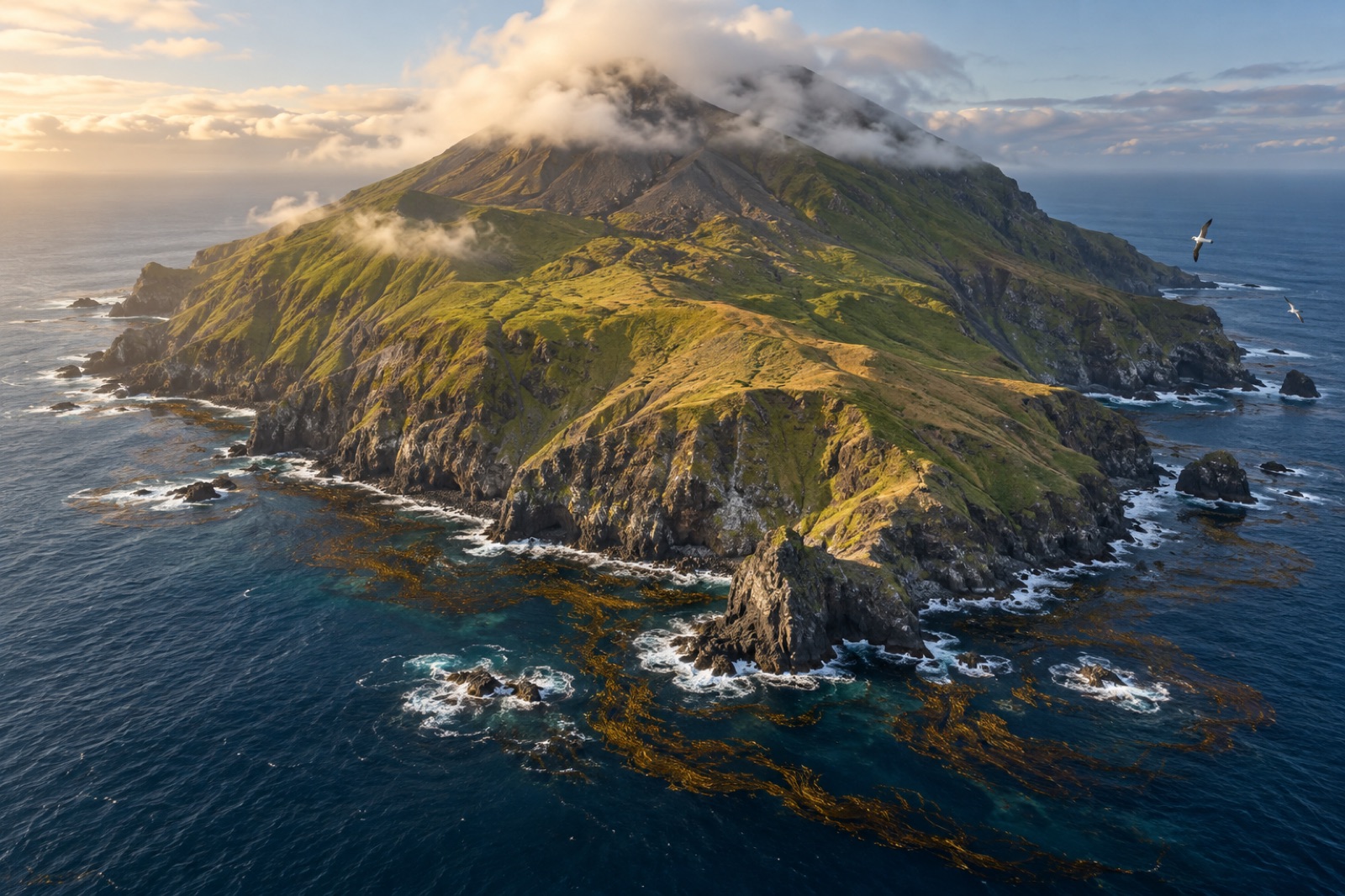
If you drew a circle in the southern Indian Ocean with no land in it for thousands of kilometres, you would draw it around Amsterdam Island — and if you asked whether a speck that small and that far from anywhere can hold a real kelp forest, the answer is yes: a narrow, deep, storm-washed ring of giant kelp that is one of the most isolated forests of its kind on Earth. This guide explains where Amsterdam Island is, why its kelp grows at an unusually warm edge of the giant kelp range, what lives with it, and the honest truth about how difficult it is to ever see.
Amsterdam Island — Île Amsterdam to the French, who administer it as part of the Terres australes et antarctiques françaises — sits at roughly 37.8° south, 77.5° east, in the middle of the southern Indian Ocean. Its only neighbour is the smaller, half-flooded volcanic crater of Île Saint-Paul, about 85 kilometres to the south. Everything else is distance on a different scale: the nearest continental land is more than three thousand kilometres away in every direction. The Dutch found and named it in the 1630s; sealers and would-be farmers hammered its wildlife and planted livestock through the 1800s; France has run it as a scientific possession ever since.
There is no airstrip and no port in the conventional sense. The island is served a handful of times a year by the resupply ship Marion Dufresne out of Réunion, a voyage of roughly a fortnight return, and the entire human population — usually a few dozen people — lives at the scientific station of Martin-de-Viviès on the island's north coast. The land itself is a single eroded basalt volcano, about ten kilometres across, climbing to a plateau around 880 metres high that sits inside the cloud belt most days of the year.
In 2019 the island group was inscribed, with the other French sub-Antarctic territories, as a UNESCO World Heritage site — the "French Austral Lands and Seas" — recognition of both the seabird colonies and the marine ecosystems around them.
Amsterdam's marine character comes from a quirk of position. The island lies near the Subtropical Front, the great boundary where warm subtropical water slides over the colder water of the Southern Ocean — the same family of boundary currents that steers kelp geography all over the world. Its nearshore water runs roughly 13–17 °C through the year: cold by tropical standards, but distinctly warm for the species that builds its forests.
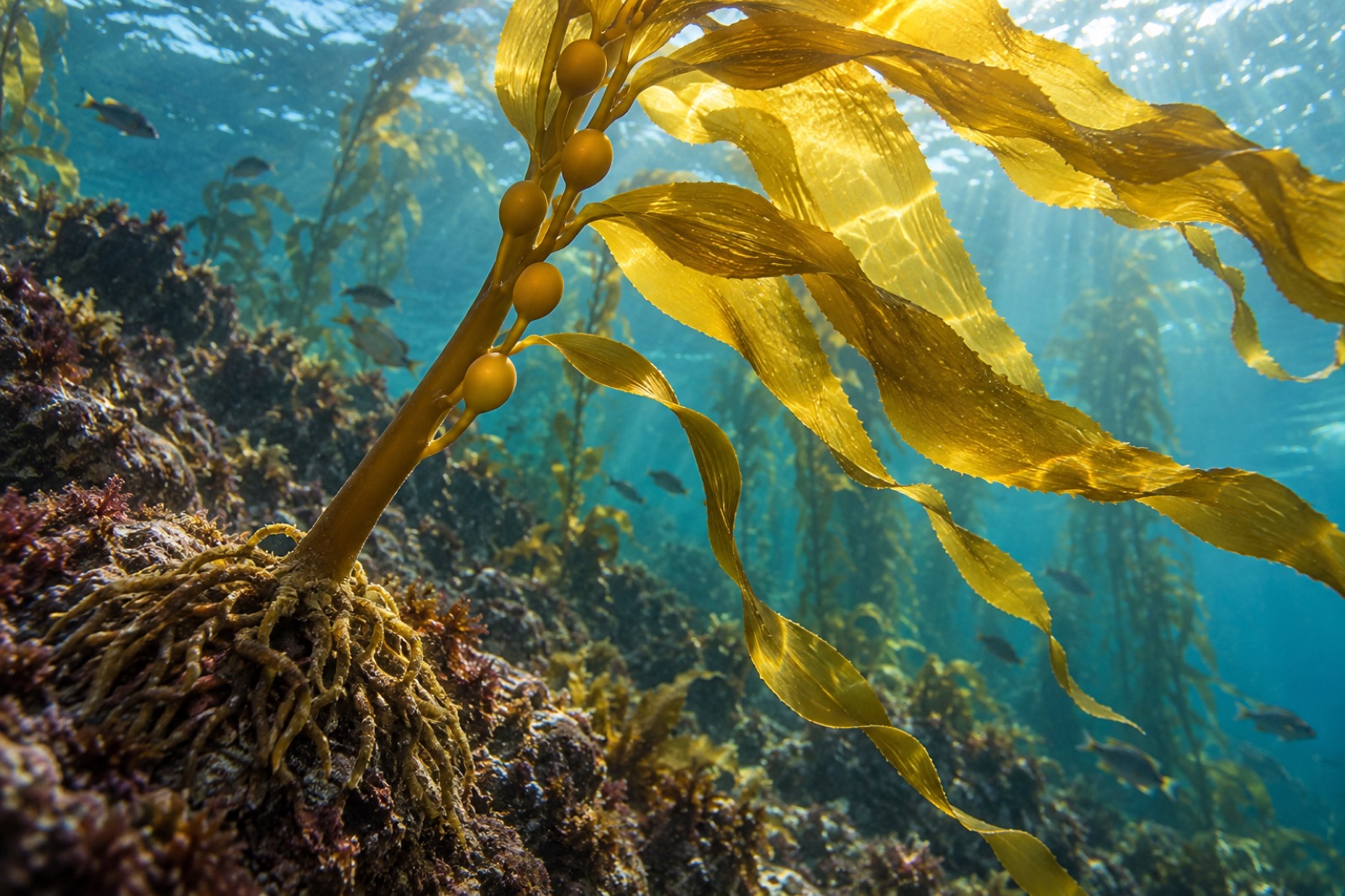
That species is giant kelp, Macrocystis pyrifera. Across the sub-Antarctic, giant kelp is the signature forest of Kerguelen, the Crozets, the Falklands and Patagonia — but Amsterdam sits at the warm, poleward-current-warmed limit where the species can persist only because the water stays reliably cool. The beds here are therefore a natural experiment that ocean climate scientists watch with interest: a forest already living at the temperature range many more accessible kelp coasts are steadily moving toward. How it copes — and what lives with it at this temperature boundary — is a small but telling data point in the bigger story of kelp and ocean warming.
Amsterdam has almost no continental shelf: the volcano rises steeply out of more than three kilometres of open water. The kelp forest occupies the narrow inshore band where hard lava substrate meets the light — a ring of Macrocystis wrapped around most of the coast, thickest on the more sheltered sectors, thinning and fraying where the full force of Southern Ocean swell arrives unbroken. There is no wide, gentle reef platform here; in many places, water usable by kelp runs straight from the breakers to dry-suit depths of twenty metres or more within a short swim.
Beneath the canopy the reef is a characteristically sub-Antarctic assemblage, edited down by the island's isolation: encrusting coralline algae, sponges and bryozoans on the rock, grazing gastropods, octopus, and schools of the temperate reef fishes that have managed the long journey across entire ocean basins to get here. Subantarctic fur seals — recovered from near-extermination by sealers — now work the kelp edges in numbers again, and southern elephant seals hold breeding beaches ashore.
Because the island is so small and steep-sided, the usual kelp-coast export story is compressed to its simplest form: blades shed from the ring either feed the inshore community or slide off the slope into the deep basin within kilometres. That makes Amsterdam an unusually clean case study for the pathways we describe in kelp carbon cycling: a whole forest, a single coastline, one way out.
One more thing makes Amsterdam's kelp scientifically interesting. Macrocystis does not cross open ocean easily as spores — its dispersal over deep water happens largely as detached, buoyant plants rafting on currents, sometimes carrying whole miniature communities of hitchhikers with them. Isolated islands like Amsterdam, Saint-Paul and the Kerguelen group (see our guide) are the stepping stones of that long-distance process: every population of kelp on a remote island is proof of at least one successful ocean crossing. The mechanisms are exactly those we unpack in our piece on kelp rafts, and they explain both how Amsterdam got its forest and why its genetics may differ subtly from the forests nearest to it.
Amsterdam's marine life shares the global stage with one of the rarest birds on Earth. The Amsterdam albatross (Diomedea amsterdamensis) breeds nowhere else: a few dozen pairs raise chicks on the island's plateau, and the entire species numbers only a few hundred birds. Ashy-plumaged sooty albatrosses and Indian yellow-nosed albatrosses also breed here, gentoo penguins hold one of their northernmost colonies on the coast, and northern rockhopper penguins share the group with Saint-Paul.
The island once carried something even stranger: low forest of the flowering tree Phylica arborea, part of a plant community found nowhere else in the world. Nineteenth-century settlers released cattle, which roamed wild for more than a century and browsed the phylica woodland almost to collapse before the herd was finally removed. The remnant forest is now fenced, replanted and slowly recovering — a terrestrial mirror of the story we tell over and over in restoration: remove the pressure, protect the survivors, and be patient.
Realistically, no — not as an independent traveller, and almost never as a diver. Access to the island is controlled, the shore is rugged and unlandable in most weather, and the station exists to do science, not tourism. A small number of expedition cruise itineraries in the southern Indian Ocean pass the island group, and a zodiac cruise past the kelp fringe on a calm day is as close as almost anyone ever gets. Diving in the beds is effectively a research activity: water in the low-to-mid teens, relentless surge, and no dive infrastructure of any kind.
For the experience of sub-Antarctic giant kelp without a two-week voyage, our guides to the Crozet Islands, the Falklands and the more accessible coasts of Patagonia and Tasmania are the practical alternatives — and the Coastal Atlas has them catalogued.
An isolated forest at a temperature boundary is exactly the kind of place where ocean change shows up first. Warming compresses the thermal envelope of Macrocystis from the temperate side; Amsterdam's ring is one of the sentinel stands that will tell us, early, what a warmer Southern Ocean does to the great sub-Antarctic kelp belt. Its isolation also keeps it unusually clean of the pressures — coastal development, runoff, fishing effort — that complicate the picture everywhere else.
At Tidewright we think of places like Amsterdam as reference forests: the baselines against which managed and restored coasts can be compared. Our monitoring platform's whole philosophy — described on the Canopy Ledger page — is that you cannot manage what you cannot measure, and remote islands are where that discipline matters most.
In the southern Indian Ocean at about 37.8° S, 77.5° E — more than 3,000 km from the nearest continent, with only Île Saint-Paul (85 km away) for company. It belongs to France's Southern and Antarctic Lands (TAAF).
Giant kelp, Macrocystis pyrifera — the same species that builds the great forests of the sub-Antarctic and the Pacific — forming a narrow ring around the island where steep volcanic rock meets the light.
Almost never. There is no airstrip or tourist infrastructure; access is reserved for scientific and administrative purposes. A few expedition cruises pass the island group, but landings are exceptional and tightly controlled.
It is the only breeding site in the world of the Amsterdam albatross, one of the rarest seabirds on Earth, and holds major colonies of fur seals, elephant seals, gentoo penguins and other albatross species.
It lives near the warm edge of the giant kelp range, so long-term warming is the central risk — which is precisely why the stand is scientifically valuable as an early-warning site for the wider sub-Antarctic kelp belt.
Giant kelp is the fastest-growing organism on Earth and the architect of undersea forests. Learn its biology, life cycle, range and why it matters.
Dr. Theo Nakamura ·
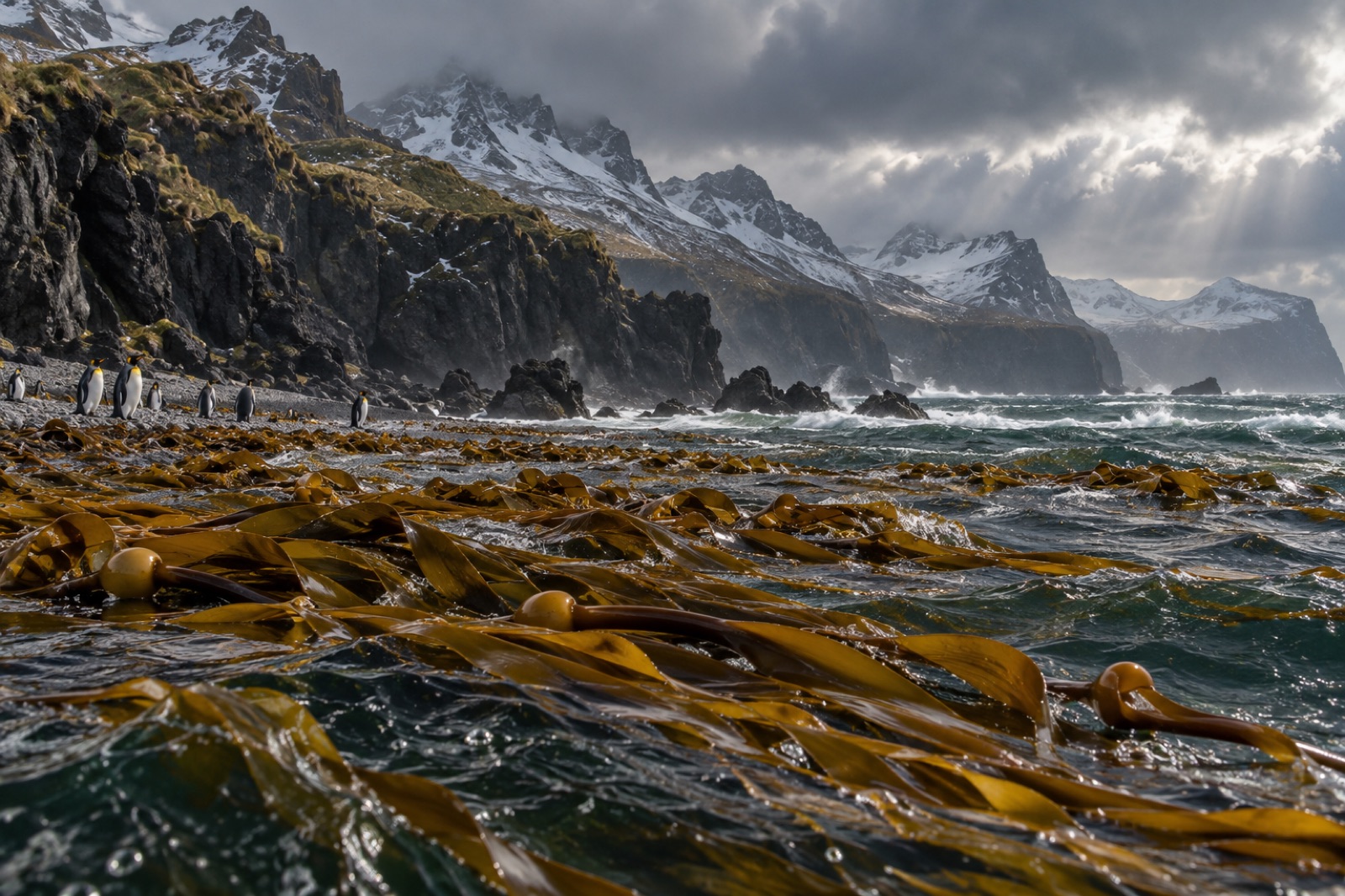
A coastal atlas guide to the Kerguelen Islands — vast giant kelp beds at 49°S, elephant seals and king penguins, iron-fed blooms, and the wildest kelp wilderness few will see.
Tom Okafor ·
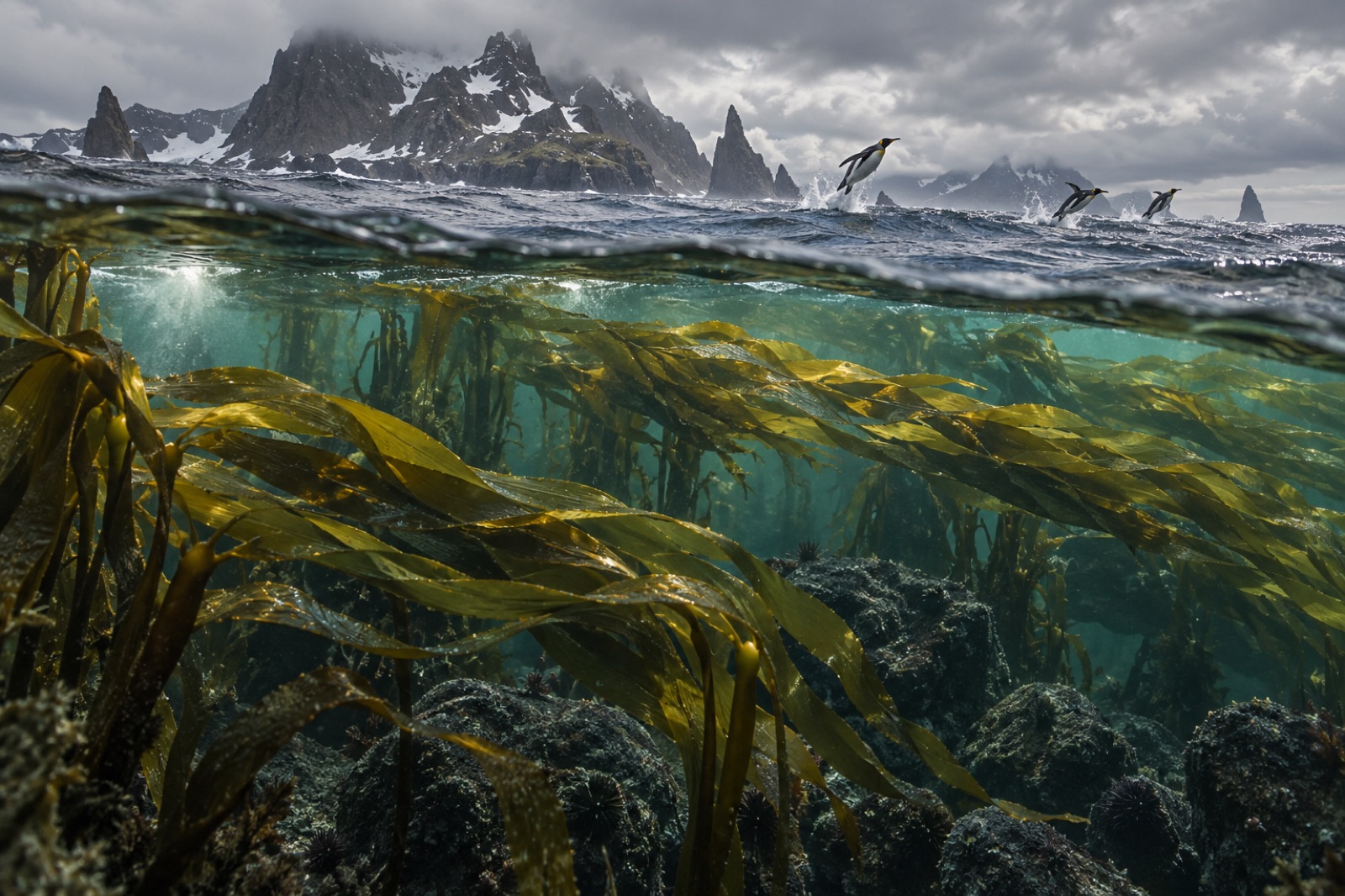
Giant kelp beds ring the Crozet Islands beneath some of the greatest penguin and albatross colonies on Earth — a coastal atlas guide to France's remote subantarctic.
Dr. Mara Ellison ·