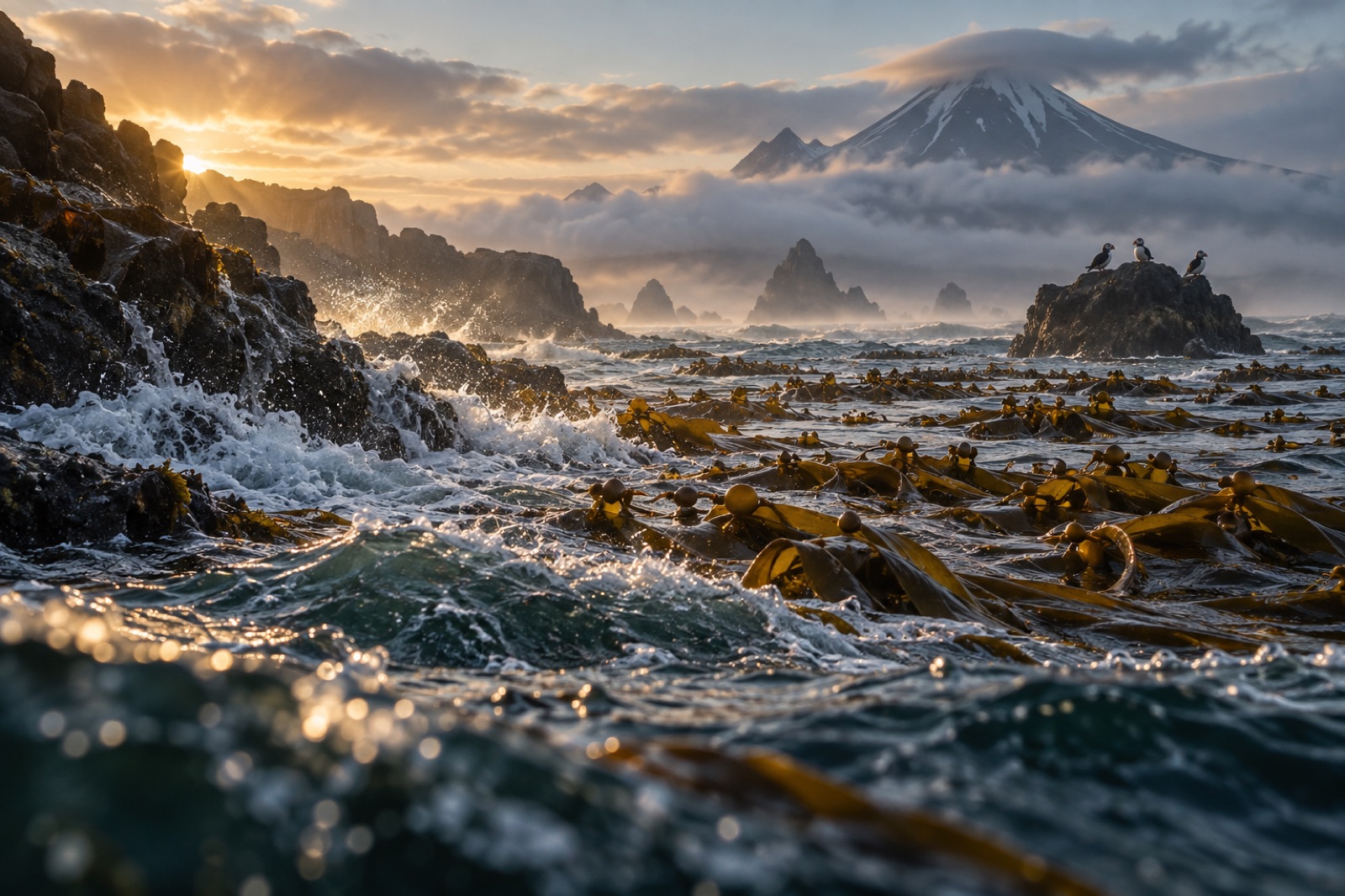
Ask a kelp ecologist to name the most haunted coastline on Earth and, sooner or later, the conversation lands on the Commander Islands: two main islands — Bering and Medny — plus a scatter of islets, sitting in open North Pacific water about 175 kilometres east of Kamchatka, at the western end of the Aleutian arc. They are foggy, remote, barely inhabited and almost never visited. They are also wrapped in some of the richest kelp habitat in the western Bering Sea — the same kelp that fed, and then failed to save, Steller's sea cow, the gentle giant whose extinction here in 1768 remains the defining cautionary tale of the North Pacific. This atlas entry walks the coast from geology to present-day protection, and explains why a place almost nobody can visit still matters enormously to how we think about kelp forests everywhere else.
Reading this atlas entry
Geographically the Commanders are the far-western continuation of the same island chain as the Aleutians, even though they belong to Russia (Kamchatka Krai) rather than Alaska. Bering Island, the larger of the two, runs about 90 kilometres long; Medny, to its southeast, is smaller, steeper and emptier. Both sit at the boundary where the shallow Bering Sea shelf drops into the deep Aleutian Basin, which is the oceanographic fact that drives everything else below.
A coast defined by one winter: 1741–1742
In November 1741, Vitus Bering's Second Kamchatka Expedition wrecked on the island that now bears his name. Bering himself died that winter, along with many of his crew, but the expedition's naturalist, the young German physician Georg Wilhelm Steller, survived — and spent the months of shipwreck producing the first scientific descriptions of an entire cold-water ecosystem: the northern fur seal, the spectacled cormorant, the sea otter, and a remarkable animal nobody had ever described: a nine-tonne relative of the dugong, grazing the kelp beds of the shallows.
Steller's sea cow (Hydrodamalis gigas) was enormous, slow, apparently tame and — crucially — delicious to castaways. When the survivors built a boat from the wreck and sailed home in 1742, word of the islands' riches spread. Fur hunters followed within the year, and between their camps and their appetite for meat, the sea cow had perhaps two dozen years left. The last reliable sighting was in 1768, twenty-seven years after the species became known to science.
There is a quieter lesson in the sea cow's biology, reconstructed from Steller's careful notes: the animals grazed kelp in water shallow enough that their backs showed above the waves, cropping the softer blade tissue and leaving some plants to regrow. They were, in effect, the kelp forests' largest-ever herbivore — a role nothing has filled since. When we talk about kelp food webs today, it is worth remembering they are missing a member, and that we noticed her only on her way out.
The kelp forests themselves
The kelp flora of the Commander Islands resembles that of the western Aleutians more than mainland Kamchatka. The canopy-forming dragon kelp (Eualaria fistulosa), with its buoyant midrib and sprawling fronds, dominates the shallow zone on exposed shores; below and between it grow laminarian kelps of the Saccharina and Arthrothamnus lineages, and in deeper, dimmer water the perforated sieve kelps that tolerate the long, low-light winters of the high-latitude Pacific. Seasonal sea ice and polar darkness shape what grows here, though at roughly 55°N the Commanders sit on the mild edge of true polar kelp country.
Two oceanographic features make these islands disproportionately productive. First, they stand astride the shelf break, where tidal and wind-driven mixing continuously lifts deep, nutrient-rich basin water onto the shelf. Second, the islands anchor a legendary fog factory: warm air riding over the Bering Sea's cold surface condenses into some of the most persistent marine fog statistics anywhere — Nikolskoye, the islands' only settlement, reports fog on well over a hundred days a year. For kelp, fog is not strictly a friend (less light) nor an enemy (cooler, moister, steadier conditions); in practice the forests here thrive, sustained by nutrients delivered from below rather than sunlight from above.
Otters, seals and a recovered wilderness — mostly
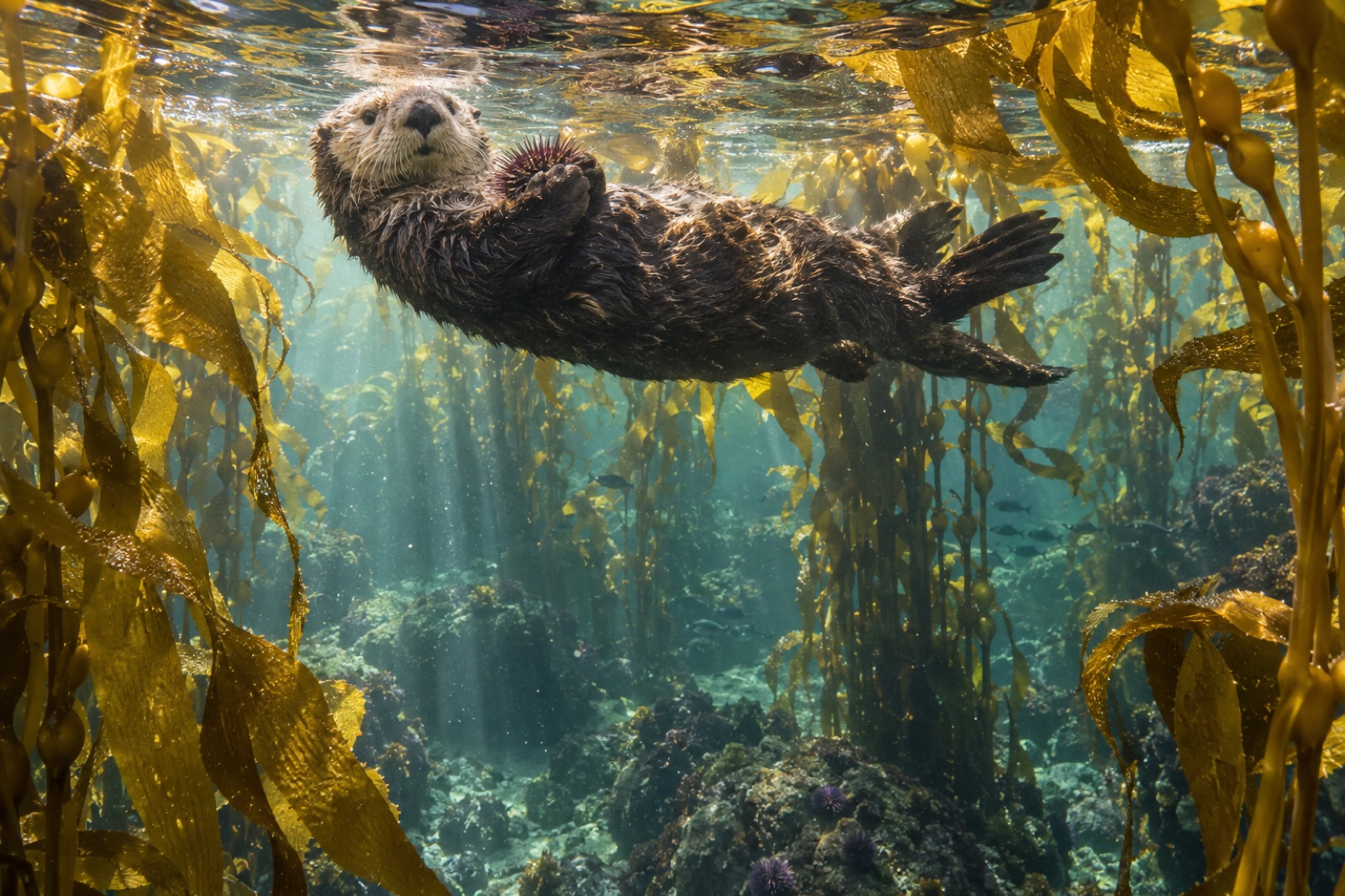
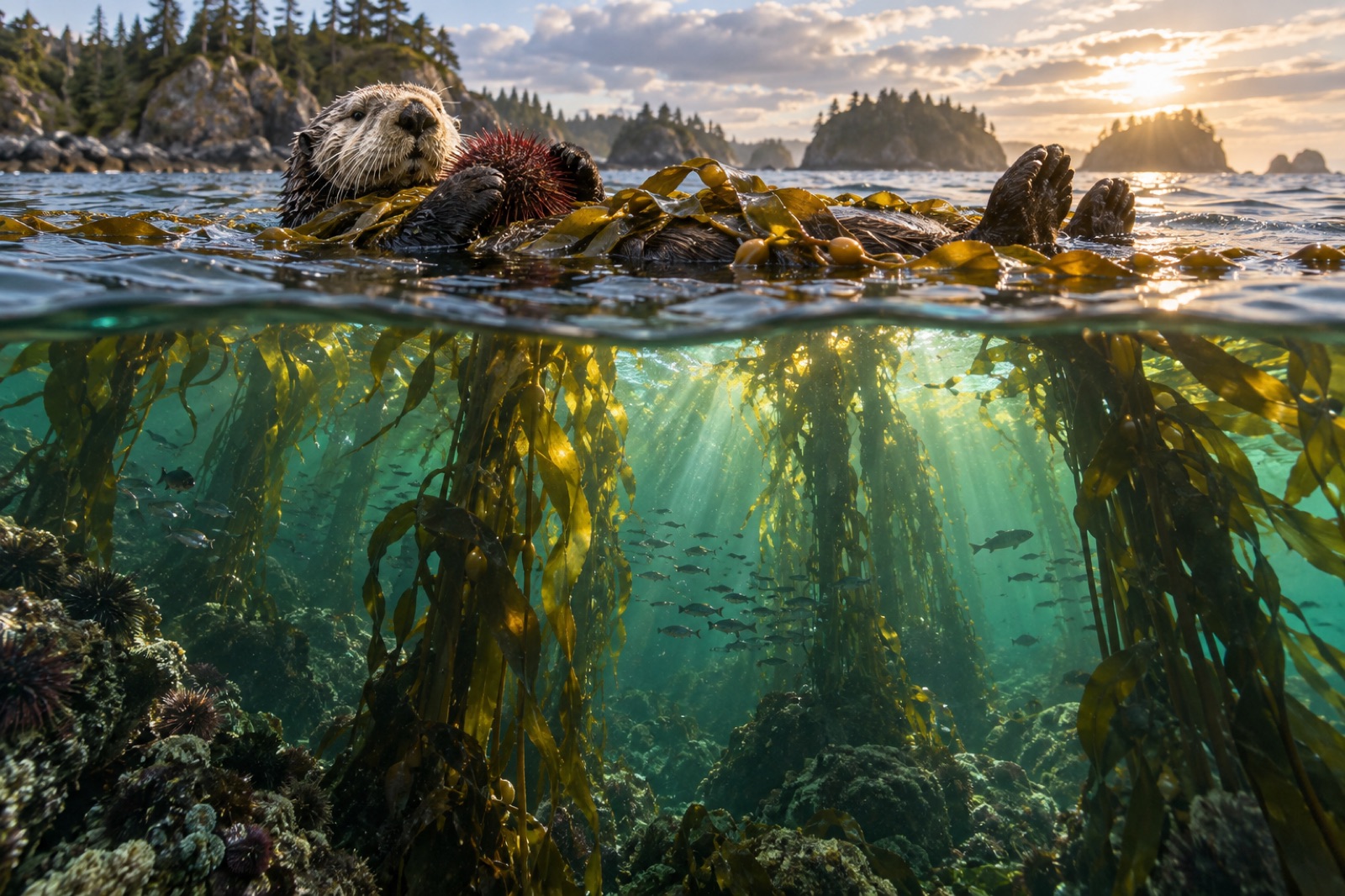
The Commander Islands hold one of the most instructive sea otter stories in the Bering Sea. Hunted hard through the nineteenth century, sea otters hung on around Medny in small numbers and expanded again through the twentieth — until the 1990s, when otter numbers around the western Aleutians and the Commanders fell sharply in the same broad pattern ecologists attributed to increased killer whale predation. The islands thus became a mirror of the Aleutian trophic cascade studies: where otters held, kelp held; where otters thinned, urchin grazing pressure rose. Today otters persist, and the shallow forests remain largely intact — a status that is monitored, but with far less intensity than their Alaskan neighbours.
Around the kelp fringe, the rest of the cast is abundant. Northern fur seals breed on Bering Island rookeries, Steller sea lions haul out on exposed points, and the cliffs carry seabird colonies that include two of the region's specialties: the red-faced cormorant, whose whole world is the arc from the Commanders to the western Aleutians, and the red-legged kittiwake, a globally near-restricted Bering Sea breeder. Orcas and humpback whales work the shelf break, and salmon streams thread the vegetated interior.
People: one village at the fog line
There is exactly one settlement: Nikolskoye, on Bering Island, home to a few hundred people. Its community has deep Unangan (Aleut) roots — nineteenth-century administrators relocated Aleut families from the Near Islands to work the fur grounds, and their descendants persist today. The village economy runs on a mixture of small-scale fishing, public employment connected to the reserve, and a little expedition tourism. Aleut language and culture here were suppressed through much of the twentieth century and have been consciously revived since the 1990s — a reminder that "remote wilderness" on this coast has, in fact, almost two centuries of continuous human memory attached to it.
Protection and the state of the coast
The Commanders are among the best-protected kelp coasts in Russia. The Komandorsky State Nature Biosphere Reserve, established in 1993, covers both islands and a wide marine buffer — a belt of protected water extending tens of kilometres offshore that is unusually generous for a marine reserve anywhere. In 2001 the islands were inscribed as a component of the Volcanoes of Kamchatka UNESCO World Heritage listing, recognising both the geology and the natural-history significance of the archipelago.
What the protection cannot yet deliver is data density. Compared with the research infrastructure of the Aleutians to the east, the Commanders are under-instrumented: remote sensing tells us the canopy persists; what we lack are the long, diver-based time series that reveal slow changes under the surface. In a warming Bering Sea — where marine heatwaves and retreating seasonal ice are rearranging food webs faster than anywhere — an intensely protected but thinly monitored forest is both a treasure and a worry. It is exactly the kind of coast that ought to have permanent temperature loggers, eDNA samplers and a kelp-watch programme, and exactly the kind that mostly doesn't.
Visiting, in theory
Realistically, you will not dive here. There are no dive operators, no moorings, no fill station; all landings require reserve permits, and access is by infrequent flight or expedition vessel from Petropavlovsk-Kamchatsky across some frequently furious water. A small number of expedition cruises call in during the brief summer window, offering zodiac cruising along the kelp fringe, bird cliffs and fur seal rookeries. If you go, go with an operator licensed to work with the reserve, and treat Nikolskoye as a host community, not a backdrop.
For the rest of us, the Commanders' contribution is conceptual. This is the coast where the world learned what disappears when nobody is counting — and where what was saved (otters, seals, the kelp itself) shows what happens when somebody starts.
Key takeaways
- The Commander Islands (Bering and Medny) sit between Kamchatka and the Aleutians, at the biologically rich junction of the Bering shelf and the deep Aleutian Basin.
- This is where Steller's sea cow was first described (1741) and last seen (1768) — the kelp forests' largest herbivore, lost within one human generation of discovery.
- Dragon kelp and laminarian kelps form dense forests, sustained by shelf-break nutrient mixing and frequent cold fog.
- Sea otters collapsed and partly recovered here in step with the Aleutians; northern fur seals, Steller sea lions, red-faced cormorants and red-legged kittiwakes round out the cast.
- The Komandorsky Reserve (1993) plus a UNESCO World Heritage listing make this one of Russia's best-protected kelp coasts — though scientific monitoring remains thin.
FAQ
Are the Commander Islands part of the Aleutian Islands?
Geologically, yes — they are the westernmost members of the Aleutian arc. Politically, no: they belong to Russia's Kamchatka Krai, while the rest of the chain is American (Alaska). Ecologically the distinction is irrelevant; the kelp forests, otters and seabirds operate as one continuous system across the border.
Did Steller's sea cow actually eat kelp?
Yes. Georg Wilhelm Steller's 1741–42 field notes describe the animals grazing on kelp in shallow water, primarily cropping the soft blade tissue of laminarian kelps and leaving holdfasts and growing tissue behind — gentle, partial harvesting consistent with a slow-moving grazer dependent on healthy canopy. It is the best direct account of kelp herbivory by a marine mammal ever written.
How big was the Steller's sea cow?
Adults are estimated around eight to ten metres long, with mass commonly estimated in the range of several tonnes up to roughly ten — making it by far the largest sirenian of modern times, and the largest herbivore the North Pacific kelp forests ever supported.
Can tourists visit the Commander Islands?
A handful of expedition cruises visit in summer, and landings require permits from the Komandorsky Reserve. There are no conventional tourism services besides basic accommodation in Nikolskoye. Expect fog, cold and extraordinary wildlife.
Why did sea otters decline there in the 1990s?
Otter numbers across the western Aleutians and Commander Islands fell sharply during that period; the leading hypothesis, advanced by Jim Estes and colleagues, is increased predation by killer whales whose larger prey had become scarcer. The details remain debated, but the pattern — otters down, urchins up, kelp under pressure — was consistent with the region's trophic cascade.