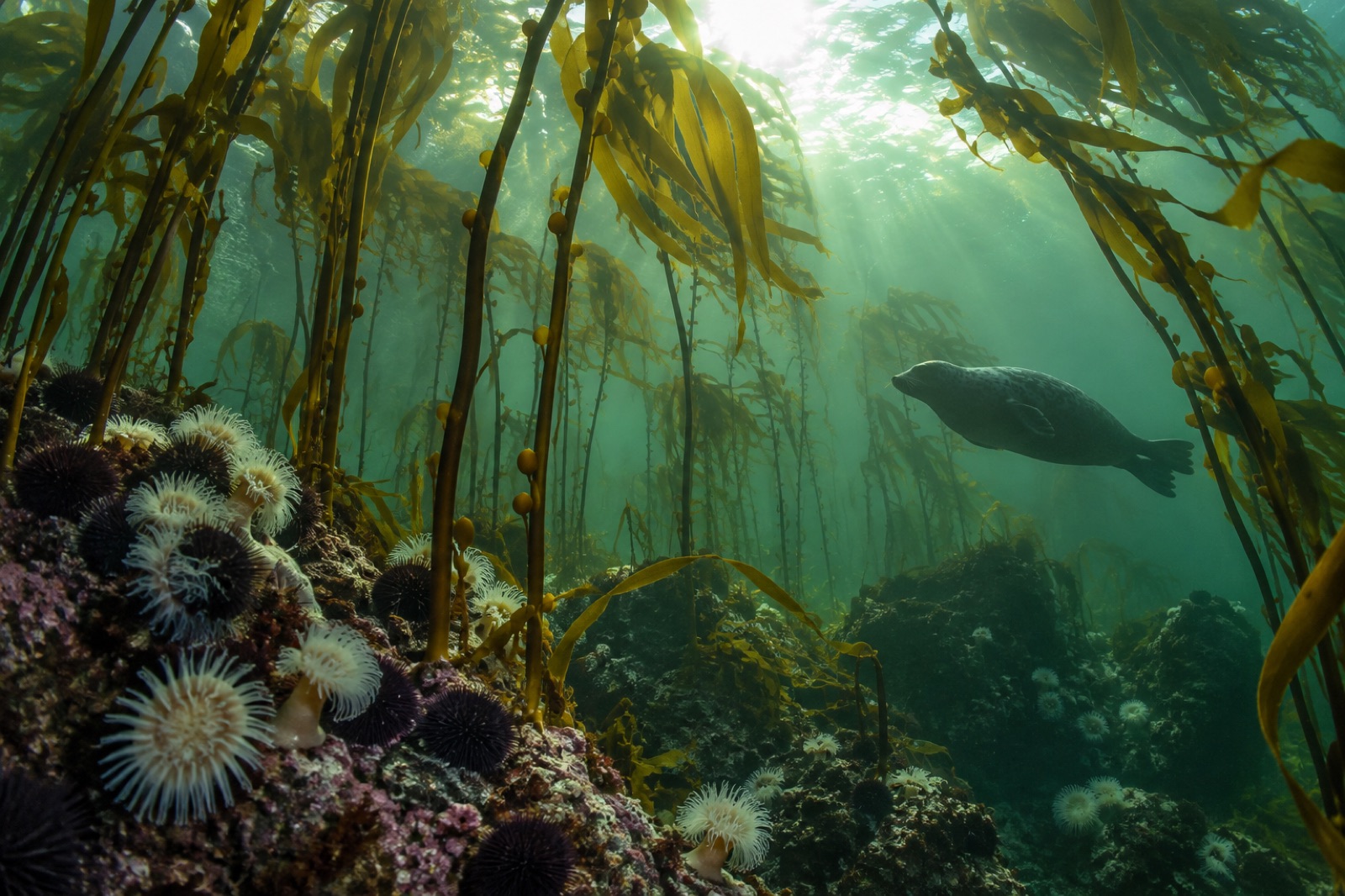
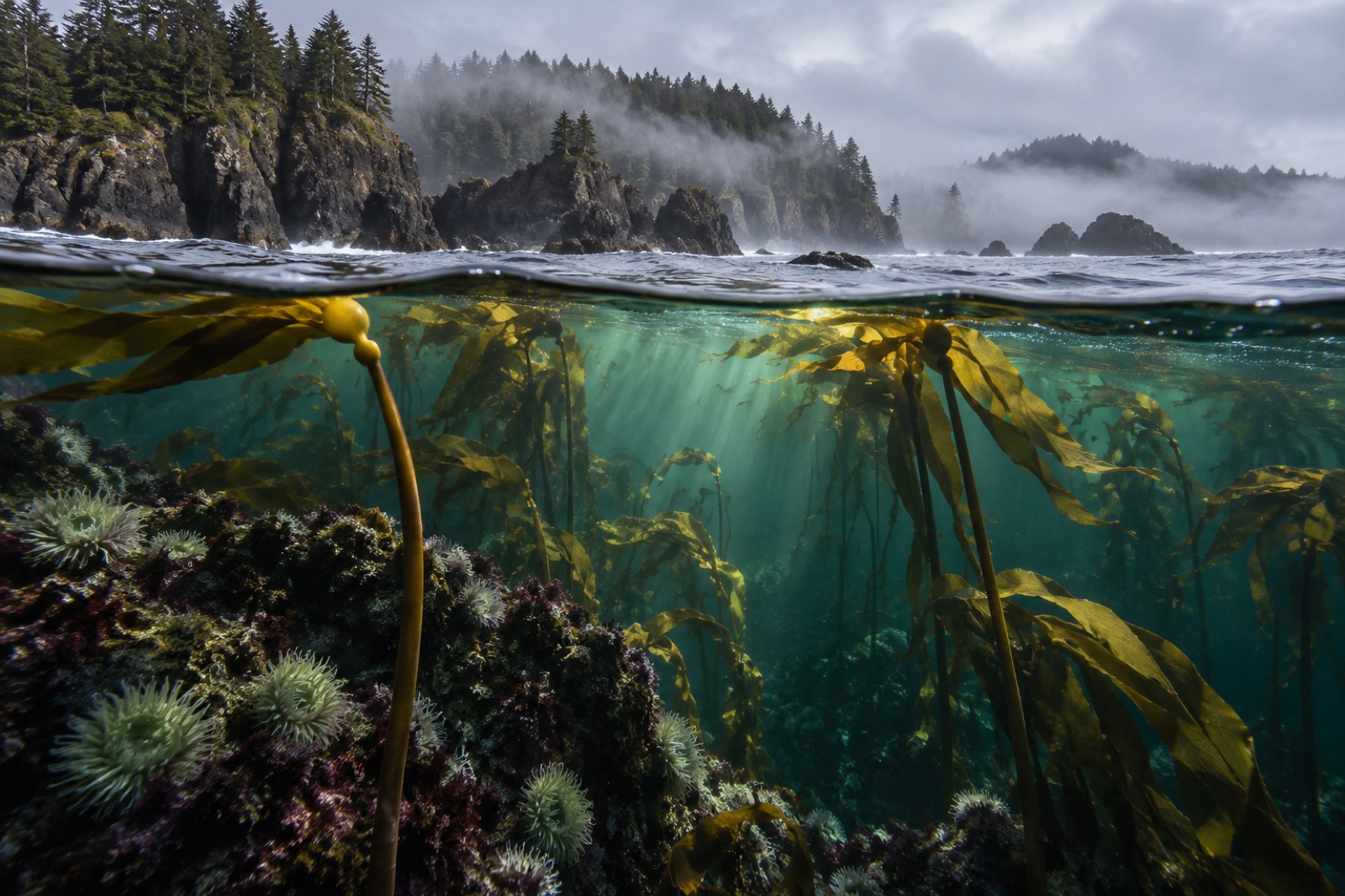
Clayoquot Sound (say it "clack-wutt") is the coast that argued Canada into a new relationship with its forests — and most of the argument happened above water. Beneath the same mountains, quiet through all the famous years, runs a marine Clayoquot: fjords and island groups, surf beaches and estuary mouths, and a ragged belt of kelp that stitches the open Pacific to the rainforest edge. This guide covers both layers — the kelp beds and the shoreline culture that protects them — because here, unlike most places, the two stories are inseparable. For regional context, start with the wider Vancouver Island west coast; then come north to the sound.
A sound of fjords and surf
Clayoquot Sound lies between the surf bulge south of Tofino and the Hesquiaht Peninsula to the north — roughly 3,500 square kilometres of islands, inlets and open coastline. Its geography comes in three bands:
- The outer islands — Flores, Vargas and Meares — take the Pacific's energy on their western faces and shelter everything behind them. Their outer reefs are classic exposed-coast bull kelp country: annual forests rebuilt from spore each spring, streaming in the surge along the rocks.
- The inner channels and inlets — Clayoquot and Tofino Inlets, Bedwell and Fortune Channels — run deep between steep rainforest slopes, cold, green and calm. Sheltered rocky reefs here carry the perennial kelps, with patches of giant kelp holding layered canopies in the middle ground.
- The estuaries and eelgrass flats at the river mouths, where salmon pour in and out with the runs and the water runs tannin-brown with forest runoff.
Tofino, at the sound's southern neck, is the human gateway — the end of the only road, and a town that has grown from fishing and logging port into the country's surf-and-wildlife capital.
Nuu-chah-nulth sea country
Clayoquot Sound is the territory of Nuu-chah-nulth nations — principally the Tla-o-qui-aht, Ahousaht and Hesquiaht — whose stewardship here is measured in millennia, not decades. Important facts for any visitor:
- This is governed, not empty, coast. Village sites, clam gardens, fisheries and travel routes structure the sound from end to end; the kelp beds themselves were managed harvesting grounds for food, herring roe and materials.
- Tribal Parks are a fact on the water. In 1984, Meares Island was declared Wanachus-Hilthuuis (Meares Island) Tribal Park by the Tla-o-qui-aht and Ahousaht — a declaration that helped halt logging plans and seeded a model of Indigenous-led protected areas that has since spread across the coast.
- Stewardship continues in the present tense. Guardian programs, co-managed fisheries, and tourism ventures run by the nations themselves mean that the people most likely to interpret this coast for you have the deepest claim to interpreting it.
Any honest account of Clayoquot's "wildness" has to hold this: it is a long-lived-in, long-loved landscape whose health owes much to the nations who never left it.
Underwater: the quiet half of the sound
The kelp here behaves like a hinge between two worlds. On the outer rocks the annual bull kelp stands take the swell; inside the island screen, perennial species build stable, multi-year structure; and between both, the understory — the crowd of smaller browns, reds and encrusting corallines — fills the light that filters through.
The wildlife reads like a roll-call of the Northeast Pacific. Grey whales pass on migration and many now stay to feed through summer, working the sound's shallows so regularly that local operators know individuals by name. Sea otters, spreading steadily down-coast from their reintroduction nucleus near Kyuquot, have been reoccupying the sound reef by reef — each new raft quietly rewriting its neighbourhood via the trophic cascade that otters bring: urchins down, kelp up, fish in. Steller and California sea lions haul out in season, harbour seals work the channels year-round, and in late summer humpbacks have returned in growing numbers to feed at the sound's mouth. The sport fishery and the whale-watching fleet both, in the end, are riding the productivity the kelp runs on.
The War in the Woods — and what it built
In 1993, the sound became the site of the largest act of civil disobedience in Canadian history: the Clayoquot Sound protests, when thousands blockaded logging roads into the ancient temperate-rainforest valleys around Meares Island and the Kennedy River, and more than 800 people were arrested through the summer.
The legacy is structural, not just symbolic. The province convened a scientific panel whose recommendations pushed Clayoquot logging toward ecosystem-based management; in 2000 the sound was designated a UNESCO Biosphere Reserve; and the Tribal Park model that predated the protests emerged from them vindicated and expanding. For the kelp beneath, the connection is direct if rarely drawn: a watershed never clearcut is a reef that never gets the sediment pulse. Water clarity is kelp's lifeline — our explainer on water clarity and light covers the physics — and the sound's intact forests are, in effect, part of its marine protected area. Upstream decisions land underwater, always (see where rivers meet the kelp).
Visiting Clayoquot Sound
- Base in Tofino. Food, gear, guides and boats out the door; the town lives facing the sound.
- Kayak the inside. Day paddles around Meares and Vargas or multi-day circuits give the closest reading of the kelp edge — skirt the eelgrass shallows at low tide and drift the kelp lines at high.
- Boat to Hot Springs Cove. The Maquinna hot pools at the head of the sound pair the classic Clayoquot boat journey with a kelp-lined passage home.
- Watch the water, not just the shore. Whale and bear tours double as kelp-forest safaris: the boats work the kelp edges because everything does.
- Dive if you're qualified. Local charters put drysuited divers onto reefs and walls where the sound's invertebrate life out-glares the kelp itself; our drysuit primer covers the exposure question honestly.
- Take the storm season seriously, from behind glass. Winter's swell is the sound's real landlord; November through February, the surf lodges sell front-row seats to it.
Working coasts like Clayoquot are also where models of shared stewardship get tested — the kind of partnership between nations, communities and restoration programs that Tidewright's fictional Reef Partners work (clearly illustrative) imagines scaling up; see solutions for communities for the shape of it.
Key takeaways
- Clayoquot Sound is a three-band system: exposed outer-island bull kelp, sheltered fjord channels with perennial and giant kelp, and estuarine eelgrass at the river mouths.
- The sound is Nuu-chah-nulth sea country under active stewardship; Meares Island's 1984 Tribal Park declaration helped invent the Indigenous-led protected-areas model on this coast.
- Grey whales feed here all summer, otters are reoccupying the reefs, and humpbacks have returned to the sound's mouth — productivity the kelp underwrites.
- The 1993 "War in the Woods" reshaped Canadian forestry and protected the watersheds whose clarity the kelp depends on; the sound became a UNESCO Biosphere Reserve in 2000.
- Visit from Tofino by kayak, boat or dive charter; take winter as a spectator sport, not a swimming one.
FAQ
Is Clayoquot Sound a national park?
No. The neighbouring Long Beach unit lies within Pacific Rim National Park Reserve, but Clayoquot Sound itself is a patchwork of provincial parks, First Nations reserves, Tribal Parks and a UNESCO Biosphere Reserve designation — a governance mosaic rather than a single protected area, with Nuu-chah-nulth nations at its centre.
Can you snorkel or dive in Clayoquot Sound?
Qualified cold-water divers can join local charters onto the sound's reefs — expect 8–13°C water, a drysuit or a serious wetsuit, and invertebrate life that rewards slow attention. Casual snorkelling is possible on calm summer days in sheltered bays, but this is cold Pacific water; dress for it and stay humble.
Are there sea otters in Clayoquot Sound?
Yes, and increasing. Otters have been expanding down the coast from their 1969–72 reintroduction site near Kyuquot, and rafts now work reefs within the sound. Where they establish, the knock-on change is quick and visible: fewer urchins, thicker kelp.
What's the best season to visit?
June to September for paddling, boats and calm-water access; March to May for the grey whale migration's peak and smaller crowds; November to February for storm watching — best enjoyed from a surf-lodge window with the woodstove going.
How does the rainforest history relate to the kelp?
Directly, through water clarity and sediment. Intact watersheds deliver clean, clear runoff; clear-cut ones deliver silt pulses that starve underwater light. Protecting the valleys in 1993 turned out to be kelp policy too — an argument this coast makes better than anywhere: forests upslope, forests below.