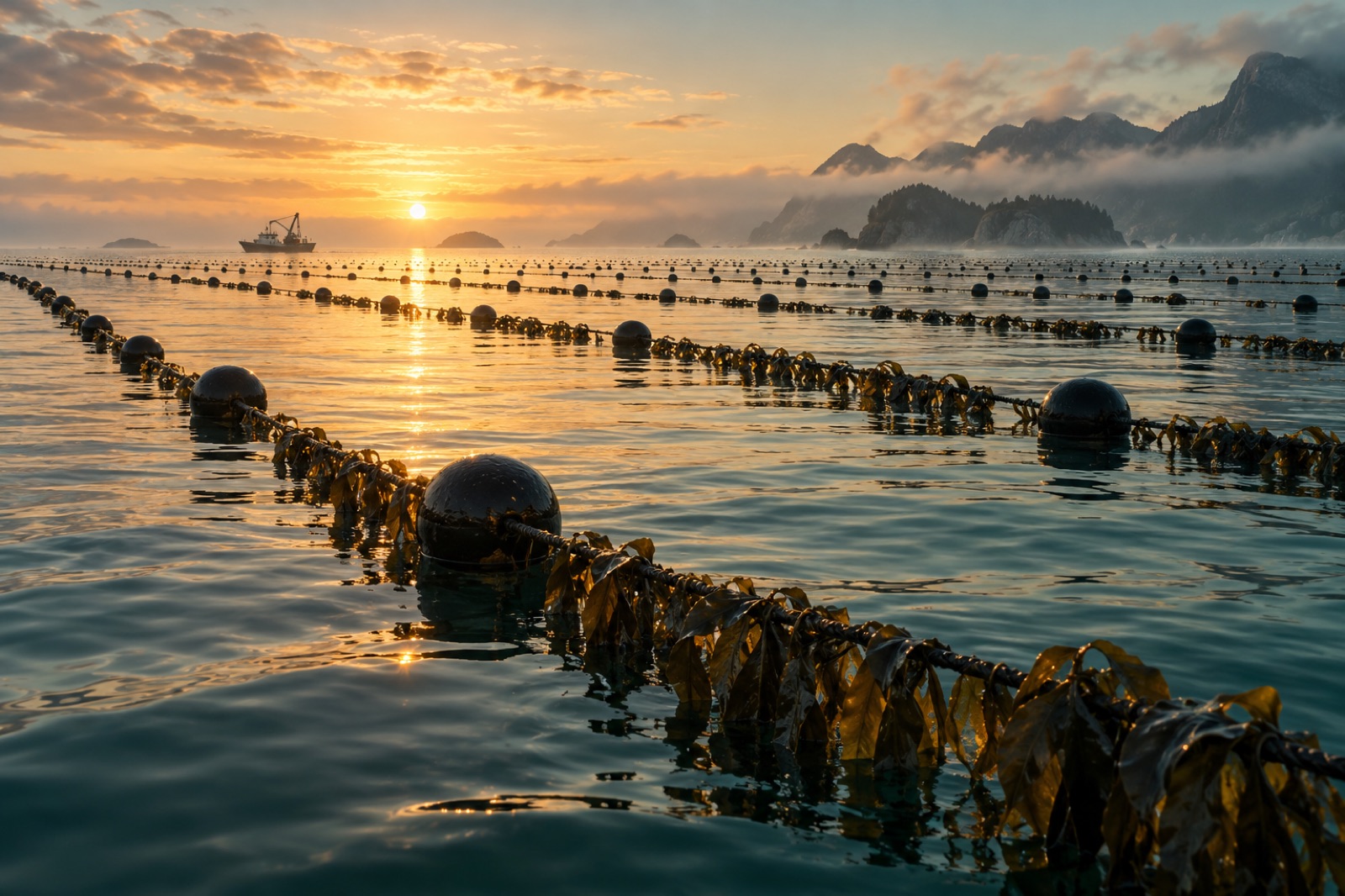
Of all the ocean-based carbon removal ideas now on the table, biomass sinking is at once the most intuitive and the most unsettled. Grow fast photosynthesisers at the surface — giant rafts of kelp or sargassum, or engineered algae systems — then deliberately send the fixed carbon to the deep ocean, where slow circulation keeps it out of the atmosphere for centuries. The appeal is obvious: the ocean covers seventy percent of the planet, seaweed needs no land, no fertiliser, no freshwater, and it grows astonishingly fast. The physics, biology and governance are far less obvious — and that is where any honest accounting must live. This explainer lays out both sides.
The core idea, and its natural model
Biomass sinking borrows its logic from a process the ocean already runs: the biological carbon pump, in which surface production — plankton, detritus, drift kelp — sinks, dissolves or is eaten on its way down, delivering a fraction of surface-fixed carbon to depth. Natural kelp forests already export part of their production offshore as drift and detritus; some of that material, tracers show, genuinely reaches deep water and sediments. The sinking proposal amplifies this: instead of waiting for storms and buoyancy to deliver fragments, a program would harvest cultivated biomass and deliberately deposit it below the reach of rapid return.
In the landscape of ocean carbon removal methods, sinking is the family that touches the ocean most directly — unlike alkalinity enhancement (which changes chemistry) or electrochemical methods (which happen onshore), sinking physically relocates living matter from one part of the ocean to another, with consequences at both ends.
The physics of staying sunk
The single most important sentence in any biomass-sinking assessment is: the ocean is layered, and the layers have different return addresses. Seawater warms and freshens toward the surface; density steps separate the wind-stirred surface from the depths. Carbon that stays in the mixed layer returns to the atmosphere within months. Carbon remineralised — eaten by microbes and converted back to dissolved CO₂ — in the mid-water "twilight zone" may return on decadal timescales as currents upwell. Carbon that genuinely reaches the deep ocean, thousands of metres down, joins water masses that the great overturning circulation typically keeps away from the surface for centuries, in the deepest reaches far longer.
So the physics demands three things of any sinking claim:
- Depth with a return time. The deeper and the further from upwelling regions, the longer the sequestration. There is no sharp brightness threshold; "durability" is a probability distribution over decades and centuries, not a binary switch. This is the same hard word that durability vs permanence debates revolve around.
- Delivery intact. The biomass must actually get down. Kelp positively floats; once gas bladders fail or blades fragment, sinking speeds are slow and the material mingles with the normal traffic of marine snow, being shredded and digested on its way. Proposals variously ballast, bale, compress or pump biomass to depth precisely because a floating frond is a broken claim.
- Accounting for the journey. Every gram respired mid-water counts as return, not removal. The net sequestered fraction is what reaches depth, minus what decomposes on the way — a number the field must measure, not assume.
The proposed methods
Proposals differ chiefly in how they get the carbon down:
- Harvest-and-deposit. Farm macroalgae on surface longline structures, harvest with vessels, compress into bales and sink them at a designated deep site. Simple to describe; engineering-intensive in practice.
- Engineered buoyancy cycles. Structures that grow kelp near the surface and then tow or flip it to depth on a timer, using the ocean's own day-night and seasonal machinery.
- Leveraging natural export. Rather than move the biomass, cultivate kelp where currents and bathymetry already shed drift toward deep basins or submarine canyons — a managed version of the deep-sea export pathway that wild kelp forests already operate.
Each has a different fuel bill, a different safety case for vessels, a different footprint at the seafloor. There is no free version: moving tonnes of wet biomass is energy, steel and logistics whoever does it.
The open questions the ocean will ask back
This is where honest assessment earns its keep. The major classes of concern:
The deposition site. Tonnes of fresh organic matter arriving in the deep sea are food — and a disturbance. Deep seafloor communities are slow, low-oxygen and vulnerable; a concentrated biological pulse can drive local oxygen down and change community structure. Dilution, siting and rate of addition determine whether a deposit bed becomes an anoxic smothering or a dispersing subsidy. No one yet has long-term monitoring of a serious deposit site, because there aren't yet any at scale.
The surface nutrient draw. Sinking removes not only carbon but nitrogen and phosphorus locked in the tissue. At massive scale, surface nutrient mining could starve the productivity that the climate argument and the food web depend on — a kind of export tax on the ecosystem.
MRV. How do you prove how much carbon reached depth, and for how long it stays? Tracking bales with transponders, deep sediment sampling, autonomous glider surveys — all are proposed; none are cheap. Credible MRV is the make-or-break here more than almost any other method, because the ledger is open to the sea.
Scale mathematics. To matter climatically, sinking must operate at a scale where farmed area, harvesting fleets and deposition footprints are all material. Early engineering assessments disagree sharply over achievable cost per tonne, and nearly all rest on supply chains that do not yet exist.
Who gives permission?
Dumping at sea is not a grey area; it is one of the most long-regulated activities in the ocean. The London Convention and London Protocol govern the deliberate disposal of matter at sea, with amendments addressing ocean fertilisation and the framework for other marine geoengineering activities under active consideration; nations also control continental-shelf and exclusive-economic-zone activity under UNCLOS; and beyond national jurisdiction the new high seas biodiversity framework adds a further layer. Any serious sinking program will require permitting, environmental impact assessment, site monitoring and — since wholesale nutrient export from one basin can land in another — transboundary consultation. Our governance explainer walks through the actors. The direction of travel is toward oversight, not away from it.
Where Tidewright stands (fictional positioning)
Tidewright's fictional position is simple: we restore kelp forests close to shore, and let the natural export pathway do what it does, counted conservatively; we do not sink biomass, we do not sell sinking credits, and we believe deliberate biomass sinking merits research vessels, small monitored pilots and public evidence before it merits purchase orders. The biology we know best — where kelp's carbon actually goes in the wild — counsels humility about engineered shortcuts past it.
Key takeaways
- Biomass sinking proposes growing seaweed at the surface and delivering it below the ocean's rapid-return layers — an engineered amplification of the natural biological carbon pump.
- Sequestration durability is a function of depth, location and circulation; "sunk" is not a guarantee, it's a distribution of return times.
- The main engineering challenge is delivery: kelp floats, fragments and decays on the way down; ballast, baling and pumping all carry costs.
- Deep-sea deposition effects, surface nutrient removal and MRV cost are the three hardest open questions.
- Governance is mature and tightening: the London Protocol, UNCLOS and the new high-seas framework all reach deliberate sinking.
FAQ
Is sinking seaweed the same as ocean fertilisation?
No. Ocean fertilisation adds micronutrients (usually iron) to stimulate plankton blooms, hoping their carbon sinks. Biomass sinking grows cultivated macroalgae and moves the harvested tissue itself. Different organisms, different risks, partly different law — though both fall under ocean-geoengineering scrutiny.
How long does sunk carbon stay down?
Below the deep thermocline, water masses are typically isolated from the atmosphere for centuries; the deepest basins hold water for the better part of a millennium. Carbon remineralised mid-water may return within decades. The answer is always a distribution — depth and location set its shape.
Couldn't we just sink drift kelp from existing forests?
Wild kelp already exports detritus naturally; harvesting wild drift at scale would strip the food web subsidies that drift kelp delivers to beaches and deep scavengers. Cultivated biomass, grown in addition to wild cover, is the proposal under study — which also makes additionality easier to argue.
Does Tidewright sell credits for biomass sinking?
No. Tidewright is a fictional demonstration company, and within its fiction it does not operate or sell biomass-sinking removals. Its carbon claims rest on restored nearshore forest area and monitored natural export, credited conservatively under recognised standards.
What's the single biggest unknown?
Fate-tracking: proving, at credible cost, how much carbon makes the trip and how long it stays. That measurement burden — gliders, tracers, sediment cores, repeat surveys over decades — is where much of the current research effort concentrates.