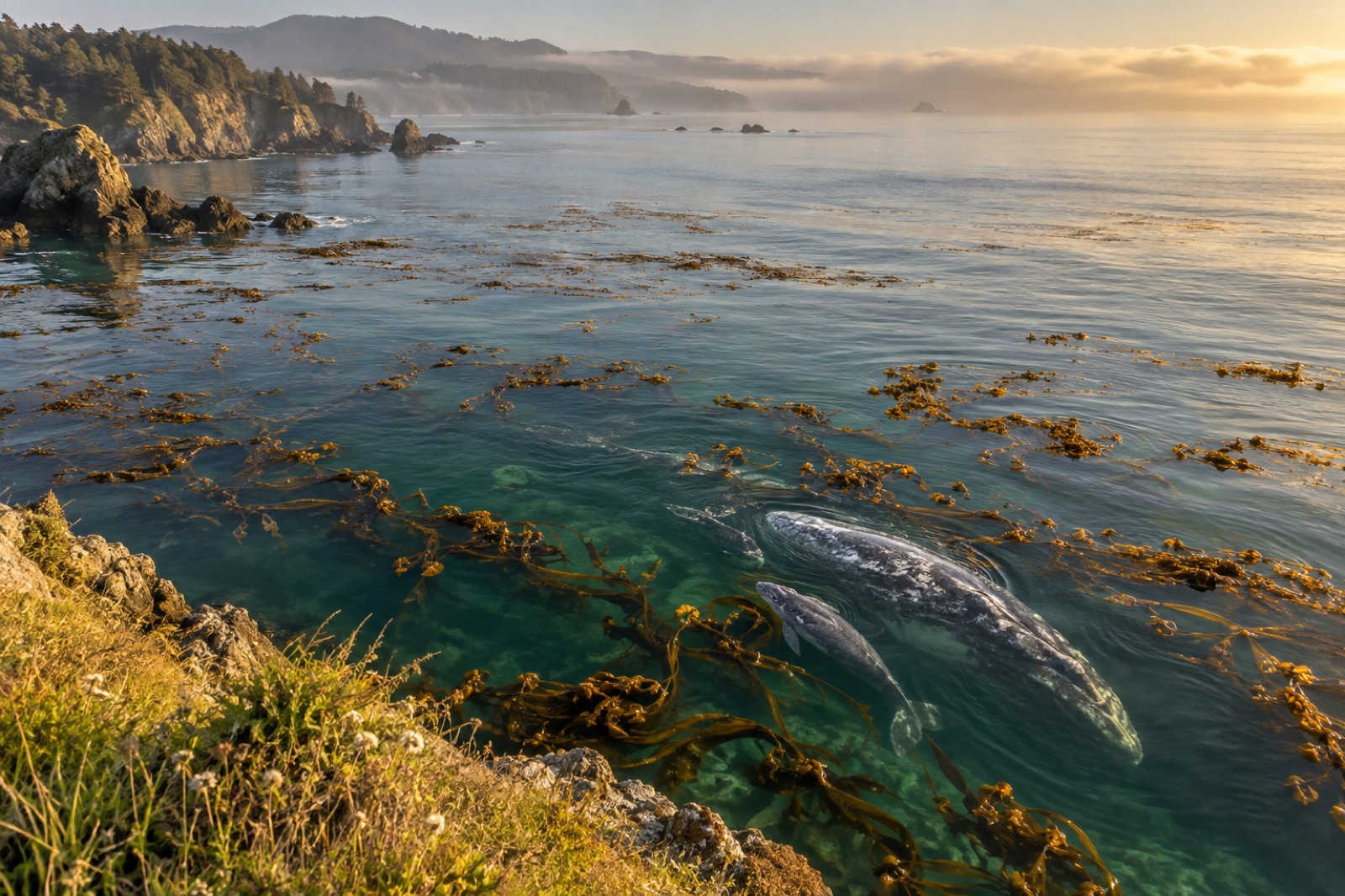
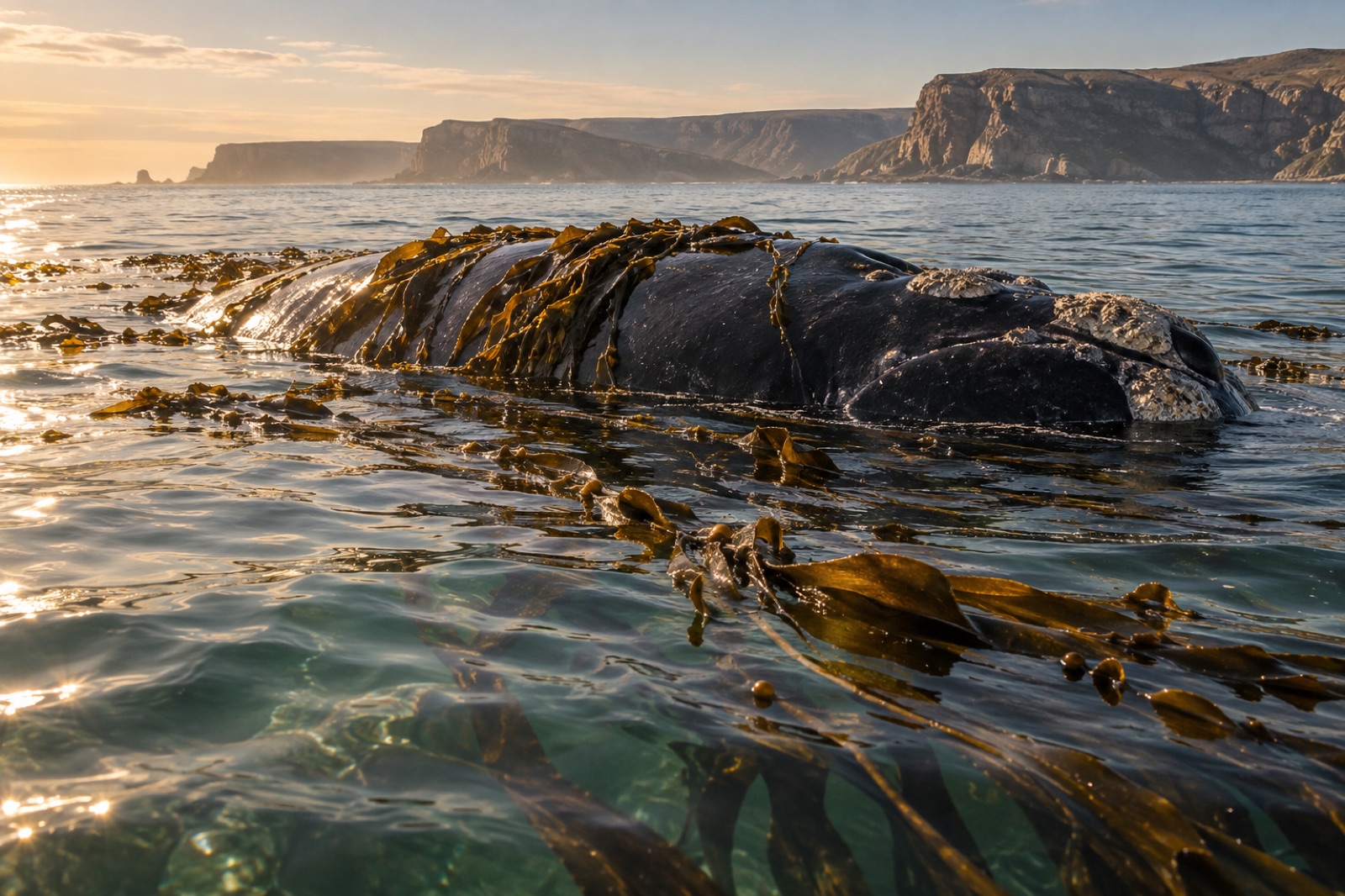
Kelp forests and whales share a coastline for the same reason forests and elk share a valley: cold, upwelled, productive water grows both. Nearly every great whale-migration corridor on Earth hugs a temperate coast fringed with kelp — because that is where the food is, and because the shallow nearshore lane is the safest road for a mother and calf. That means some of the finest whale watching in the world happens not from a boat but from a headland, above a kelp forest, with a thermos in hand. This is when the giants pass which coasts, what to look for from shore, and how kelp itself fits into the lives of whales.
Why kelp coasts are whale coasts
Three features of kelp country explain the whales:
Productivity. Kelp thrives where cold, nutrient-rich water reaches sunlight — upwelling coasts, tidal fronts, subpolar shelves. The same nutrients feed the plankton and baitfish that feed the krill-and-herring economies that whales run on. A kelp forest on the chart is a marker for a rich sea.
The nearshore lane. Long-distance migrants — grey whales above all — travel astonishingly close to land, often inside the kelp line itself, in water barely deeper than they are long. Sheltered from oceanic swell and from orcas (who hunt less effectively in shallow, kelp-cluttered water), the inside lane is the family route.
The kelp itself. Whales genuinely use kelp. Grey whales pause to roll and rub in bull-kelp rafts on their migration; southern right whales drape fronds over their backs and calves mouth the canopy, a behaviour documented from South Africa to New Zealand's subantarctic islands. Whether it is play, parasite management or learning, kelp is part of whale culture — our grey whale profile and southern right whale profile go deeper into the science.
The seasons, coast by coast
Grey whales: the Pacific's inside lane
The marathon of the whale world — up to 20,000 kilometres a year between Baja California's lagoons and the Bering Sea — runs along the kelp coast of North America twice annually:
- Southbound, December to February. Pregnant females lead, pressing steadily south past Washington, Oregon and California, sometimes only a few hundred metres out.
- Northbound, February to May. The return is slower and closer inshore. The unmissable act is April and May, when mothers with new calves travel the innermost lane — regularly inside the kelp — resting in coves, nursing in sheltered water, rolling in the canopy. This is the finest shore whale watching on Earth: a lighthouse point, morning calm, patience, and a cow-calf pair at what feels like arm's length below you.
The classic overlooks sit on the migration's great headlands — Point Reyes, the Big Sur headlands, and Oregon's high capes among them.
Humpbacks: the feeding season
Humpbacks spend winters breeding in the tropics and summers eating, which puts them on kelp coasts when the water is richest: May through November in Monterey Bay and along California, June to November migrating past eastern Australia — hugging the kelp-fringed southern stretches of that coast at each end of the season — and through the southern summer around Antarctica's edge. Humpbacks are the whale watchers' whale: lunging through bait balls at kelp-bed edges, breaching, pec-slapping, and approaching boats and headlands with what appears to be curiosity.
Southern right whales: the calving coasts
The southern right whale is the kelp coast's most devoted whale. Every austral winter and spring — roughly June to November — mothers return to the same shallow, sheltered bays to calve and wean: the cliffs of South Africa's Cape Peninsula and Garden Route, and the great white sweep of Head of Bight on Australia's Nullarbor edge, where cows rest for months in water so shallow their backs dry in the sun. These coasts pair the season's best land-based whale watching with some of the southern hemisphere's finest kelp — the same water, the same reason: shelter plus food.
Orcas: the resident and the transient
Killer whales work kelp coasts year-round on two different business models. Salmon-eating residents shadow the fish runs — in the Pacific Northwest that concentrates them in summer and autumn around the San Juan and Vancouver Island passages. Mammal-hunting transients patrol unpredictably, year-round, and are the reason the kelp line matters: harbour seals hug the forest because orcas do not. Watching a transient group work a kelp fringe — patiently, flushing seal territory — is among the most electric events a headland can offer.
The supporting cast
Blue whales, the largest animals that have ever lived, appear off California's kelp coast in summer and early autumn to feed on krill. Minke whales — the kelp coasts' small regulars — work tidal fronts off Scotland's west coast and Scandinavia through the northern summer. Dall's porpoises rooster-tail through the passes; humpback bubble-net feeding rafts gulls over the inside passages of British Columbia and Alaska. On a rich kelp coast, there is always something with a fin.
Reading the sea from shore
Land-based whale watching is a skill, and it is learnable in one season:
- Choose height and calm. Fifteen to forty metres of elevation over open water is ideal. Calm mornings let a blow hang visible for seconds; wind shreds them instantly. Rain kills the enterprise.
- Scan slow, scan bare-eyed. Binoculars first is the beginner's error — you need pattern recognition across a whole horizon. Sweep slowly and watch for interruptions: a blow (a grey push of vapour that hangs), a back, a fluke, a splash out of place, a fleet of birds over feeding fish.
- Learn the blow. Grey whales blow low and bushy-heart-shaped. Humpbacks tall and columnar. Right whales a wide V. Orcas a single sharp puff under a tall black fin. Shape at distance identifies species before you ever see the body.
- Watch the kelp line. In migration season, the inside lane runs at the kelp. A rippled passage through floating canopy, a sudden flurry of gulls scrambling off the water ahead of something unseen — the forest's surface tells on the whales.
- Give it an hour. Whales travel their own schedule. The watcher who settles — thermos, seat pad, sun behind them — sees more in the third half-hour than the first.
Shore spots worth the drive
- Point Reyes and the Big Sur headlands, California — grey whales in season, humpbacks in summer, orcas any time it feels like.
- Hermanus-to-De Hoop and the Cape Peninsula, South Africa — the world's great right-whale shore show from June to November, kelp on every rock below you.
- Head of Bight, South Australia — right-whale calving under the Nullarbor cliffs; nothing else like it.
- Monterey Bay shore points — humpbacks and blues within binocular range of the kelp beds in summer; otters in the canopy while you watch.
- Scottish west-coast headlands — minkes at the tidal fronts, plus otters, eagles and oarweed forest at your feet.
Etiquette and expectations
From shore, etiquette is mostly patience: no drones over whales (illegal in many jurisdictions, stressful everywhere), no pressuring lookouts, take the viewing the sea agrees to give. From boats, the rules are stricter and for good reason — stand-off distances, no approach paths into a whale's course, engine discipline near calves. If you want the water-level encounter, book operators who follow them; our wildlife ethics guide applies to whale boats as much as dive boats. And resist disappointment on grey days: a blow at distance from a headland you hiked to is a whale the way whales mostly are — wild, unhurried, and indifferent to your calendar.
Key takeaways
- Kelp coasts concentrate whales because upwelling feeds kelp, baitfish and whales alike, and because the shallow inside lane is the safest migration route for calves.
- Grey whales pass Pacific headlands December to May, with mother-calf pairs inside the kelp in April and May; humpbacks feed off kelp coasts through local summer; southern right whales calve beside southern-hemisphere kelp from June to November.
- Whales use kelp directly — greys roll in it, right whales wear it — making the canopy itself part of the behaviour you might witness.
- Shore-watching craft: height, calm mornings, slow bare-eyed scans, blow-shape identification, and at least an hour of patience.
- No drones, no crowding, boats by the rules — the best encounter is the one the whale barely notices.
FAQ
When is the best single month for whale watching on a kelp coast?
On the US Pacific coast, April — mother-calf grey whale pairs in the inside lane, plus early humpbacks and year-round orcas. On southern hemisphere coasts, August and September — the heart of right-whale calving season in South Africa and southern Australia, overlapping humpback migration in the east.
Do I need a boat to see whales properly?
No. The nearshore migration lanes mean many of the world's great whale spectacles are land-based by design — headland lookouts exist at Point Reyes, Cape Peninsula sites and Head of Bight precisely because the whales come to the coast. Boats add range and angles; shore adds comfort, patience and zero pressure on the animals.
What binoculars do I need for shore whale watching?
8×42 or 10×42 marine binoculars are the standard; image stabilisation is a luxury that genuinely helps from cliffs. But the first skill is scanning bare-eyed — binoculars are for confirming and enjoying what your eyes found.
Why do whales roll in kelp?
The honest scientific answer is "several reasons, not fully resolved": kelp-rolling in grey and right whales is documented and consistent, and hypotheses from play and social learning to skin care — kelp fronds as exfoliant against barnacles and whale lice — all have support. Watch it once and you will stop caring about the taxonomy of joy.
Can I see whales and kelp forest wildlife on the same day?
Constantly — that is the whole point of this article. Headlands above kelp beds give you whales at middle distance and otters, seals and rafted birds in the canopy directly below. Bring a field guide for both scales, and watch the small world while you wait for the large one.