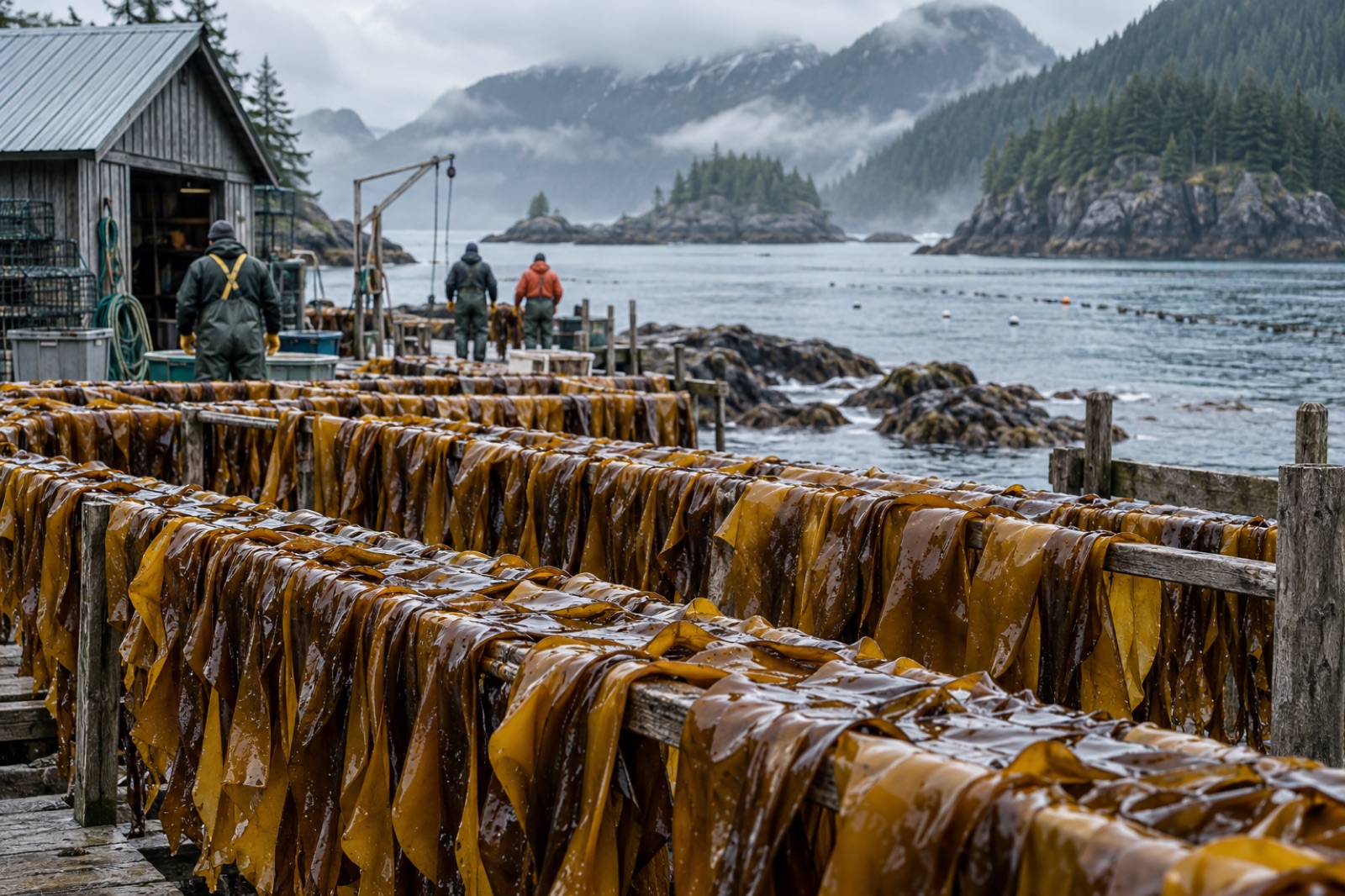
Somewhere in your news feed this month there is probably a video of an edible water pod or a dissolving sachet, captioned as the end of plastic. The truth behind seaweed-based packaging is better than the caption: a genuine, growing materials industry that turns farmed and wild seaweed into films, coatings and foams — and a set of honest engineering limits that decide where it can and cannot replace plastic. This article follows the whole chain from kelp line to finished film: the chemistry that makes it possible, each production step, the products that actually work, and what it all means for seaweed farmers deciding where their harvest should go.
Why seaweed can become a material at all
Conventional plastics are chains of carbon built from oil. Seaweeds grow their own polymers in saltwater, for free — and three of them are industrially useful:
- Alginate, the structural gum in the cell walls of brown kelps. Extracted from the stipe and blades, it forms gels and films and is the backbone of most seaweed packaging; our alginate production explainer covers the extract itself.
- Carrageenan and agar, gelling polysaccharides from red seaweeds, long used in food and now appearing in films and coatings (see farming Gracilaria for one agar supply chain).
- Ulvan and other green-seaweed sugars, a newer research material from sea lettuce.
The key property these share: they are hydrophilic film-formers. Dissolved in water and dried, they self-organise into continuous, transparent, grease-resistant films — the thing conventional cellulose needs heavy chemistry to do.
Step one: growing and harvesting the feedstock
The chain starts with the same agronomy as any crop. Brown kelps for alginate — farmed on longlines in cold water, harvested at peak alginate content, which varies by season and species. This matters more for materials than for food: an extractor cares about gum yield and quality per tonne, so harvest timing and post-harvest handling directly set the value of what the farm delivers.
Then the standard post-harvest sequence: wash, dewater, dry or preserve. For extraction feedstock, fast drying matters because alginate degrades and darkens in wet, warm storage — quality loss that shows up later as off-colour film.
Alginates don't come out of kelp ready to use. The industrial extraction, at high level:
- Milling and acid washing of dried kelp to remove salts, pigments and laminarin.
- Alkaline extraction — the alginate, insoluble in its native calcium form, is converted to soluble sodium alginate by treatment with alkali, dissolving it out of the plant matrix.
- Clarification of the viscous extract, then conversion — typically precipitating alginic acid and re-neutralising it to the salt customers want (sodium, potassium or calcium alginate).
- Drying and milling to a consistent powder, graded by viscosity and purity.
The output looks unremarkable — an off-white powder — but it is a precisely specified industrial ingredient, and consistency is everything: a film line tuned for a 400-centipoise grade misbehaves on a 200.
Pure alginate makes a beautiful film with a fatal flaw: it dissolves in water, and it is brittle without help. Formulation is where packaging performance is created:
- Plasticisers (glycerol is the common one) soften the film and stop it cracking.
- Crosslinking with calcium turns water-soluble sodium alginate into water-resistant calcium alginate — the same ion-exchange gel chemistry as spherification in a chef's kitchen, run in a coating bath.
- Blends with other biopolymers — starch, cellulose, chitosan, pectin — tune strength, flexibility and cost.
- Fillers and fibres, often seaweed residue from the extraction step itself, add body to rigid items like trays and cutlery.
This formulation work is most of the intellectual property in the sector. Two companies can start from the same gum powder and ship products with wildly different performance.
Step four: making the physical product
Three production routes dominate:
Casting. A formulated alginate solution is pumped onto a moving belt, dried into a continuous film, then peeled, conditioned and sometimes passed through a calcium bath for water resistance. The result: transparent, heat-sealable film for sachets, wrappers and pouches.
Coating. The seaweed polymer isn't the product — it's the barrier. Paper cups, takeaway boxes and cardboard trays are coated with a thin alginate layer that blocks grease and moisture, replacing the polyethylene or fluorochemical lining that made those packages unrecyclable. Coatings are arguably the highest-impact use: the package stays paper, gains a barrier, and remains compostable and repulpable.
Moulding and extrusion. Seaweed fibres and powders blended into compostable compounds can be pressed or moulded into trays, caps and cutlery, or foamed into protective packaging that competes with expanded polystyrene and genuinely disappears in a home compost or the sea.
Where seaweed beats plastic — honestly
The use cases that work today share one trait: short life, dry goods, grease or moisture barrier needed, disposal problem acute. Sachets for dry powders; edible wraps for condiments; greaseproof liners; coated paper board; foamed void fill. In these roles seaweed materials can be home-compostable, edible or marine-degradable, and they drop out of the plastic debate entirely because they were never a long-lived object.
Where it doesn't — equally important
- Wet, long-life containment. A bottle that must hold water for a year is the wrong product for a hydrophilic polymer without heavy compromise layers — and once you laminate, you re-enter the recycling problem you were escaping.
- Mechanical strength. Seaweed films are weaker and more humidity-sensitive than polyolefins; they don't replace pallet wrap or structural film.
- Cost and scale. Global seaweed polymer capacity is a rounding error next to petrochemical film capacity, and per-unit prices reflect it. The market today is premium applications where the disposal story has value — events, sachets, food service, brands with packaging commitments.
Treating these limits as real — not as PR failure — is what will let the sector grow; overclaiming invites the backlash single-use "bioplastics" have already earned. The same honesty discipline applies here as in seaweed carbon claims: say what is proven, label the rest.
End of life: the actual advantage
The strongest argument for seaweed packaging is downstream. Because the polymers are marine carbohydrates, the realistic end-of-life menu is wide: home composting, industrial composting, repulping with paper (for coatings), and — unlike conventional and many "bio" plastics — genuine biodegradation in seawater within weeks to months rather than centuries. Certifications matter here; look for the actual test standards behind "compostable" or "marine degradable" claims, and treat uncertified language as marketing.
What this means for seaweed farmers
Materials are a volume, price-stable but specification-strict market — almost the opposite of food:
- Processors buy on gum yield and consistency, so extraction-grade kelp farming rewards reliable drying, quality grading and steady tonnage over boutique flavour.
- Contracts are longer and closer to offtake agreements than spot food sales — attractive derisking for a farm's revenue mix, alongside food and biostimulant buyers.
- Waste streams close the loop: extraction residue becomes filler, off-spec film becomes feedstock — the circular version of the seaweed value chain.
At Tidewright, restoration-adjacent farms in our Harvest program supply exactly this kind of diversified demand — food-grade cuts, biostimulant biomass and materials feedstock from the same lines — because a farm with three buyers is a farm that can afford to keep restoring the reef it grows beside.
Key takeaways
- Seaweed becomes bioplastic through its own polymers — alginate, carrageenan, agar — which form films and coatings without petrochemistry.
- The chain is: grow and dry well, extract the gum, formulate for performance, then cast, coat or mould.
- Calcium crosslinking is the master switch that turns water-soluble film into water-resistant film.
- The winning products are short-life barrier applications — sachets, coatings, foams — not bottles or heavy film.
- End-of-life is the real advantage: home-compostable, repulpable and genuinely sea-degradable, when certified.
- For farmers, materials demand is a volume-and-consistency market that pairs well with food and biostimulant sales.
FAQ
What part of the seaweed becomes bioplastic?
The structural polysaccharides — mainly alginate from brown kelps, plus carrageenan and agar from red seaweeds. They're extracted from the plant as gum powders, then formulated and cast, coated or moulded into films, coatings and rigid items.
Is seaweed plastic actually biodegradable?
Properly made seaweed films and coatings are among the most genuinely degradable packaging materials — home-compostable and, unlike most conventional and many "bio" plastics, able to break down in seawater within weeks to months. Certifications and test standards matter; uncertified claims deserve scepticism.
Can seaweed packaging replace plastic bottles?
Not realistically, today. Seaweed polymers are water-loving by nature, which is wrong for long-life liquid containment without laminates that defeat the purpose. The strong applications are sachets, edible films, paper coatings, grease-barriers and foams.
Does making seaweed packaging require a lot of energy?
The energy pinch, as with all seaweed products, is drying the harvest. Extraction and casting are conventional wet-chemistry and drying operations. Overall footprint depends heavily on drying energy source and transport distances — another reason processors favour consistent, dry, well-graded feedstock.
I farm kelp — can I sell into the bioplastics market?
Possibly. Materials processors buy on alginate yield, consistency and dry matter rather than culinary grade, so reliable volumes, fast drying and good records matter more than appearance. Start by contacting regional extractors and being precise about your tonnage and quality data.