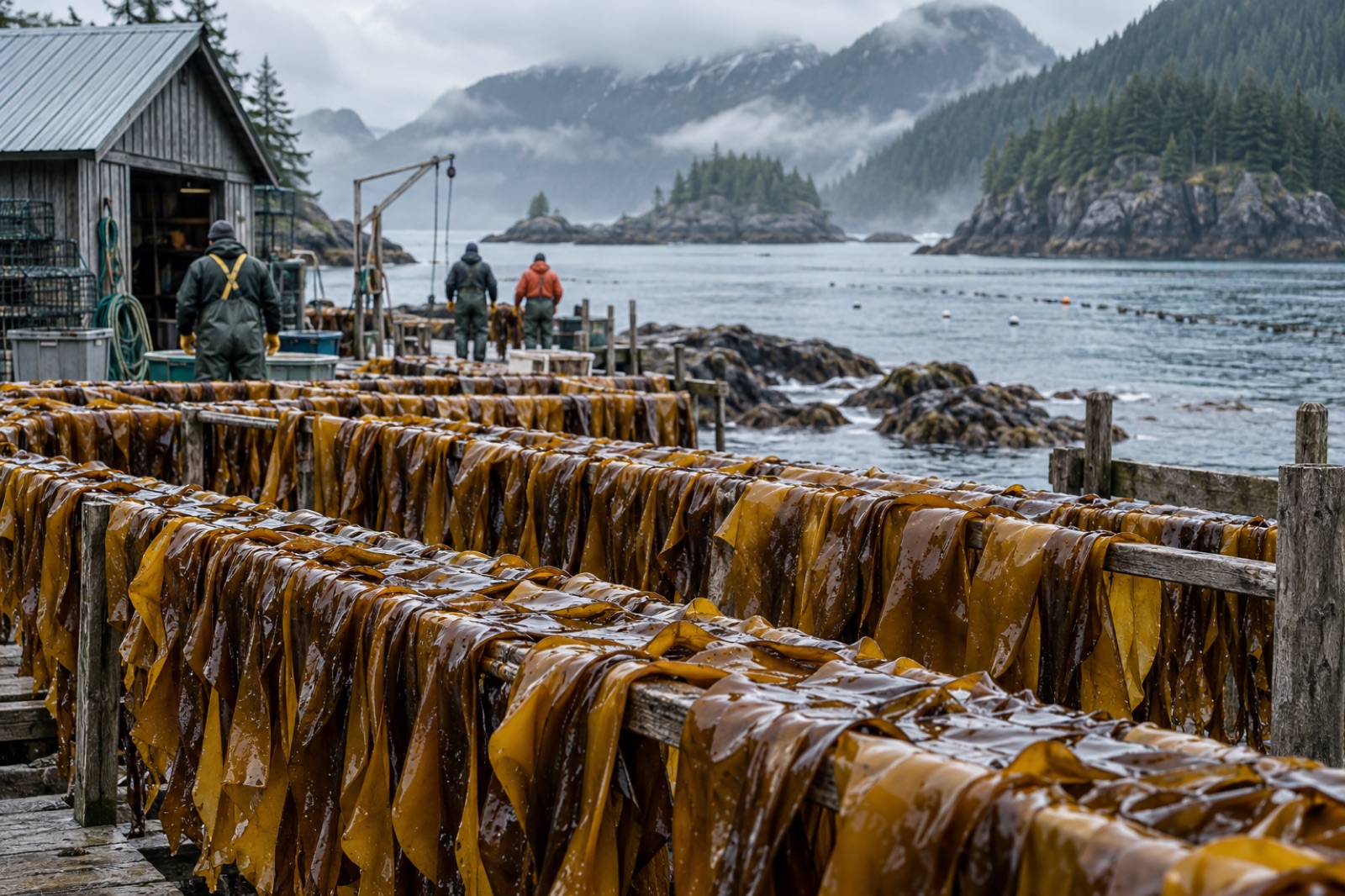
Biochar is charcoal made deliberately: biomass heated with little or no oxygen until its carbon locks into a porous, stable solid that resists decay in soil for decades to centuries. Make it from seaweed and you get a provocative idea — take the fastest-growing biomass in the ocean, convert it, and put durable carbon into farmland. The concept is real and actively researched, but seaweed is a genuinely awkward feedstock, and the honest answer to "does kelp biochar work?" is: sometimes, with caveats that matter. This article covers how seaweed biochar is actually made, what the ash and salt content do in soil, the uses with the best evidence, and the carbon-accounting questions buyers should ask.
Why anyone bothers: the appeal of a kelp-to-char pipeline
Seaweed checks several boxes that land-based biomass cannot:
- It needs no land, freshwater or fertiliser to grow — the argument that underpins the whole case for farmed versus wild seaweed.
- Growth rates are extraordinary. Kelps can be among the fastest-growing organisms on Earth, so a tonne of feedstock represents a short growing window.
- There's waste to valorise. Farms and processors generate trimmings, holdfasts, storm-cast material and off-spec harvests. A conversion pathway that turns waste into a saleable, carbon-stable product improves the economics of the whole seaweed value chain.
That is the pitch. Now the friction.
The feedstock problem: wet, salty and ashy
Three properties of seaweed make it a harder pyrolysis feedstock than wood:
- Moisture. Fresh kelp is roughly 80–90% water. Pyrolysis requires dry feedstock, so the energy bill starts with drying — the same constraint that shapes all seaweed drying — and that energy cost can eat much of the claimed carbon benefit unless waste heat or solar drying is used.
- Ash. Seaweeds carry far more mineral ash than wood — often 20–40% of dry weight in kelps, versus a few percent in timber. High ash dilutes the carbon content of the resulting char and changes its behaviour in soil.
- Salts and alkali metals. Seaweed chars are rich in potassium, sodium and other salts. That can be a feature (potassium is a fertiliser nutrient) or a bug (sodium is hostile to soil structure), depending on the crop, the soil and the dose.
None of these are deal-breakers; all of them mean seaweed biochar is its own product class, not just "wood biochar from the sea."
How seaweed biochar is made
The process chain:
- Harvest and dewater. Screw presses or centrifuges drop moisture from ~85% toward 60–70% cheaply; mechanical dewatering always beats thermal.
- Dry. Solar or waste-heat drying to below ~15% moisture. This is the energy pinch point; co-locating with an existing heat source changes the economics entirely.
- Pyrolyse. Slow pyrolysis — heating at roughly 300–600°C in a low-oxygen retort or kiln for tens of minutes to hours — is the standard route. Temperature steers the product:
- Lower temperatures (~350–450°C) retain more volatile matter and more of the ash minerals in plant-available form; char yield is higher, carbon stability lower.
- Higher temperatures (~500–650°C) drive off more volatiles, concentrating aromatic, stable carbon; yield drops but persistence in soil rises. High-temperature seaweed chars also tend to develop higher pH and more fused mineral content.
- Post-treat. Quench, and — critically for seaweed — wash or leach if the salt load is a problem for the intended soil. Some producers blend seaweed char with woody char, compost or manure to balance salinity and biology.
Pyrolysis also yields syngas and bio-oil fractions that can fuel the dryer — when engineered well, the process can approach energy self-sufficiency after start-up.
The evidence base for seaweed biochar is younger and thinner than for wood biochar, and it's honest to say so. Findings so far, stated carefully:
- Soil liming and pH. Seaweed chars are strongly alkaline, so on acidic soils they act like a liming amendment — genuinely useful on the acidic tropical and weathered soils where biochar research is most active, and pointless or harmful on already-alkaline ground.
- Nutrient content. Potassium and micronutrients in the ash can be plant-available, giving seaweed char a fertiliser-like kick that woody char lacks. Trials have reported yield responses in pot studies particularly on poor soils — though pot results routinely overstate field performance, and field trials remain few.
- Salinity risk is real. Unwashed seaweed char applied at agronomically meaningful rates can raise soil salinity and sodicity, especially in dry climates. Salt-sensitive crops and arid regions are the wrong target without washing, blending or modest application rates.
- Carbon persistence. The aromatic fraction behaves like other biochars — far more stable than raw biomass — but the high ash fraction means a tonne of seaweed char contains less carbon than a tonne of wood char. Durability claims should be quoted per tonne of carbon, not per tonne of product.
The fairest summary: seaweed biochar looks most promising as a blended, modest-rate amendment for acidic soils, produced with clean energy accounting — not as a bulk soil replacement.
Other uses: where seaweed char may beat soil amendment
Some of the most defensible uses aren't classical soil amendment at all:
- Adsorbents. The mineral-rich, porous structure of seaweed chars performs well in laboratory studies at binding heavy metals and some nutrients, pointing toward filtration and remediation products.
- Feed additives and compost co-ingredients at low inclusion rates, where the mineral profile and gut-buffering properties are the point (this overlaps conceptually with the interest in seaweed in animal nutrition, though char is a different ingredient).
- Cement and construction fillers, a research frontier where any stable carbon locked into long-lived material counts as storage.
- Poultry and livestock bedding conditioners, where odour and ammonia binding are valued — a known niche for biochars generally.
The carbon accounting: honest questions to ask
Seaweed biochar sits at the intersection of two scrutinised ideas — seaweed carbon claims and biochar carbon removal. If you're evaluating a "kelp biochar" carbon credit or product claim, ask:
- What is the drying energy source? If fossil heat dried the kelp, the net carbon balance shrinks fast.
- Per tonne of what? A tonne of seaweed char is part carbon, part mineral ash. Claims should state carbon content and the fraction expected to persist over a defined timescale.
- Would the feedstock have counted anyway? If the kelp would have gone to food, feed or biostimulant extraction, diverting it to char is a real trade-off in embodied carbon and value, not a free win. Additionality applies here as anywhere.
- Is there actually a long-lived sink? Char spread on soil is a genuine storage pathway with decent durability; char that washes, erodes or is mismanaged is less so. Permanence logic — buffer pools, monitoring — is beginning to reach biochar standards, and buyers should expect it.
In our own work at Tidewright, we treat farm waste valorisation as a business-and-waste question first and a carbon question second: the product has to make agronomic sense at the field before a single credit is claimed. That ordering keeps everyone honest.
For farmers: is this on your roadmap?
For a working seaweed farm, biochar is best understood as a destination for genuinely low-value biomass — storm losses, holdfasts, season-end clean-up material — rather than a primary crop plan, unless a processor is paying char-quality prices for biomass. The practical checklist:
- Do you have a dewatering step already? (If not, that's the first cost.)
- Do you have access to waste heat or reliable solar drying?
- Is there a biochar producer within economical transport range, or a shared facility model with neighbouring farms?
- Does your region have acidic soils and buyers — horticulture, viticulture, land rehabilitation — who will trial blended char?
If several answers are no, the wiser waste destinations remain compost, feed trials and biostimulant inputs, which tolerate wetter, saltier feedstock.
Key takeaways
- Seaweed biochar is real but distinctive: high ash, high salts and lower carbon-per-tonne than wood char make it its own product class.
- Moisture is the biggest energy hurdle — dewater mechanically and dry with waste heat or sun, or the carbon balance suffers.
- Chemistry is temperature-sensitive: hotter pyrolysis gives more stable carbon; cooler retains more plant-available minerals.
- The best-evidenced soil use is modest rates blended into acidic soils; salinity risk is genuine on dry or salt-sensitive land.
- Carbon claims deserve hard questions about drying energy, carbon content per tonne, additionality and permanence.
- For farms, char is a smart destination for true waste biomass — rarely a reason to grow kelp.
FAQ
Is seaweed biochar good for soil?
It can be, in the right context. On acidic soils its liming effect and potassium content are genuinely useful, and its carbon adds long-lived organic matter. On alkaline, saline or drought-prone soils, unwashed seaweed char can do harm. Blending, washing and modest application rates are the norm in trials that show benefit.
How is seaweed biochar made?
By drying the seaweed (the energy-critical step), then slow pyrolysis — heating at roughly 300–650°C with little oxygen. Lower temperatures preserve more minerals; higher temperatures concentrate stable carbon. Salt-rich chars are often washed or blended before soil use.
Does kelp biochar count as carbon removal?
Potentially — the aromatic carbon fraction persists in soil far longer than raw biomass. But net claims depend on drying energy, transport, the carbon fraction of the char, and what the kelp would otherwise have become. Scrutinise credits with the same rigour as any blue carbon claim.
Why is seaweed harder to pyrolyse than wood?
Three reasons: it's 80–90% water when harvested, it carries far more mineral ash, and it's loaded with salts. All three change the energy balance, the equipment and the end product compared with woody feedstock.
What's a better use for farm waste than biochar?
Often composting, animal-feed trials, or biostimulant extraction — all of which handle wet, salty material more forgivingly. Biochar makes most sense where there's waste heat, an established producer nearby, and acidic-soil buyers for the finished char.